A Milky Way radio source beat every 62 minutes then fell silent
Archival recordings reveal a cosmic object whose twin radio pulses point to a twisted magnetic field, challenging models of how dead stars emit energy.
Across the cosmos, dead stars act like cosmic lighthouses, sweeping beams of radiation past Earth with precision so dependable that astronomers once mistook them for artificial beacons. Most of these spinning stellar embers turn on time scales of milliseconds to seconds.1 When an object in the Milky Way takes more than an hour between flashes, the physics powering ordinary pulsars begins to fail.12
Such leisurely pulses should not generate the electrical conditions required to ignite coherent radio beams. Yet nestled deep within archival recordings of the southern sky, an uncataloged source did exactly that. For roughly 15 hours, it released a paired burst of radio emission every 62.2 minutes, shining brightly enough to register on two separate continents before vanishing into complete silence.23
The discovery adds to a baffling cosmic family known as long-period transients. These enigmatic emitters send out prolonged radio pulses separated by extensive quiet intervals, confounding astronomers because neither standard neutron stars nor typical white dwarfs neatly match their behavior. A team led by Scott Hyman, an astronomer at Sweet Briar College, reports the finding in The Astrophysical Journal.21
How did the unusual signal produce its twin radio pulses?
The signal originated from an object whose magnetic poles both sweep across our line of sight during a single slow turn. In a rotating stellar remnant, radio emission generally streams along intense magnetic field lines anchored at the magnetic poles. If the magnetic axis aligns closely with the rotational axis, only one pole swings toward Earth, delivering a single flash per revolution. When the magnetic axis sits nearly perpendicular to the spin axis, both poles swing past our vantage point in turn, creating a double pulse per full cycle.
The newfound source, designated LPT J1555−5631, displayed two distinct emissions within each 62.2-minute period.31 Rather than mirroring each other, the two components behaved very differently. The primary pulse lasted approximately 2.44 minutes, while a narrower secondary pulse, or interpulse, lasted only 0.66 minutes.32 Despite the disparity in duration, both pulses reached almost identical peak brightness.21

The two flashes also exhibited opposite circular polarization, a property describing the corkscrew orientation of propagating electromagnetic waves.31 One burst twisted clockwise while the other twisted counterclockwise. The narrower pulse proved almost entirely circularly polarized.32 In the published analysis, Hyman and colleagues concluded that the object is a near-orthogonal rotator whose rotation and magnetic axes are oriented almost at right angles, allowing radiation from opposite magnetic poles to wash over detectors.21
The geometry, however, revealed a noticeable asymmetry. In a clean, symmetrical dipolar magnetic field shaped like a simple bar magnet, the two pulses would appear separated by exactly 180 degrees. In LPT J1555−5631, the pulses were separated by 165.4 degrees.31 That offset indicates that the underlying magnetic field is distorted and far more intricate than a standard dipole.12
Why did astronomers fail to notice the source until years later?
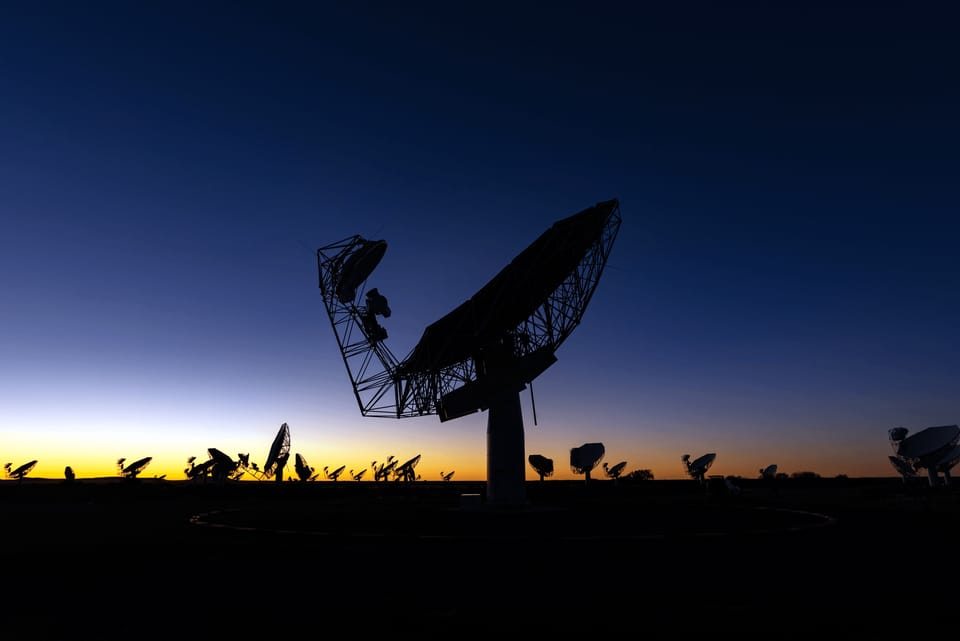
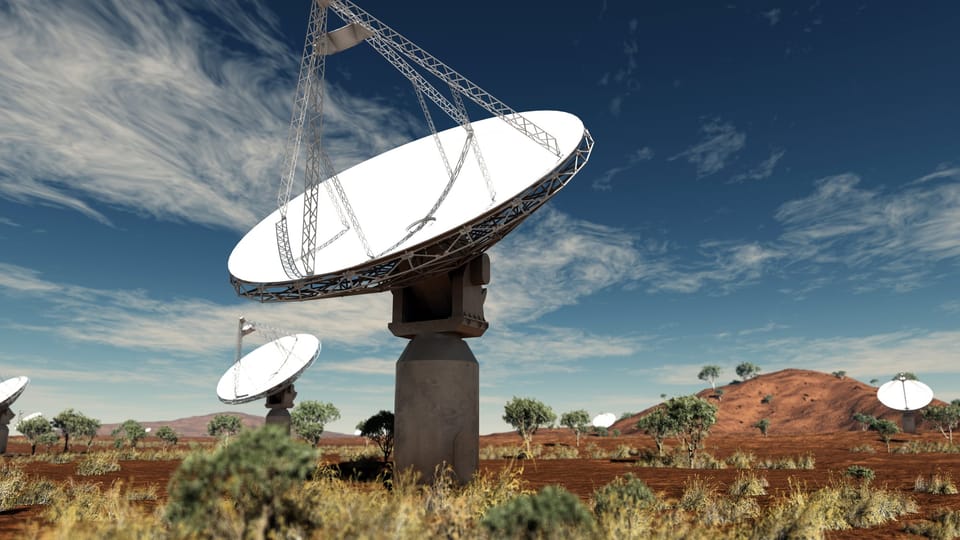
Astronomers missed the flashes at the time because neither instrument was actively searching for slow transient radio sources. On May 14, 2022, the MeerKAT radio telescope in South Africa collected data near the plane of the Milky Way, recording an observation targeted at a supernova remnant.32 On the very same day, the Australian Square Kilometre Array Pathfinder, known as ASKAP, surveyed that identical celestial quadrant during a 10-hour observation.32 Both facilities captured the flickering pattern without human observers realizing it had occurred.
The signal came to light only when researchers conducted an archival search of public MeerKAT data for millisecond pulsars, rapidly spinning neutron stars that could illuminate an excess of galactic gamma rays.1 Hyman and his collaborators noticed a candidate displaying regular pulsar-like emissions separated by tens of minutes. Cross-referencing other databases confirmed that ASKAP had recorded the source simultaneously, validating the 62.2-minute timing across two independent instruments.
The coordinates placed LPT J1555−5631 approximately 0.5 degrees from the center of SNR G 326.3–1.8, an expanding cloud of stellar debris produced by an ancient supernova.32 Determining its exact distance remains difficult. The authors arrived at a tentative distance estimate of roughly 5.4 kiloparsecs, or about 17,600 light-years, though they cautioned that this measurement remains weak.32
Could the silent object be an exotic neutron star or a white dwarf?
Neither a lone neutron star nor a conventional white dwarf easily explains the 62-minute rhythm and sudden disappearance. If the source is a neutron star, it spins at a pace far too slow for standard pulsar mechanisms to generate radiation. Generating radio waves at such long periods would demand an exceptionally twisted or highly organized magnetic structure, somewhat similar to a magnetar undergoing severe internal field rearrangements.21
A white dwarf provides a larger surface and naturally rotates at slower rates, but isolated white dwarfs have never been observed generating coherent radio emission of this kind.21 Such stars typically require a companion star to feed magnetic interactions or drive mass transfer. However, searches in other wavelengths have found no companion. Furthermore, the 62.2-minute period sits below the approximately 78-minute minimum orbital period known for the most common white dwarf binary configurations.32
Archival searches across multiple observatories emphasize the fleeting nature of the event. Astronomers scrutinized roughly 60 ASKAP observations of the target coordinates taken between 2019 and 2026, finding pulses exclusively in the single May 2022 session.32 Eleven MeerKAT observations from a 2021 galactic plane survey detected nothing, as did two earlier observations from 2019.32 The Murchison Widefield Array in Australia examined the location in June 2022, mere weeks after the outburst, and recorded only silence.32 Observations from high-energy space observatories, including eROSITA, Chandra, and XMM-Newton, turned up no X-ray counterpart, while visible-light and infrared catalogs revealed no obvious host star beyond an incidental background star roughly 1 arcsecond away.32
What does the discovery suggest about the Milky Way?
The fleeting activity of LPT J1555−5631 shows that the galaxy may host an undetected population of magnetic stellar corpses that switch on only briefly. Based on the observational gaps, researchers calculate that the source was active for at least 15 hours and at most 10 months before shutting down.32 The wider category of long-period transients was recognized only after GLEAM-X J1627−5235 was identified in 2018 data and reported in 2022.21 Since then, roughly a dozen similar slow-pulsing candidates have been uncovered.21
The phenomenon is reminiscent of GCRT J1745−3009, an enigmatic transient that Hyman recorded in September 2002. That earlier object emitted five radio flares spaced 77 minutes apart before slipping into dormancy.21 Although it vanished for years, it later reactivated, as have two other known long-period transients.21 Whether LPT J1555−5631 will awaken again remains uncertain, but systematic searches across archival datasets continue to offer the best hope of determining whether these oddities represent a single class of star or an unrecognized evolutionary path.
The record
29 sentences trace to 3 sources.
- 1 A Mysterious Object in Space Pulsed Every 62 Minutes. Then It Vanished. See the source
- 2 Something in the Milky Way Pulsed Every 62 Minutes, Then Vanished Without a Trace. Astronomers Still Can't Say What It Was See the source
- 3 Something in the Milky Way Pulsed Every 62 Minutes, Then Vanished Without a Trace. Astronomers Still See the source