Soto Laveaga traces Green Revolution to Sonora farmers
A new history examines how Yaqui Valley growers funded research and lost river access while exporting high-yielding seed across the globe.
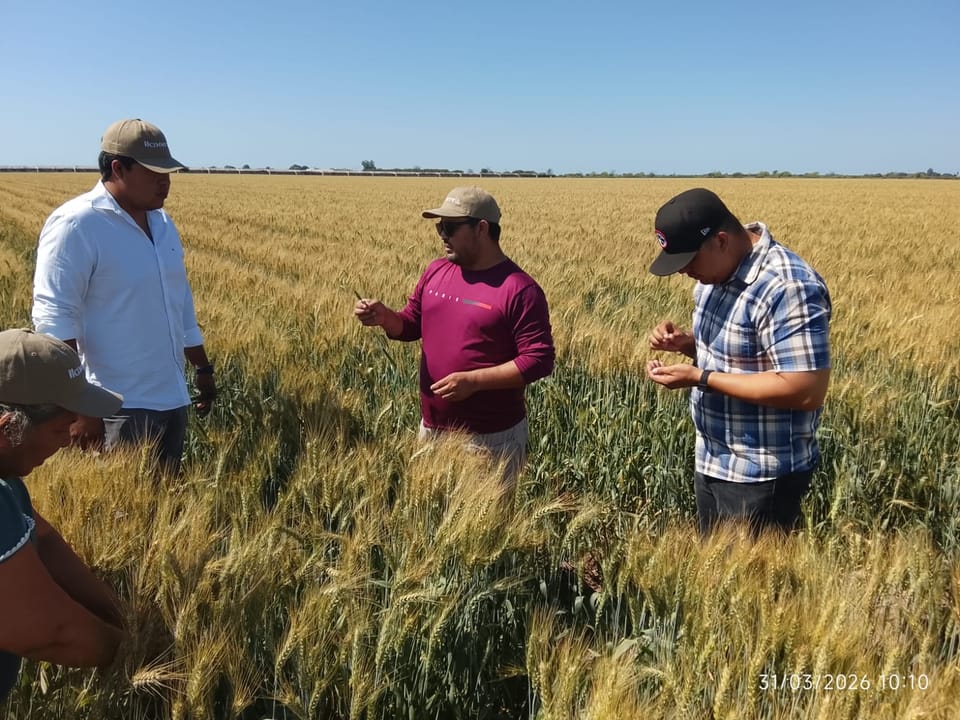
In 1966, a cargo vessel loaded with 18,000 tons of wheat seed sailed from the Mexican port of Guaymas bound for drought-stricken India.12 The shipment capped years of plant breeding in Sonora's Yaqui Valley, where Mexican agronomists and local agricultural workers cultivated the short-stalked grain that would soon alter global farming.1
The infrastructure behind the seeds
Popular accounts of the Green Revolution have long centered on Norman Borlaug, the American plant pathologist who received the 1970 Nobel Peace Prize, and the financial backing of the Rockefeller Foundation.13 In her study, The World in a Wheat Field: Mexico, Science, and the Challenge of Ending Global Hunger, Harvard historian Gabriela Soto Laveaga directs attention toward the regional infrastructure and domestic workforce that made those biological discoveries viable.1
The agricultural transformation in Sonora did not happen in an institutional vacuum. Soto Laveaga, a professor of the history of science and the Antonio Madero Professor for the Study of Mexico at Harvard University, examined archival records and oral histories across two continents.1 Her research details how commercial growers in Sonora organized to fund field research stations, creating the institutional base that supported international scientists.1
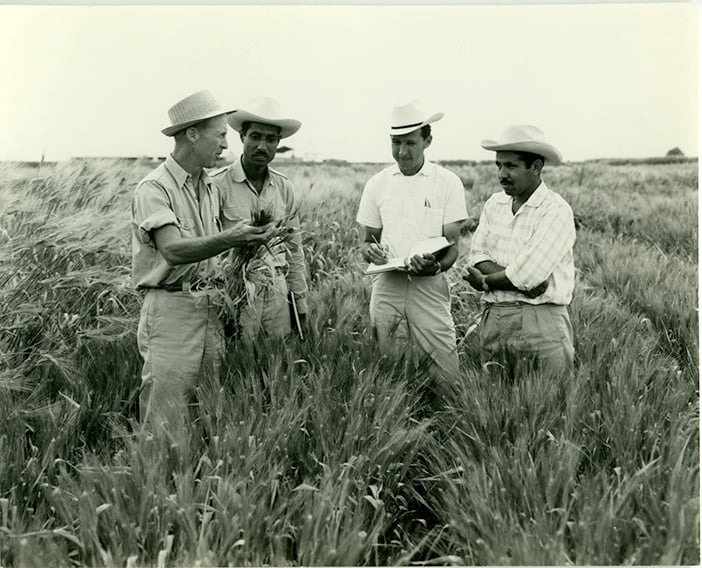
That expansion carried severe local costs. The state-driven construction of reservoirs and irrigation canals enabled intensive wheat cultivation across the valley floor.1 However, those hydrological projects diverted water away from indigenous Yaqui communities, sharply reducing their access to the river that had long anchored their subsistence and territorial autonomy.1
Cross-continental agricultural networks
The institutional exchange between Mexico and India began decades before the 1966 seed transfer.1 Pandurang Khankhoje, an Indian nationalist and revolutionary who sought political asylum in Mexico after fleeing British colonial authorities, ran free agricultural training programs and worked with Mexican agronomists during the early decades of the twentieth century.1
When Mexican wheat varieties arrived in India's Punjab region during the mid-1960s, local breeders and farmers adapted them to regional soil conditions.1 Those adaptations relied on regional irrigation works and substantial public spending rather than imported seed technology alone.1
The biological material itself carried an international pedigree. In 1935, Japanese plant scientist Gonjoro Inazuka crossed a native semi-dwarf wheat line with two American varieties at an experimental station in Honshu. The resulting strain, designated Norin 10, contained the dwarfing genes Rht 1 and Rht 2.2 These reduced normal wheat height from 150 centimeters down to between 60 and 110 centimeters, allowing the plant to carry heavy grain heads without falling over in wind or rain.2
Breeding trials and uneven yields
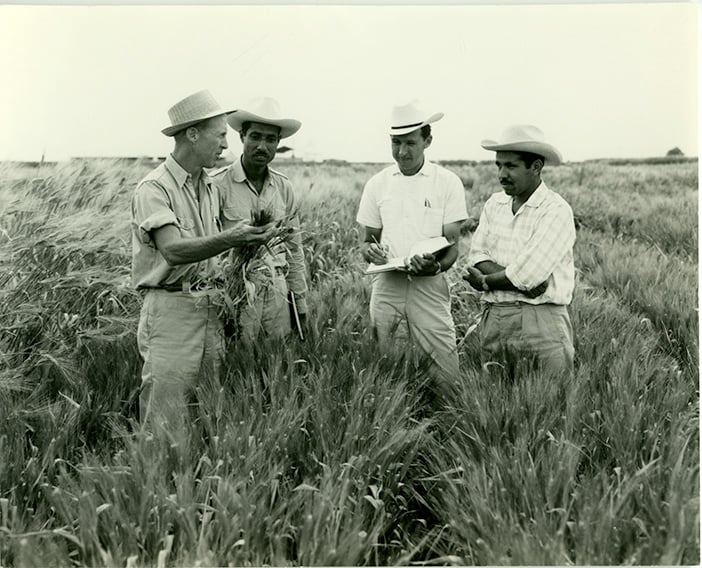
United States Department of Agriculture breeder S.D. Salmon collected Norin 10 germplasm from Japan and sent samples to Orville Vogel at Washington State University.2 In 1953, Borlaug obtained seed carrying the Norin 10 dwarfing traits from Vogel and initiated crossbreeding experiments with Mexican varieties.2
The early crosses failed to produce viable lines.2 Subsequent breeding rounds eventually generated resilient spring wheats with thick stems and abundant tillering capacity.2 In 1962, commercial growers received the first two Norin 10 derivatives, Pitic 62 and Penjamo 62.2 Within seven years of their distribution, average wheat yields in Mexico doubled.2
Later selections, including Sonora 64, Lerma Rojo 64, and Siete Cerros 66, were distributed internationally through what became the International Maize and Wheat Improvement Center, known as CIMMYT, established in 1966 from a joint program started in the 1940s by the Mexican government and the Rockefeller Foundation.23 In 1967, large foreign seed purchases expanded rapidly, with Pakistan acquiring about 42,000 tons, Turkey taking 22,000 tons, and India ordering 18,000 tons.2
Soto Laveaga argues that the physical abundance created by high-yielding grain did not resolve broader systemic inequities.1 The high-volume strains required steady synthetic fertilizer, dependable irrigation canals, and formal farm credit to deliver promised harvests.1 Because smallholders and peasant farmers had unequal access to capital, the resulting windfall concentrated among wealthier landowners, leaving foundational economic disparities intact.1
The record
26 sentences trace to 3 sources.
-
1
EP
 EIN Presswire
Press release
· einpresswire.com · 16 Nov 2026
'The World in a Wheat Field' Traces the Green Revolution to Its Mexican Roots
See the source
- 2 From east Asia to south Asia, via Mexico: how one gene changed the course of history See the source
- 3 Our history See the source