Starship survives orbital return to meet launch tower mechanical arms
SpaceX caught its upper stage with tower arms for the first time after 14 orbits, even as an engine failure destroyed the booster.
Returning a spacecraft from orbit normally ends with parachutes drifting into water or heavy shock-absorbing legs pressing down onto a concrete pad. Each of those approaches forces a vehicle to carry heavy landing gear into orbit, gear that takes up mass that could otherwise carry fuel, instruments, or commercial cargo. The hardware must then be retrieved from remote ocean zones or hauled across extensive recovery grounds before technicians can inspect it. A launch tower that reaches out to catch a descending vehicle directly out of the sky removes that landing equipment entirely, turning the launch pad itself into the recovery device.
For that approach to succeed, an incoming craft must slow its hypersonic descent, guide itself toward the launch site, pivot into a vertical orientation, and hover stably between two steel arms just moments before touchdown. The capture demands exact millimeter-scale guidance and rapid aerodynamic control under fluctuating wind conditions. If the engines fire too weakly, the vehicle impacts the structure; if they cut out too early, the rocket drops into the ocean. Catching the vehicle at the pad allows engineers to secure the hardware in the exact place where it will be inspected, refurbished, and mounted atop another booster for future flights.
How does a launch tower capture an orbital spacecraft?
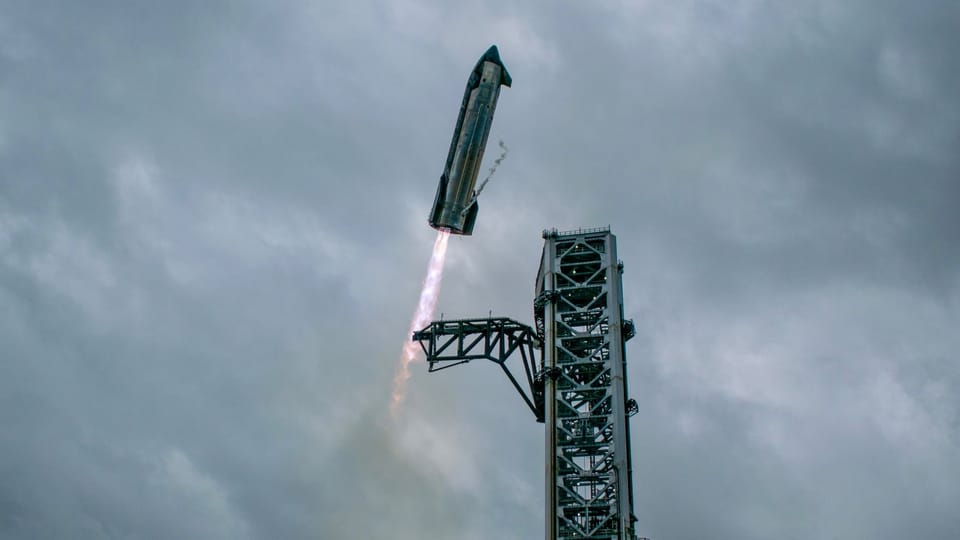
A launch tower captures a spacecraft by using two giant mechanical arms to arrest the vehicle while it hovers above the ground.1 The structure, designated Mechazilla, features two massive motorized arms attached directly to the primary launch tower at SpaceX's Starbase facility in southern Texas.1 During descent, the vehicle guides itself into the airspace beside the tower, using its engines to arrest its vertical fall and settle into a controlled hover. The mechanical arms then close around the designated catch points on the vehicle, supporting its weight above the ground and eliminating any need for onboard landing legs.1
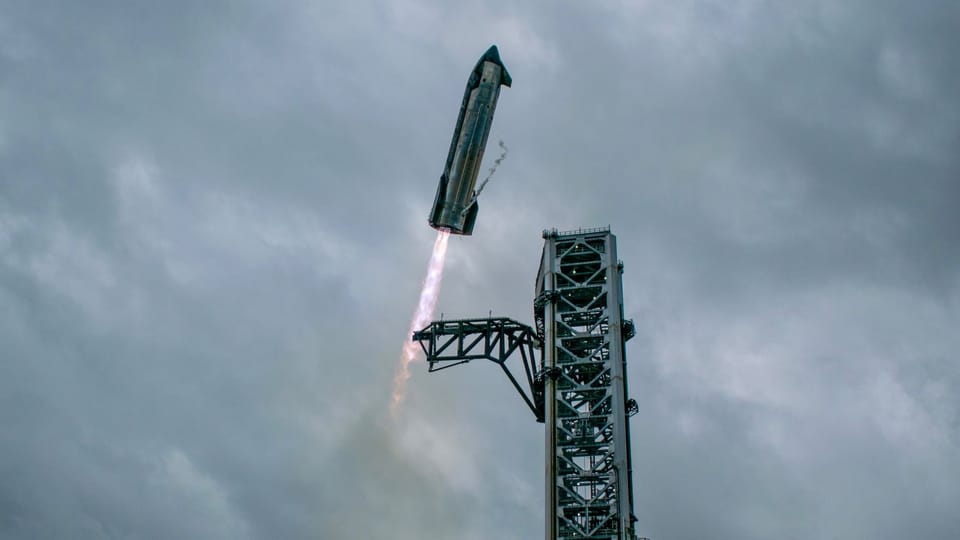
SpaceX demonstrated this capture technique for the first time with its upper-stage Starship spacecraft on November 14, 2026.1 The milestone concluded Starship's 15th test flight, an orbital mission that lifted off from Starbase on Friday, November 13, 2026.1 While the company had previously caught three returning Super Heavy boosters with the tower arms, the upper-stage spacecraft had never before attempted or achieved a tower capture. Upper stages endure the intense heat and aerodynamic forces of atmospheric reentry before arriving at the tower, making their aerodynamic behavior and structural temperatures distinct from those of suborbital boosters.
During its mission, the spacecraft remained in orbit for approximately 22 hours, circling Earth 14 times.1 The flight included functional satellite deployment operations, releasing 26 Starlink satellites into orbit before the vehicle began its reentry sequence.1 According to SpaceX, pairing active satellite deployments with a first-of-its-kind landing attempt demonstrated that the test served as an operational delivery run in addition to an experimental hardware recovery flight.1
Why did the booster fail during the same test?
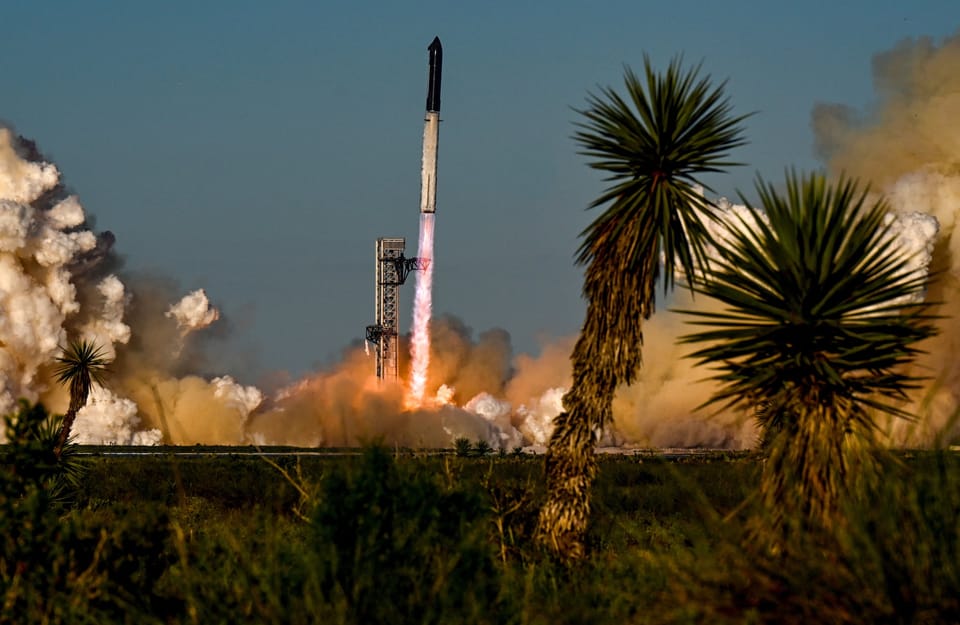
The Super Heavy booster failed because several of its engines shut down prematurely during descent, preventing the vehicle from maintaining its planned trajectory.1 While the upper-stage Starship was completing its 14 orbits in space, the Super Heavy booster attempted to fly back toward Starbase following stage separation. When the descent engines suffered an unexpected shutdown, flight controllers diverted the vehicle away from the launch facility toward the open water.1 The booster subsequently exploded over the Gulf of America, leaving recovery teams to retrieve debris and engineers to analyze the shutdown sequence.1
The booster explosion prevented SpaceX from achieving a dual-catch mission where both rocket components returned safely to the launch site.1 SpaceX had successfully recovered Super Heavy boosters with the mechanical arms during three previous test flights, illustrating that successful catches during prior missions do not guarantee repeatable performance.1 Technicians now face the task of identifying why the booster's propulsion system failed during descent while preparing modifications to ensure engine reliability across future flights.
The contrast between the Starship spacecraft's capture and the booster's loss shows the ongoing difficulty of recovering both stages of a massive launch system during a single launch window. Biographer Walter Isaacson, who chronicled Elon Musk's work, recalled that Musk first proposed catching rockets with launch tower arms during a December 2020 meeting at Starbase.1 According to Isaacson, the engineering group at Starbase originally received the concept with astonishment before working out the physical requirements.1 Following Saturday's catch, Isaacson wrote on social platform X that "This is actually a bigger deal for humanity than most people can imagine."1 NASA Administrator Jared Isaacman praised the recovery, writing that "It was almost magic" and was "Making more believers by the day," while War Secretary Pete Hegseth publicly congratulated Musk on the technical milestone.1
What does the demonstration leave unresolved?
The demonstration cannot confirm how rapidly a captured Starship can be refurbished, refueled, and returned to flight status. A single successful catch shows that the aerodynamic guidance and mechanical arms can align under specific test conditions, but it does not establish the operational lifespan of the structure or its catch mechanisms. Recovered vehicles must undergo extensive nondestructive evaluation to determine whether thermal stress from reentry or mechanical stress from the catch arms warped the stainless-steel hull. SpaceX has not yet revealed how much post-flight repair the captured Starship will require before it is certified for another mission.
Furthermore, the test cannot ensure that the mechanical catch system will operate reliably under adverse weather, strong coastal wind shears, or secondary hardware failures. Catching a rocket suspended between tower arms provides zero margin for late thrust fluctuations or structural misalignment, meaning any propulsion error during the final hover risks catastrophic damage to the launch tower itself. Sustaining commercial operations requires repeating these catches dozens of times without damaging the surrounding ground infrastructure, a standard that Saturday's mixed flight did not demonstrate.
The test also leaves open the schedule for Starship's role in NASA's lunar exploration plans, which depend on an operational and fully verified upper stage capable of carrying crew and cargo.1 Achieving low-cost orbital access requires both the Super Heavy booster and the Starship upper stage to land reliably without losing vehicles in flight. Until SpaceX isolates the engine shutdown that destroyed the booster over the Gulf of America, the transportation architecture remains an experimental system working toward operational repeatability. Engineers at Starbase must now examine the captured Starship hull, evaluate mechanical wear on the Mechazilla arms, and prepare for the next orbital test.
The record
18 sentences trace to 1 source.
- 1 SpaceX Catches Starship With Giant Mechanical Arms in a Historic First See the source