Atmospheric neutrinos point to normal mass ordering in unified global fit
Combining observations from four detectors across the globe strengthens evidence that the third neutrino state is the heaviest, but researchers caution that definitive discovery requires more data.
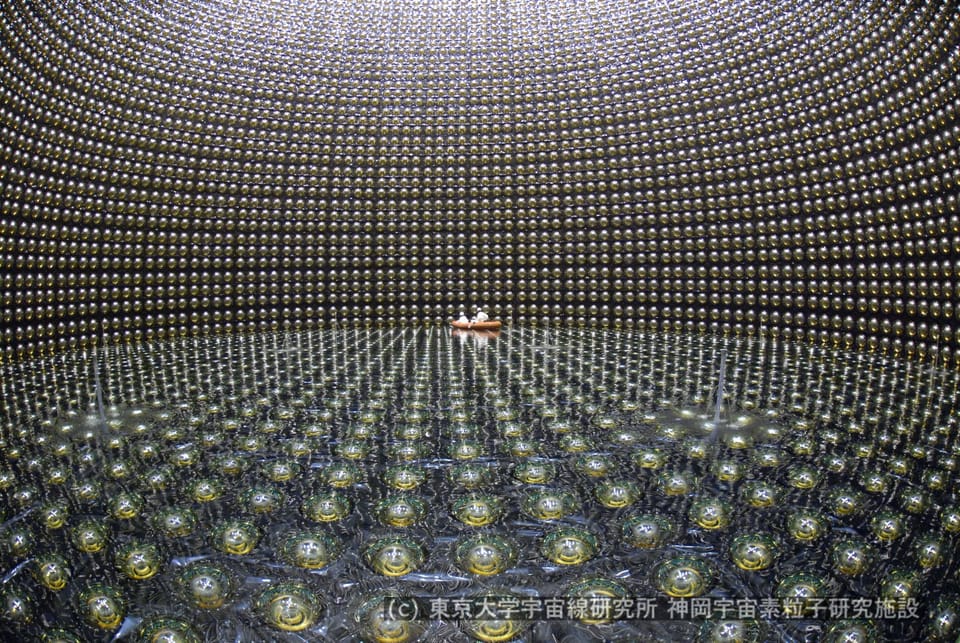
High above the ground, cosmic rays crash into air molecules, triggering cascades of invisible subatomic particles that shower downward in every direction.1 Among these debris are neutrinos, elementary particles so light and unreactive that billions pass through an ordinary human hand every second without leaving a trace. Because they interact so weakly with matter, these atmospheric neutrinos travel unimpeded through thousands of kilometres of rock and iron, traversing the entire diameter of Earth.
Yet during that planetary transit, something subtle alters their identity. Neutrinos exist in three distinct types, or flavours: electron, muon, and tau.1 As a neutrino travels through space and matter, it periodically transforms from one flavour into another, a quantum process known as oscillation.12 Measuring precisely how and where these identities shift reveals the fundamental structure of matter itself, establishing how elementary particles acquire mass and how the universe assembled its basic building blocks.
For a neutrino to change flavour while travelling through Earth, several physical conditions must align in sequence. First, a high-energy particle must strike an atmospheric nucleus to produce parent particles that decay into neutrinos. Second, the resulting neutrino must propagate as a quantum mixture of distinct mass states, each travelling at a fractionally different velocity. Third, when traversing the dense interior of Earth, interactions with ambient electrons alter the effective potential experienced by electron neutrinos, modifying the transformation rate in a manner that depends directly on the relative weights of the mass states.1 Finally, the particle must strike an atom inside a detector, producing a detectable charged lepton that flags its final identity. Because the rock alters that transformation, comparing neutrinos that plunge directly through Earth with those arriving from overhead reveals which mass state is heavier.
Determining that hierarchy, known as the neutrino mass ordering, has remained one of the foremost open questions in particle physics. While solar neutrino measurements proved decades ago that the second mass state is slightly heavier than the first, experiments could not determine whether the third state is heavier than both, an arrangement called the normal mass ordering, or lighter than both, known as the inverted mass ordering.1 In a preprint posted on the arXiv server on September 15, 2026, Philipp Eller, a physicist at the Technical University of Munich, reported a unified analysis that combines atmospheric neutrino measurements across three major observatories alongside reactor neutrino data, finding a 3-sigma preference for the normal mass ordering.1
How do atmospheric neutrinos change as they travel through Earth?
Neutrinos alter their apparent flavour because the physical states that interact through weak forces do not match the states that possess definite masses. When a muon neutrino forms in the upper atmosphere, it enters existence as a composite quantum packet made of three distinct mass states, designated as mass eigenstates one, two, and three. As this composite packet travels, the three mass components propagate through space at slightly different frequencies. Over long distances, these wave packets drift out of phase with one another, so that an instrument measuring the particle thousands of kilometres away detects an altered flavour mixture.
When these particles traverse ordinary matter, the medium itself reshapes that quantum evolution. Terrestrial rock contains protons, neutrons, and electrons, but lacks muons and tau leptons.1 Electron neutrinos therefore experience extra elastic scattering with atomic electrons through the exchange of charged W bosons, creating an effective matter potential that shifts their oscillation frequency. This interaction, known as the matter effect, acts as an asymmetric filter: it either amplifies or suppresses the transition probability depending on whether the third mass state sits above or below the other two.1 Earth itself functions as a vast natural prism, separating the two possible ordering hypotheses according to the trajectory of particles crossing its mantle and core.
Explaining the physical mechanism governing this filter, Philipp said in response to questions from Primary, "If you look at the relevant equations, it is a game of plus (+) and minus (-) signs that appear in Normal vs. Inverted Ordering and Neutrinos vs. Anti-neutrinos. Only in the combination of NO + Neutrinos, or IO + Anti-neutrinos, is the mixing with the electron flavors enhanced."
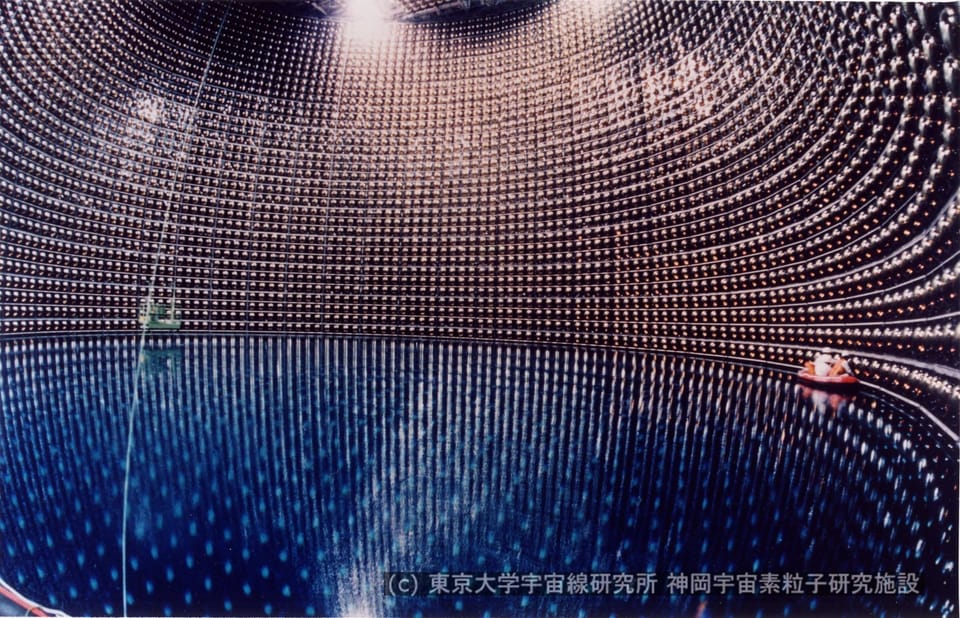
Earlier experiments laid the empirical foundation for this behaviour. The Super-Kamiokande collaboration famously reported 5-sigma evidence against the no-oscillation hypothesis in 1998, as documented in Physical Review Letters by lead author Y. Fukuda and colleagues.12 That milestone Super-Kamiokande study analysed atmospheric neutrino observations from a 33.0 kiloton-year exposure spanning 535 days, observing a zenith-angle-dependent deficit of muon neutrinos that could not be explained by flux or cross-section uncertainties, but matched two-flavour oscillations between muon and tau neutrinos.21 In 2002, the Sudbury Neutrino Observatory confirmed the oscillation mechanism in solar neutrinos, demonstrating that the second mass state outweighs the first.1
Why has neutrino mass ordering remained unsettled?
Conflicting hints from different experimental setups have kept the ordering of neutrino masses in dispute for years. Man-made accelerator neutrino beams sent across long baselines, such as those measured by the T2K experiment in Japan and the NOvA experiment in the United States, produced subtle tensions when interpreted together. The T2K collaboration favoured a charge-parity violating phase near 3/2 pi and preferred normal ordering with a Bayes factor of 1.7, corresponding to a delta chi-squared of 2.1 between the inverted and normal hypotheses.1 Meanwhile, the NOvA experiment recorded a 1.4-sigma preference for normal ordering, but its data favoured a phase of 0.87 pi under that assumption.1 Because this phase tension eases under an inverted ordering, joint statistical combinations of T2K and NOvA data ended up slightly favouring the inverted hierarchy with a Bayes factor of 1.3, even though each experiment favoured the normal hierarchy in isolation.1
Atmospheric neutrinos provide an independent path to resolve this ambiguity because their matter effects depend directly on planetary scale baselines and are less susceptible to that specific accelerator phase tension. Super-Kamiokande reported a preference for normal ordering over inverted ordering with a delta chi-squared of 5.69, while a joint effort combining Super-Kamiokande with T2K recorded similar findings.1 At the South Pole, IceCube reported a mild preference of normal over inverted ordering with a delta chi-squared of 0.738 using three years of data in 2019, and an unreleased 9.3-year analysis recorded in a doctoral thesis noted a delta chi-squared of 4.398 across 150,257 events.1 In the Mediterranean Sea, the KM3NeT collaboration observed a mild preference with a delta chi-squared of 0.62 in its initial ORCA oscillation analysis.1 However, external researchers had long considered combining these public atmospheric datasets computationally intractable because of the hundreds of analysis bins, diverse detector response functions, and intricate systematic uncertainties involved.1
Clarifying the technical hurdles that previously blocked such joint syntheses, Philipp told Primary, "One of the main challanges was to put disparate datasets into a common framework. The other challenges involved a good bit of "reverse engineering" to reproduce the collaboration's official results as closely as possible."
Regarding the unreleased 9.3-year IceCube dissertation result mentioned in the study, Philipp noted that it was excluded from the statistical fit. Philipp said, "This is not the dataset used in the fit; instead, we used the official IceCube data product, featuring a smaller 7.5-year dataset. The result from 9.3 years of data used in that particular PhD thesis was mentioned only for completeness, as it is not (yet) an official IceCube result; hence, we did not use it."
How did the unified analysis combine separate detector datasets?
Philipp Eller built a unified numerical framework that bridges the disparate recording formats and software pipelines of multiple research collaborations.1 The analysis combined atmospheric neutrino records from Super-Kamiokande, IceCube-DeepCore, and KM3NeT/ORCA with reactor neutrino measurements from the Daya Bay experiment, simultaneously fitting 839,048 candidate events divided across 1,536 bins using 91 free parameters.1 For Daya Bay, which collected 752,954 candidate neutrino events over 3,158 days of operation across 26 bins, the model utilized a published covariance matrix covering systematic uncertainties, yielding a goodness-of-fit of 58 percent without requiring shared systematic parameters, as reactor antineutrinos occupy the lower mega-electronvolt energy regime and interact through inverse beta decay.
For the atmospheric detectors, the study harmonised divergent simulation platforms into a single reference model. DeepCore and KM3NeT originally simulated neutrino interactions using versions of the GENIE software package, whereas Super-Kamiokande relied on the NEUT generator.1 Eller reweighted the DeepCore and KM3NeT spectra to match NEUT expectations, verifying that swapping the reference standard shifted the final results by less than 0.2 sigma.1

Discussing the choice between interaction models, Philipp explained to Primary, "This is a somewhat arbitrary choice, and one could just as well have gone the other way by reweighting NEUT toward GENIE. The peer review of this work asked the same question, and we checked that no significant shift of the results is observed when doing it the other way around."
Earth's matter distribution was incorporated using the Preliminary Reference Earth Model across four concentric layers consisting of the inner core, outer core, mantle, and crust, accompanied by a fit parameter that allowed the terrestrial electron density to vary within a 6.8 percent uncertainty around nominal values, plus an atmospheric production height baseline of 20 kilometres with an uncertainty margin of 10 kilometres. When asked whether alternative interior geophysical profiles could affect the statistical preference, Philipp said, "We do include some systematic uncertainties that can vary the matter density inside Earth. This is already included in the 9.11 delta chi-squared number."
The combined dataset encompassed Super-Kamiokande phases one through five, representing 6,511 days and 484 kiloton-years of data.1 Eller excluded 50 low-momentum bins where boundary effects caused an elevated per-bin delta chi-squared of 0.017, reducing the sample from 930 bins to 880 bins while retaining 99.9 percent of the ordering sensitivity, and introduced 38 detector systematic parameters to handle efficiencies, bin migrations, and energy scales. IceCube-DeepCore contributed 7.5 years of atmospheric data across 200 bins spanning 6.3 to 160 giga-electronvolts, governed by seven detector systematic parameters that parameterized ice absorption, scattering, and optical efficiencies. KM3NeT contributed 510 days of data from its six-line ORCA configuration, representing 433 kiloton-years of exposure across three event topologies, oversampling the energy grid from 10 points to 50 points per decade and employing six detector parameters.
What do these combined measurements reveal about fundamental particles?
Across the full collection of 839,048 events, the unified model achieved a consistent fit with no substantial parameter tensions among the participating experiments.1 The simultaneous fit yielded a delta chi-squared between inverted and normal ordering of 9.11, establishing a 3-sigma preference for the normal mass hierarchy.1 The analysis determined the primary atmospheric mass splitting to be 2.51 plus 0.0463 or minus 0.0441 times 10 to the power of minus three electronvolts squared, the atmospheric mixing angle theta-two-three to be 0.785 plus 0.0318 or minus 0.0407 radians, and the reactor mixing angle theta-one-three to be 0.149 plus 0.00281 or minus 0.00274 radians.1 The leptonic charge-parity violating phase delta-CP was measured at 3.78 plus 0.89 or minus 0.884 radians, disfavouring a conservation value of zero at a delta chi-squared of 8.06.
Emphasizing the appropriate standard for interpreting this statistical margin, Philipp told Primary, "Our results find only a mild preference of NO over IO at a statistical significance of 3 sigma. This is not yet a decisive result, and IO is still possible. In particle physics, we typically require a 5 sigma result to claim something."
These findings must be understood as an external statistical synthesis of publicly released datasets rather than an official collaborative measurement by the experimental consortia. The study relies on binned summary statistics and reconstructed response matrices rather than raw unbinned detector telemetry, which forced the author to approximate detector smearing functions and systematic correlations that only internal collaborations can evaluate directly. The work is described in a preprint that has been posted on the arXiv server and has not yet completed formal peer review.1 Furthermore, the precision of the fit rests on the accuracy of prevailing atmospheric flux tables, neutrino interaction cross-section models, and terrestrial density profiles. If those shared geological or nuclear inputs carry unrecognized collective systematic shifts, the true statistical confidence could vary.
Establishing the normal mass ordering sets concrete boundaries for the next generation of particle physics experiments. Knowing that the third neutrino mass state is the heaviest guides the target mass and sensitivity thresholds required for neutrinoless double-beta decay searches, experiments designed to determine whether neutrinos act as their own antiparticles. It also assists upcoming massive facilities like the Jiangmen Underground Neutrino Observatory in China and the Deep Underground Neutrino Experiment in the United States by providing an independent benchmark for their multi-year measurements.1
Looking ahead to future facilities, Philipp pointed out that individual detectors face steep statistical challenges on their own. Philipp said, "As said earlier, our 3 sigma result is not yet enough to make a definite statement, so in any case, more data, for example, by JUNO, or other experiments, is needed in the near future. However, a single experiment is unlikely to deliver a 5 sigma result in the coming years. Achieving a 5 sigma result will require combining multiple datasets, as in our study." As larger atmospheric samples and new detector configurations come online, researchers will continue testing whether this unified picture of quantum oscillations holds firm across all scales.
The record
46 sentences trace to 2 sources and 1 contributor.
-
1
PE
 Philipp Eller
Paper
· arxiv.org · 15 Sep 2026
Atmospheric Neutrino Oscillations: the Full Picture
Preprint · may not have been peer reviewed
See the source
- 2 Evidence for Oscillation of Atmospheric Neutrinos | Phys. Rev. Lett. See the source
- 3 Contribution — Philipp Eller 16 statements added to this article
Other consulted pages1 page
ar5iv.labs.arxiv.org1 page
arxiv.org1 page
nu.to.infn.it1 page
Article history
-
Published 17 Nov 2026, 19:21Assembled by the Primary desk from 2 sources · 1 contributor · 46 cited sentences
-
Philipp Eller, a physicist at the Technical University of Munich
- Go to the sentence: This interaction, known as the matter effect, acts as an asymmetric filter: it either amplifies or suppresses the transition probability depending on whether the third mass state sits above or below the other two.
- Go to the sentence: Explaining the physical mechanism governing this filter, Philipp said in response to questions from Primary, "If you look at the relevant equations, it is a game of plus (+) and minus (-) signs that appear in Normal vs. Inverted Ordering and Neutrinos vs. Anti-neutrinos. Only in the combination of NO + Neutrinos, or IO + Anti-neutrinos, is the mixing with the electron flavors enhanced."
- Go to the sentence: At the South Pole, IceCube reported a mild preference of normal over inverted ordering with a delta chi-squared of 0.738 using three years of data in 2019, and an unreleased 9.3-year analysis recorded in a doctoral thesis noted a delta chi-squared of 4.398 across 150,257 events.
- Go to the sentence: However, external researchers had long considered combining these public atmospheric datasets computationally intractable because of the hundreds of analysis bins, diverse detector response functions, and intricate systematic uncertainties involved.
- Go to the sentence: Clarifying the technical hurdles that previously blocked such joint syntheses, Philipp told Primary, "One of the main challanges was to put disparate datasets into a common framework. The other challenges involved a good bit of "reverse engineering" to reproduce the collaboration's official results as closely as possible."
- Go to the sentence: Regarding the unreleased 9.3-year IceCube dissertation result mentioned in the study, Philipp noted that it was excluded from the statistical fit.
- Go to the sentence: Philipp said, "This is not the dataset used in the fit; instead, we used the official IceCube data product, featuring a smaller 7.5-year dataset. The result from 9.3 years of data used in that particular PhD thesis was mentioned only for completeness, as it is not (yet) an official IceCube result; hence, we did not use it."
- Go to the sentence: Philipp Eller built a unified numerical framework that bridges the disparate recording formats and software pipelines of multiple research collaborations.
- Go to the sentence: Eller reweighted the DeepCore and KM3NeT spectra to match NEUT expectations, verifying that swapping the reference standard shifted the final results by less than 0.2 sigma.
- Go to the sentence: Discussing the choice between interaction models, Philipp explained to Primary, "This is a somewhat arbitrary choice, and one could just as well have gone the other way by reweighting NEUT toward GENIE. The peer review of this work asked the same question, and we checked that no significant shift of the results is observed when doing it the other way around."
- Go to the sentence: When asked whether alternative interior geophysical profiles could affect the statistical preference, Philipp said, "We do include some systematic uncertainties that can vary the matter density inside Earth. This is already included in the 9.11 delta chi-squared number."
- Go to the sentence: The simultaneous fit yielded a delta chi-squared between inverted and normal ordering of 9.11, establishing a 3-sigma preference for the normal mass hierarchy.
- Go to the sentence: Emphasizing the appropriate standard for interpreting this statistical margin, Philipp told Primary, "Our results find only a mild preference of NO over IO at a statistical significance of 3 sigma. This is not yet a decisive result, and IO is still possible. In particle physics, we typically require a 5 sigma result to claim something."
- Go to the sentence: Furthermore, the precision of the fit rests on the accuracy of prevailing atmospheric flux tables, neutrino interaction cross-section models, and terrestrial density profiles.
- Go to the sentence: It also assists upcoming massive facilities like the Jiangmen Underground Neutrino Observatory in China and the Deep Underground Neutrino Experiment in the United States by providing an independent benchmark for their multi-year measurements.
- Go to the sentence: Philipp said, "As said earlier, our 3 sigma result is not yet enough to make a definite statement, so in any case, more data, for example, by JUNO, or other experiments, is needed in the near future. However, a single experiment is unlikely to deliver a 5 sigma result in the coming years. Achieving a 5 sigma result will require combining multiple datasets, as in our study."