Synthetic eight-letter genetic alphabet is read by bacterial enzyme
Cellular machinery from common bacteria can copy artificial DNA pairs into RNA, expanding possibilities for synthetic molecular tools and targeted therapies.
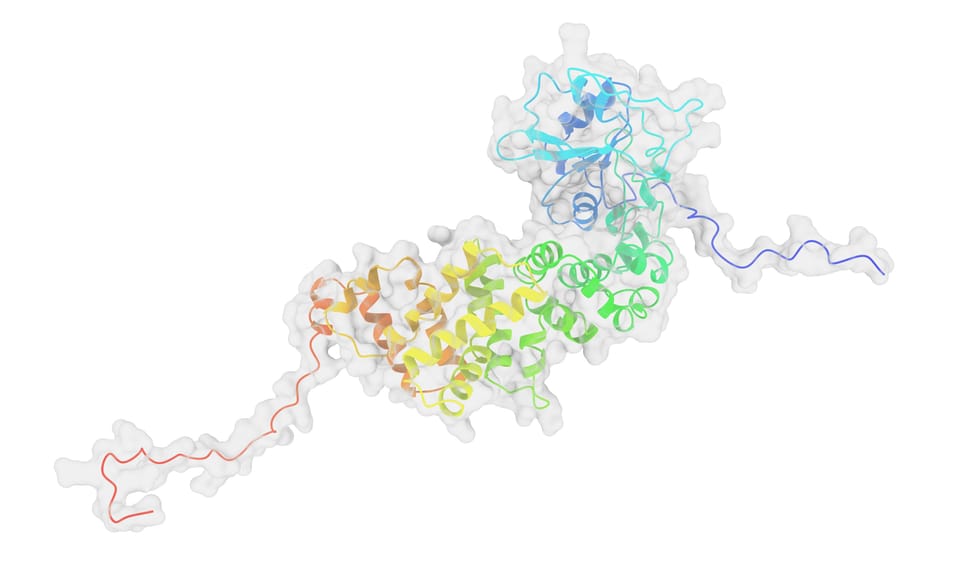
Every known living creature on Earth records biological instructions using four chemical units arranged in long molecular chains.12 These chemical units, known as nucleic acids, are adenine, cytosine, guanine and thymine.21 In natural genetic code, they assemble exclusively into two matched pairings, with adenine binding to thymine and guanine binding to cytosine.12 The simplicity of this four-part system has governed all terrestrial life for billions of years, but whether the cellular machinery that processes genetic data can operate across an expanded vocabulary has remained an open experimental question.
For an organism to put genetic instructions to practical use, a sequence stored within double-stranded DNA must be accessed and transcribed. Cellular reading begins when an enzyme binds to a designated stretch of DNA, unwinds the double helix, and steps along one strand to build a complementary single strand of messenger molecule called RNA.31 The working parts of this copying apparatus must recognise each incoming chemical unit, verify that it fits the opposite template position, and join it into the growing chain without frequent mismatching. If the copying enzyme stalls or introduces too many errors, the resulting genetic message fails.
A research study from scientists at the University of California San Diego, published in Nature Communications, demonstrated that the primary transcription enzyme from the bacterium Escherichia coli can copy synthetic DNA built with eight chemical letters.13 The artificial genetic system, known as Hachimoji DNA, adds two synthetic pairs named P paired with Z and B paired with S to the conventional four letters.12 In controlled biochemical reactions, the bacterial enzyme read this expanded synthetic code and incorporated the matching synthetic RNA partners into an extending transcript.1
How can an enzyme copy letters that nature never built?
Bacterial RNA polymerase relies on molecular shape and chemical compatibility rather than an absolute evolutionary requirement for only four specific bases. In a typical cellular transcription process, RNA polymerase locates specific promoter sequences in a DNA template, melts a small region containing the transcription start site, initiates RNA synthesis, and processively elongates the transcript before releasing the completed molecule.3 In laboratory experiments conducted with purified enzyme from Escherichia coli, the researchers presented the polymerase with synthetic DNA templates containing the non-standard chemical letters.1
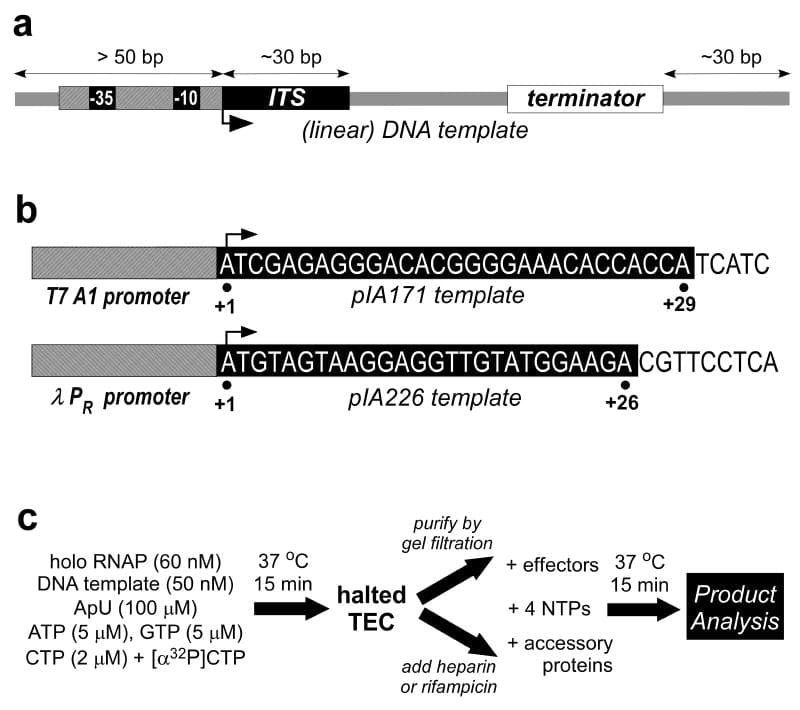
The researchers supplied the reaction with all eight corresponding RNA building blocks and monitored which chemical units the polymerase selected as it advanced.1 The non-standard pairs largely operated according to design, with P matching with Z and B matching with S.1 The enzyme successfully discriminated against most incorrect combinations, maintaining proper molecular pairing across the synthetic positions.1
The speed of this synthetic assembly remained comparable to natural genetic copying. Reactions incorporating the artificial P and Z pair proceeded only about twofold slower than a natural guanine and cytosine comparison tested under the same laboratory conditions.1 Rather than stalling when encountering the unfamiliar synthetic pairs, the bacterial polymerase continued moving smoothly down the engineered DNA template to complete its transcription process.1
Why did the synthetic genetic system require chemical refinement?
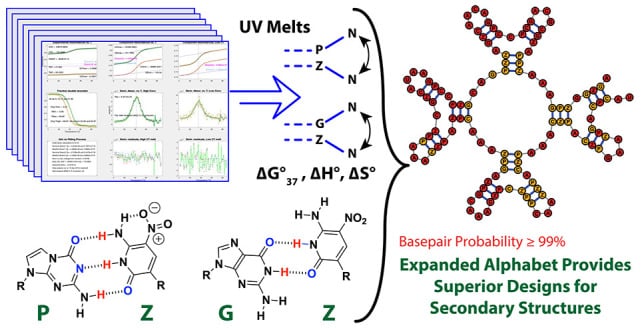
Initial transcription tests produced occasional errors when the artificial letter Z mistakenly paired with natural guanine during RNA synthesis.1 The researchers traced this mispairing to the underlying molecular structure of Z, which permitted an alternative chemical state that resembled a natural pairing partner for guanine.1 This occasional chemical ambiguity caused the bacterial copying enzyme to insert natural guanine opposite Z, introducing copying errors into the resulting synthetic transcript.
To correct this copying problem, the research team engineered an altered version of the synthetic base, designated Z*.1 In this modified chemical building block, one chemical group was substituted with another to make the unwanted alternative state far less likely to form during copying reactions.1 Subsequent laboratory trials demonstrated that Z* sharply decreased erroneous pairing with natural guanine while preserving its intended capacity to pair accurately with P.1
Earlier investigations by a research group led by synthetic biologist Steven Benner, reported in Science in 2019, had established that an eight-letter system containing P, Z, B and S could produce stable double helices and support the synthesis of a functional fluorescent RNA molecule.12 Previous experiments had also confirmed that Escherichia coli RNA polymerase could transcribe a six-letter alphabet containing the B and S pair.1 The experiments conducted at the University of California San Diego resolved whether the natural enzyme could accommodate the more demanding eight-letter template containing both artificial pairs simultaneously.1
What does this laboratory success leave unanswered?
These biochemical trials represent cell-free laboratory experiments and do not demonstrate an organism living or reproducing on an expanded genetic code.1 The experiments used purified bacterial RNA polymerase alongside short, artificially engineered strands of DNA and RNA rather than an intact cellular system.1 The researchers did not rewrite the genomic sequence of a living Escherichia coli cell, nor did they construct a bacterium capable of propagating an eight-letter genome across generations.1
A full living system presents biological challenges that purified enzymes do not encounter in a test tube. A living organism running on eight letters would need to replicate its synthetic DNA during division, synthesize and regulate all eight chemical building blocks internally, and protect the non-standard bases from cellular repair systems that routinely excise abnormal nucleic acids. Furthermore, the question of whether cell-based molecular factories called ribosomes can translate transcripts derived from eight-letter genetic sequences into extended proteins remains untested.1
The findings nonetheless show that an enzymatic machine central to terrestrial life does not strictly require the four-letter chemical palette shared by every known organism. Demonstrating that bacterial RNA polymerase can process an eight-letter code provides a defined operational baseline for designing custom molecular tools. Artificial nucleic acids possessing non-standard letters offer expanded chemical properties that standard DNA and RNA cannot provide, potentially allowing researchers to engineer synthetic RNA aptamers that bind disease targets with higher affinity.1
What possibilities open if expanded genetic codes mature?
Expanding the genetic alphabet offers concrete avenues for designing targeted diagnostics and synthetic biomaterials. Conventional DNA and RNA are limited by the physical and chemical properties of four standard bases, whereas adding artificial base pairs provides novel molecular shapes, reactive groups, and folding patterns. These distinct properties could allow researchers to construct synthetic RNA strands tailored to bind cancer biomarkers, medicines, or diagnostic targets with greater selectivity than natural nucleic acids can muster.1
A further objective involves using expanded genetic messages to direct the synthesis of entirely new classes of proteins. If transcription from an expanded genetic code can be paired with synthetic translation systems that assign new three-letter codon combinations to non-standard amino acids, scientists could manufacture proteins containing chemical functional groups that natural evolution never incorporated.1 Such molecules could serve as durable industrial catalysts, advanced therapeutic binders, or specialized biosensors operating beyond the biochemical limits of standard biology.1
The record
29 sentences trace to 3 sources.
-
1
MA
 Mihai Andrei
Document
· zmescience.com · 17 Nov 2026
Life As We Know It Uses 4 DNA Letters. Scientists Expanded It to 8
See the source
- 2 A New Way to Spell Life? | NIH Common Fund See the source
-
3
N
 nature.com
Paper
· nature.com
Three-dimensional structure of Escherichia coli RNA polymerase holoenzyme determined by electron crystallography - Nature
Journal article
Download the document