Stone Age clay figures from Romania capture prehistoric meditation
Excavated from a 7,000-year-old cemetery along the Danube, two seated Hamangia figurines challenge assumptions about early European ritual art
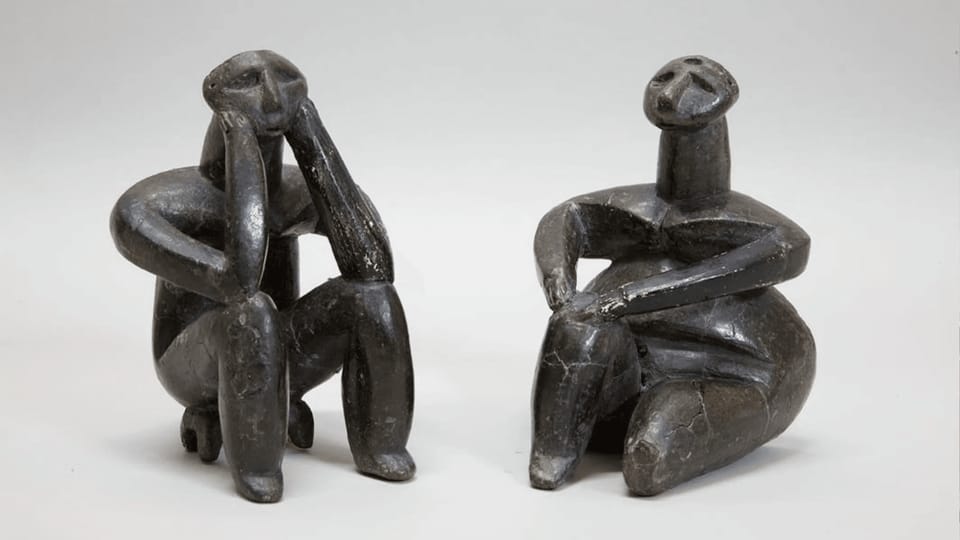
Two small ceramic figures buried in the soil of southeast Romania have puzzled archaeologists since their discovery in the mid-twentieth century.12 Most Neolithic figurines across Europe depict upright female forms, yet this pair presents a man resting his head in his hands on a stool, accompanied by a woman seated directly on the ground.3 Shaped seven millennia ago, their poses convey a contemplative stillness rarely observed in Stone Age funerary goods.14
Prehistoric symbolic art required a deliberate chain of human choices. Artisans first selected fine local clay, shaped the limbs and facial features by hand, and hardened the wet mineral paste through kiln firing. Communities then placed the finished objects in a tomb beside an inhumed person, meaning the objects functioned as intentional grave offerings rather than casual debris. In 1956, archaeologists directed by Dumitru Berciu uncovered the two clay statuettes inside a single burial in the Columbia D cemetery at Cernavodă, located in Constanȕa County along the Danube River.5 The artifacts, known as the Thinker and the Seated Woman, belong to the Late Neolithic Hamangia culture, which flourished from roughly 5200 to 4500 BC.12

Why are the Cernavodă figurines unusual for Stone Age art?
Male figurines formed a very small minority among Neolithic ceramic sculptures, and finding a male figure paired with a female counterpart in one grave is an exceptional rarity.32 The National Museum of Romanian History notes that the dual deposit points to a direct relationship between the two figures, possibly symbolizing masculine and feminine principles or an early family unit.41 Excavations in the Cernavodă necropolis yielded dozens of human statuettes, but these two stand apart because the artisans modelled them in seated postures.12
Both sculptures measure 11.5 centimetres in height and fit comfortably within the palm of a hand.42 The male Thinker sits on a low, four-legged clay stool with his legs parted and bent at the knees.1 His torso arches forward from a long conical neck, and his arms bend at the elbows so that his hands support his cheeks, framing an almost oval face.4 Triangular impressed marks indicate his eyes, a modelled ridge forms his nose, and a small puncture defines his mouth, as documented in an analysis by Marius Comper.2 His companion, the Seated Woman, rests directly on the earth with her left leg bent and her right leg extended forward.43 Her silhouette displays stylized oval facial contours, a conical neck, and pronounced anatomical hips, thighs, and abdomen.41
What do the physical details reveal about how they were made?
Careful examination of the dark grey ceramic reveals that the Hamangia artisans shaped the figures entirely by hand and smoothed their exterior to a polished finish.24 The Institute for the Study of the Ancient World notes that the male sculpture measures 7.5 centimetres in width, whereas the female figure measures 5.4 centimetres across.3 A historical summary by Biostate AI indicates that the Cernavodă cemetery formed part of an extensive settlement landscape along the Danube River, where communities practiced sheep and goat herding and manufactured spiral-patterned pottery alongside human idols.51
Parallels to the seated male posture remain uncommon across early farming societies.23 A roughly shaped clay figurine in a comparable seated pose was documented at Trușești in northeastern Romania, belonging to the Cucuteni cultural sphere.2 Related contemplative poses also emerged in distant contexts, including a Neolithic figure uncovered at Karditsa in Greece and a Bronze Age seated sculpture from Yehud in Israel.2 These scattered discoveries suggest that the physical gesture of resting a head in cupped hands emerged independently across prehistoric communities as a universal human expression.2
What can the burials tell us about their purpose?
Archaeological evidence confirms the figures were interred beside an inhumed body, but their precise spiritual meaning cannot be proven because the Hamangia culture left no written records.32 Berciu suggested that the stylized forms served a religious role, proposing a link to early solar worship by drawing analogies with later European Bronze Age sun cults.1 Other researchers interpret the pair as mourners performing funerary rites, deities tied to vegetation cycles or death, or an explicit celebration of maternal fertility.52
These theories remain working hypotheses based on grave context, not measurable historical facts. The artifacts demonstrate that prehistoric potters possessed sophisticated sculptural skill, yet the exact cosmology behind the burial remains unknowable.2 Today, the original sculptures are preserved in Bucharest under inventory numbers 15906 and 15907 at the National Museum of Romanian History, where the male Thinker serves as the institution's official emblem.3
The record
26 sentences trace to 5 sources.
-
1
KK
 Kristina Killgrove
Document
· livescience.com · 16 Nov 2026
Thinkers of Cernavodă: Mysterious Stone Age figurines discovered in a 7,000-year-old grave in Romania
See the source
- 2 He has been thinking for 7,000 years. We still don See the source
- 3 Exhibition Narrative | ISAW See the source
- 4 …at Hand ⋆ Muzeul Național de Istorie a României See the source
- 5 Cernavoda See the source