Magnetic microrobots can tumble through blood vessels to clear clots
Tiny polymer particles rotating under magnetic fields can generate local fluid currents that drive clot-dissolving drugs into obstructed vessels, accelerating treatment in preclinical trials.
When a blood clot wedges inside an artery, the human circulatory system faces a brutal mechanical paradox. Blood must flow to deliver the very medicines formulated to dissolve the obstruction, yet the blockage itself diverts that essential stream away into unobstructed neighbouring vessels. Starved of circulation, tissues in the brain, heart, or lungs quickly suffocate as oxygen supplies collapse. Physicians can thread slender catheters directly into nearby vascular junctions to administer clot-dissolving compounds, known as thrombolytics, but those chemical agents often stall right at the threshold of the blockage.12 Without a steady hydrodynamic push, the drug molecules must rely on passive molecular diffusion to cross the final few millimetres of stagnant fluid, a process that unfolds at an agonizingly sluggish pace while vulnerable cellular tissue dies.21
To overcome this vascular roadblock, biomedical engineers have looked to natural organisms that navigate complex fluid environments using magnetic fields. Certain aquatic bacteria synthesize internal chains of iron oxide crystals, creating microscopic compass needles that align their single-celled bodies with Earth's geomagnetic lines.1 Inspired by this biological architecture, a research group led by Simone Schürle, professor of medical microsystems at ETH Zurich, has engineered artificial microrobots designed to tumble along the inner boundaries of blood vessels.12 Rather than acting as mechanical drills or passive chemical carriers, these microscopic structures manipulate local fluid dynamics, whipping up miniature vortices that sweep medication across occluded pathways.
In preclinical evaluations, ETH Zurich announced on November 9, 2026, that these magnetically steered microrobots substantially accelerated the dissolution of blood clots in both synthetic laboratory vessels and live animal models.123 The experimental results, which were conducted alongside medical researchers from Charité University Hospital in Berlin, indicate that combining rotating microparticles with conventional thrombolytic medication can restore blood flow across significantly wider vascular territories than medication alone can achieve within the same critical treatment window.21
Why do severe blood clots resist conventional drug delivery?
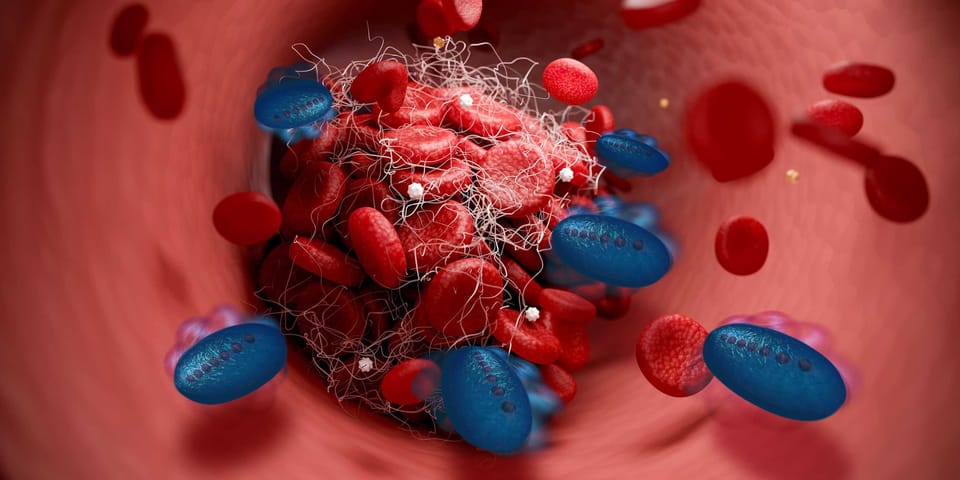
Severe blood clots resist conventional pharmacological treatment because vascular blockages fundamentally alter local fluid resistance, forcing circulating blood to bypass the obstructed channel entirely.12 In any branching pipe network, liquid follows the path of least physical resistance, pouring into open side passages and leaving blocked corridors functionally stagnant. When a thrombus forms inside a vessel, the incoming bloodstream diverts into unobstructed collateral paths instead of pressing against the obstruction.14 Doctors routinely deliver thrombolytic agents near the clot through an endovascular catheter, expecting the circulation to wash the therapy over the obstruction. When that physical current drops to near zero, therapeutic molecules can advance only through diffusion, drifting haphazardly across the stagnant pocket until they encounter the fibrin mesh of the clot.
This transport failure costs valuable time during acute medical crises such as ischemic strokes, myocardial infarctions, and pulmonary embolisms.24 Every minute of stalled flow broadens the permanent boundary of dead muscle or injured neural tissue. While clinicians can deploy mechanical thrombectomy tools to manually snag and extract large blockages from accessible major vessels, deep or delicate arterial branches remain dangerous to enter with physical retrieval devices. The pharmacological alternative of infusing higher systemic drug doses introduces dangerous bleeding risks, including haemorrhagic strokes, because thrombolytics degrade clotting proteins throughout the entire circulatory system. Delivering a targeted physical stimulus that directs existing drug molecules directly into the face of the clot represents an urgent clinical priority.
How do tumbling microrobots generate local flow?
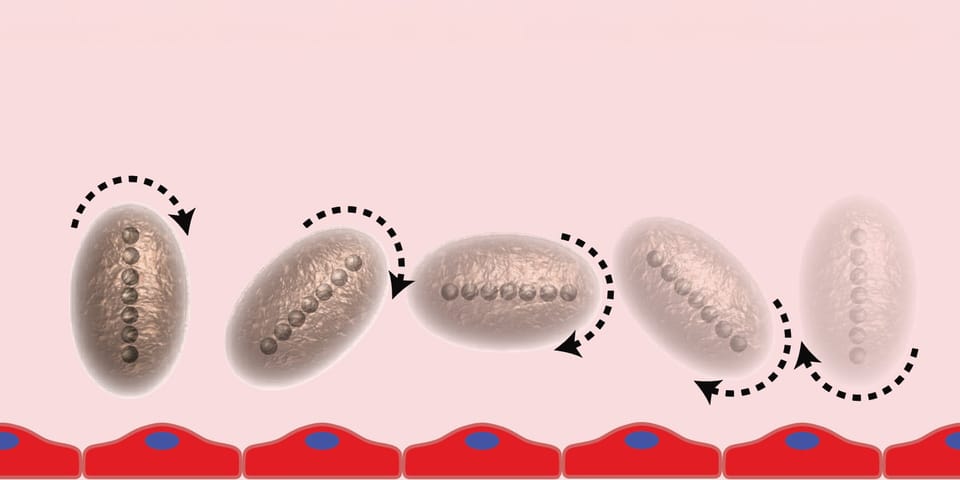
Microscopic robots generate localized forward flow by performing continuous rotational somersaults along the interior walls of blood vessels under the guidance of an external magnetic field.21 Each microbot measures approximately eight micrometres in length, roughly matching the dimensions of an individual human red blood cell.24 Their bodies resemble miniature oblong cocoons or rice grains, fabricated from a biocompatible sugar polymer gel that encloses magnetic iron oxide nanoparticles.4 Rather than scattering these metallic particles randomly through the polymer, the engineers cluster them into a distinct linear column running along the longitudinal axis of each particle.24 This alignment is created during synthesis by exposing the droplets to a rotating magnetic field during a droplet-based microfluidics production process.21
This internal alignment causes the particle to behave like a microscopic compass needle with a distinct magnetic orientation. When clinicians position an external electromagnet system over the tissue and activate a rotating magnetic field, the internal magnetic backbone twists to stay aligned with the rotating vectors.24 Because the microbot sits near the vessel boundary, where friction against the endothelial wall provides physical traction, this torque drives the particle forward in an uninterrupted series of forward flips, akin to a gymnast performing sequential handsprings across an arena mat. As these particles tumble forward, their rotating surfaces pull and push surrounding plasma, creating micro-vortices in the adjacent fluid.21 These small currents draw therapeutic molecules out of the stagnant zone and push them forcefully into the face of the blockage, transforming a stalled pool of blood into an active chemical washing zone.

What did the laboratory and animal tests reveal?
Controlled experiments demonstrate that adding magnetically driven microbots to thrombolytic medication dramatically accelerates clot dissolution and expands the restoration of blood flow.32 In initial benchtop experiments, Schürle and her colleagues constructed a silicone vascular model containing miniature fluid channels configured to mimic human arterial branching patterns.21 The researchers introduced artificial clots formed from pig blood into these synthetic channels, then infused standard thrombolytic drugs alongside suspensions of the microrobots.24 Aided by the rotating particles, the medication cleared the obstructed passages significantly faster than drug infusions delivered without the microbots, dissolving blockages roughly six to ten times more rapidly across distinct experimental trials.21
Building on these laboratory simulations, the research team partnered with investigators from Charité University Hospital in Berlin to test the microbots inside live pigs.21 The investigators placed blood clots into arterial branches supplying the kidneys of the anaesthetised animals to model acute vascular occlusion in living tissue.12 They then injected conventional thrombolytic medicine into the obstructed arteries, comparing outcomes when the medication acted alone against outcomes when coupled with rotating microbots guided by external electromagnets. After 30 minutes of treatment, the cross-sectional area of tissue where blood flow had been successfully restored was twice as large in animals treated with the microbots compared with animals that received medication alone.24
What remains unknown before clinical trials?
Preclinical animal trials cannot determine whether the microrobot system will operate safely or effectively across the complex vascular networks of human stroke and heart attack patients.4 The findings represent preclinical evaluations in controlled synthetic channels and porcine kidney arteries rather than completed human clinical trials. Furthermore, the underlying scientific research paper remains under formal peer review prior to journal publication, following an initial preprint posted in March.32 The acute pig experiments focused exclusively on the mechanical restoration of blood flow during a 30-minute intervention and did not evaluate long-term tissue recovery, downstream vessel inflammation, or the physiological fate of the animals after the clot dissolved.12
Assessing long-term toxicity and particle clearance in large animals constitutes a major hurdle for the ETH Zurich team before regulatory bodies can permit human testing. While earlier safety trials conducted in mice demonstrated that the sugar polymer sheath and iron oxide nanoparticles safely degrade and clear from the body within several weeks, larger mammals possess differing vascular architectures and metabolic clearance rates that demand rigorous validation.12 Schürle has filed a patent application covering the microfluidic production technique, and ETH Zurich nominated the technology for its annual Spark Award.21 The researchers must now evaluate particle behaviour in specialized disease models, including acute myocardial infarction and cerebral ischemia, ensuring that these microscopic tumblers navigate varied vessel geometries without causing secondary blockages or endothelial irritation.2
The record
29 sentences trace to 4 sources.
-
1
VA
 Victoria Atkinson
Document
· livescience.com · 16 Nov 2026
Tiny robots can tumble through blood vessels to help dissolve blood clots, early test shows
See the source
- 2 Dissolving blood clots with flow-generating microbots See the source
- 3 ETH microbots help dissolve blood clots - zurich.tech See the source
- 4 Tiny Magnetic Robots Help Dissolve Blood Clots Six Times Faster Than With Drugs Alone See the source