Psilocybin can rewire stressed brains without triggering psychedelic trips in mice
New brain circuits formed and damaged connections endured in mice after treatment, even when cellular receptors for hallucination-linked behaviors were decoupled.
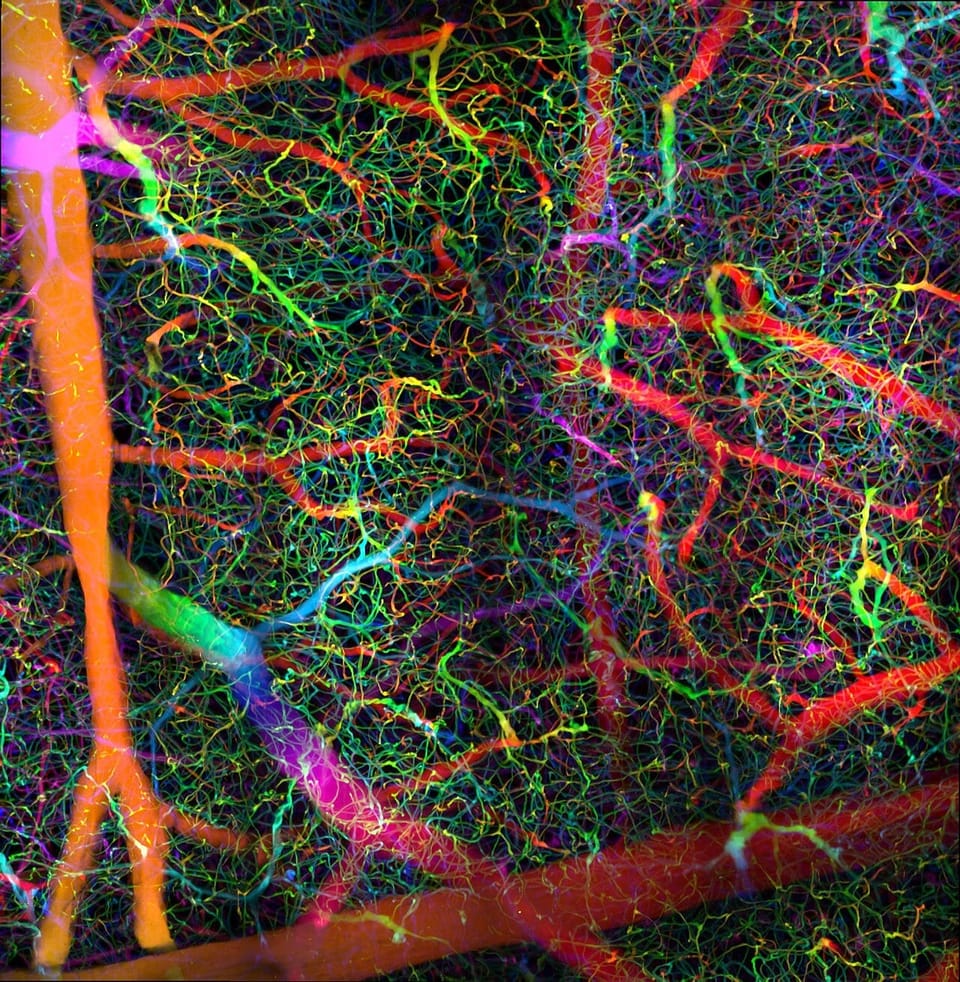
Prolonged emotional stress takes a physical toll on the cellular architecture of the mammalian brain. Under chronic strain, nerve cells in the cerebral cortex shed the tiny physical contacts that allow them to communicate across circuits controlling learning, memory, and mood regulation.1 Over time, that steady attrition strips down neural pathways, leaving networks less adaptable and less capable of coping with further distress.
For years, researchers have recognized that psychedelic compounds can prompt the brain to rebuild those damaged connections. Among these substances, psilocybin, the active chemical found in magic mushrooms, can stimulate structural neuroplasticity, which is the physical process by which neurons remodel their communication networks.12 In clinical settings, guided psilocybin sessions have shown therapeutic promise for people experiencing major depressive episodes and post-traumatic stress disorder.1 Yet those same interventions produce intense, hours-long altered states of consciousness, demanding specialized medical facilities, extensive therapeutic monitoring, and clinical resources that limit who can access them.
A central question has divided neuroscientists: must a patient undergo a disorienting psychedelic trip for their brain circuits to rebuild, or can structural healing happen independently? In a study published on October 15, 2026, in the journal Nature Neuroscience, researchers led by Jacob J. Baker and Yi Zuo at the University of California, Santa Cruz, demonstrated that the biological pathway psilocybin uses to remodel cortical connections can be separated from the pathway that triggers psychedelic-associated behavior in mice.1
How do brain cells build and prune their connections?
Communication between neurons relies on physical junctions called synapses, which form when electrical or chemical signals travel from one cell to another across tiny fluid-filled spaces. Most excitatory communication in the cortex takes place on dendritic spines, which are microscopic protrusions budding off the branched arms of nerve cells.1 When a new spine emerges, it usually begins as a fragile, thread-like filament.1 Over time, activity across the junction can either stabilize the structure, swelling its tip into a robust mushroom-shaped head capable of enduring transmission, or cause the cell to retract and discard it.1
Chronic stress alters this delicate balance by depressing spine formation and accelerating the loss of existing synapses. To reverse that decline, an intervention must orchestrate a multi-step sequence. First, a chemical messenger must bind to specific protein receptors embedded on the outer surface of target cortical cells. That binding event triggers intracellular signaling cascades that command the cell to manufacture new structural proteins. As those proteins assemble, new dendritic spines push outward along the dendrite, mature into durable connections, and integrate into functioning circuits while outdated or dysfunctional pathways are pruned away.
Baker, a doctoral researcher at the university, and Zuo, a professor of molecular, cell and developmental biology, tracked this dynamic sequence in living mice.12 Using two-photon microscopy, an optical technique that uses focused pulses of infrared light to image fluorescent structures deep inside living tissue over consecutive weeks, the team observed how individual cortical spines responded to psilocybin.12
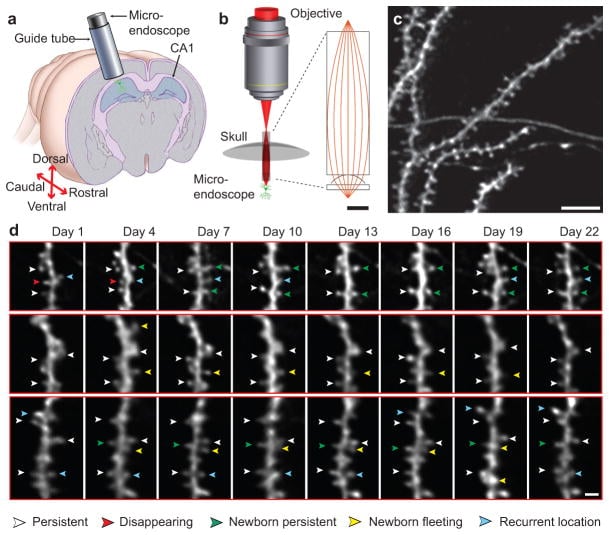
Within 24 hours of receiving a single dose of psilocybin, mice showed a marked surge in the emergence of new dendritic spines.1 The compound also accelerated spine maturation, prompting a higher fraction of nascent buds to transform into mushroom-shaped heads that persisted across subsequent weeks.12 As Baker stated in public comments on the work, these newly formed connections can integrate into existing neural circuitry and persist over time, leaving a lasting structural trace of psilocybin’s effects on the brain.1
Why does chronic stress change the way the brain responds?
Psilocybin does not affect an unstressed brain in the same manner that it affects a chronically stressed one. In mice living under ordinary laboratory conditions without chronic disturbance, a single dose generated an initial burst of new spine formation that gradually subsided across three weeks.12 As those new spines appeared, the cortex eliminated an elevated portion of pre-existing connections, demonstrating that the drug acts by accelerating overall circuit turnover and remodeling rather than merely accumulating endless connections.12
When the researchers applied psilocybin to mice subjected to chronic, unpredictable mild stress, the structural outcome changed.12 Prolonged stress on its own drove severe synaptic attrition, thinning the density of connections across the cortex.1 In these stressed animals, psilocybin exerted a dual protective action: it produced an unusually pronounced spike in new spine formation and simultaneously curbed the excessive loss of connections that had existed before the stress began.1
As Zuo noted, these findings challenge the prevailing view that psilocybin simply increases neural connectivity and suggest that its effects depend on the brain’s underlying condition.1 The drug appears to tune its actions to the state of the surrounding circuit, reinforcing vulnerable pathways when stress has eroded them while pruning and rebuilding when connections are intact.
Can physical rewiring occur without the psychedelic experience?
Serotonin 2A receptors, which are specialized surface proteins that detect the neurotransmitter serotonin, sit at the heart of psilocybin’s known effects.12 Psychedelic compounds bind directly to these receptors, particularly in the cerebral cortex. To determine whether the same receptors govern both circuit remodeling and psychedelic symptoms, the Santa Cruz researchers zeroed in on Layer 5 pyramidal neurons, large projection cells that run through deep cortical tissue and express dense clusters of serotonin 2A receptors.12
In rodents, scientists cannot directly survey subjective hallucinations. Instead, they track the head-twitch response, a rapid, involuntary rotational movement of the head that serves as a well-validated behavioral proxy for psychedelic activity across mammalian species.12 Using genetically engineered mouse models, the investigators manipulated the presence of serotonin 2A receptors exclusively within Layer 5 pyramidal neurons while leaving receptors in other brain regions untouched.
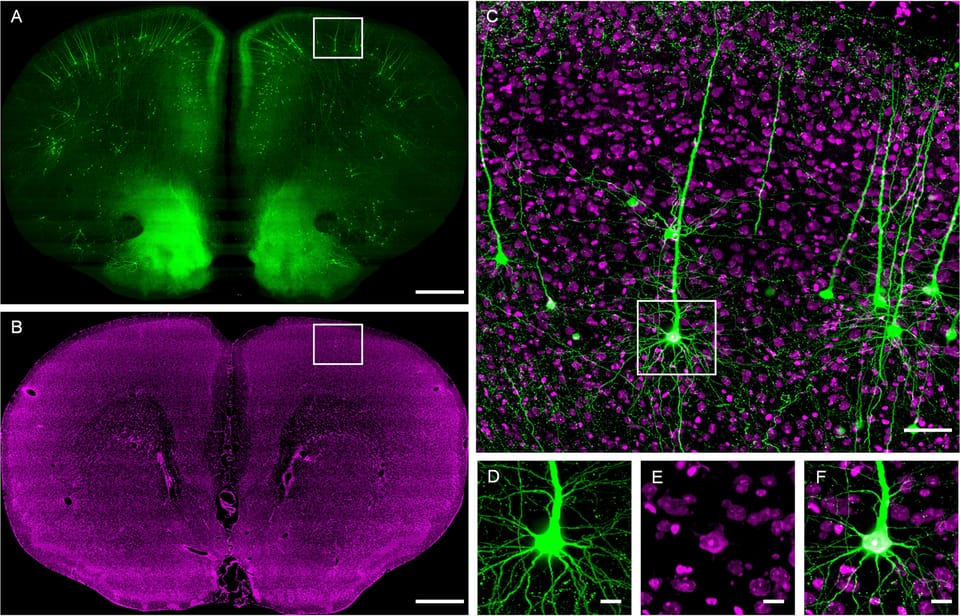
In their first test, the researchers examined mice lacking serotonin 2A receptors across their entire brains, but selectively restored the functional receptor gene only inside Layer 5 pyramidal neurons.12 When given psilocybin, these mice generated new dendritic spines and stabilized their synapses at rates comparable to normal animals, yet they showed no head-twitch behavior.12 In their complementary test, the team deleted serotonin 2A receptors specifically from Layer 5 pyramidal neurons while preserving them everywhere else.12 After receiving psilocybin, these mice exhibited typical head-twitch behavior, but their cortical neurons failed to grow new spines or remodel connections.12
The dual experiments demonstrate that serotonin 2A signaling in Layer 5 pyramidal neurons is both necessary and sufficient for psilocybin to remodel synapses, but entirely unnecessary for the behavioral head-twitch response.21 The cellular machinery responsible for rebuilding physical connections in the cortex can operate independently from the circuits driving psychedelic actions elsewhere in the brain.
What are the boundaries of these findings?
These experiments were conducted exclusively in laboratory mice, and their conclusions cannot be directly equated with clinical relief in humans. The study measured physical spine dynamics under microscopes and counted repetitive twitches, not changes in mood, cognitive restoration, or remission from depressive illness.1 Furthermore, while the head-twitch response correlates with hallucinogenic potency in people, it remains an indirect behavioral stand-in that cannot capture the full spectrum of subjective psychedelic experience.
The findings also reflect acute single-dose exposures within controlled genetic strains. The researchers manipulated receptor expression through artificial genetic modifications, a laboratory tool that isolates cellular mechanisms rather than a treatment that can be administered in clinical settings. The results demonstrate that structural neuroplasticity and hallucination-related pathways diverge at the cellular level, but they do not prove that an existing pill or molecule can currently replicate this separation in human patients.
Where does psychedelic medicine go from here?
Demonstrating that structural neuroplasticity does not require the cellular pathway of the head-twitch response provides a clear chemical roadmap for drug development. If the structural benefits of psilocybin depend on activating serotonin 2A receptors on Layer 5 pyramidal neurons while psychedelic reactions require receptors in distinct cell populations or brain regions, chemists can design targeted analogs that selectively engage the therapeutic circuit.
Medicines developed around this structural mechanism could reshape psychiatric care. Synthetic compounds engineered to promote neuroplasticity without inducing hallucinations could be dispensed as conventional outpatient prescriptions, bypassing the intensive psychological support and multi-hour medical supervision currently required for psychedelic therapy. As Zuo noted, by showing that therapeutic circuit remodeling and hallucinogenic effects operate through distinct cellular pathways, the study provides a blueprint for designing non-hallucinogenic drug analogs.1
For the researchers, the immediate next step is clarifying which downstream biochemical pathways Layer 5 pyramidal neurons use to stabilize dendritic spines after serotonin 2A stimulation. Unraveling those internal signals will reveal whether future therapeutics can stimulate structural repair directly within the cell, sidestepping surface receptor interactions altogether.
The record
28 sentences trace to 2 sources.
-
1
RB
 Rupendra Brahambhatt
Document
· zmescience.com · 17 Nov 2026
Magic Mushrooms Can Rewire a Stressed Brain. Scientists Found a Way to Separate That from the Trip
See the source
-
2
N
 nature.com
Paper
· nature.com
5-HT2A receptors in layer 5 pyramidal neurons mediate the neuroplastic but not the hallucinogenic effects of psilocybin - Nature Neuroscience
Journal article
See the source