Hard mental effort barely changes the brain energy budget
Intense concentration burns almost no extra fuel compared to resting on a sofa, prompting the nervous system to protect its massive baseline costs by trimming computational precision during shortages.

A demanding afternoon spent wrestling with complicated financial statements or studying for an advanced qualification leaves most people feeling completely spent. The instinctive conclusion is that intense mental concentration has consumed a mountain of physical fuel, just as an exhausting sprint drains the legs. Yet inside the skull, the metabolic furnace burns at an almost invariant temperature regardless of what the mind is doing. An afternoon of intense intellectual work requires essentially the same daily caloric expenditure as an idle afternoon spent watching dust drift across a living room.
Understanding this disconnect matters because it reshapes how science views both cognitive exhaustion and metabolic health. For decades, popular assumptions have treated mental labor like physical exertion, suggesting that an active brain burns through fuel reserves that need immediate replacement. In reality, intellectual fatigue does not stem from a drained biological gas tank. The brain maintains a steep, non-negotiable operating baseline, and clarifying how that budget is spent explains how neural circuits survive periods of food scarcity and how energy demands shaped human development.
The biological reason for this steady burn lies in the physical machinery of brain communication. To transmit information, a neuron permits charged mineral ions to rush through specialized channels in its outer wall, generating a tiny electrical wave. Once that impulse passes, the cell must immediately restore its internal balance by pumping those ions back out against their natural concentration gradient. These tiny microscopic pumps require an uninterrupted supply of fuel simply to keep the cell primed to fire. Because billions of neurons must maintain this ready electrical tension across every second of life, the cost of keeping the network available dwarfs the modest extra expense of sending an individual thought across it.
The scale of that baseline demand was laid out in a foundational 2002 commentary in the Proceedings of the National Academy of Sciences by neuroscientist Marcus Raichle and a colleague.1 The authors reported that the human brain accounts for about 2 percent of total body weight while consuming roughly 20 percent of the oxygen and calories used by the resting body.1 Furthermore, Marcus Raichle and his coauthor noted that this rate of consumption remains remarkably constant despite widely varying mental and motoric activity.1
Why does thinking hard burn almost no extra energy?
Concentrated mental effort demands surprisingly little additional fuel because task-driven signals represent tiny ripples on a massive, permanent metabolic sea. In the 2002 paper, Marcus Raichle and his colleague stated that local changes in blood flow measured with positron emission tomography during most cognitive tasks are often 5 percent or less.1 In subsequent work, Marcus Raichle observed that the additional energy used when brain activity shifts is often less than 5 percent of the baseline level of activity, an underlying expense he termed dark energy.1
To translate that small fraction into familiar terms, science writer Sanchana Charles noted in an analysis of the data that the standard figure quoted for total brain power is roughly 20 watts.1 Over a full day, that rate accounts for approximately 410 calories, roughly equivalent to a single bakery muffin.1 If demanding thought sustained that maximum 5 percent increase across an entire day, Charles calculated that the mental work would add roughly 20 calories, about the energy contained in three almonds.1 Feeling hungry after an afternoon of difficult calculations is therefore unlikely to be caused by calorie depletion in the head.
This tight energetic window also provides essential context for modern neuroimaging. When popular accounts describe functional magnetic resonance imaging scans lighting up with vivid colors, they frequently give the impression that dormant tissue has burst into action. In reality, the baseline remains enormous. In the 2002 paper reviewed by Marcus Raichle, functional magnetic resonance imaging signals in the visual cortex of seven volunteers increased by an average of 1.8 percent, with a variation of 0.9 percent, when processing visual stimuli.1 The glowing regions seen on brain maps highlight modest local fluctuations rather than a dramatic surge in total consumption.
At the same time, changes in circulating blood do not map cleanly onto changes in consumed oxygen. A 1986 study cited in the commentary demonstrated that tactile stimulation of the fingers raised local blood flow by an average of 29 percent, while local oxygen utilization rose by only 5 percent.1 The vascular network can dilate to bring fresh fluids to active regions without those cells taking up an equivalent volume of oxygen.
Where does all that resting fuel actually go?
The vast majority of the brain metabolic budget is spent maintaining the baseline infrastructure required for long-range communication rather than performing local calculations. A 2021 theoretical paper cited by Sanchana Charles estimated that actual local computation within the cerebral cortex accounts for approximately 0.1 watts of power.1 By contrast, transmitting electrical signals across long cellular cables between distant regions was calculated to consume roughly 3.5 watts, about 35 times the computational cost.1 The expensive part of operating a brain is not running the numbers, but keeping the sprawling transmission lines open and charged.
Because that structural baseline is so costly, researchers have sought to determine what happens when the body faces a genuine energetic deficit. When a smartphone battery runs low, the device can switch into a low-power mode, dimming the screen and throttling processor speeds so that basic functions survive. Recent evidence suggests mammalian neural tissue adopts an analogous survival strategy when calories run short.
A 2022 study published in the journal Neuron investigated this adaptation by examining adult male mice.1 The researchers maintained the mice at 85 percent of their normal body weight for two to three weeks through controlled food restriction, feeding the animals just before experimental trials to ensure that hunger in the immediate moment was not the factor being tested.1 Within the visual cortex of these calorie-restricted mice, the amount of energy that individual neurons expended on incoming signals dropped by 29 percent.1
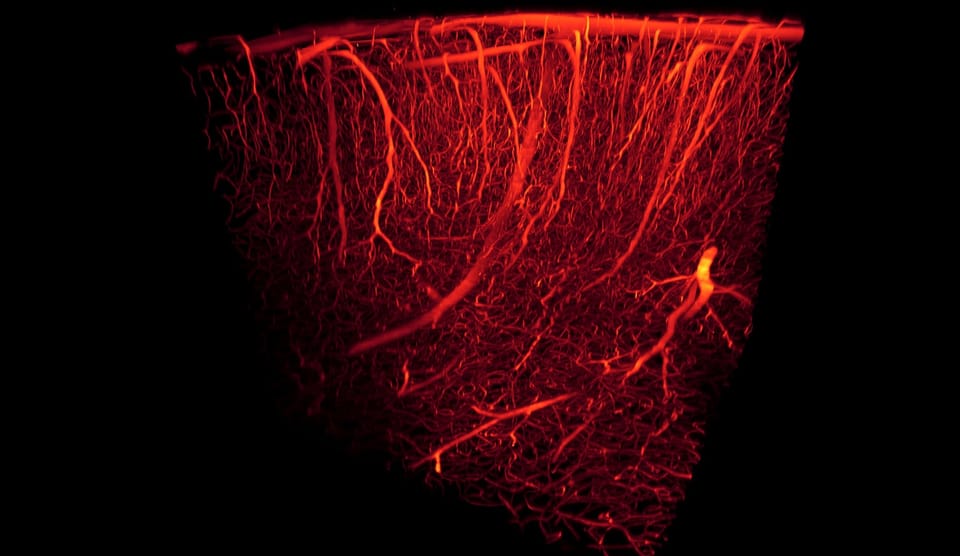
The neurons did not stop firing or fall silent under food restriction. Instead, the cells fired at their typical rate while their signaling precision degraded. The directional tuning of neurons monitoring visual lines widened by 32 percent, meaning the cells responded to a broader and sloppier band of angles, and the mice performed worse when tested on their ability to distinguish subtle differences between visual patterns.1 When the researchers administered leptin, an endocrine hormone whose circulating levels drop as body fat declines, the original sharpness of the neural tuning was restored.1 The authors titled their findings around this trade-off, concluding that the cerebral cortex saves energy by reducing coding precision.1
How does the nervous system cope with calorie scarcity?
The nervous system manages severe energetic constraints by trading sensory accuracy for survival, operating like a dimmed display that preserves communication while losing high-resolution detail. These trade-offs are not limited to periods of adult starvation. They appear to shape human development from the earliest stages of life, when the brain claims an even larger proportion of the body resources.
The adult standard of 20 percent of resting metabolism is far from universal across the human lifespan. A 2014 study published in the Proceedings of the National Academy of Sciences by Christopher Kuzawa and colleagues combined brain imaging records from 29 participants spanning from birth to late adolescence.1 The researchers discovered that cerebral glucose uptake does not peak in infancy, but reaches its maximum in early childhood between the ages of 4 and 5, when the glucose consumed by the brain accounts for roughly 66 percent of the resting metabolic budget of the entire body.1
The authors observed that these peak energetic demands coincide precisely with the developmental window in which a child physical growth slows to its minimum rate.1 Christopher Kuzawa and his coauthors hypothesized that the two phenomena are directly linked through an evolutionary trade-off, where physical body growth slows down to ensure that the exorbitant energetic requirements of the developing brain can be reliably met.1
These observations carry clear limitations that prevent sweeping conclusions about human behavior. The trade-off between energy and sensory precision was demonstrated in laboratory mice under controlled visual tasks, and no clinical study has established that dietary calorie restriction impairs human visual discrimination. Similarly, the developmental findings by Christopher Kuzawa and colleagues rely on an observational model built from brain scans of 29 individuals, meaning the suggested trade-off between brain metabolism and physical body growth remains an informed hypothesis rather than a proven causal law. Estimates dividing brain wattage into local computing and signal transmission are theoretical calculations derived from cellular dimensions rather than physical measurements gathered inside living human tissue.
What the assembled research does make clear is that the human nervous system cannot easily ramp its energy consumption up or down to match intellectual ambition. The expensive part of cognition is keeping the biological system switched on and synchronized, while the active thinking that humans consciously experience is an energetic bargain. The brain is not a muscle that can be exercised to burn surplus calories, nor does it shut down during lean times. Instead, when resources dwindle, it remains active, sacrificing fine-grained precision to preserve the critical baseline that keeps the organism alive.
The record
22 sentences trace to 1 source.
-
1
SC
 Sanchana Charles
Document
· scienceblog.com · 17 Nov 2026
Your brain is only about 2 percent of your body weight but uses about 20 percent of the calories your body burns at rest, and most mental tasks raise local blood flow by only about 5 percent or less
See the source