America loses measles elimination status after cases top 5,400
Pan American health officials concluded uninterrupted transmission exceeded twelve months as childhood immunization fell to ninety-two percent.

An international health commission revoked the United States’ measles elimination status after concluding that the virus circulated uninterrupted for more than 12 months, ending a public health milestone held since 2000.12
The determination by an independent commission of the Pan American Health Organization followed nationwide outbreaks that pushed the annual caseload to its highest level in more than three decades.13 For a country to maintain elimination status under international benchmarks, sporadic transmission chains must end within a year.4 Genetic tracking and epidemiological data confirmed that ongoing transmission crossed that threshold.3
Federal and state health records show that the resurgence accelerated sharply over the past two years.4 The Centers for Disease Control and Prevention recorded 5,412 confirmed measles cases in 2026 as of Nov. 12, spanning 47 jurisdictions.51 That figure more than doubled the 2,289 confirmed cases recorded across the country during 2025.53 Hospitalizations reached 591 in 2026, with roughly one in six infected children under age 5 requiring inpatient medical care.1
Fatality counts have climbed alongside hospital admissions. CDC tallies derived from federal death certificates listed six confirmed measles deaths in 2026.15 State health agencies, applying a broader classification standard, reported 10 fatalities across three states, including seven deaths in Pennsylvania, two in Wisconsin, and one in New York.12 Since early 2025, combined multi-year tallies show at least 13 measles-associated deaths nationwide.43 Several deaths occurred in infants younger than 12 months, an age group too young to receive routine immunization.24
The threshold behind herd protection
Measles ranks among the most infectious pathogens known to medicine. A single infected individual can transmit the virus to nine out of 10 susceptible people in close proximity, and infectious respiratory droplets remain suspended in indoor air for up to two hours.2 Complications range from severe ear infections and pneumonia to encephalitis and immune amnesia, a condition in which the virus erases existing antibodies against other illnesses.16 In rare instances, patients develop subacute sclerosing panencephalitis, a fatal neurological disorder that emerges years after apparent clinical recovery.16
Vaccination breaks these transmission chains when population coverage remains high. The combined measles, mumps, and rubella shot delivers roughly 97% protection after two doses.15 Because the pathogen spreads easily, epidemiologists calculate that at least 95% of a community must maintain immunity to prevent sustained community spread.15
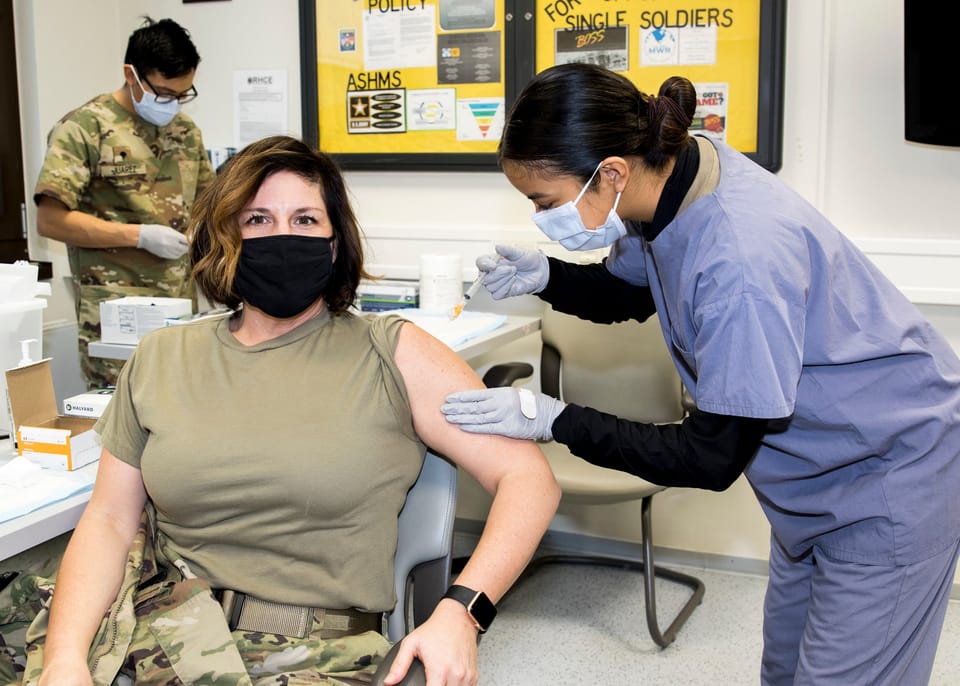
American childhood coverage has slipped beneath that defensive line. Across the country, kindergarten vaccination rates dropped from 95.2% during the 2019–20 school year to 92.4% in 2025–26, leaving approximately 280,000 kindergartners without documented immunization.51 Non-medical and personal exemptions reached a record 4.2%.1 In Idaho, statewide kindergarten coverage fell to 75.2%, with several rural counties reporting rates below 50%.12
“It is a fully preventable disease,” said Noel Brewer, a professor of public health at the University of North Carolina who chairs an independent advisory panel on measles. “It is unconscionable that we have this amount of measles.”3
The vulnerability extends beyond young children. Adults accounted for 41% of confirmed 2026 infections, with 15% requiring hospitalization.1 Many adults immunized prior to 1989 received only a single dose before public health guidance shifted to the two-dose schedule.14
How localized sparks became continuous chains
For a quarter century following the certification of elimination in 2000, American measles cases followed a consistent pattern. Travelers contracted the virus abroad and imported isolated cases that health departments quickly ring-fenced. Because surrounding communities possessed high immunization rates, secondary transmission fizzled out.
That pattern broke in early 2025 when an outbreak emerged in West Texas and expanded across state borders into New Mexico and Mexico, sickening more than 4,500 people.41 Outbreaks subsequently took root in Pennsylvania, South Carolina, and Utah.14 The Utah cluster, which began in June 2025, continued past the 12-month mark, providing direct grounds for revoking national elimination status.14 In Pennsylvania, an ongoing cluster produced 1,542 cases and 305 hospitalizations by mid-November.1
The epidemiological shift became visible in surveillance metrics. An academic analysis by researchers at Boston Children’s Hospital and Harvard Medical School found that by early 2026, the country failed four of seven elimination criteria, with local cases dwarfing imported infections and the effective reproduction rate staying above one for more than three-quarters of the evaluated period.6
The loss aligns the United States with several other nations that recently surrendered elimination standing. Canada lost its measles-free status in November 2025 following a multi-thousand case surge, while the United Kingdom and Spain surrendered their status after reviews earlier in 2026.62

“It wasn’t for a lack of effort in Canada,” said Jon Andrus, a global health professor at George Washington University and the chair of the commission reviewing elimination status. “There was a political commitment at the highest level to sustain measles elimination and to stop that outbreak. That was for me the sad part of the story, because they really did try.”2
Shifting policy and public health friction
The spread of vaccine hesitancy received fresh momentum during the coronavirus pandemic, when online communities amplified discredited claims regarding childhood inoculations. A 1998 research paper that alleged a connection between the combined vaccine and autism was retracted in 2010, yet public polling demonstrated that doubts persisted and drove parents to postpone scheduled appointments.1
Federal health guidance has reflected these shifting attitudes. President Donald Trump signed an executive directive in August 2026 instructing officials to explore splitting the combined shot into three separate disease injections, an option not marketed in the United States.1 Medical researchers note that requiring multiple appointments increases the likelihood of missed immunizations without providing documented safety advantages.1
Department of Health and Human Services Secretary Robert F. Kennedy Jr. questioned early mortality reports from Pennsylvania, suggesting state counts might have been fabricated. Kennedy also promoted high-dose vitamin A and dietary measures as measles therapies.1 Federal guidance recognizes vitamin A as supportive clinical treatment for nutritional deficiency rather than a replacement for preventive immunization.1
Spokespeople for the administration defended federal actions, stating that health agencies allocated $100 million in emergency response funding in October and continue to distribute vaccines to affected jurisdictions.24 “The President and the Secretary have repeatedly encouraged measles vaccination, coordinated with states, and facilitated the deployment of vaccine doses across the country,” stated White House spokesperson Allison Schuster.4
CDC Director Erica Schwartz maintained that operational priorities would not change following the international ruling.1 “We know where transmission is occurring and we’re working with state and local health departments to reach those communities,” Schwartz said. “Losing a designation doesn’t mean we abandon an evidence-based approach. It means we remain focused on stopping outbreaks.”2
Former public health leaders caution that reclaiming elimination will require years of sustained community intervention. “Measles causes so much unnecessary suffering, everything from a high fever and missed work and school to long-term complications like progressive degenerative nerve disease and death,” said Anne Schuchat, a former deputy director at the CDC.4 To regain certification, the country must halt current chains and demonstrate 12 continuous months without local circulation.13
The record
46 sentences trace to 6 sources.
-
1
KW
 Katrine Wallace
Document
· zmescience.com · 16 Nov 2026
America Is Losing Its Fight Against a Disease It Once Eliminated
See the source
-
2
T
 TODAY
Third-party reporting
· nbcnews.com · 17 Nov 2026
U.S. loses measles-elimination status, erasing decades of progress
See the source
-
3
DW
 Deutsche Welle
Third-party reporting
· dw.com · 14 Nov 2026
US loses measles-elimination status after 26 years: WSJ
See the source
-
4
KH
 KFF Health News
Third-party reporting
· npr.org · 14 Nov 2026
US has lost measles elimination status, global health authorities say
See the source
- 5 https://tools.cdc.gov/api/v2/resources/media/131274/content.html Not published online
-
6
Z
zmescience.com
Third-party reporting
· zmescience.com · 6 May 2026
America Eliminated Measles 25 Years Ago. Now, the U.S. is About to Lose One Of Its Biggest Public Health Wins
See the source