Patchy snow across Antarctic sea ice skews polar energy models
Fine-scale variations in snow cover alter how much heat escapes the Southern Ocean, creating systematic errors in forecasts that assume uniform winter pack ice.
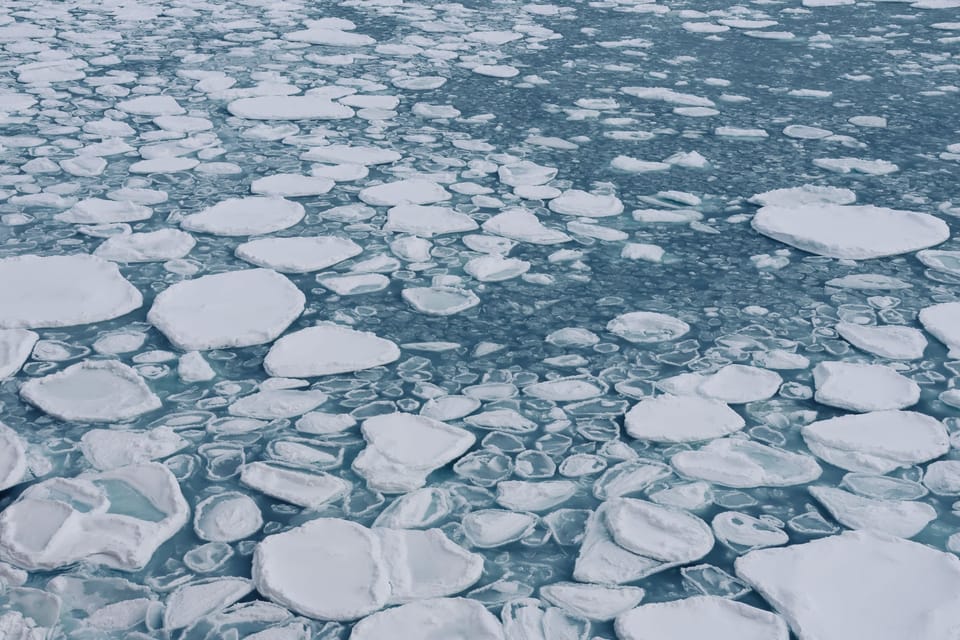
Across the freezing surface of the Southern Ocean, the boundary between seawater and the atmosphere is rarely an unbroken sheet of white. Wind and ocean swells fracture freezing water into distinct floes, creating a surface where bare frozen brine sits directly alongside deep drifts of snow. In the marginal ice zone, the outer band of ocean where ocean waves break the pack into separate rafts, this uneven surface determines how much sunlight bounces back into space and how quickly heat escapes from the water beneath.
For decades, large-scale climate models have treated this complex landscape with broad approximations. Global forecasting frameworks often represent the sea ice surface as a smooth, unbroken blanket of snow throughout the winter months and strip it down to bare ice in summer.12 When sunlight reaches the surface, snow reflects the bulk of the radiation, whereas exposed ice absorbs more light and warms faster.23 At the same time, snow acts as an insulator, reducing the upward flow of heat from the relatively warm ocean into the frigid polar air and slowing ice growth underneath.23
A short physical sequence governs this exchange across polar seas. First, open ocean freezes into thin sheets and rounded pancakes, leaving exposed brine at the surface. Next, accumulating snowfall settles on the developing ice, forming an insulating barrier that slows further thermodynamic thickening from below. Finally, wave action and surface winds shuffle the pack, driving collisions that strip snow away or pile it into raised perimeters. If a computer model assumes that snow blankets every floe uniformly, it misjudges every step in that chain, miscalculating how much heat escapes through bare ice and how much sunlight reflects off snowdrifts.
In a preprint posted on the arXiv server, a research team led by Ippolita Tersigni at the University of Melbourne reported that snow cover on Antarctic sea ice remains persistently heterogeneous across all seasons.12 The authors found that this fine-scale variation does not depend directly on total ice concentration.1 When researchers incorporate this patchy distribution into surface energy calculations, the resulting energy exchanges diverge systematically from the values produced by uniform-surface assumptions.1
Why does snow cover remain uneven across the ice pack?
Snow distribution across the Southern Ocean is governed by ice morphology and the physical motion of individual floes rather than simple ice coverage.1 When new sea ice forms, wave action churns young pancake ice, creating unstable, wet floe surfaces where snow struggles to settle.2 As ocean swells push ice floes together, collisions push loose snow toward the outer rims of the floes, creating thick ridges at the edges while leaving the centers comparatively bare.2 In rough seas, breaking waves can wash entirely over small floes, stripping away accumulated snow even when sea ice covers almost the entire ocean surface.2
Alessandro, a researcher on the project, told Primary that these surface patterns reflect the complex developmental history of the ice pack. "Even where the ice was fully compacted, stretching unbroken for kilometres, the snow on top of it was never uniform," Alessandro said in response to questions from Primary. "Standing on deck, you could see patches of ice almost completely bare right next to areas nearly buried in snow, even though the ice cover itself looked continuous and solid."
Alessandro explained that the study was designed to measure the cumulative outcome of these physical forces rather than dissect each mechanism in isolation. "We didn't isolate collisions from wind-driven drift in this study," Alessandro said. "Our cameras could map where the snow ended up on each floe, but not pin every pattern to one specific cause. Floe collisions and wave motion are well known to push snow toward floe edges, and wind can do the same, or strip it away entirely. What we're showing is the combined result of all these processes: the fine-scale patchiness itself."
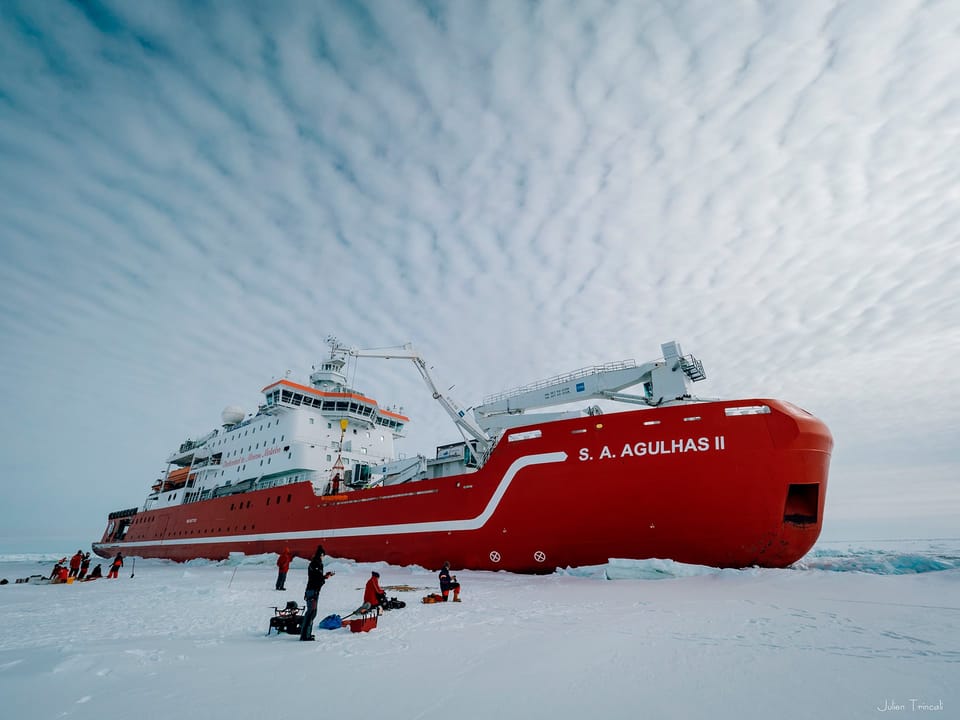
Using visual observations, atmospheric data, and close-range imagery gathered across five research voyages between 2019 and 2024, the researchers tracked surface states in the Atlantic and Indian sectors of the Southern Ocean.12 The expeditions deployed the icebreaker S.A. Agulhas II into the eastern Weddell Sea during the winters of 2019 and 2022 and the spring of 2019, alongside voyages by RSV Nuyina into East Antarctic waters during the late summer and spring of 2024.2
How did researchers map the fine-scale texture of sea ice?
Shipborne digital cameras and thermal infrared sensors mounted on the vessels recorded continuous imagery of the passing ice field.2 To analyze the high-resolution visible images, Tersigni and colleagues applied the Segment Anything Model, an image-segmentation artificial intelligence framework, to distinguish ice floes from open water.2 Within each isolated floe, grayscale thresholds separated bare ice from snow cover.2 The team validated these fractional snow measurements against synchronized multispectral camera data collected aboard RSV Nuyina, recording a root mean square error of 10.7% and a mean bias of 1.2%.2
The resulting measurements showed that fractional snow cover followed multimodal probability distributions across the marginal ice zone.2 In winter conditions across the eastern Weddell Sea, a dominant mode appeared with less than 10% snow coverage on young, consolidating ice, coexisting with intermediate modes near 60% and high-snow modes near 100% on thicker consolidated floes.2 Because standard models assume uniform snow across all ice types, they miscalculate both the surface albedo, which reflects roughly 80% of incoming solar radiation over dry snow, and the conductive heat flux passing through the ice column.23
Alessandro noted that these split distributions confirmed qualitative observations made during field expeditions over several years. "The multimodal distributions weren't a surprise in the sense of overturning an assumption," Alessandro said. "They were the first time we could put hard numbers on something we'd been seeing in the field for years, and show that it wasn't just noise, but a structured, partitioned pattern tied to ice development and accumulation history."
When these segmented observations were fed into thermodynamic equations, the calculated energy balance shifted dramatically.1 "When snow and bare ice sit side by side like that, a model that treats the whole area as uniformly snow-covered or uniformly bare misses that mix entirely," Alessandro said. "In winter, the bare patches let more heat escape than expected, so assuming full snow cover underestimates heat loss. In summer, it's the opposite: even small leftover patches of snow reflect enough sunlight that assuming bare ice overestimates how much energy is available for melting. In our data, that added up to roughly a 20% underestimation of winter heat loss and a 40% overestimation of summer energy gain, on average."
What limits the reach of these findings?
These findings reflect observations from two specific sectors of the Southern Ocean and do not provide a global forecast of polar sea ice volume.1 The calculations rely on bulk thermodynamic formulations and shipborne optical sensors that record two-dimensional surface fractions rather than fully resolved three-dimensional snow internal stratigraphy across entire ice basins.25 Furthermore, the dataset does not cover the autumn freezing transition, leaving open questions about how snow accumulates during the earliest stages of seasonal ice formation. The study is a preprint posted to the arXiv repository and has not yet undergone peer review.2
Alessandro cautioned against assuming that identical quantitative relationships exist across all polar regions. "Our observations come from the eastern Weddell Sea and East Antarctica, and even between those two regions we found quite different behaviour, particularly in spring," Alessandro said. "In the Weddell Sea, snow cover tended to increase as the ice consolidated, while in East Antarctica we still found very little snow even on compact, thick ice. That tells us regional differences in snowfall, wind, and how the ice develops can strongly change the pattern."
Even so, the presence of persistent sub-grid heterogeneity suggests that climate and weather forecasting models require refined parameterizations for snow on Antarctic sea ice.1 Operational centers have begun testing updated schemes that capture partial snow cover across grid cells, recognizing that ice growth and seasonal melt cannot be accurately projected through uniform approximations. Future field campaigns that link surface optical mapping with subsurface snow density measurements will be essential for resolving how snow redistribution governs the long-term stability of the Antarctic cryosphere.
This piece was prepared from the arXiv preprint and public records together with answers from Alessandro to 7 questions from the Primary news team, completed September 2026.
The record
45 sentences trace to 4 sources and 1 contributor.
-
1
IT
 Ippolita Tersigni, Filippo Nelli, Emiliano Cimoli, Marcello Vichi, Petra Heil, Luke G. Bennetts, Giulio Passerotti, Alberto Alberello, Alessandro Toffoli
Paper
· arxiv.org · 25 Aug 2026
Fine-Scale Heterogeneity of Snow Cover in the Antarctic Marginal Ice Zone
Preprint · may not have been peer reviewed
See the source
-
2
A
arxiv.org
Paper
· arxiv.org
Fine-Scale Heterogeneity of Snow Cover in the Antarctic Marginal Ice Zone
Preprint · may not have been peer reviewed
See the source
- 3 Effects of the snow cover on Antarctic sea ice and potential modulation of its response to climate change | Annals of Glaciology | Cambridge Core See the source
- 4 Contribution — Alessandro 27 statements added to this article
- 5 Variability of Snow over Antarctic late summer sea ice on different spatial scales See the source
Other consulted pages2 pages
cambridge.org3 pages
- Snow-ice accretion and snow-cover depletion on Antarctic first-year sea-ice floes | Annals of Glaciology | Cambridge Core
- Spatially distributed simulations of the effect of snow on mass balance and flooding of Antarctic sea ice | Journal of Glaciology | Cambridge Core
- Interannual and regional variability of Southern Ocean snow on sea ice | Annals of Glaciology | Cambridge Core
Article history
-
Published 18 Nov 2026, 21:38Assembled by the Primary desk from 4 sources · 1 contributor · 45 cited sentences
-
Alessandro, a researcher on the project
- Go to the sentence: The authors found that this fine-scale variation does not depend directly on total ice concentration.
- Go to the sentence: When researchers incorporate this patchy distribution into surface energy calculations, the resulting energy exchanges diverge systematically from the values produced by uniform-surface assumptions.
- Go to the sentence: When new sea ice forms, wave action churns young pancake ice, creating unstable, wet floe surfaces where snow struggles to settle.
- Go to the sentence: As ocean swells push ice floes together, collisions push loose snow toward the outer rims of the floes, creating thick ridges at the edges while leaving the centers comparatively bare.
- Go to the sentence: In rough seas, breaking waves can wash entirely over small floes, stripping away accumulated snow even when sea ice covers almost the entire ocean surface.
- Go to the sentence: Alessandro, a researcher on the project, told Primary that these surface patterns reflect the complex developmental history of the ice pack.
- Go to the sentence: "Even where the ice was fully compacted, stretching unbroken for kilometres, the snow on top of it was never uniform," Alessandro said in response to questions from Primary.
- Go to the sentence: "Standing on deck, you could see patches of ice almost completely bare right next to areas nearly buried in snow, even though the ice cover itself looked continuous and solid."
- Go to the sentence: Alessandro explained that the study was designed to measure the cumulative outcome of these physical forces rather than dissect each mechanism in isolation.
- Go to the sentence: "We didn't isolate collisions from wind-driven drift in this study," Alessandro said.
- Go to the sentence: "Our cameras could map where the snow ended up on each floe, but not pin every pattern to one specific cause. Floe collisions and wave motion are well known to push snow toward floe edges, and wind can do the same, or strip it away entirely. What we're showing is the combined result of all these processes: the fine-scale patchiness itself."
- Go to the sentence: The expeditions deployed the icebreaker S.A. Agulhas II into the eastern Weddell Sea during the winters of 2019 and 2022 and the spring of 2019, alongside voyages by RSV Nuyina into East Antarctic waters during the late summer and spring of 2024.
- Go to the sentence: Within each isolated floe, grayscale thresholds separated bare ice from snow cover.
- Go to the sentence: The team validated these fractional snow measurements against synchronized multispectral camera data collected aboard RSV Nuyina, recording a root mean square error of 10.7% and a mean bias of 1.2%.
- Go to the sentence: The resulting measurements showed that fractional snow cover followed multimodal probability distributions across the marginal ice zone.
- Go to the sentence: Alessandro noted that these split distributions confirmed qualitative observations made during field expeditions over several years.
- Go to the sentence: "The multimodal distributions weren't a surprise in the sense of overturning an assumption," Alessandro said.
- Go to the sentence: "They were the first time we could put hard numbers on something we'd been seeing in the field for years, and show that it wasn't just noise, but a structured, partitioned pattern tied to ice development and accumulation history."
- Go to the sentence: When these segmented observations were fed into thermodynamic equations, the calculated energy balance shifted dramatically.
- Go to the sentence: "When snow and bare ice sit side by side like that, a model that treats the whole area as uniformly snow-covered or uniformly bare misses that mix entirely," Alessandro said.
- Go to the sentence: "In winter, the bare patches let more heat escape than expected, so assuming full snow cover underestimates heat loss. In summer, it's the opposite: even small leftover patches of snow reflect enough sunlight that assuming bare ice overestimates how much energy is available for melting. In our data, that added up to roughly a 20% underestimation of winter heat loss and a 40% overestimation of summer energy gain, on average."
- Go to the sentence: These findings reflect observations from two specific sectors of the Southern Ocean and do not provide a global forecast of polar sea ice volume.
- Go to the sentence: Furthermore, the dataset does not cover the autumn freezing transition, leaving open questions about how snow accumulates during the earliest stages of seasonal ice formation.
- Go to the sentence: Alessandro cautioned against assuming that identical quantitative relationships exist across all polar regions.
- Go to the sentence: "Our observations come from the eastern Weddell Sea and East Antarctica, and even between those two regions we found quite different behaviour, particularly in spring," Alessandro said.
- Go to the sentence: "In the Weddell Sea, snow cover tended to increase as the ice consolidated, while in East Antarctica we still found very little snow even on compact, thick ice. That tells us regional differences in snowfall, wind, and how the ice develops can strongly change the pattern."
- Go to the sentence: Even so, the presence of persistent sub-grid heterogeneity suggests that climate and weather forecasting models require refined parameterizations for snow on Antarctic sea ice.