Turmeric compound protects brewer yeast during high sugar fermentation
Curcumin shields yeast cells from severe osmotic pressure and sustains alcohol production by activating a protective molecular relay.
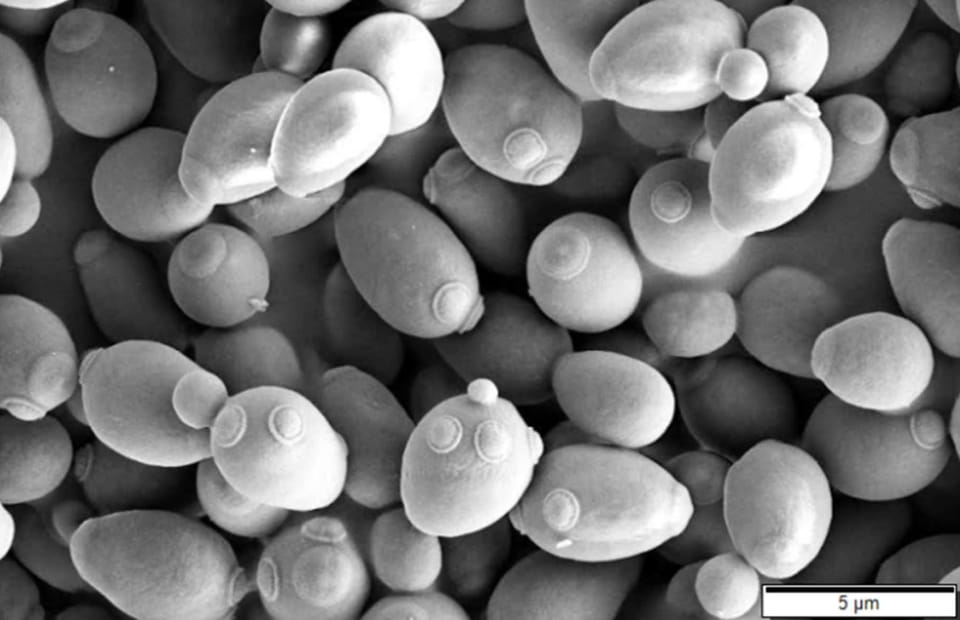
High concentrations of sugar are both the fuel for fermentation and an immediate physical hazard for the single-celled fungi tasked with consuming them. In wine vats, distilling tanks, and industrial biofuel fermenters, brewing yeast must operate within an environment dense with dissolved carbohydrates. Yeast cells placed in thick sugar syrups encounter acute osmotic pressure, a physical imbalance that pulls water outward across the cellular membrane, threatening to collapse the cell wall and halt metabolism before alcohol production can proceed.
Industrial fermentations frequently stall when sugar levels rise too high, leaving unfermented residues, wasting feedstocks, and lowering overall yields. Microbes possess biochemical circuits to survive environmental shocks, but mounting an emergency defence requires energy. When cells spend their internal resources repairing damaged membranes or countering desiccation, fermentation slows. Finding non-toxic ways to shield yeast from physical distress without disrupting the final product remains a central challenge for commercial fermentation.
Surviving severe osmotic stress demands a precise sequence of cellular events. First, the cell must perceive the sudden rise in external solute concentration across its outer membrane. Second, this physical tension must be converted into a chemical message, relayed through specialized signalling enzymes inside the cytoplasm. Third, that relay must enter the cell nucleus to switch on protective genes that reinforce the external cell wall and adjust internal osmolyte pools. Finally, the cell must redirect its metabolism away from wasting resources on non-essential breakdown and toward cellular maintenance, allowing sugar conversion to continue smoothly.
How does turmeric alter yeast fermentation?
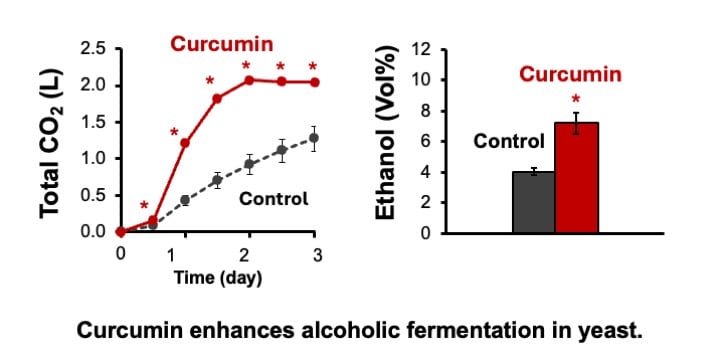
Curcumin, the primary bioactive compound found in common turmeric, significantly boosts alcoholic fermentation in the budding yeast Saccharomyces cerevisiae by fostering stress adaptation, according to a preprint posted on bioRxiv by Y. Nakase and colleagues.1 The researchers discovered that adding the spice metabolite helped yeast survive and ferment efficiently even under extreme sugar loads ranging from 20% to 40% glucose, conditions that typically impose debilitating osmotic stress on the microorganisms.1
The protective boundary of this rescue remains an open research question. Asked about the boundaries of this sugar tolerance, Yukiko told Primary that "we have not yet determined the upper sugar concentration at which curcumin loses its protective effect."
The study also examined piperine, the primary pungent component of black pepper, and reported that both plant secondary metabolites stimulated alcoholic fermentation in budding yeast.1 Spices produce these secondary chemical constituents in nature to mediate interactions with environmental microbes and provide antioxidant and antimicrobial defences.1 In the context of dense sugar broths, however, the presence of curcumin altered how fungal cells managed the surrounding physical pressure, enhancing overall cell growth rather than repressing it.1
Whether black pepper extract operates along identical biological paths is not yet settled. "We do not yet know whether piperine enhances fermentation through the same Hog1-dependent mechanism as curcumin," Yukiko said in response to questions from Primary, adding that the research group is interested in comparing cellular responses to both compounds to clarify whether they share a stress-adaptation route or act through distinct pathways.
Under these heavy glucose concentrations, yeast supplied with curcumin exhibited noticeably greater resistance to osmotic stress along with enhanced tolerance to enzymatic digestion of their cell walls.1 The researchers reported that these physiological protections allowed the fungal population to sustain higher growth rates during active fermentation, suggesting changes in cell-wall or cell-surface properties.
The physical basis for that surface defence is still under active investigation. Yukiko said that "our current data do not yet demonstrate that curcumin physically integrates into the yeast cell wall," noting that observed resistance to the digestive enzyme Zymolyase indicates altered surface properties that could stem from internal cellular remodelling. Direct visual confirmation using microscopy after washing will be needed to verify whether curcumin physically lodges within the yeast cell wall.
Which genetic pathway enables the protective effect?
The protective action of curcumin depends entirely on the high-osmolarity glycerol signalling cascade, commonly known as the HOG pathway.1 In yeast, this biochemical route acts as the primary emergency network for surviving osmotic shock, governed by a key regulatory protein kinase called Hog1.1 When Nakase and colleagues evaluated a mutant strain of yeast carrying a deletion of the HOG1 gene, the fermentation-boosting benefits of curcumin vanished completely, demonstrating that a functional Hog1 kinase is strictly required for the compound to work.1
That requirement, however, might not explain every action the botanical compound exerts on the fungus. Yukiko said that while Hog1 is essential for boosting fermentation under the tested conditions, "this does not necessarily mean that every cellular effect of curcumin is Hog1-dependent." The researchers are investigating whether curcumin also engages in a Hog1-independent physical association with the cell surface.
To trace the molecular mechanics involved, the research team conducted transcriptomic profiling alongside quantitative reverse-transcription polymerase chain reaction assays, measuring how messenger RNA levels shifted inside the cells.1 These analyses confirmed that curcumin treatment elevated the expression of several stress-adaptation genes, specifically those regulated downstream of the HOG pathway.1 Rather than implying direct or early activation of this circuit, the compound is better described as coinciding with HOG-linked gene expression that may help yeast cope with ongoing osmotic hardship.
This genetic response was accompanied by a clear shift in how the cells managed nutrients. At 12 hours after the initiation of fermentation, the expression of genes responsible for catabolizing amino acids dropped markedly in cells treated with curcumin.1 Metabolomic analyses performed at 24 hours confirmed that intracellular concentrations of amino acids, including glutamate and asparagine, remained elevated. Rather than treating amino-acid conservation as a demonstrated mechanism, the transcriptomic and metabolomic observations are an interpretation that the cells retained these nitrogen-rich building blocks rather than breaking them down for immediate fuel.
Yukiko said that "what surprised me most was the consistency between the transcriptomic and metabolomic results," explaining that while the cells accumulated glutamate and asparagine alongside lowered catabolic gene expression, it remains unproven whether the cells intentionally conserve those reserves. Future work could examine whether nutrient-sensing complexes like TORC1 coordinate these metabolic shifts during fermentation.
What are the limits of the current findings?
These findings represent laboratory observations from a single experimental study posted to a preprint server, and the research has not yet undergone formal peer review. The experiments were conducted under controlled culturing conditions using defined glucose concentrations and purified botanical extracts, which cannot fully replicate the variable nutrient mixes, fluctuating temperatures, and complex microbial pressures present in commercial brewing or industrial bioethanol refineries. Furthermore, while the data demonstrate that the Hog1 enzyme is required for curcumin to promote fermentation, wording that assumes a specific physical binding target or that curcumin directly initiates HOG signalling is avoided because those mechanisms remain unresolved.
Yukiko told Primary that "at this stage, we do not have a specific membrane protein that we can identify as a direct binding target of curcumin." Curcumin might interact broadly across the cell surface or lipid bilayer to influence membrane-localized stress sensors, rather than docking into a single receptor protein.
Whether adding spice compounds is economically viable at an industrial scale also remains unexamined, as large-scale fermenters process thousands of litres of material where additive costs and residue filtration present logistical hurdles. Flavour impacts also need thorough evaluation before such additives could be deployed in beverage production, where residual polyphenols could alter taste profiles.
Future work will need to test whether related botanical polyphenols trigger similar stress pathways, and whether brewer strains adapted to specific grains react with the same metabolic shift. For now, the study provides a clean demonstration of how a dietary secondary metabolite can interface with conserved stress-response machinery, turning an environmental challenge into a sustained metabolic run.
The record
22 sentences trace to 1 source and 1 contributor.
-
1
NY
 Nakase, Y., Kim, S., Sakaue, K., Sugimoto, Y., Seike, T., Watanabe, M., Tohge, T., Morozumi, Y., Watanabeb, D.
Paper
· biorxiv.org · 13 Sep 2026
Curcumin Enhances Alcoholic Fermentation in Yeast by Promoting Osmotic Stress Adaptation
Preprint · may not have been peer reviewed
See the source
- 2 Contribution — Yukiko 15 statements added to this article
Other consulted pages1 page
intechopen.com1 page
preprints.epiforecasts.io1 page
Article history
-
Published 18 Nov 2026, 18:05Assembled by the Primary desk from 1 source · 1 contributor · 22 cited sentences
-
Yukiko
- Go to the sentence: The researchers discovered that adding the spice metabolite helped yeast survive and ferment efficiently even under extreme sugar loads ranging from 20% to 40% glucose, conditions that typically impose debilitating osmotic stress on the microorganisms.
- Go to the sentence: Asked about the boundaries of this sugar tolerance, Yukiko told Primary that "we have not yet determined the upper sugar concentration at which curcumin loses its protective effect."
- Go to the sentence: The study also examined piperine, the primary pungent component of black pepper, and reported that both plant secondary metabolites stimulated alcoholic fermentation in budding yeast.
- Go to the sentence: "We do not yet know whether piperine enhances fermentation through the same Hog1-dependent mechanism as curcumin," Yukiko said in response to questions from Primary, adding that the research group is interested in comparing cellular responses to both compounds to clarify whether they share a stress-adaptation route or act through distinct pathways.
- Go to the sentence: Under these heavy glucose concentrations, yeast supplied with curcumin exhibited noticeably greater resistance to osmotic stress along with enhanced tolerance to enzymatic digestion of their cell walls.
- Go to the sentence: Yukiko said that "our current data do not yet demonstrate that curcumin physically integrates into the yeast cell wall," noting that observed resistance to the digestive enzyme Zymolyase indicates altered surface properties that could stem from internal cellular remodelling.
- Go to the sentence: Direct visual confirmation using microscopy after washing will be needed to verify whether curcumin physically lodges within the yeast cell wall.
- Go to the sentence: When Nakase and colleagues evaluated a mutant strain of yeast carrying a deletion of the HOG1 gene, the fermentation-boosting benefits of curcumin vanished completely, demonstrating that a functional Hog1 kinase is strictly required for the compound to work.
- Go to the sentence: Yukiko said that while Hog1 is essential for boosting fermentation under the tested conditions, "this does not necessarily mean that every cellular effect of curcumin is Hog1-dependent."
- Go to the sentence: The researchers are investigating whether curcumin also engages in a Hog1-independent physical association with the cell surface.
- Go to the sentence: At 12 hours after the initiation of fermentation, the expression of genes responsible for catabolizing amino acids dropped markedly in cells treated with curcumin.
- Go to the sentence: Yukiko said that "what surprised me most was the consistency between the transcriptomic and metabolomic results," explaining that while the cells accumulated glutamate and asparagine alongside lowered catabolic gene expression, it remains unproven whether the cells intentionally conserve those reserves.
- Go to the sentence: Future work could examine whether nutrient-sensing complexes like TORC1 coordinate these metabolic shifts during fermentation.
- Go to the sentence: Yukiko told Primary that "at this stage, we do not have a specific membrane protein that we can identify as a direct binding target of curcumin."
- Go to the sentence: Curcumin might interact broadly across the cell surface or lipid bilayer to influence membrane-localized stress sensors, rather than docking into a single receptor protein.