Giant telescopes learn to map blurred starlight using hardware logs
Astronomers will soon reconstruct complex optical distortions on deep-space exposures without hunting for reference stars, unlocking pristine views of distant infant galaxies.
Starlight travels across billions of light years in undisturbed straight lines, only to encounter the turbulent atmosphere of Earth in the final milliseconds before striking a telescope mirror. Pockets of warm and cold air constantly churn, refracting and scattering incoming light waves. The result is that a point-like celestial object never arrives on a camera detector as an infinitely small dot. Instead, optical diffraction and atmospheric turmoil spread the arriving photons into an irregular pattern known as a point spread function.12 For ground-based observatories, understanding the exact contour of that smeared pattern is essential for separating genuine cosmic structures from optical noise.
On giant telescopes, this optical blur behaves in an unusual manner that complicates astronomical measurements.1 Modern observatories employ adaptive optics, using flexible mirrors that change shape thousands of times every second to cancel out atmospheric turbulence.2 When a telescope mirror stretches nearly 40 meters across, this correction concentrates light into an extremely sharp core surrounded by an expansive, diffuse halo of uncorrected light. For an astronomer attempting to measure the true brightness or physical size of a faint infant galaxy, the extended halo presents a serious obstacle.1 If the exact profile of the starlight blur remains unknown, distinguishing where a faint galactic disk ends and where scattered starlight begins becomes nearly impossible.1
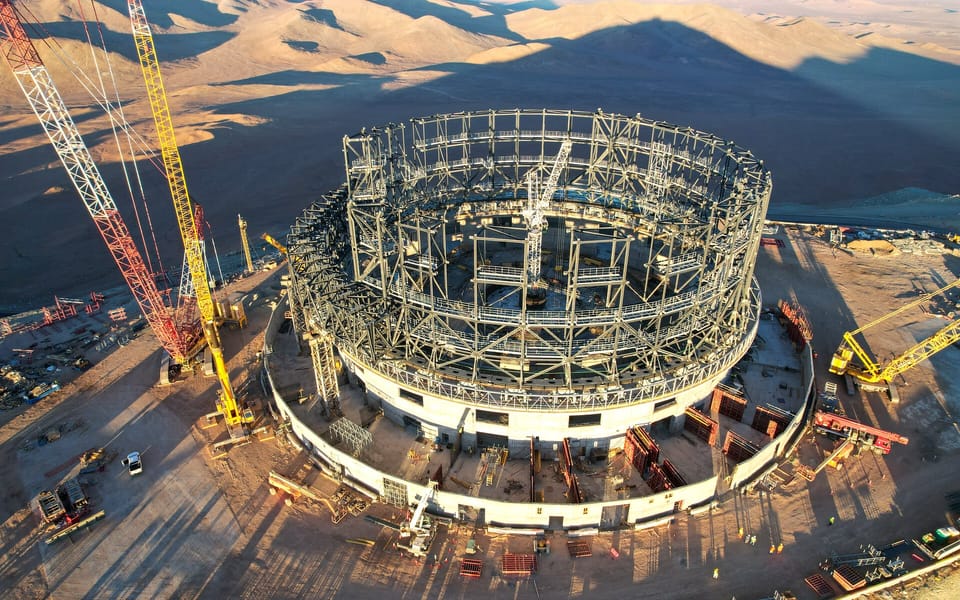
In an arXiv preprint posted in September 2026, Andrea Grazian of the National Institute for Astrophysics in Padua, Italy, and colleagues across Europe outline a software system built to solve this challenge for the Multi-AO Imaging Camera for Deep Observations, known as MICADO. The instrument will serve as a first-light camera and spectrograph on the European Southern Observatory's Extremely Large Telescope, currently under construction in the Atacama Desert of northern Chile.21 Grazian and his collaborators report that their pipeline can reconstruct the telescope's point spread function purely from internal engineering logs recorded during observations, bypassing the need to search science images for bright reference stars.23
To understand why this reconstruction is necessary, consider what happens to light between the upper atmosphere and the camera sensor. Starlight first strikes descending layers of turbulent air with varying temperatures and densities. These shifting air pockets slow down different sections of an incoming light wave at unequal rates, warping a flat sheet of light into a wrinkled surface. As this wrinkled wave enters the telescope, sensitive sensors measure its local slopes across the mirror aperture.2 A real-time control computer interprets these readings and instructs motorized actuators behind a deformable mirror to push and pull against the wave, flattening its ripples.2 Yet this mechanical correction is never perfect: fine-scale ripples slip past the actuators, sensor noise introduces false adjustments, and tiny mechanical tremors in the telescope mount shake the optical path.2 All these residual imperfections combine to mold the final pattern of starlight into its smeared core and halo.1
Astronomers study distant objects that often sit in sparse patches of deep space where no bright reference stars exist. In standard astronomical images, researchers measure the point spread function empirically by locating an isolated, bright star in the field and treating its shape as an accurate mold of the optical blur. However, earlier studies on the MICADO work package, led by Matteo Simioni at the Padua Astronomical Observatory, revealed that between 35 percent and 40 percent of deep extragalactic target fields contain no point sources suitable for this traditional calibration. Without an empirical star to measure, astronomers must either guess the shape of the optical blur or rely on computational models derived from the instrument itself.1
Andrea explained the physical boundaries behind this calibration gap in response to questions from Primary. The magnitude limit for the single-conjugate adaptive optics module of MICADO is 16 magnitudes in the R band filter under the AB photometric system. Because the camera operates across a field of view measuring one arcminute by one arcminute, this restricted search area means that more than a third of target pointings lack any star luminous enough to serve as an optical reference.
Why does extreme telescope scale complicate image calibration?
The enormous aperture of the Extremely Large Telescope fundamentally alters the proportion of light distributed between the sharp central core of an image and its surrounding halo.1 In a descriptive paper on the instrument work package, Matteo Simioni and coauthors calculated that the central core of the telescope's point spread function will be approximately five times narrower in diameter than that produced by existing eight-meter telescopes. Because light concentrates so intensely into this needle-sharp center, the surface brightness of the diffuse halo falls by a factor of roughly 25 compared with current instruments.
While an intensely sharp core provides unprecedented resolving power, the faintness and breadth of the halo present an analytical trap. The same work package report noted that the halo expands to roughly five times the physical diameter seen on eight-meter telescopes, causing halos from neighboring celestial sources to merge into a smooth background veil. For faint stars and distant galaxies, the first ring of diffraction emerges as a prominent feature, while the broader halo vanishes below the sensitivity limit of standard detectors.1 If astronomers do not know the proportion of energy captured by the core relative to the unseen halo, measurements of an object's total brightness suffer systematic errors.1
According to project design documents, the single-conjugate adaptive optics system is engineered to deliver a point spread function with a Strehl ratio of up to 60 percent in the near-infrared K-band under median atmospheric turbulence conditions, with a design goal of 70 percent when pointing near a bright guide star. The Strehl ratio expresses the peak brightness of an observed star as a percentage of the theoretical maximum for a flawless optical system.2 Simioni and his team noted that when observing conditions degrade, the achieved Strehl ratio falls, causing a larger fraction of total starlight to spill out of the core and into the faint halo.1
Andrea told Primary that while the turbulence parameters defining image quality include wind speed, wind direction, and the vertical turbulence profile across atmospheric layers, the baseline Strehl ratio of 60 percent in the K band depends primarily on hardware design and guide star brightness, with environmental fluctuations acting as secondary factors.
How can engineering telemetry reconstruct the path of light?
Telemetry data generated by the adaptive optics control loop can supply all the physical parameters required to mathematically reconstruct the optical blur without inspecting the scientific image.21 Rather than searching for a reference star on the detector, the software developed by Grazian and colleagues exploits a mathematical formulation originally established in 1997 by Jean-Pierre Véran and collaborators on the Canada-France-Hawaii Telescope.23 This approach splits the optical transfer function, which describes how an optical system filters spatial details, into distinct components that can be evaluated independently from recorded hardware signals.21
The software architecture divides the incoming wave disturbances into frequency modes that the adaptive optics system actively measures and corrects, and higher-frequency modes that fall outside the hardware correction limits.23 Wavefront sensors and deformable mirror actuators record real-time measurements that feed directly into equations calculating the corrected phase structure function.2 Meanwhile, statistical models of atmospheric turbulence supply the structure function for the uncorrected high-frequency phase ripples that the mirror cannot smooth.2
Addressing how unmeasured turbulence is handled, Andrea told Primary that the instrument can correct only within a specific frequency band set by its physical design. Outside this range, the software measures disturbances within the accessible frequency window and extrapolates outward by assuming a von Karman distribution, using established statistical equations to model how turbulence moves through the air column. In an earlier paper on the pipeline, the team showed that these separate terms are multiplied together alongside the inherent diffraction pattern of the telescope aperture and corrections for directional differences across the sky.
Non-atmospheric disturbances that distort the final image must also enter the calculation as separate corrections.21 Imperfections along the optical path between the adaptive optics sensor and the scientific detector, known as non-common path aberrations, escape real-time sensing because the sensor never sees them.21 Mechanical vibrations from telescope cooling pumps, motors, and wind buffeting similarly introduce blur that operates independently of the wavelength of observed light.12 The software pipeline accounts for these physical effects by integrating dedicated calibration maps derived from laboratory bench tests and instrument sensors into the final reconstructed blur pattern.1
Grazian and colleagues structured this reconstruction framework into five separate software recipes managed by the ESO Data Processing System, an automated pipeline coordinator.2 In the preprint, the authors report that software development for the single-conjugate adaptive optics pipeline currently stands at 70 percent completion.23 Three of the five core recipes, covering the corrected modes, the uncorrected high-frequency modes, and the final combination module, have already been implemented and executed within the processing system.2 A fourth recipe modeling telescope-specific optical transfer terms is nearing completion, while the fifth recipe dedicated to non-adaptive optics effects awaits final calibration measurements from the MICADO laboratory bench.2
Andrea told Primary that measurements of non-common path aberrations will rely on dedicated calibration images collected on the laboratory bench near the end of 2028, followed by routine on-sky calibrations near the end of 2030. These records will use standard astronomical image files and will be analyzed through specialized recipes written in C code before joining the primary instrument software release after first light.
How accurately does the algorithm capture real starlight?
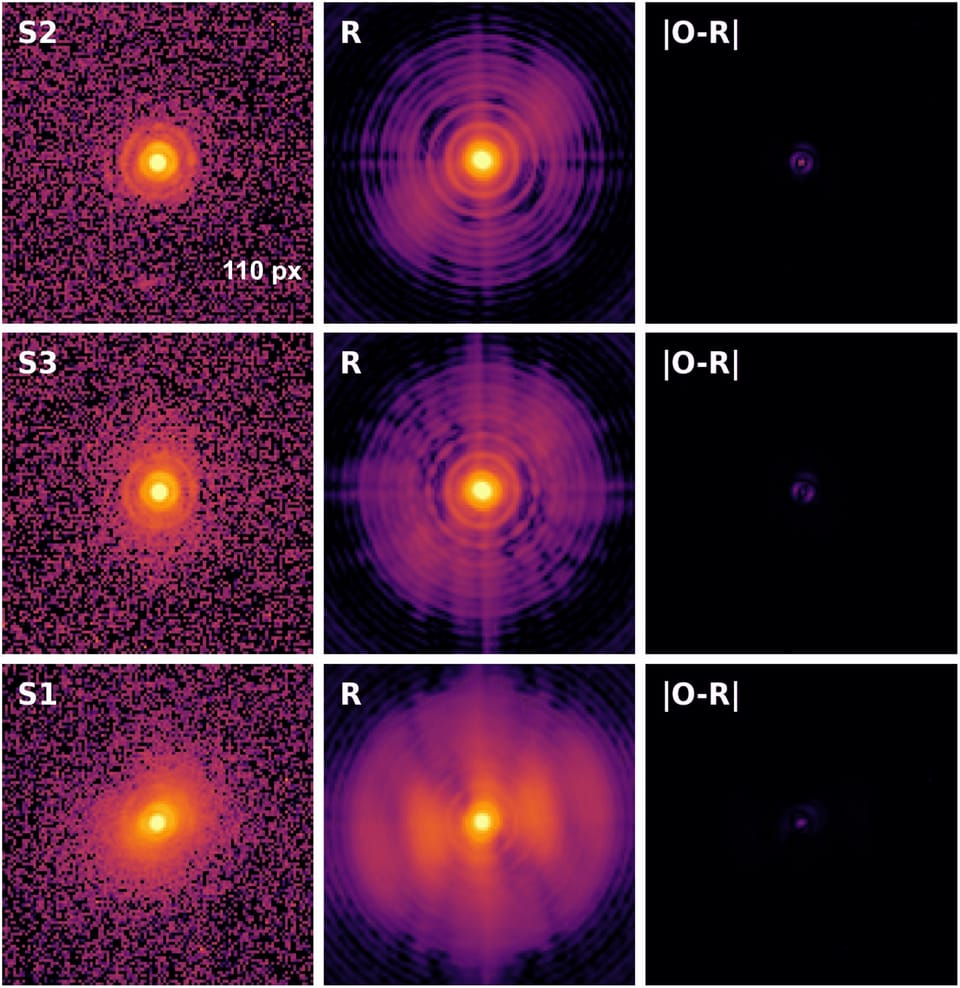
Test runs on real telescope telemetry demonstrate that the reconstruction software predicts the shape of starlight with percent-level precision for sources aligned with the guide star.23 Grazian and colleagues validated their algorithms using telemetry captured by the ERIS instrument on the Very Large Telescope in Chile, analyzing light from a bright three-star asterism.23 The authors report that for the on-axis star, the software reconstructed key image metrics within an accuracy of 1 to 5 percent compared with the actual observed starlight.23 These metrics included the Strehl ratio, which quantifies image quality as a percentage of theoretical perfection, the full width at half maximum of the core, the encircled energy within the central core, and the half-light radius.2
Andrea said in response to questions from Primary that the half-light radius and the Strehl ratio proved the most challenging parameters to match during these test runs. Because the image core spans only a few pixels across the detector, even an extremely minor physical discrepancy between the observed starlight and the reconstructed model produces a noticeable percentage error in both values.
As distance from the central guide star increases, optical performance naturally degrades because light passes through different columns of turbulent air.2 In their preprint, Grazian and colleagues state that validation tests across the field of view yielded an accuracy of 5 to 20 percent for off-axis stars.23 These results match the target specifications outlined in earlier project descriptions, which established an error budget of plus or minus 2 percent on-axis and plus or minus 10 percent off-axis for Strehl ratio under nominal operating conditions. In simulated tests mimicking extreme atmospheric turbulence or faint guide stars, the acceptable error margin expands to plus or minus 10 percent on-axis and plus or minus 20 percent off-axis.
Simulations conducted by the research group show that this level of off-axis precision remains viable for core extragalactic science goals.25 Andrea noted that in initial modeling of compact star-forming regions within galaxies at cosmic noon, situated around redshift 2, the software accurately recovered galaxy shapes out to 30 arcseconds from the guide star in the K band, spanning the entire camera field of view.
The reported validation results reflect specific observational conditions and do not guarantee identical accuracy across every possible night on the mountain.2 Grazian and colleagues posted their findings as a preprint that has not yet undergone formal peer review.23 Furthermore, the performance figures derived from eight-meter telescopes depend on the assumption that atmospheric turbulence profiles and instrument vibration levels behave predictably during an exposure.2 A sudden gust of wind, rapid changes in high-altitude turbulence layers, or uncalibrated mechanical resonance within the telescope frame could introduce wavefront errors that the current mathematical model cannot fully isolate from telemetry alone.2
Andrea told Primary that the software is expected to struggle under severe atmospheric turbulence, particularly when the Strehl ratio on the guide star drops substantially below 5 percent. The research team is currently conducting dedicated observations with the Very Large Telescope to define these performance boundaries more rigorously.2
Without a dependable point spread function, analyzing the clumpy internal structures of distant galaxies observed during the early universe introduces severe systematic uncertainties in stellar mass and size estimates.52 Grazian and colleagues noted that simulated scientific tests indicate their software achieves the precision required for rigorous morphological analysis of distant galaxies.25 By demonstrating that the optical blur can be reconstructed without finding an empirical calibration star, the tool secures the scientific utility of deep-field imaging surveys.2
The development group is preparing to expand the software beyond single-star adaptive optics toward multi-conjugate systems that utilize multiple laser guide stars.21 Future operational phases will integrate the pipeline with MORFEO, the multi-conjugate adaptive optics module that will illuminate MICADO's full field of view.3 Grazian and colleagues plan to incorporate upcoming calibration measurements from the physical MICADO laboratory bench once hardware assembly concludes, finalizing the recipe that compensates for internal optical errors and hardware vibrations before the telescope achieves first light.2
This piece was prepared from the arXiv preprint and public records together with answers from Andrea to seven questions from the Primary news team, completed September 2026.
The record
63 sentences trace to 4 sources and 1 contributor.
-
1
A
 ar5iv.labs.arxiv.org
Paper
· ar5iv.labs.arxiv.org
MICADO PSF-Reconstruction work package description
Preprint · may not have been peer reviewed
See the source
-
2
AG
 Andrea Grazian, Fernando Pedichini, Matteo Simioni, Jani Achren, Carmelo Arcidiacono, Luca Cortese, Ric Davies, Marco Gullieuszik, Johanna Hartke, Hanindyo Kuncarayakti, Roberto Piazzesi, Elisa Portal
Paper
· arxiv.org · 11 Sep 2026
The MICADO first light imager for the ELT: the PSF Reconstruction Software
Preprint · may not have been peer reviewed
See the source
-
3
A
arxiv.org
Paper
· arxiv.org
The MICADO first light imager for the ELT: the PSF Reconstruction Software
Preprint · may not have been peer reviewed
See the source
- 4 Contribution — Andrea 15 statements added to this article
-
5
A
arxiv.org
Paper
· arxiv.org
The MICADO first light imager for the ELT: the PSF Reconstruction Software
Preprint · may not have been peer reviewed
See the source
Other consulted pages1 page
ar5iv.labs.arxiv.org1 page
arxiv.org4 pages
spie.org1 page
Article history
-
Published 18 Nov 2026, 21:38Assembled by the Primary desk from 4 sources · 1 contributor · 63 cited sentences
-
Andrea
- Go to the sentence: However, earlier studies on the MICADO work package, led by Matteo Simioni at the Padua Astronomical Observatory, revealed that between 35 percent and 40 percent of deep extragalactic target fields contain no point sources suitable for this traditional calibration.
- Go to the sentence: Andrea explained the physical boundaries behind this calibration gap in response to questions from Primary.
- Go to the sentence: The magnitude limit for the single-conjugate adaptive optics module of MICADO is 16 magnitudes in the R band filter under the AB photometric system.
- Go to the sentence: Because the camera operates across a field of view measuring one arcminute by one arcminute, this restricted search area means that more than a third of target pointings lack any star luminous enough to serve as an optical reference.
- Go to the sentence: According to project design documents, the single-conjugate adaptive optics system is engineered to deliver a point spread function with a Strehl ratio of up to 60 percent in the near-infrared K-band under median atmospheric turbulence conditions, with a design goal of 70 percent when pointing near a bright guide star.
- Go to the sentence: Andrea told Primary that while the turbulence parameters defining image quality include wind speed, wind direction, and the vertical turbulence profile across atmospheric layers, the baseline Strehl ratio of 60 percent in the K band depends primarily on hardware design and guide star brightness, with environmental fluctuations acting as secondary factors.
- Go to the sentence: Addressing how unmeasured turbulence is handled, Andrea told Primary that the instrument can correct only within a specific frequency band set by its physical design.
- Go to the sentence: Outside this range, the software measures disturbances within the accessible frequency window and extrapolates outward by assuming a von Karman distribution, using established statistical equations to model how turbulence moves through the air column.
- Go to the sentence: Andrea told Primary that measurements of non-common path aberrations will rely on dedicated calibration images collected on the laboratory bench near the end of 2028, followed by routine on-sky calibrations near the end of 2030.
- Go to the sentence: These records will use standard astronomical image files and will be analyzed through specialized recipes written in C code before joining the primary instrument software release after first light.
- Go to the sentence: Andrea said in response to questions from Primary that the half-light radius and the Strehl ratio proved the most challenging parameters to match during these test runs.
- Go to the sentence: Because the image core spans only a few pixels across the detector, even an extremely minor physical discrepancy between the observed starlight and the reconstructed model produces a noticeable percentage error in both values.
- Go to the sentence: Andrea noted that in initial modeling of compact star-forming regions within galaxies at cosmic noon, situated around redshift 2, the software accurately recovered galaxy shapes out to 30 arcseconds from the guide star in the K band, spanning the entire camera field of view.
- Go to the sentence: Andrea told Primary that the software is expected to struggle under severe atmospheric turbulence, particularly when the Strehl ratio on the guide star drops substantially below 5 percent.
- Go to the sentence: The research team is currently conducting dedicated observations with the Very Large Telescope to define these performance boundaries more rigorously.