A flickering neutron star reveals hidden stellar pauses across snapshot radio images
Erratic pauses in radio pulses from a dead star demonstrate how missing signals can reveal hidden physics, according to observations that caught a celestial lighthouse switching off.
A pulsar is usually known for punctuality that rivals atomic clocks. As these collapsed stellar cores spin, intense beams of radio waves sweep through space like lighthouse beams, washing over terrestrial antennas with intervals measured down to milliseconds. Yet some pulsars do not maintain a steady metronome. Without warning, their radio emission drops to absolute silence for seconds, minutes, or even hours at a time, before resuming as though nothing happened. For decades, astronomers searching for these objects relied almost entirely on algorithms designed to find perfectly unbroken rhythms, leaving erratic, flickering pulsars hidden in plain sight.
Understanding how and why these cosmic lighthouses falter addresses fundamental questions about the extreme physics of neutron stars. Inside their ultra-dense magnetospheres, magnetic fields trillions of times stronger than Earth accelerates particles to near the speed of light, producing the coherent radio waves detected by observatories. When emission abruptly ceases, known to astrophysicists as nulling, the particle accelerator itself may be stalling, or the beam may be drifting out of our direct line of sight. Mapping these irregular cessations helps theorists determine whether a pulsar is exhausting its supply of relativistic plasma or reorganising its magnetic structure as it slowly ages.
To understand how an astronomer catches a star in the act of turning off, consider the path a radio signal takes from deep space to a digital detector. First, high-energy particles within the magnetic field of the spinning star produce an intense cone of radiation. Second, this sweeping beam crosses the sightline of Earth once per rotation, creating an apparent flash. Third, free electrons drifting across the interstellar medium disperse the arrival times of different radio frequencies, causing lower-frequency waves to arrive noticeably later than higher-frequency waves. Finally, if the particle cascade inside the magnetosphere flickers out, the entire sequence stops, leaving only background noise until the engine reignites. Standard search software adds together millions of individual pulses over hours to pull a weak, regular beat out of telescope noise; if the pulses vanish for extended stretches, the averaged mathematical pattern weakens or disappears completely.
A research team led by Tariq Blecher of Rhodes University and the South African Radio Astronomy Observatory has uncovered a striking example of this phenomenon, designated PSR J0052−7551, by using a fundamentally different detection method.1 Instead of combining fast time samples into a single periodicity score, the investigators searched sequential, snapshot radio pictures taken over minutes, looking for points of light that flickered like slow fireflies. The newly identified object switches between active emission and quiet nulls, spending nearly a third of its existence in complete radio silence.1
How did snapshot images reveal an intermittent stellar remnant?
Archival radio images collected by the MeerKAT telescope array in the Karoo region of South Africa captured the flickering star by registering changes in image brightness rather than tracking individual sub-second pulses.1 Between August 4 and August 5, 2019, MeerKAT observed ten adjacent sky fields on the periphery of the Small Magellanic Cloud in the L-band radio spectrum, which spans frequencies from 900 to 1670 megahertz. The telescope recorded data using an eight-second integration time, yielding a sequence of short-exposure snapshots.1 A transient detection system called TRON, developed to uncover dynamic radio sources by comparing consecutive snapshot images, searched these data cubes for residual brightness peaks that appeared and disappeared.1
In standard processing, radio astronomers average hours of observations into a single deep image to detect faint, motionless galaxies. TRON takes the opposite approach by subtracting the stable radio sky and isolating residual pictures at every eight-second time step. By filtering out spurious signals caused by bright neighbouring objects or telescope calibration drifts, the software identified a transient source at right ascension 00h 52m 43.8s and declination −75° 51′ 04″ with an astrometric uncertainty of approximately 1 arcsecond.1 The source stood out at roughly 20 times the background noise level of 9.7 microjanskys per beam, showing repeated intensity variations that recurred every 65 seconds in the eight-second snapshot data.
These fluctuations initially led the investigators to suspect they had found an ultra-long-period transient, a rare class of slowly spinning neutron star or magnetic white dwarf.1 Because the snapshot camera integrated eight seconds of light into every frame, a brief run of normal, fast pulses followed by a minute of silence averaged out to look like a single, sluggishly oscillating radio beacon. To discover what was truly happening, the observers had to examine the signal with much higher time resolution.
What makes the newly discovered pulsar turn off?
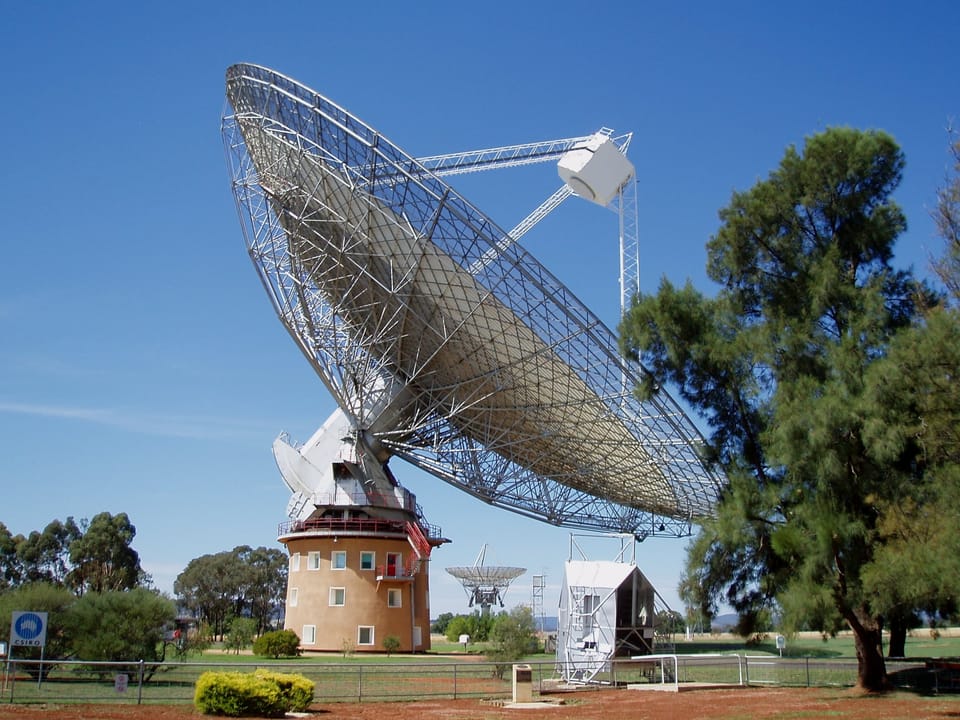
Follow-up observations with high-speed recording equipment proved that the apparent 65-second cycle was actually caused by a canonical, half-second pulsar undergoing intermittent cessation of emission. In December 2024, the researchers pointed MeerKAT back toward the coordinates using its ultra-high-frequency receiver, which observes frequencies between 580 and 1015 megahertz. Operating the array in beamformer mode, a technique that digitally combines the signals from individual dishes to synthesize a single highly sensitive detector, the team recorded data with a sampling resolution of 60 microseconds using the PTUSE backend instrument. Subsequent timing observations in August and September 2025, supported by archival and contemporary scans with the Murriyang radio telescope at the Parkes Observatory in Australia, pinned down the true properties of the star.1
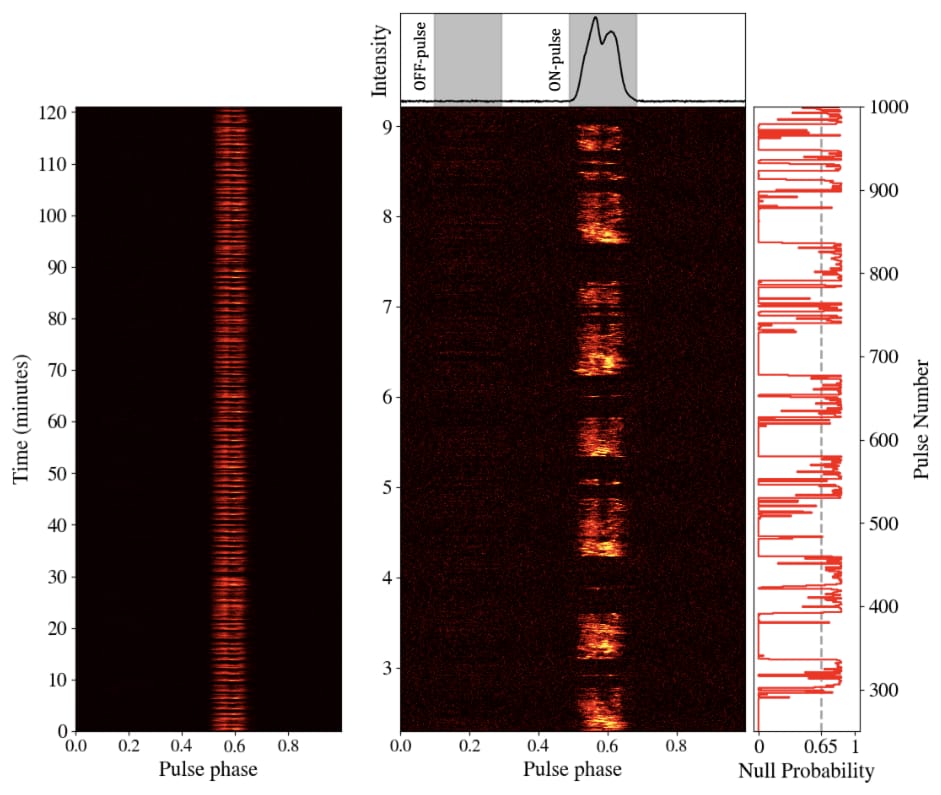
The high-speed beamformer data revealed that PSR J0052−7551 rotates once every 0.55 seconds, accompanied by a measured spin-down rate, or period derivative, of 6.1 × 10⁻¹⁷ seconds per second.1 Instead of rotating at an unusually leisurely pace, the pulsar spins at a typical rate but regularly stops emitting radio waves for spans lasting tens of seconds. To quantify this behaviour, the authors fitted the pulse intensity distribution using a statistical Gaussian Mixture Model, an approach that models data as a mixture of overlapping normal components.1 The model revealed a nulling fraction of approximately 32%, meaning the star spends about one-third of its life switched off.1 An analysis of the lengths of these off periods demonstrated that they follow an exponential distribution, confirming that the transitions into silence occur as a random, stochastic process rather than as an orderly, clockwork cycle.1
The measurements also clarified the distance and location of the star relative to the Small Magellanic Cloud, a dwarf satellite galaxy of the Milky Way. As radio waves travel through space, free electrons slow down lower frequencies more than higher ones, creating a measurable dispersion delay that directly reflects the total column of matter along the line of sight. PSR J0052−7551 exhibits a dispersion measure of 29.24 parsecs per cubic centimetre.1 Known pulsars residing inside the Small Magellanic Cloud display dispersion values between 71 and 292 parsecs per cubic centimetre, whereas standard Galactic electron density models predict a contribution of 30 to 42 parsecs per cubic centimetre from our own Milky Way in this direction.1 The newly discovered pulsar is therefore located in the outer halo of the Milky Way, lying along the foreground line of sight towards the southern dwarf galaxy rather than embedded inside it.1
What can these measurements tell us about the pulsar environment?
The observational results provide an exact timing profile and statistical description of the star's radio beam, but they cannot directly map the physical plasma conditions operating thousands of kilometres above the neutron star surface. While the analysis confirms that the duration of null states is stochastic, the data cannot distinguish whether the radio engine completely stops producing electrons and positrons or whether the emission beam temporarily swings away from our viewing direction. Furthermore, the findings reflect radio properties captured across specific observing campaigns; they cannot verify whether the nulling fraction remains constant over multi-year spans or drifts as the star's local magnetospheric current systems evolve.
Multi-wavelength searches across other spectral windows yielded only upper constraints. The researchers observed the field on December 2, 2024, using the high-speed optical camera ULTRACAM, obtaining three-sigma magnitude upper limits of 21.7 in the us filter, 23.0 in the gs filter, and 22.0 in the is filter, finding no visible counterpart. A targeted two-kilosecond X-ray observation conducted on February 26, 2025, using the X-Ray Telescope aboard the Neil Gehrels Swift Observatory detected only a single photon in the source aperture, establishing a three-sigma upper limit on the 0.5 to 10 kiloelectronvolt X-ray flux of at most 3 × 10⁻¹³ ergs per square centimetre per second. These non-detections confirm that the object is not a bright binary system or an active cataclysmic variable, but they leave the high-energy emission levels of the stellar surface unconstrained.
The study also leaves an intriguing instrumental mystery. Power spectra constructed from the MeerKAT ultra-high-frequency visibility data revealed an unexplained, quasi-periodic signal oscillating at approximately five to seven seconds.1 The authors evaluated possible explanations and concluded that this periodic signature does not originate from the pulsar itself, nor does it match known patterns of terrestrial radio frequency interference or established telescope hardware artefacts.1 Oleg Smirnov, a co-author of the study, told Primary that the team does not have a leading hypothesis for the oscillation, calling it "the perfect mystery, which makes it simultaneously fun and very frustrating." Oleg Smirnov explained that every candidate explanation investigated by the researchers had been solidly ruled out by observational evidence. As Oleg Smirnov told Primary, the puzzle emerged specifically because the team combined two independent recording methods: in the timing data, the fluctuation resembles terrestrial radio interference or an instrumental glitch and would typically be dismissed, but the imaging data rules out those terrestrial explanations and points toward an astrophysical cause, which the timing data in turn refutes.
How does snapshot transient mining change future pulsar searches?
The successful detection of PSR J0052−7551 validates image-plane transient searching as an effective, complementary route for discovering extreme and irregular neutron stars. Traditional pulsar surveys use coherent beamforming backends, which demand enormous computational power to search thousands of combinations of trial spin periods and dispersion measures. While those searches excel at cataloguing stable, rapidly spinning pulsars, they can fail when a source dims, undergoes significant orbital acceleration in a compact binary, or vanishes behind thick clouds of interstellar plasma. Because image-plane searches detect the average flux changes of a source across consecutive camera frames, they bypass many dispersion and scattering hurdles that obscure fast periodicity.
Previous detections produced by the TRON pipeline relied on different physical mechanisms, such as extreme interstellar scintillation, where plasma turbulence in space focuses and defocuses radio light, or eclipsing binary systems where an orbiting companion star periodically blocks the pulsar beam.13 The discovery of PSR J0052−7551 marks the first time TRON has identified a pulsar solely because of its intrinsic nulling behavior.1 Oleg Smirnov told Primary that the boundary where this method stops working "follows straightforwardly from the observational modality." As Oleg Smirnov noted, snapshot pipelines like TRON are blind to flux variations faster than the correlator integration step, which is typically eight seconds for MeerKAT, and cannot track variations longer than the total duration of the observing run. Consequently, a steady, canonical pulsar remains invisible as a transient in snapshot images because its millisecond pulses blur together into continuous brightness. To trigger detection in an image cube, an object must fluctuate on intermediate timescales between several seconds and several hours through phenomena such as nulling, binary eclipses, or refractive interstellar scintillation, while remaining sufficiently bright to rise above background noise and calibration residuals.
As modern observatories like MeerKAT and the upcoming Square Kilometre Array generate petabytes of high-cadence imaging, automated snapshot pipelines will regularly survey the time domain on timescales spanning seconds to minutes. This observational window, long overlooked between sub-second beamformers and daily sky surveys, promises to uncover an unmapped population of erratic neutron stars, episodic magnetars, and transient cosmic engines.
20 Nov 2026, 19:59 UTC — This article was updated to reflect revised text and images.
20 Nov 2026, 19:54 UTC — This article was updated to reflect revised text and images.
The record
26 sentences trace to 2 sources and 1 contributor.
-
1
TB
 T. Blecher, M. Geyer, O. M. Smirnov, A. Coelen, I. Heywood, I. Pelisoli, A. K. Hughes, J. S. Bright, V. Prayag, T. Myburgh, C. Tasse, B. Hugo, J. S. Kenyon, H. L. Bester, S. J. Perkins, J. Dawson, V.
Paper
· arxiv.org · 9 Sep 2026
Mining the time axis with TRON - III. Discovery of a nulling pulsar towards the SMC with MeerKAT
Preprint · may not have been peer reviewed
See the source
- 2 Contribution — Oleg 9 statements added to this article
-
3
A
arxiv.org
Paper
· arxiv.org
Mining the time axis with TRON. I. Millisecond pulsars in Omega Centauri, Terzan 5 and 47 Tucanae detected through MeerKAT interferometric imaging
Preprint · may not have been peer reviewed
See the source
Other consulted pages1 page
arxiv.org5 pages
- Mining the time axis with TRON. I. Millisecond pulsars in Omega Centauri, Terzan 5 and 47 Tucanae detected through MeerKAT interferometric imaging
- Mining the time axis with TRON. II. MeerKAT detects a stellar radio flare from a distant RS CVn candidate
- Audio for 2609.07528v1
- Mining the time axis with TRON - III. Discovery of a nulling pulsar towards the SMC with MeerKAT
- Mining the time axis with TRON - III. Discovery of a nulling pulsar towards the SMC with MeerKAT
research.universityofgalway.ie1 page
Article history
-
Update 20 Nov 2026, 19:59
This article was updated to reflect revised text and images.
-
Update 20 Nov 2026, 19:54
This article was updated to reflect revised text and images.
-
Published 18 Nov 2026, 18:05Assembled by the Primary desk from 2 sources · 1 contributor · 26 cited sentences
-
Oleg
- Go to the sentence: The authors evaluated possible explanations and concluded that this periodic signature does not originate from the pulsar itself, nor does it match known patterns of terrestrial radio frequency interference or established telescope hardware artefacts.
- Go to the sentence: Oleg Smirnov, a co-author of the study, told Primary that the team does not have a leading hypothesis for the oscillation, calling it "the perfect mystery, which makes it simultaneously fun and very frustrating."
- Go to the sentence: Oleg Smirnov explained that every candidate explanation investigated by the researchers had been solidly ruled out by observational evidence.
- Go to the sentence: As Oleg Smirnov told Primary, the puzzle emerged specifically because the team combined two independent recording methods: in the timing data, the fluctuation resembles terrestrial radio interference or an instrumental glitch and would typically be dismissed, but the imaging data rules out those terrestrial explanations and points toward an astrophysical cause, which the timing data in turn refutes.
- Go to the sentence: The discovery of PSR J0052−7551 marks the first time TRON has identified a pulsar solely because of its intrinsic nulling behavior.
- Go to the sentence: Oleg Smirnov told Primary that the boundary where this method stops working "follows straightforwardly from the observational modality."
- Go to the sentence: As Oleg Smirnov noted, snapshot pipelines like TRON are blind to flux variations faster than the correlator integration step, which is typically eight seconds for MeerKAT, and cannot track variations longer than the total duration of the observing run.
- Go to the sentence: Consequently, a steady, canonical pulsar remains invisible as a transient in snapshot images because its millisecond pulses blur together into continuous brightness.
- Go to the sentence: To trigger detection in an image cube, an object must fluctuate on intermediate timescales between several seconds and several hours through phenomena such as nulling, binary eclipses, or refractive interstellar scintillation, while remaining sufficiently bright to rise above background noise and calibration residuals.