Stepping through mixed dimensions leaves nearest neighbour counts governed by real space
A unified packing framework shows that non-Archimedean directions contribute no additional nearest-neighbour distance values, even when classical denominator recurrence breaks down.

When a point travels around a circle by taking steps of a fixed irrational length, it never lands in the exact same spot twice. Each new landing site falls into one of the open gaps left between previous visits, splitting an existing arc into two smaller pieces. Common sense might suggest that as hundreds or thousands of points accumulate, the gaps between neighbouring points would fracture into an unruly assortment of lengths. Instead, a classical mathematical result known as the three-gap theorem shows that no matter how many steps the process takes, the distances between neighbouring points along the circle take at most three distinct values at any stage.1
This structural regularity governs how uniform sequences fill geometric spaces, a property central to numerical integration, dynamical systems, and the theory of Diophantine approximation. For decades, mathematicians sought to understand whether similar strict bounds survive when stepping through spaces with multiple dimensions, or across spaces built from alternative number systems. In higher dimensions, gaps between points become harder to order because points lack a single circular sequence, leading researchers to examine the distances separating each point from its closest companion.
To see how these nearest-neighbour distances behave, consider the sequence of events that unfolds as a point moves across an abstract space. First, each successive step adds a new location according to a fixed translation rule. Second, each location identifies its closest existing neighbour across the entire accumulated set. Third, whenever a new point lands closer to the origin than any previous step has managed, it sets a record return. These record returns determine when the overall geometry rearranges its closest pairs. As long as these record steps grow with predictable spacing, the total inventory of distinct nearest-neighbour distances remains tightly constrained.
In a preprint posted to the arXiv mathematics archive, Evgeniy Zorin, a mathematician at the University of York, proved that this geometric rigidity extends far beyond standard smooth shapes into hybrid, infinite-dimensional realms. Zorin demonstrated that when ordinary real spaces merge with ultrametric spaces, which measure distances using tree-like, non-Archimedean branching structures, the ultrametric dimensions add zero additional complexity to the maximum number of nearest-neighbour distances.1 The upper bound on these distances is governed entirely by the geometry of the real components.1
How does a simple rotation divide a circle?
A simple rotation divides a circle into arcs whose neighbour distances are limited because every new step shifts the entire existing collection of points simultaneously by an identical distance.1 In the classical setting on the one-dimensional circle, mathematicians study the Kronecker sequence generated by taking multiples of a fixed step size.1 Because the shift is rigid and preserves all distances across the circle, any local arrangement of points mirrors arrangements elsewhere along the loop. Consequently, the spacing between adjacent points cannot vary arbitrarily, restricting the set of gap lengths to at most three values at any finite stopping point.
When researchers moved from the one-dimensional circle to higher-dimensional flat spaces called tori, they had to replace the intuitive notion of adjacent gaps with nearest-neighbour distances. On a two-dimensional surface equipped with a maximum metric, Nicolas Chevallier previously proved that the distances from points to their nearest neighbours can take at most five distinct values.13 Alan Haynes and Sara Ramirez later generalized this result to arbitrary lattices in any finite number of dimensions, establishing that an orbit across a d-dimensional space with a maximum metric produces at most two raised to the power of d, plus one, distinct nearest-neighbour distances.1
Other geometric metrics produce similarly rigid ceilings. In flat spaces governed by standard Euclidean inner products, Jens Marklof and Alan Haynes linked distance counts to kissing numbers, which describe how many non-overlapping spheres can touch a central sphere of the same size.13 More recently, Nikita Shulga proved that for every inner-product metric on a flat real torus of dimension d, the count of nearest-neighbour distances cannot exceed two raised to the power of d, plus one.1 In three dimensions, this established that at most nine distances can ever appear, confirming a conjecture posed by Haynes and Marklof.1
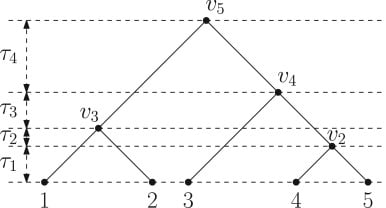
Why do non-Archimedean spaces fail to increase the count?
Ultrametric spaces fail to increase nearest-neighbour distance counts because their distances obey an equilateral-triangle rule that prevents points from clustering in varied geometric configurations. In an ultrametric group, the distance between two points never exceeds the maximum of their individual distances to a third reference point.1 This strong triangle inequality forces every triangle to be isosceles with a narrow base, meaning balls in an ultrametric space either lie completely disjoint from one another or nest entirely inside each other.
Zorin examined quotients formed by taking the product of a finite-dimensional real space and an arbitrary abelian group equipped with a translation-invariant ultrametric, divided by a closed subgroup.1 In these mixed systems, the combined distance between two points is defined as the larger of their real distance and their ultrametric distance.1 While one might expect the ultrametric directions to introduce extra degrees of freedom and multiply the possible nearest-neighbour distances, Zorin showed that they vanish from the separation calculations. The maximum number of distinct nearest-neighbour distances is bounded by the real space packing number plus one.1
Explaining why non-Archimedean directions contribute nothing to the distance count, Evgeniy told Primary that he views these components as providing structure rather than continuous freedom. Evgeniy said that the non-Archimedean directions act by “adding layers or branching to the space, rather than genuinely new continuous directions of geometry.” Evgeniy added: “They can distinguish or separate different clusters of points, but they do not provide the same freedom of relative position that an additional real coordinate would. This is why, under the assumptions of our result, the complexity of the possible nearest-neighbour distances is ultimately controlled by the effective real part of the space, rather than by the full ambient product.”
The packing number measures the maximum number of points that can sit inside an open unit ball such that every pair remains separated by a distance of at least one. For a real space of dimension d, this packing count is strictly less than three raised to the power of d.1 Zorin showed that any continuous real directions contained in the dividing subgroup can be factored out completely.1 For inner-product metrics, the distance ceiling depends only on an effective real factor, which corresponds to the subspace spanned by the projected subgroup.1 If this effective dimension is zero, the sequence produces at most two nearest-neighbour distances; for effective dimensions one, two, and three, the universal upper bounds are exactly 3, 6, and 13, regardless of the ambient dimension of the surrounding space.1
Asked about conditions where this quotient decomposition might encounter limits, Evgeniy said in response to questions from Primary that non-commutativity alone is not an obstacle in a direct product. Evgeniy said that a “substantially different situation arises if the non-Archimedean group acts nontrivially on the real space, for example in a semidirect product,” because motion in the non-Archimedean component can transform the real component, meaning the real displacement between two lifts is no longer simply the difference of two vectors in a fixed real space. Evgeniy noted that “translation invariance is what makes the distance between two orbit points depend only on the difference of their indices,” warning that losing metric invariance destroys the running-minimum description of nearest-neighbour distances.
This formulation unifies several earlier milestones within a single mathematical architecture. For example, Soumya Das and Alan Haynes had established a three-distance theorem for adelic tori, which combine a single continuous real coordinate with p-adic fields across a set of prime numbers.1 Zorin showed that the adelic torus is a special case of his mixed quotient framework where the effective real dimension equals one, naturally reproducing the three-distance bound without requiring arithmetic descriptions of the prime factors.
When does the pattern of closest returns break down?
The pattern of closest returns breaks down when ultrametric coordinates match the exact distance of a record return, preventing the sequence of denominators from satisfying standard real-space growth rules. In classical Diophantine approximation, a best return occurs at a step count where the moving point lands closer to its starting point than it has at any earlier step.1 In purely real spaces, these record denominators follow strict recurrence relations. For an inner-product space where the discrete part of the subgroup has rank r, Shulga showed that the denominator at index n plus two raised to the power of r is at least as large as the sum of the denominators at indices n and n plus one.1
Whenever denominators obey this kind of additive recurrence, an elementary combinatorial bridge ensures that the count of nearest-neighbour distances cannot exceed the recurrence index plus one. In purely real settings, this link explains why the distance bound remains stable. However, Zorin discovered that introducing an ultrametric factor can disrupt this denominator recurrence even while the nearest-neighbour distance bound remains completely intact. On a mathematical object known as an adelic solenoid, combining the real line with the 2-adic numbers, Zorin identified a specific trajectory whose first four strict record denominators are 1, 3, 6, and 7.1 Because seven is smaller than three plus six, the real two-step recurrence fails, yet the total count of nearest-neighbour distances on this space never exceeds three.1
Reflecting on this breakdown, Evgeniy told Primary that uncovering the sequence 1, 3, 6, 7 dismantled the expectation that real-space denominator behavior would persist unchanged. Evgeniy stated: “That was an important distinction: the rigidity of the distance count is more robust than the rigidity of the denominator sequence.” He explained that the counterexample isolated the precise geometric obstacle: at the critical return, the ultrametric coordinate reaches the record distance, preventing the preceding record from serving as an additional separated vector in the real packing argument.1
To salvage recurrence bounds in mixed settings, Zorin proved an alternative packing recurrence that holds universally across all mixed quotients.1 In effective Euclidean dimensions one and two, he established that the denominator at index n plus two raised to the power of the effective dimension, plus one, is strictly greater than the sum of denominators at indices n and n plus one.1 This one-index shift from the purely real recurrence is mathematically sharp, as confirmed by counterexamples on the solenoid and on a two-dimensional torus paired with modular arithmetic.
Describing how geometric packing recovers control over denominator growth, Evgeniy explained to Primary that if too many new record returns occurred before denominators grew past index sums, their index differences would be too small to permit short returns. Because the ultrametric coordinates of new improvements are both smaller than the current record radius, their difference is also smaller in that coordinate, forcing separation into the real component. Evgeniy said: “Ultrametricity forces the separation back into the real factor, where finite-dimensional packing geometry takes over. In effective dimensions one and two we can push this geometry further and recover the sharp recurrence with only one extra index compared with the purely real case.”
These findings describe mathematical bounds on idealized geometric translations and do not provide empirical predictions or algorithmic runtimes. The conclusions apply strictly to systems where the quotient metric is generated by the maximum product metric between a real space and an ultrametric group, under translation-invariant conditions. Furthermore, the results establish universal upper ceilings rather than exact counts for every specific orbit, meaning individual trajectories can exhibit far fewer nearest-neighbour distances. This work appears as a research preprint that has been posted to arXiv and has not yet undergone formal peer review.1
Beyond clarifying the behavior of low-dimensional systems, the framework reveals surprising links to high-dimensional sphere packings. In very high effective dimensions, the strong kissing number that governs inner-product quotients grows exponentially more slowly than the power-of-two bounds found in maximum-norm spaces. In dimension eight, where sphere packing is related to the exceptional E8 lattice, the nearest-neighbour bound is at most 240, and in dimension 24, governed by the Leech lattice, the bound is at most 196,560.1 As mathematicians probe deeper into higher dimensions, the next open challenge is determining whether the sharp low-dimensional denominator recurrences can be extended into effective dimension three.1
Discussing the challenge in dimension three, Evgeniy told Primary that the planar proof relies on an inequality for two angular neighbours, which lacks an immediate analogue in higher dimensions. Evgeniy said: “In three dimensions, the ordinary packing geometry is much less restrictive. Up to twelve directions can remain mutually separated in the relevant sense, so the general packing argument only gives index 13, whereas the hoped-for analogue would have index 9. Moreover, points on the sphere no longer have a natural cyclic order, so there is no immediate replacement for the ‘two angular neighbours’ argument that works in the plane.”
This piece was prepared from the arXiv preprint and public records together with answers from Evgeniy to questions from the Primary news team, completed September 2026.1
The record
40 sentences trace to 2 sources and 1 contributor.
-
1
EZ
 Evgeniy Zorin
Paper
· arxiv.org · 14 Sep 2026
Kronecker sequences beyond the torus: nearest-neighbour distances and best returns
Preprint · may not have been peer reviewed
See the source
- 2 Contribution — Evgeniy 15 statements added to this article
-
3
A
arxiv.org
Paper
· arxiv.org
The five distance theorem for a convex norm
Preprint · may not have been peer reviewed
See the source
Other consulted pages1 page
en.wikipedia.org1 page
Article history
-
Published 18 Nov 2026, 21:38Assembled by the Primary desk from 2 sources · 1 contributor · 40 cited sentences
-
Evgeniy
- Go to the sentence: Zorin demonstrated that when ordinary real spaces merge with ultrametric spaces, which measure distances using tree-like, non-Archimedean branching structures, the ultrametric dimensions add zero additional complexity to the maximum number of nearest-neighbour distances.
- Go to the sentence: The upper bound on these distances is governed entirely by the geometry of the real components.
- Go to the sentence: Evgeniy said that the non-Archimedean directions act by “adding layers or branching to the space, rather than genuinely new continuous directions of geometry.”
- Go to the sentence: Evgeniy added: “They can distinguish or separate different clusters of points, but they do not provide the same freedom of relative position that an additional real coordinate would. This is why, under the assumptions of our result, the complexity of the possible nearest-neighbour distances is ultimately controlled by the effective real part of the space, rather than by the full ambient product.”
- Go to the sentence: Zorin showed that any continuous real directions contained in the dividing subgroup can be factored out completely.
- Go to the sentence: If this effective dimension is zero, the sequence produces at most two nearest-neighbour distances; for effective dimensions one, two, and three, the universal upper bounds are exactly 3, 6, and 13, regardless of the ambient dimension of the surrounding space.
- Go to the sentence: Evgeniy said that a “substantially different situation arises if the non-Archimedean group acts nontrivially on the real space, for example in a semidirect product,” because motion in the non-Archimedean component can transform the real component, meaning the real displacement between two lifts is no longer simply the difference of two vectors in a fixed real space.
- Go to the sentence: Evgeniy noted that “translation invariance is what makes the distance between two orbit points depend only on the difference of their indices,” warning that losing metric invariance destroys the running-minimum description of nearest-neighbour distances.
- Go to the sentence: Because seven is smaller than three plus six, the real two-step recurrence fails, yet the total count of nearest-neighbour distances on this space never exceeds three.
- Go to the sentence: Evgeniy stated: “That was an important distinction: the rigidity of the distance count is more robust than the rigidity of the denominator sequence.”
- Go to the sentence: He explained that the counterexample isolated the precise geometric obstacle: at the critical return, the ultrametric coordinate reaches the record distance, preventing the preceding record from serving as an additional separated vector in the real packing argument.
- Go to the sentence: To salvage recurrence bounds in mixed settings, Zorin proved an alternative packing recurrence that holds universally across all mixed quotients.
- Go to the sentence: Evgeniy said: “Ultrametricity forces the separation back into the real factor, where finite-dimensional packing geometry takes over. In effective dimensions one and two we can push this geometry further and recover the sharp recurrence with only one extra index compared with the purely real case.”
- Go to the sentence: As mathematicians probe deeper into higher dimensions, the next open challenge is determining whether the sharp low-dimensional denominator recurrences can be extended into effective dimension three.
- Go to the sentence: Evgeniy said: “In three dimensions, the ordinary packing geometry is much less restrictive. Up to twelve directions can remain mutually separated in the relevant sense, so the general packing argument only gives index 13, whereas the hoped-for analogue would have index 9. Moreover, points on the sphere no longer have a natural cyclic order, so there is no immediate replacement for the ‘two angular neighbours’ argument that works in the plane.”