Pulsing optical crystals can swallow light and amplify it simultaneously
Time-varying photonic materials can absorb specific incoming waves while simultaneously radiating laser light, according to new theoretical modeling of optical scattering matrices.
Most optical materials guide light through fixed physical boundaries, steering beams through glass prisms or silicon channels etched into rigid patterns. If an engineer seeks to modify how a beam bends, reflects, or vanishes, they alter the spatial boundaries of the object or change the path the light travels. A different class of behavior emerges when the physical properties of a medium remain uniform across space while oscillating rapidly across time. In such an environment, an incoming electromagnetic wave interacts with a medium that continuously resets its basic physical response.
These structures are known as photonic time crystals, systems in which a physical property such as electric permittivity shifts periodically like a steady metronome.12 Controlling light through temporal changes rather than spatial patterns offers unusual possibilities for communication networks and optical processing hardware.1 Conventional lasers require dedicated energy reservoirs and mirrors to generate amplified beams, while optical absorbers rely on lossy materials to trap and destroy stray signals. Achieving both behaviours inside a single compact structure could simplify the architecture of photonic circuits by letting a single material perform opposing optical tasks on demand.
The mechanism behind this behavior follows an orderly sequence of physical interactions. An incoming electromagnetic wave enters a material whose electrical permittivity pulses rapidly at a constant frequency.1 As the wave propagates, the rhythmic oscillation of the medium injects energy into the electromagnetic field, mixing the incoming frequency with multiples of the modulation rate.1 When the strength of this time-dependent driving force reaches a specific resonance threshold, the system crosses an exceptional point where the wave dynamics divide into two divergent paths.1 Along one path, the incoming energy cancels completely, leaving no outgoing wave, while along the complementary path, the wave gathers energy and exits as an amplified emission.1
How can time-varying materials reshape light?
Time-varying materials reshape light by scattering incoming waves into multiple frequency channels through periodic changes in their electrical permittivity.1 In a study posted to the arXiv preprint server on October 3, 2025, David Globosits, Puneet Garg, Jakob Hüpfl, Adrià Canós Valero, Thomas Weiss, Carsten Rockstuhl, and Stefan Rotter examined how spatially finite photonic time crystals interact with electromagnetic radiation. The authors analyzed the scattering process using a mathematical tool known as the multispectral Floquet scattering matrix, an operator that accounts for the frequency-mixing processes inherent to time-modulated systems.1
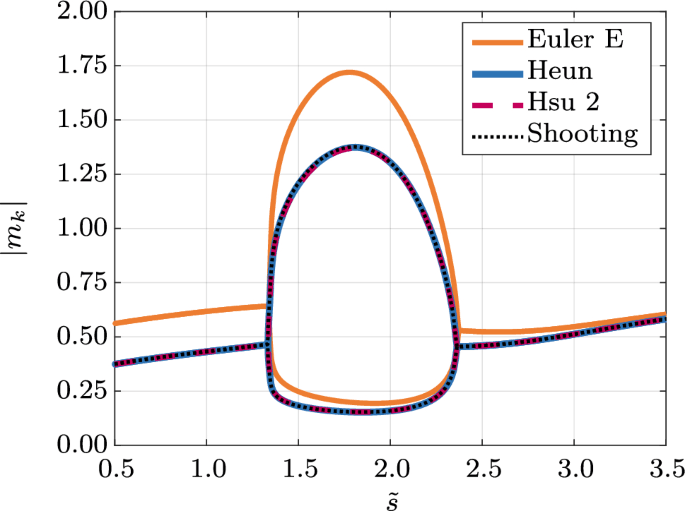
For materials with real, dispersionless, and time-periodic permittivity, the researchers found that this scattering matrix possesses a mathematical property called pseudounitarity.1 In traditional, time-invariant optical systems, energy conservation forces scattering matrices to remain unitary, meaning the total energy of outgoing waves matches the energy of incoming waves. In time-modulated systems, pseudounitarity reflects the presence of an underlying symmetry operator that governs how energy enters and leaves the oscillating medium.1 In systems with temporal symmetry, this operator corresponds directly to the time-reversal operator, establishing a strict balance between forward-moving and backward-moving wave states.1
What happens when light reaches parametric resonance?
When light in a time-modulated system hits the parametric resonance condition, one scattering eigenvalue drops to zero while its counterpart diverges toward infinity.1 Globosits and colleagues demonstrated that increasing the driving strength of the periodic modulation pushes the eigenvalues of the scattering matrix around the unit circle in an unbroken symmetry regime until they collide at exceptional points.1 At these exceptional points, which mark spectral singularities where distinct states coalesce, the system undergoes a symmetry-breaking transition into a broken symmetry regime where the eigenvalues split into inverse complex conjugate pairs.1 Stefan, a researcher on the project, told Primary that the team was surprised to discover that this mechanism arises directly from the mathematics of the scattering operator without depending on the construction of a specific structure. Stefan said that the team members "were indeed surprised to find that this mechanism comes out of the mathematics itself, not out of the details of any particular system, which is why it describes so many different systems at once."
Under parametric resonance, this splitting produces two simultaneous and opposing physical effects: coherent perfect absorption and lasing.1 Coherent perfect absorption occurs when the vanishing eigenvalue causes incoming waves of a particular interference pattern to be absorbed entirely by the system with zero reflection or transmission.1 At the same moment, the diverging eigenvalue indicates that an incoming perturbation triggers an intense, coherent emission, acting as a laser.1 Stefan described this duality to Primary through a time-reversed thought experiment: "Picture a film of the experiment. A pulse of light goes into our modulated material and nothing comes back out - no reflection, no transmission. That is coherent perfect absorption. Play the film backwards and light appears inside the material and radiates away, although nothing was ever sent in. This is a laser. The two are the same process run in opposite directions in time, provided the material is modulated in a way that looks the same whether the clock runs forwards or backwards. At parametric resonance, our system does both at once: it can perfectly absorb a specific incoming wave while simultaneously supporting a self-emitting lasing mode."
The authors reported that because their mathematical formulation relies on the Floquet scattering matrix rather than specific boundary shapes, the occurrence of simultaneous absorption and amplification applies across diverse geometries, including slabs, spheres, and metasurfaces.1
Can these optical effects work in practical devices?
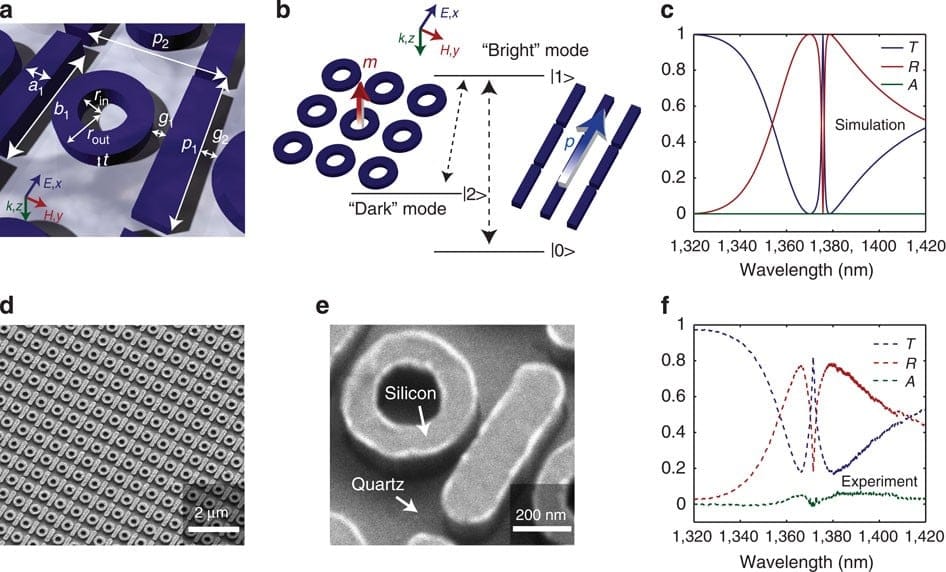
Practical implementation of simultaneous absorption and lasing depends on lowering the modulation strength needed to trigger parametric resonance in real materials. In their mathematical analysis, Globosits and colleagues investigated whether nanostructured surfaces could ease these operating requirements. The authors showed that metasurfaces sustaining quasi-bound states in the continuum, which are localized resonant modes that remain tightly trapped despite coupling to radiation channels, permit coherent perfect absorption and lasing under a minimal modulation strength of the permittivity.1
The findings describe an idealized theoretical model and cannot predict exact operational yields in physical hardware. The calculations model idealized materials with dispersionless, real permittivity, leaving out the frequency-dependent dispersion and internal absorption losses that characterize real physical substances.1 Stefan noted to Primary that while the scattering geometry poses few restrictions, modulation speed remains the principal hurdle, explaining that achieving sufficient modulation depth and speed is feasible at microwave frequencies but exceptionally difficult in the optical regime. Stefan stated that "the geometry is not really the limiting factor - the modulation speed is. Modulating a material deeply and fast enough is within reach at microwave frequencies but very hard at optical ones, so a first demonstration will almost certainly come from the microwave domain rather than from optics."
David Globosits told Primary that dispersion remains manageable, observing that "dispersion is not a fundamental obstacle and that our theory can be extended to dispersive media, where it modifies the required modulation amplitude, but not the effect itself." Regarding physical attenuation, David Globosits explained that internal losses alter the balance between the two phenomena: "With loss the situation is different. No universal number can be given, since the effect persists as long as the modulation supplies energy faster than the medium dissipates it. Loss also acts in opposite ways on the two phenomena: it is detrimental for lasing but beneficial for perfect absorption so that in a lossy system the point of coherent perfect absorption is reached before the lasing threshold."
Addressing what would challenge the resonance threshold in physical experiments, Stefan said that testing a sequence of samples with increasingly sharp resonances should cause the required modulation strength to drop steadily, warning that if this threshold curve flattens out, structural disorder or fabrication flaws may have quenched the resonance effect. Stefan suggested that experimentalists "make a series of samples in which the resonance is sharpened step by step, and measure the modulation strength needed in each. We predict the threshold keeps falling as the resonance sharpens. If that curve flattens out, the effect does not survive fabrication, potentially due to disorder or other imperfections." The work has been published in Light: Science & Applications (https://doi.org/10.1038/s41377-026-02380-9).
If experimentalists can replicate these resonance conditions in physical laboratories, the framework could guide the design of dynamic optical components capable of switching between signal detection, amplification, and cancellation. Future work will need to test whether ultrafast laser pulses or electrical gating can drive the permittivity of real semiconductor metasurfaces rapidly enough to reach the predicted exceptional points. Stefan told Primary that nonlinear material saturation depends heavily on internal field intensity, which surges whenever an incoming wave is strongly amplified by the modulation drive or when crossing the threshold into lasing emission. Stefan explained that "the onset of saturation or other non-linear phenomena primarily depends on the field intensities inside the system. Strong field enhancements happen either when an incoming wave gets strongly amplified by the drive or when crossing the laser threshold, where the system radiates even without incoming radiation." Resolving how material loss and nonlinear saturation affect the stability of the divergent lasing mode will decide whether Floquet scattering systems can operate reliably inside practical photonic technologies.
The record
43 sentences trace to 2 sources and 2 contributors.
-
1
DG
 David Globosits, Puneet Garg, Jakob Hüpfl, Adrià Canós Valero, Thomas Weiss, Carsten Rockstuhl, Stefan Rotter
Paper
· arxiv.org · 18 Sep 2026
Exceptional Points, Lasing, and Coherent Perfect Absorption in Floquet Scattering Systems
Preprint · may not have been peer reviewed
See the source
-
2
A
arxiv.org
Paper
· arxiv.org
Photonic time crystals: Theory and applications
Preprint · may not have been peer reviewed
See the source
- 3 Contribution — Stefan Rotter 16 statements added to this article
- 4 Contribution — David Globosits 3 statements added to this article
Other consulted pages1 page
arxiv.org1 page
link.springer.com1 page
Article history
-
Published 20 Nov 2026, 22:15Assembled by the Primary desk from 2 sources · 2 contributors · 43 cited sentences
-
Stefan Rotter
- Go to the sentence: As the wave propagates, the rhythmic oscillation of the medium injects energy into the electromagnetic field, mixing the incoming frequency with multiples of the modulation rate.
- Go to the sentence: Globosits and colleagues demonstrated that increasing the driving strength of the periodic modulation pushes the eigenvalues of the scattering matrix around the unit circle in an unbroken symmetry regime until they collide at exceptional points.
- Go to the sentence: Stefan, a researcher on the project, told Primary that the team was surprised to discover that this mechanism arises directly from the mathematics of the scattering operator without depending on the construction of a specific structure.
- Go to the sentence: Stefan said that the team members "were indeed surprised to find that this mechanism comes out of the mathematics itself, not out of the details of any particular system, which is why it describes so many different systems at once."
- Go to the sentence: Under parametric resonance, this splitting produces two simultaneous and opposing physical effects: coherent perfect absorption and lasing.
- Go to the sentence: Coherent perfect absorption occurs when the vanishing eigenvalue causes incoming waves of a particular interference pattern to be absorbed entirely by the system with zero reflection or transmission.
- Go to the sentence: At the same moment, the diverging eigenvalue indicates that an incoming perturbation triggers an intense, coherent emission, acting as a laser.
- Go to the sentence: Stefan described this duality to Primary through a time-reversed thought experiment: "Picture a film of the experiment. A pulse of light goes into our modulated material and nothing comes back out - no reflection, no transmission. That is coherent perfect absorption. Play the film backwards and light appears inside the material and radiates away, although nothing was ever sent in. This is a laser. The two are the same process run in opposite directions in time, provided the material is modulated in a way that looks the same whether the clock runs forwards or backwards. At parametric resonance, our system does both at once: it can perfectly absorb a specific incoming wave while simultaneously supporting a self-emitting lasing mode."
- Go to the sentence: The authors reported that because their mathematical formulation relies on the Floquet scattering matrix rather than specific boundary shapes, the occurrence of simultaneous absorption and amplification applies across diverse geometries, including slabs, spheres, and metasurfaces.
- Go to the sentence: The authors showed that metasurfaces sustaining quasi-bound states in the continuum, which are localized resonant modes that remain tightly trapped despite coupling to radiation channels, permit coherent perfect absorption and lasing under a minimal modulation strength of the permittivity.
- Go to the sentence: Stefan noted to Primary that while the scattering geometry poses few restrictions, modulation speed remains the principal hurdle, explaining that achieving sufficient modulation depth and speed is feasible at microwave frequencies but exceptionally difficult in the optical regime.
- Go to the sentence: Stefan stated that "the geometry is not really the limiting factor - the modulation speed is. Modulating a material deeply and fast enough is within reach at microwave frequencies but very hard at optical ones, so a first demonstration will almost certainly come from the microwave domain rather than from optics."
- Go to the sentence: Addressing what would challenge the resonance threshold in physical experiments, Stefan said that testing a sequence of samples with increasingly sharp resonances should cause the required modulation strength to drop steadily, warning that if this threshold curve flattens out, structural disorder or fabrication flaws may have quenched the resonance effect.
- Go to the sentence: Stefan suggested that experimentalists "make a series of samples in which the resonance is sharpened step by step, and measure the modulation strength needed in each. We predict the threshold keeps falling as the resonance sharpens. If that curve flattens out, the effect does not survive fabrication, potentially due to disorder or other imperfections."
- Go to the sentence: Stefan told Primary that nonlinear material saturation depends heavily on internal field intensity, which surges whenever an incoming wave is strongly amplified by the modulation drive or when crossing the threshold into lasing emission.
- Go to the sentence: Stefan explained that "the onset of saturation or other non-linear phenomena primarily depends on the field intensities inside the system. Strong field enhancements happen either when an incoming wave gets strongly amplified by the drive or when crossing the laser threshold, where the system radiates even without incoming radiation."
-
David Globosits, lead author
- Go to the sentence: The calculations model idealized materials with dispersionless, real permittivity, leaving out the frequency-dependent dispersion and internal absorption losses that characterize real physical substances.
- Go to the sentence: David Globosits told Primary that dispersion remains manageable, observing that "dispersion is not a fundamental obstacle and that our theory can be extended to dispersive media, where it modifies the required modulation amplitude, but not the effect itself."
- Go to the sentence: Regarding physical attenuation, David Globosits explained that internal losses alter the balance between the two phenomena: "With loss the situation is different. No universal number can be given, since the effect persists as long as the modulation supplies energy faster than the medium dissipates it. Loss also acts in opposite ways on the two phenomena: it is detrimental for lasing but beneficial for perfect absorption so that in a lossy system the point of coherent perfect absorption is reached before the lasing threshold."