Microscopic black holes could devour sunlike stars from the inside
Simulations indicate that ancient relics of the early cosmos could trigger sudden stellar explosions, providing astronomers with an observational signature to search for missing dark matter.
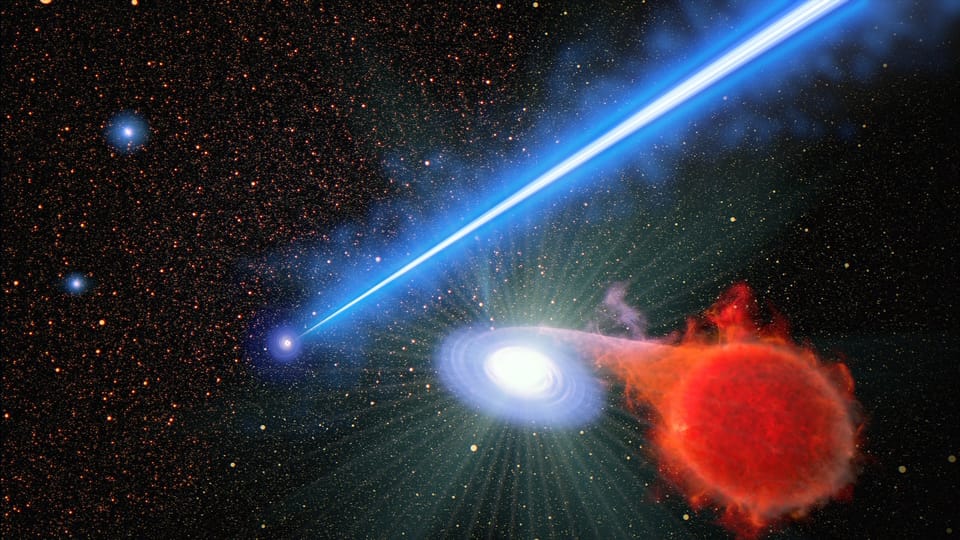
A star resembling the Sun can burn steadily for billions of years, sustained by nuclear fusion that balances the inward crush of its own gravity. Yet an invisible speck formed in the first fraction of a second after the Big Bang could quietly bring that lifetime to a violent end.12 Under certain cosmic conditions, an atom-sized primordial black hole could become trapped within a stellar interior, sink into the central furnace, and consume the star from the inside out.12
Astrophysicists have studied primordial black holes because their existence could resolve the mystery of dark matter, the unseen mass that shapes galaxies across the cosmos.12 Unlike black holes formed by collapsing massive stars, primordial black holes are theoretical relics that emerged from dense pockets of matter in the infant universe before stars existed.13 The lightest of these hypothetical objects would have evaporated over cosmic history through Hawking radiation, a quantum process in which black holes slowly shed energy and mass.12 Heavier survivors, packing the mass of an asteroid into a radius no larger than an atom, could remain scattered across space today.12
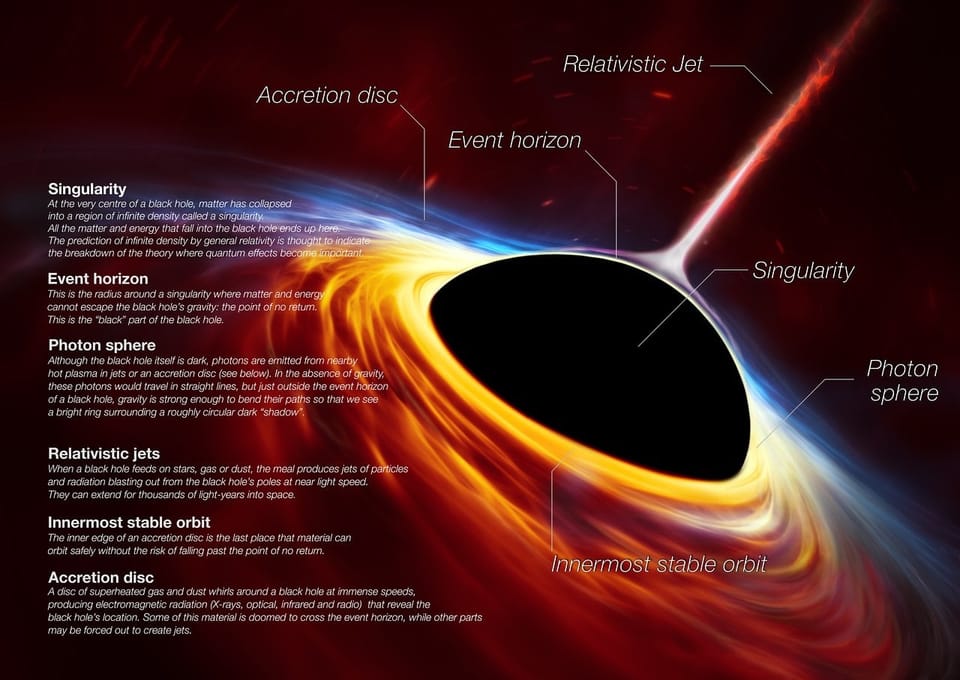
Before such an object can produce any visible flare, an orderly gravitational chain must bring it from interstellar space to the heart of a stellar core. A lone star lacks the gravitational leverage to capture a passing black hole on its own.12 If a third celestial body is present, such as an orbiting planet or a stellar companion, the resulting three-body interaction can deflect the tiny black hole into an orbit that repeatedly plunges through the star.12 As the object plows through dense stellar plasma, frictional drag saps its momentum, causing its orbit to contract toward the stellar center over thousands to millions of years.12 Once settled in the core, the black hole begins accreting stellar gas.13 Because the star spins, infalling matter eventually piles up into a rapidly swirling disk rather than dropping directly into the event horizon.12 The spinning disk twists surrounding magnetic field lines, launching relativistic jets from the black hole poles that rip outward through the stellar envelope and destroy the star.12
Simulations carried out by Ore Gottlieb, an assistant professor of physics at the Massachusetts Institute of Technology, and collaborating researchers reveal that while the inward accretion takes millions of years, the ultimate destruction occurs in a matter of dozens of seconds.12 Their study, published in The Astrophysical Journal, models the hydrodynamics, general relativity, and magnetic interactions of this microscopic invasion.12
How does a microscopic speck capture and consume a star?
A star captures a passing primordial black hole when a planetary or stellar companion provides the gravitational deflection needed to trap the object into a crossing orbit.13 The researchers calculated that without a third body to absorb excess orbital energy, a solitary sunlike star cannot gravitationally bind an asteroid-mass black hole traveling through its vicinity.32 When a companion planet or secondary star provides the necessary gravitational assist, the black hole enters an elongated orbit that repeatedly cuts through the primary star.32 Each journey through stellar gas produces hydrodynamic friction that steadily degrades the orbit, pulling the speck into the stellar center across a timespan of thousands to millions of years.32
Once positioned in the dense stellar core, the black hole begins feeding on the surrounding gas. In standard accretion models, incoming material often heats up and radiates outward, driving away surrounding gas and slowing the growth rate.32 The researchers discovered that inside the stellar center, most of the released energy enters the black hole alongside the infalling gas.12 Because heat does not disperse outward to choke off the supply, the black hole consumes material faster than prior studies anticipated.13 Over several million years of continuous accretion, the black hole can swallow approximately 1% of the star's total mass, expanding to a diameter of several meters.12
Why would a trapped black hole cause a sudden explosion?
An explosion occurs because the rotation of the dying star forces infalling gas into a swirling disk, which twists magnetic fields into relativistic jets that pierce the star in dozens of seconds.12 Once the growing black hole reaches meters in width, the star's natural spin prevents gas from falling straight into the core, causing material to settle into an accretion disk.32 The black hole spins alongside the disk, dragging the surrounding fabric of space and time.12 This rotational shear wraps the magnetic fields threading the disk into tightly coiled conduits at the black hole's poles.12
These coiled magnetic fields act as powerful particle accelerators, launching electromagnetic jets of matter outward at speeds near the speed of light.13 Although building the disk requires millions of years of silent accretion, the resulting polar jets drill through the stellar layers in a few dozen seconds.13 The outward pressure tears the star apart from the center, transforming a peaceful stellar furnace into an abrupt, luminous detonation.32

What optical and energetic signals would reach Earth?
An explosion powered by an internal black hole releases an initial burst of gamma rays and X-rays alongside bright blue and ultraviolet light.12 The researchers calculated that the initial relativistic breakout produces high-energy electromagnetic radiation, which can shine brightly enough to be observed across multiple galaxies by contemporary space-based observatories.12 As the expanding debris expands and cools over subsequent weeks, the dominant emissions transition toward optical and infrared wavelengths, eventually giving way to long-wavelength radio signals.13
The multi-wavelength succession gives astronomers a clear timeline to search for in observational archives and wide-field survey data.13 Because the initial flash contains distinct ultraviolet and blue emissions alongside high-energy photons, telescopes trained on transient alerts could capture the signature shortly after breakout. This electromagnetic footprint provides the first concrete observational method to test for the presence of asteroid-mass black holes.12
How can astronomers distinguish this blast from ordinary stellar deaths?
Astronomers can identify candidate events by looking for violent detonations among stars whose mass and life stage should make an explosion impossible.12 Massive stars typically end their lives in core-collapse supernovae, but stars with masses comparable to the Sun do not possess sufficient gravitational pressure to ignite an explosive collapse at the end of their lives. When a sunlike star detonates without the evolutionary mass normally required for a supernova, the explosion indicates that an internal parasite has consumed the star from within.13
These theoretical models carry clear limitations, as no primordial black hole has ever been observed in nature.13 The simulation represents a theoretical framework connecting general relativity and stellar dynamics rather than a confirmed observational detection.32 Furthermore, diverse high-energy astrophysical events can mimic aspects of the predicted light curves, meaning brightness and color alone cannot confirm a primordial black hole origin without detailed spectroscopic data and progenitor tracking.12 Even if future observations fail to find these stellar detonations, the absence of detections will allow researchers to establish rigorous upper bounds on the abundance of primordial black holes and constrain their potential share of cosmic dark matter.12
The research, authored by Gottlieb alongside Matteo Cantiello of the Flatiron Institute, Cameron Norton and Matthew Kleban of New York University, and Ken Van Tilburg of Stanford University, was supported in part by the National Science Foundation and the U.S. Department of Energy Office of Science Advanced Scientific Computing Research Program.24 Observers operating transient sky surveys can now use these numerical blueprints to evaluate unexplained stellar explosions across distant galaxies.
The record
42 sentences trace to 4 sources.
- 1 Scientists Identify a Violent Cosmic Signal That Could Reveal Hidden Black Holes See the source
-
2
N
 news.mit.edu
Third-party reporting
· news.mit.edu
If tiny “primordial” black holes exist, here’s how we might find them
See the source
- 3 An asteroid-mass black hole could destroy a star from the inside in seconds See the source
- 4 Primordial See the source