Early life stress primes female brains for lasting pain after injury
Mice exposed to childhood isolation developed persistent mechanical pain and anxiety after a nerve injury, driven by altered signalling between threat and emotion hubs in the brain.

A physical injury in adulthood can linger long after damaged tissue heals, but the vulnerability that turns an ordinary nerve injury into chronic pain often takes root decades before the initial damage occurs. For years, clinicians have observed that people who endured severe adversity in childhood are noticeably more prone to developing long-term pain and anxiety disorders as adults.123 This vulnerability appears with striking frequency in women, who consistently report higher rates of widespread pain and chronic physical symptoms following early trauma.41 Yet the physical reasons why an emotional hardship during youth would lie dormant for years, only to reawaken as unyielding bodily pain after an adult injury, have remained deeply elusive.
Understanding this deferred vulnerability matters because chronic pain rarely travels alone. When persistent pain takes hold, it frequently brings anxiety, avoidance of everyday movement, and heightened fear, creating a debilitating cycle that undermines standard physical rehabilitation. If doctors can determine how early hardship alters the nervous system before any physical trauma occurs, they can begin to treat post-injury pain as the culmination of a longer biological story rather than an isolated mechanical failure.
To see how this vulnerability takes shape, consider what happens when the body processes a threat. When an animal encounters sensory discomfort or an environmental danger, sensory pathways route those signals upward into the brain to be catalogued. A central relay station assesses the significance of the threat, gauges how urgent it is, and then passes that message along to emotional command centres that orchestrate fear, defensiveness, and protective behaviours. Under ordinary conditions, when the immediate threat recedes or the tissue heals, these nerve pathways quiet down, and normal sensitivity returns. If early stress permanently recalibrates that central relay, however, the pathway remains primed at an elevated baseline. When a physical injury eventually happens in adulthood, that primed connection amplifies the incoming sensory signals and keeps the emotional alarm sounding indefinitely.
A research study published on November 19, 2026, in the journal Science now demonstrates how that biological chain operates in the mammalian brain.123 The investigation, led by Anna Maria Borruto and Sebastian Wieland at Heidelberg University alongside colleagues at the Central Institute of Mental Health in Mannheim, identified a specific nerve pathway that permanently changes after early adversity in female mice, making them uniquely vulnerable to chronic pain and anxious avoidance following a later injury.13 Male mice subjected to the exact same sequence showed no such amplification, revealing a biological mechanism that may help explain why early trauma leaves a stronger footprint in females.13

How does early adversity reshape the response to injury?
Early social adversity alters how the brain processes subsequent physical trauma by establishing a hidden, persistent vulnerability in neural threat networks.31 To uncover this interaction, the researchers at Heidelberg University used a vulnerability-stress model that separated two distinct hardships by several weeks.12 They housed young mice in solitary cages starting at postnatal day 21, around the time of weaning, to model early social adversity.13 Weeks later, once the animals reached early adulthood, some underwent a standard nerve injury in one hind leg that causes long-lasting pain, while others received a sham operation without nerve damage.12 This created four experimental groups for each sex: animals with neither stressor, animals with isolation alone, animals with nerve injury alone, and animals that experienced both hardships.1
The animals were evaluated for up to 12 weeks following surgery to track how their behaviour evolved over time.1 Researchers assessed physical pain sensitivity by measuring how readily each mouse withdrew its hind paw when touched with a thin filament, a calibrated test of mechanical sensitivity.13 They also measured emotional distress through tests of anxious avoidance, such as recording how long a hungry mouse hesitated before venturing into a brightly lit, unfamiliar arena to retrieve food.1 While social isolation on its own caused both male and female mice to become slightly more sensitive to mechanical touch, the combination of early isolation and adult nerve injury caused a much larger, more enduring increase in mechanical hypersensitivity and avoidance behavior exclusively in female mice.123 Sensitivity to cold stimuli, by contrast, remained entirely unchanged across the groups.1
Which brain circuit amplifies the pain?
A dedicated neural highway connecting the paraventricular thalamus to the central amygdala acts as the primary amplifier of chronic pain and avoidance in doubly stressed females.123 The paraventricular thalamus is a midline brain structure responsible for detecting threats and highlighting emotionally significant events, while the central amygdala serves as a core processing hub for fear, distress, and pain.12 Previous experiments in rodents had already linked this connection to neuropathic pain, and past work had shown that the pathway could drive pain for approximately two weeks following an injury in male mice.1 In the new experiments, however, the pathway showed a far more profound, enduring transformation in females.
When the investigators examined brain tissue from female mice that had experienced both early isolation and adult injury, they observed an activity-dependent synaptic gain, meaning the neural junctions along this circuit transmitted incoming signals far more efficiently than normal.13 Amygdala cells fired at significantly higher rates in response to bursts of stimulation arriving from the thalamus.1 Furthermore, neural recordings gathered from freely behaving mice showed that this thalamus-to-amygdala pathway became intensely active whenever the animals entered anxiety-inducing settings.13 Early stress had essentially turned up the internal volume control on threat signalling, priming the circuit so that a subsequent adult injury caused it to flood the amygdala with amplified alarm signals.
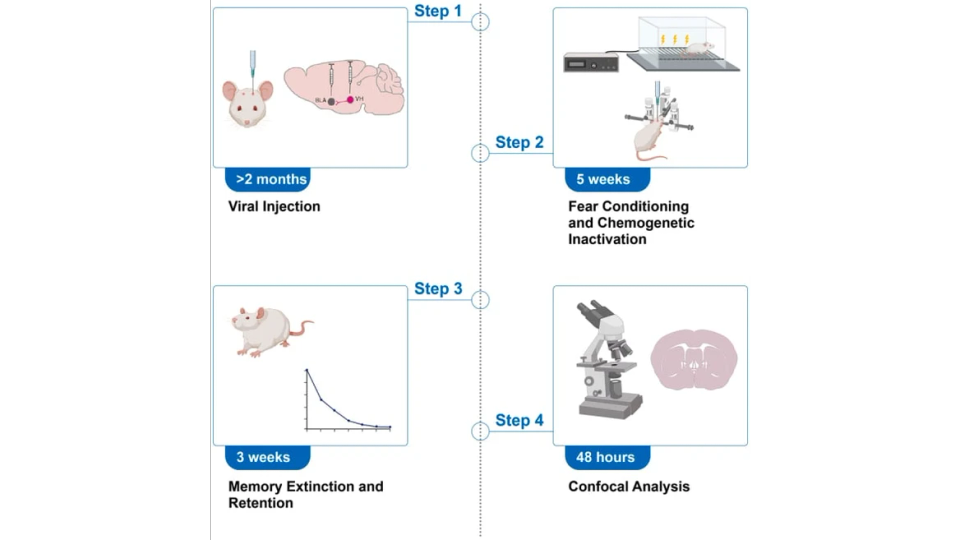
To confirm whether this single circuit was directly responsible for the behavioural changes, the researchers applied chemogenetics, an experimental technique that uses synthetic, drug-activated receptors to temporarily switch specific nerve cells on or off.1 When they silenced the pathway connecting the paraventricular thalamus to the central amygdala, doubly stressed female mice experienced a substantial reduction in both their heightened mechanical touch sensitivity and their anxious avoidance.123 Silencing the circuit did not erase the baseline pain caused directly by the nerve injury itself, nor did it alter the behaviour of animals in the other experimental groups.13 In separate experiments, artificially switching the same pathway on was sufficient to trigger mechanical hypersensitivity and avoidance behaviours, establishing that the circuit directly governs this heightened vulnerability.12
What are the limits of the animal findings?
The current findings describe the biological mechanisms of a single laboratory mouse strain subjected to one specific form of early stress, meaning they cannot be translated directly to human patients.1 Childhood adversity in human lives encompasses complex, overlapping experiences such as emotional neglect, physical maltreatment, household instability, and trauma, which are far more varied than solitary cage housing after weaning. As the researchers noted in their preprint, the investigation is limited by the choice of one specific vulnerability-stress model, leaving open the question of whether other forms of developmental hardship would alter this exact neural circuit.1
The study also does not explain why male mice remained resilient to this dual-stress amplification.1 Although isolated males exhibited higher anxiety in some behavioural tasks, they did not display the exaggerated pain sensitivity or circuit-level synaptic gain observed in females after injury.13 The authors highlighted several potential explanations, including protective hormonal influences, differing baseline brain architecture, or alternative behavioural coping strategies, but they did not test those hypotheses directly in these experiments.1 In addition, no human neural tissue or clinical brain imaging was analyzed as part of the study.13
What do these findings mean for treating chronic pain?
These findings provide a concrete biological framework for understanding why childhood hardship frequently correlates with adult chronic pain conditions in women. In clinical populations, this connection is well documented. For instance, a 2017 epidemiological study of 4,229 Japanese adults published in the Journal of Pain Research found that reported early-life adversity was associated with an elevated likelihood of multisite pain and multiple somatic symptoms specifically among women living with chronic pain, while men with chronic pain showed no such association.41 The mouse research provides a plausible neural bridge for that clinical reality, demonstrating that psychosocial stress during early development can physically remodel sensory and emotional brain circuits before physical trauma ever occurs.
Looking ahead, Sebastian Wieland and his colleagues plan to map the detailed spatial and molecular signatures of this stress-induced vulnerability to identify the precise receptors and signalling proteins involved.31 In the long term, isolating those molecular targets could aid the development of sex-specific therapies aimed at dampening pathological pain amplification without dulling normal, protective sensation. Before any of these discoveries can influence clinical care, researchers will need to determine whether an equivalent thalamus-to-amygdala pathway governs chronic pain vulnerability in the human brain.31
The record
34 sentences trace to 4 sources.
-
1
SB
 Science Blog Research Desk
Document
· scienceblog.com · 23 Nov 2026
Thalamus-to-amygdala circuit drives female vulnerability to chronic pain after early-life stress in animal study
See the source
- 2 How early-life stress primes the female brain for later-life chronic pain and anxiety See the source
- 3 Chronic Pain: Early-Life Stress Leaves Lasting Traces in the Brain See the source
- 4 Sex-specific impact of early-life adversity on chronic pain: a large population-based study in Japan - PMC See the source