Higher-spin gravity edges closer to local particle interactions
A mathematical proof shows how massless particles of arbitrary spin can interact in curved space-time without producing unphysical non-local infinities across all orders of a simplified theoretical sector.
Fundamental forces in the physical universe depend on the spin of the particles that carry them. Light and electromagnetism rely on massless particles with an intrinsic angular momentum of spin one, known as photons.1 Gravity, which shapes the curvature of space and time, operates through hypothetical massless particles of spin two, known as gravitons.1 For nearly a century, theoretical physicists asked whether nature could permit massless particles of spin three, spin four, or even higher values to interact in a consistent universe.1 The free theory of massless higher-spin fields in Minkowski space is well-defined and consistent (the Fronsdal equations). The genuine difficulty, highlighted by no-go theorems, is that introducing consistent interactions for these fields in flat space is highly non-trivial and often impossible without enlarging the theory, for example by including an infinite tower of fields or moving to AdS space.
The dilemma found a potential resolution when researchers placed the hypothetical particles into an anti-de Sitter background, a curved geometry of space-time possessing a negative cosmological constant.1 In this curved arena, an infinite tower of massless particles of every integer spin can theoretically coexist. Such higher-spin gauge theories attract intense interest because they represent a natural extension of the gauge principles underpinning the Standard Model and general relativity.1 While chiral or other simplified sectors serve as tractable models, the wider higher-spin gravity programme is also pursued as a candidate for a fundamental theory of quantum gravity, in part because its infinite-dimensional gauge symmetry might address UV problems of standard quantum gravity.
Yet an unsettling physical problem immediately emerged inside this curved space. Standard physical laws demand locality, the principle that an event occurring at one point in space-time can only directly influence its immediate neighbourhood. In ordinary field theories, an interaction vertex connecting a few particles involves a small, finite number of spatial and temporal derivatives. In higher-spin theories, the number of derivatives required to describe particle interactions grows higher as the spins of the colliding particles increase.1 If an interaction involving fields of fixed spins required an infinite number of derivatives, the interaction would become non-local, smearing across space-time and destroying predictive power.
To keep the physics sensible, an interaction vertex must satisfy spin-locality.12 For any chosen set of particles with fixed spins, the vertex must contain only a finite tally of space-time derivatives.12 The causal chain that governs these interactions requires several strict steps. First, the fields of various spins propagate through the curved background geometry. Second, when two or more fields collide at an interaction vertex, their mathematical combination must generate higher-derivative corrections to balance the enlarged gauge symmetries. Third, for the interaction to remain physically causal, those derivative corrections must terminate at a finite order for any specific spin combination. If that derivative count never terminates, the interaction spreads arbitrarily across space and time, destroying physical causality.
Now, a preprint posted to the arXiv repository by D. A. Valerev, a theoretical physicist at the Lebedev Physical Institute and the Moscow Institute of Physics and Technology, presents a systematic mathematical scheme designed to enforce this locality to all orders in the holomorphic (self-dual) zero-form sector; locality for the full non-holomorphic Vasiliev system remains an open challenge. Valerev derived necessary and sufficient conditions on intermediate interaction structures that ensure the resulting physical interaction vertices remain strictly spin-local.1 The preprint demonstrated the framework by explicitly computing a specific interaction vertex, moving beyond earlier approximations that achieved locality only in auxiliary mathematical spaces.1
Why does higher-spin gravity struggle with locality?
Higher-spin gravity struggles with locality because balancing an infinite collection of gauge symmetries demands an ever-increasing quantity of spatial and temporal derivatives. When Christian Fronsdal and J. Fang formulated the equations for free, non-interacting massless fields of arbitrary integer spin in the late 1970s, the equations described isolated symmetric tensor fields. The difficulty arose when theorists attempted to turn on interactions among those fields. To keep the immense gauge symmetries intact when particles interact, each new field requires derivative couplings that scale directly with its spin value.
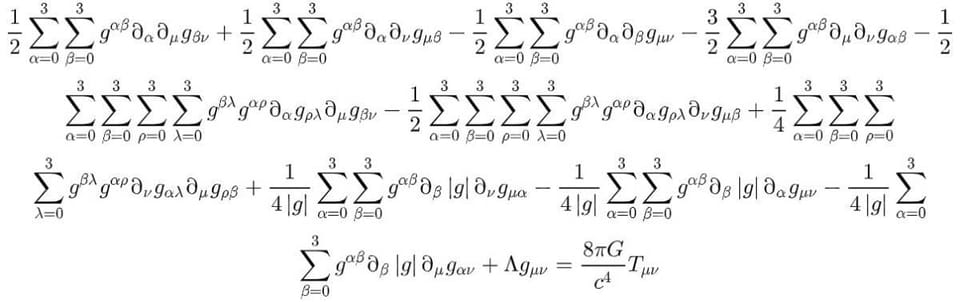
When Mikhail Vasiliev constructed the full non-linear equations for higher-spin gauge theory in an anti-de Sitter background in 1990, the system required an infinite collection of fields spanning all integer spins. Because an infinite ladder of spins participates in the complete theory, the traditional definition of locality, which demands a universal upper bound on derivatives across the entire theory, cannot hold.1 Physicists therefore formulated the weaker requirement of spin-locality. Under spin-locality, the interaction vertex between any subset of fields whose spins are held fixed must possess a finite derivative count, even if that count grows as one considers particles of higher and higher spin.
The question of whether Vasiliev theory actually obeys spin-locality provoked deep debates, particularly through the lens of the holographic correspondence. The Klebanov-Polyakov conjecture proposed that higher-spin gravity in an anti-de Sitter bulk space corresponds directly to a three-dimensional vector model residing on the boundary.1 Several boundary calculations suggested that the dual bulk higher-spin theory was unavoidably non-local beyond leading-order interactions.1 Those boundary reconstructions generated controversy because the underlying conjecture remained unproved, prompting researchers to investigate locality directly within the bulk equations of motion rather than relying on boundary dualities.
Contributor Danila told Primary that the boundary non-locality claims rest on assumptions that may not hold. Danila explained that “the holographic arguments rest on two assumptions: first, that the duality conjecture itself is true, and second, that the boundary dual is a free sigma model.” In an alternative perspective, the bulk higher-spin geometry pairs with conformal currents interacting with Chern-Simons gauge fields. Danila argued that if this perspective holds, earlier boundary deductions depended on an incorrect model and “until that is done, the holographic non-locality claim is not decisive against local vertices in the bulk.”
How can auxiliary spinor variables resolve the derivative problem?
Auxiliary spinor variables resolve the derivative problem by bundling infinite towers of space-time fields and their derivatives into compact, manageable generating functions. In the frame-like formulation of higher-spin theory, researchers replace cumbersome multi-index tensor fields with functions that depend on two-component auxiliary spinor variables.1 By combining these variables through an associative Moyal star product and introducing discrete Klein operators, the infinite set of physical fields condenses into two primary master fields: a one-form field that carries all gauge fields of spin one or higher, and a zero-form field that encapsulates the higher-spin Weyl tensors, matter fields, and their infinite derivatives.
Calculations in this framework routinely handle two distinct notions of locality. The first is spinor spin-locality, which measures whether the mathematical expressions contain finite derivatives with respect to the internal auxiliary spinor variables.1 The second is space-time spin-locality, the true physical requirement that interactions contain finite derivatives across physical space and time.12 Controlling spinor variables is mathematically straightforward, but securing spinor spin-locality does not automatically produce space-time spin-locality.12
To bridge the gap between auxiliary spinor algebra and physical space-time, researchers introduced the concept of projectively-compact vertices. In 2022, Mikhail Vasiliev posted research showing that if an auxiliary vertex satisfies a projective compactness condition, spinor spin-locality directly guarantees space-time spin-locality for that interaction.1 Valerev built upon that foundation by focusing on a specific constraint where the interaction vertex of the zero-form field vanishes whenever the auxiliary spinor variable is set to zero. This constraint acts as an efficient mathematical sieve, ensuring that auxiliary spinor calculations translate cleanly into local space-time physics.
What did the new calculation establish for interaction vertices?
The new calculation established necessary and sufficient conditions on the one-form interaction vertices that guarantee the existence of spin-local holomorphic zero-form vertices across all perturbative orders.1 Valerev analysed the holomorphic sector of the theory, also known as the self-dual sector, where interaction vertices are proportional to powers of the holomorphic coupling constant, commonly denoted η, distinct from the anti-holomorphic coupling η̄; the full theory also has a mixed sector whose vertices depend on both. By examining the algebraic structure of the master field equations order by order, the work proved that specific vertex dualities in the one-form sector dictate whether the zero-form vertices can remain local.
Danila explained the mathematical engine driving this proof to Primary. “The mechanism is an inductive one. At each perturbative order, the zero-form field is determined only up to a shift by a function that does not depend on the auxiliary Z variables. That freedom is the key. The non-local tail terms that would otherwise accumulate are absorbed into this shift,” Danila said. This inductive step solves the equations at order n while maintaining projective compactness, provided the one-form sector satisfies cyclic symmetries. As Danila noted, “If they fail, no shift exists that removes the non-local tail while preserving the projectively-compact condition.”
The preprint demonstrated the power of this inductive scheme by explicitly calculating a spin-local holomorphic zero-form vertex proportional to the square of the coupling constant.1 Earlier investigations of this quadratic sector had succeeded in proving spinor spin-locality, but they had not established full space-time spin-locality.1 The new calculation produced an explicit vertex that satisfies the vanishing condition at zero spinor argument, verifying that the resulting physical interaction possesses only a finite number of space-time derivatives for fields of fixed spins.
This explicit calculation provides a concrete roadmap toward proving locality to all perturbative orders in the holomorphic sector. The author showed that the required algebraic conditions match underlying dualities identified in previous studies of higher-spin algebras.1 In response to questions from Primary, Danila said that “the known dualities were a guide, not a coincidence discovered afterward.” Danila noted that earlier explicit calculations displayed cyclic permutations and vanishing spinor properties, adding that “these were not assumptions pulled from thin air. They were patterns visible in the existing literature.”
The findings carry clear mathematical limitations that define what the result can and cannot show. The analysis applies strictly to the holomorphic sector of higher-spin theory, meaning it isolates self-dual interactions proportional to the holomorphic coupling constant and does not resolve the full non-chiral theory where anti-holomorphic couplings mix. Furthermore, the preprint was posted to the arXiv repository on September 21, 2026, and has not undergone formal peer review.1 While the derivation provides a systematic framework for constructing vertices order by order, it represents an inductive existence and construction proof rather than a closed-form summation of all physical interactions in full quantum gravity.
Danila confirmed this boundary in comments to Primary. Danila stated that “the construction has not been extended to the mixed or full sector, so it is not known how it would generalize.” While restricting interactions to holomorphic terms makes the inductive shifts tractable, combining both chiralities introduces algebraic entanglements that have not been tamed. Danila emphasized that “this work should be seen as a proof of principle in a consistent corner of the theory; extending it to the full non-chiral system has not been attempted.”
These mathematical developments provide crucial insights for theoretical physicists investigating the interface between gauge theory, string theory, and quantum gravity. In the self-dual sector, higher-spin systems exhibit exact classical solutions with high residual symmetries.1 Theorists believe that breaking these high symmetries could establish a direct dynamical link between higher-spin gauge fields and the vibrating strings of string theory.1 Establishing that the self-dual sector possesses well-behaved, strictly local interaction vertices demonstrates that the theory rests on sound mathematical foundations rather than uncontrolled non-local infinities.
The next step for theoretical physicists will be testing whether this all-order construction can survive beyond the holomorphic sector. Researchers are actively working to extend the generating techniques used in self-dual models to the complete, parity-invariant Vasiliev system.1 If the duality constraints derived by Valerev can be generalized to incorporate both holomorphic and anti-holomorphic interactions simultaneously, physicists may finally settle the decades-old debate over whether higher-spin gravity represents a truly local, consistent theory of fundamental interactions.
The record
39 sentences trace to 2 sources and 1 contributor.
-
1
DA
 D. A. Valerev
Paper
· arxiv.org · 22 Sep 2026
Towards All-Order Locality in the Higher-Spin Holomorphic Zero-Form Sector
Preprint · may not have been peer reviewed
See the source
-
2
A
arxiv.org
Paper
· arxiv.org
Projectively-Compact Spinor Vertices and Space-Time Spin-Locality in Higher-Spin Theory
Preprint · may not have been peer reviewed
See the source
- 3 Contribution — Danila Valerev 12 statements added to this article
Other consulted pages1 page
Article history
-
Published 23 Nov 2026, 23:00Assembled by the Primary desk from 2 sources · 1 contributor · 39 cited sentences
-
Danila Valerev
- Go to the sentence: Several boundary calculations suggested that the dual bulk higher-spin theory was unavoidably non-local beyond leading-order interactions.
- Go to the sentence: Danila explained that “the holographic arguments rest on two assumptions: first, that the duality conjecture itself is true, and second, that the boundary dual is a free sigma model.”
- Go to the sentence: Danila argued that if this perspective holds, earlier boundary deductions depended on an incorrect model and “until that is done, the holographic non-locality claim is not decisive against local vertices in the bulk.”
- Go to the sentence: The new calculation established necessary and sufficient conditions on the one-form interaction vertices that guarantee the existence of spin-local holomorphic zero-form vertices across all perturbative orders.
- Go to the sentence: “The mechanism is an inductive one. At each perturbative order, the zero-form field is determined only up to a shift by a function that does not depend on the auxiliary Z variables. That freedom is the key. The non-local tail terms that would otherwise accumulate are absorbed into this shift,” Danila said.
- Go to the sentence: As Danila noted, “If they fail, no shift exists that removes the non-local tail while preserving the projectively-compact condition.”
- Go to the sentence: The author showed that the required algebraic conditions match underlying dualities identified in previous studies of higher-spin algebras.
- Go to the sentence: In response to questions from Primary, Danila said that “the known dualities were a guide, not a coincidence discovered afterward.”
- Go to the sentence: Danila noted that earlier explicit calculations displayed cyclic permutations and vanishing spinor properties, adding that “these were not assumptions pulled from thin air. They were patterns visible in the existing literature.”
- Go to the sentence: The analysis applies strictly to the holomorphic sector of higher-spin theory, meaning it isolates self-dual interactions proportional to the holomorphic coupling constant and does not resolve the full non-chiral theory where anti-holomorphic couplings mix.
- Go to the sentence: Danila stated that “the construction has not been extended to the mixed or full sector, so it is not known how it would generalize.”
- Go to the sentence: Danila emphasized that “this work should be seen as a proof of principle in a consistent corner of the theory; extending it to the full non-chiral system has not been attempted.”