Grid coverings reveal a nested mathematical structure behind intractable counting problems
A newly derived formula decomposes monomer-dimer arrangements on two-dimensional grids into concentric sums governed by a double-exponential sequence, showing structural order within a canonical class of computational hardness.
Arranging rigid two-site dominoes across a checkerboard sounds like a simple recreational puzzle, yet it represents one of the foundational challenges in physics and theoretical computer science. When every single square on a grid must be paired up with a neighbour, mathematicians have known how to tally the total number of possible arrangements since the early nineteen-sixties.1 But leave even a handful of squares empty, and the difficulty explodes. What begins as an orderly exercise in tiling turns into a computational wall where standard counting algorithms stall entirely.
This sharp dividing line between easy and impossible has puzzled researchers for decades. In statistical physics, the grid represents a surface and the tiles represent diatomic molecules adhering to it, while the vacant sites represent empty surface points. Understanding how many ways these molecules can arrange themselves helps physicists determine how materials undergo phase transitions between different states of matter.1 In computational complexity theory, the problem of counting these configurations belongs to a class of problems known as sharp-P-complete, which theoretical computer scientists consider to be at least as demanding as the famous NP-complete class.1 Finding exact formulas for such problems has long been regarded as out of reach.
Now, a study posted to the arXiv preprint server by Yong Kong, a researcher at Yale University, shows that this supposedly chaotic problem possesses an orderly, deeply nested architecture.1 Kong found an explicit mathematical formula that computes the exact number of ways to arrange a fixed count of dominoes on a two-dimensional quadratic lattice.12 Rather than confronting an impenetrable combinatorial thicket, the solution organizes itself like a sequence of concentric Russian nesting dolls, where each layer of summation neatly encapsulates the next.1 The work demonstrates that the computational cost of evaluating these arrangements scales as an exponential function of the number of dominoes, specifically bounded by order two to the power of the domino count.12
To understand why leaving squares empty transforms the challenge so completely, consider the physical chain of events that governs how tiles sit on a surface. Each domino placed on a grid covers two adjacent vertices, blocking both from being used by any other tile. If every space must be filled, every single vertex is constrained simultaneously, and the interactions between adjacent placements can be mapped onto directed paths across the grid. That collective rigidity allows algebraic signs to cancel out cleanly, turning the global tally into a single determinant calculation. Once vacant spaces are introduced, however, those rigid constraints dissolve. A vacancy allows local clusters of tiles to shift independently without forcing global adjustments across the rest of the board. The neat cancellations disappear, and the number of competing local possibilities multiplies with every additional empty square.
Why did counting partial coverings resist exact formulas for so long?
Partial coverings resisted exact mathematical formulation because allowing empty spaces destroys the global symmetry that makes fully packed grids solvable. In nineteen-sixty-one, Michael E. Fisher, along with H. N. V. Temperley, and independently Pieter W. Kasteleyn in nineteen-sixty-one, demonstrated that the close-packed dimer problem could be solved exactly on planar lattices using the Pfaffian method, an algebraic technique that reduces configuration counting to computing the square root of a matrix determinant. On a fully covered board, every vertex must participate in a dimer, which establishes strict global constraints. But when unoccupied sites, known as monomers, remain on the grid, that mathematical machinery fails. In nineteen-eighty-seven, theoretical computer scientist Mark Jerrum proved that counting monomer-dimer arrangements on two-dimensional quadratic lattices is sharp-P-complete, confirming that the problem sits in the most difficult tier of counting problems established by Leslie G. Valiant in nineteen-seventy-nine.13
For nearly four decades following Jerrum's proof, the monomer-dimer problem served as a canonical benchmark of intractability. While researchers developed approximation algorithms using random sampling and Markov chain simulations to estimate configuration totals, the exact algebraic structure governing partial coverings remained hidden. The challenge lay in bridging the microscopic rules of local exclusion with the macroscopic behavior of the entire system. Without the rigid cancellations offered by close packing, counting partial configurations appeared to require an exhaustive, brute-force tallying of possibilities that expanded too rapidly for any closed expression to capture.

The mathematical physics community generally assumed that because the counting problem is sharp-P-complete, any exact analytical description would be completely intractable or degenerate into an unstructured list of ad hoc cases. The sharp distinction between decision problems and counting problems made this barrier especially rigid. In a standard decision problem, an algorithm only needs to verify whether at least one valid arrangement exists, which can often be checked efficiently. In a counting problem, the algorithm must account for every single arrangement without omission or double counting. When vacancies break the algebraic Pfaffian pairing, every independent monomer introduces an additional degree of combinatorial freedom, causing the number of possible states to branch uncontrollably across the lattice.
How does the nested mathematical structure work?
The mathematical structure works by expressing the configuration total as a polynomial function of the grid size whose coefficients unfold through a hierarchy of nested sums. Kong focused on a two-dimensional grid of dimensions n by m with periodic boundary conditions, meaning the edges wrap around like a torus, containing a total of N vertices.1 In an earlier paper published in the Journal of Statistical Physics in twenty-twenty-six, Kong proved that the canonical partition function for s rigid rods of length k on such lattices forms a polynomial in N of degree s, provided the grid dimensions exceed the rod length and count constraints. Specializing this theorem to dimers, where the rod length k equals two, the total number of arrangements for s dimers on N sites forms a polynomial of degree s whenever both lattice dimensions m and n exceed s plus one.1
By conducting exact symbolic calculations on these cyclic lattices, Kong evaluated the polynomials for values of s up to 17.1 Looking closely at the resulting coefficients for each power of N, he discovered a repeating mathematical pattern. When each coefficient is multiplied by an alternating prefactor that depends on the total dimer count and the specific index, it becomes a polynomial in the dimer count s.1 Examining the coefficients of those internal polynomials revealed yet another polynomial layer, which in turn contained another. Combining these recursive relationships yielded an overall solution where the last term contains s minus one nested sums.12 Evaluating each nested loop level requires a number of arithmetic operations given by a binomial coefficient, and summing these operations across all levels produces an overall computational complexity of order two to the power of s.
At the center of this nested architecture sits a universal numerical sequence, designated g sub i by Kong, which completely dictates the coefficients across every layer of the sums.1 The first few values of this sequence are ordinary rational numbers: two, seven, twenty-three over six, twenty-eight thirty-one over twenty-four, and negative twelve nineteen seventy-two seventy-four seventy-seven over one hundred fifty-five thousand five hundred twenty. Because each term in the sequence is independent of the dimer count s, the identical numbers govern lattices of any size.1 Knowing the sequence up to an index of s allows a researcher to write down the exact polynomial for s dimers on any sufficiently large grid.1
The universal sequence acts as an algebraic scaffold that locks every level of summation into place. In response to questions from Primary about how these exact numbers control the torus calculations across all scales, Kong said that because intermediate factors and expressions within the derivation depend directly on the sequence, the resulting formula for the number of dimer arrangements likewise depends on g sub i. Rather than having to recalculate how local interactions propagate across a larger grid, every higher-order interaction between dominoes can be read directly off the terms of this single sequence. Once the values of g sub i are established up to s, moving to a higher dimer count requires determining only one additional term, which remains valid across all grid sizes satisfying the boundary conditions.1
Why does the underlying sequence grow so rapidly?
The underlying sequence grows with extraordinary speed because its terms expand double-exponentially, meaning the logarithm of the logarithm of each term increases linearly with its position.12 Fitting the calculated values from the tenth through the seventeenth terms of the sequence, Kong found that the log of the log of the absolute value of g sub i follows an approximately linear trajectory given by zero point six nine two nine seven four times i minus one point two seven nine six one.1
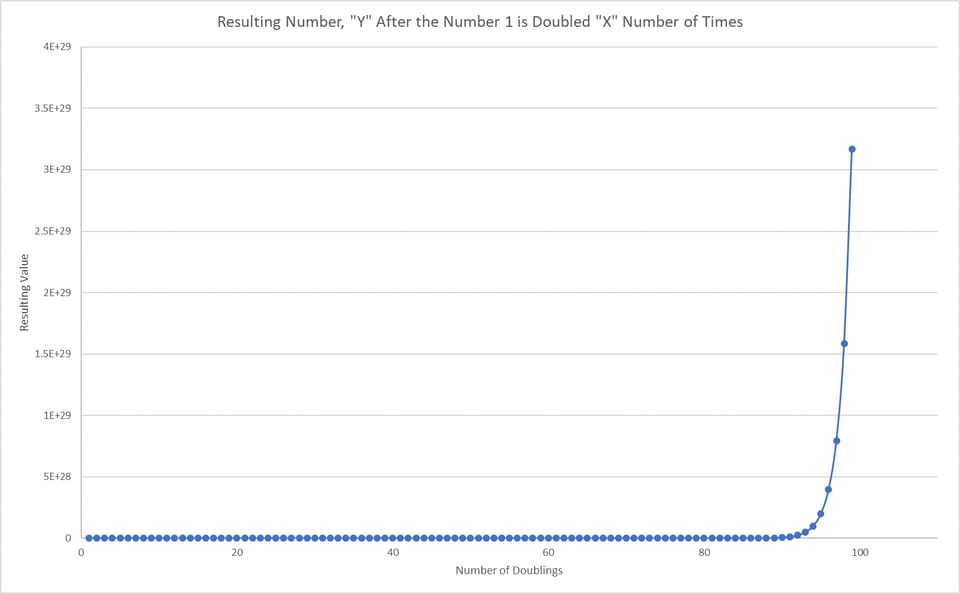
The deviation of the earliest terms from the asymptotic fit also highlights the empirical nature of the formula. Asked about why the linear fit was restricted to terms ten through seventeen, Kong said that the earlier terms are irregular and do not follow the asymptotic trend.
This explosive growth makes the numbers astonishingly large within just a few steps. While the coefficients of the final configuration polynomials remain comparatively modest, the rational numbers in the sequence accumulate immense strings of digits in both their numerators and denominators. By the seventeenth term, the numerator contains thirty-nine thousand four hundred twenty-one digits, while the denominator contains twenty-three thousand six hundred twenty-eight digits.1 Such double-exponential sequences occasionally emerge in highly contrived mathematical constructions, but Kong noted that they are virtually unknown in natural physical models and enumerative combinatorics.1
The emergence of this double-exponential rate was completely unexpected during the initial analysis. Kong said that no prior assumptions were made regarding the sequence, adding that it emerged naturally upon deriving the final structure of the solution and exhibits a remarkably rapid, explosive growth rate. To verify the accuracy of these enormous symbolic calculations, Kong checked his results against classical series expansions developed for the Ising model of magnetism. In the thermodynamic limit, where the grid volume approaches infinity, the grand-canonical partition function relates directly to the monomer-dimer polynomial evaluated at N equals one. Substituting N equals one into his polynomial formulas produced a sequence of configuration numbers that matched, row for row, the historical square-lattice series expansions published by David Gaunt in nineteen-sixty-nine, confirming the reliability of the derived coefficients.1
What are the limits of this new formulation?
The formulation provides an exact structural breakdown of the problem, but it does not provide a fast, polynomial-time algorithm that would violate computational complexity bounds. The paper is an unrefereed preprint posted to arXiv, meaning its derivations have not yet undergone formal peer review by the mathematical physics community.12 Furthermore, because evaluating the full nested expression still requires order two to the power of s operations, computing exact values for configurations with very large numbers of dimers remains computationally demanding.1 The nested summands cannot be recast into simple hypergeometric functions, meaning the exponential complexity is intrinsic to the representation.1
Kong clarified that while the paper provides an explicit expression, the broader question of tractability remains open. Asked where the computational evaluation breaks down, Kong told Primary that while the paper provides a closed-form solution to the monomer-dimer problem, it does not elaborate on its computational tractability. He noted that if the order two to the power of s term persists in a formal computational complexity analysis, it will demonstrate that the problem remains intractable. For higher dimensions, Kong hypothesized that the base of the exponential term scales with the dimension itself, and added that introducing non-periodic boundary conditions will likely complicate the analysis due to broken translational symmetry. Addressing why the nested summands cannot be collapsed into simpler closed forms, Kong said that the presence of terms involving variables raised to complicated index powers in the final formula may preclude further algebraic simplification.
The result also applies specifically to two-dimensional quadratic lattices endowed with periodic boundary conditions whose linear dimensions exceed the dimer count by at least one.1 It does not immediately extend to open planar boundaries, higher-dimensional lattices, or irregular graph networks where boundary effects can alter local geometric freedom. While the discovery demonstrates that sharp-P-complete problems can harbor hidden internal symmetries, it does not suggest that sharp-P problems can be reduced to polynomial-time algorithms, leaving the broad foundation of computational complexity theory intact.
Despite these computational boundaries, revealing the exact anatomy of a sharp-P-complete solution opens fresh lines of inquiry for discrete mathematics and theoretical physics. For decades, the designation of sharp-P completeness acted as an intellectual stop sign, suggesting that exact algebraic relationships could not be uncovered. Demonstrating that a canonical hard problem contains an orderly, recursive framework governed by a double-exponential sequence challenges the assumption that intractability implies structural formlessness. Researchers can now investigate whether similar nested sums and double-exponential sequences govern other intractable counting problems, from polymer coverings in higher dimensions to spin glasses and constraint satisfaction problems.
The record
33 sentences trace to 3 sources and 1 contributor.
-
1
YK
 Yong Kong
Paper
· arxiv.org · 18 Sep 2026
Intractable enumeration problems are like Russian nesting dolls: structural properties of monomer-dimer coverings on two-dimensional quadratic lattices
Preprint · may not have been peer reviewed
See the source
-
2
A
arxiv.org
Paper
· arxiv.org
Intractable enumeration problems are like Russian nesting dolls: structural properties of monomer-dimer coverings on two-dimensional quadratic lattices
Preprint · may not have been peer reviewed
See the source
- 3 Mark Jerrum's publications See the source
- 4 Contribution — Yong Kong 7 statements added to this article
Other consulted pages2 pages
link.springer.com2 pages
ysph.yale.edu1 page
Article history
-
Published 23 Nov 2026, 21:25Assembled by the Primary desk from 3 sources · 1 contributor · 33 cited sentences
-
Yong Kong, a researcher at Yale University
- Go to the sentence: In response to questions from Primary about how these exact numbers control the torus calculations across all scales, Kong said that because intermediate factors and expressions within the derivation depend directly on the sequence, the resulting formula for the number of dimer arrangements likewise depends on g sub i.
- Go to the sentence: Asked about why the linear fit was restricted to terms ten through seventeen, Kong said that the earlier terms are irregular and do not follow the asymptotic trend.
- Go to the sentence: Kong said that no prior assumptions were made regarding the sequence, adding that it emerged naturally upon deriving the final structure of the solution and exhibits a remarkably rapid, explosive growth rate.
- Go to the sentence: Asked where the computational evaluation breaks down, Kong told Primary that while the paper provides a closed-form solution to the monomer-dimer problem, it does not elaborate on its computational tractability.
- Go to the sentence: He noted that if the order two to the power of s term persists in a formal computational complexity analysis, it will demonstrate that the problem remains intractable.
- Go to the sentence: For higher dimensions, Kong hypothesized that the base of the exponential term scales with the dimension itself, and added that introducing non-periodic boundary conditions will likely complicate the analysis due to broken translational symmetry.
- Go to the sentence: Addressing why the nested summands cannot be collapsed into simpler closed forms, Kong said that the presence of terms involving variables raised to complicated index powers in the final formula may preclude further algebraic simplification.