Random hexagonal loops on a sphere tie into trefoil knots
A new geometric calculation shows that six random points on a sphere form a knotted polygon with an exact probability of one divided by sixteen pi squared.

Tying a closed loop of string into a knot in three dimensions requires at least a modest amount of geometric slack. If a loop is made from rigid straight sticks pinned end to end, three sticks can form only a flat triangle, four sticks can bend into an unknotted quadrilateral, and five sticks can flex into space while remaining topologically untangled.1 To form even the simplest genuine knot, known as a trefoil, a rigid closed loop must have at least six straight segments.1 When six points are picked completely at random across the curved surface of a sphere and joined in cyclic order with straight rods, a natural question arises about how often that random closed polygon ends up genuinely tied.1
Knotting is not merely a curiosity of geometric puzzles. Long chain molecules like strands of DNA and industrial polymers continually tumble and fold inside crowded physical spaces, where cellular enzymes called topoisomerases must sever, pass, and reseal entangled molecular strands to prevent lethal snarls.21 Physical knot theorists have sought for decades to understand the baseline statistical rules of how confinement and geometric constraints govern the chance that a wandering strand will become tangled. While computer simulations have long suggested that knots become inevitable as loop lengths approach infinity, computing the exact mathematical probability of forming a knot for any finite number of edges in three dimensions has remained an elusive target.1
To see how a closed six-segment loop can knot itself in three-dimensional space, consider what must happen to the geometry of the polygon step by step. First, three consecutive vertices form a flat triangular disk.1 Second, the remaining three straight segments of the loop must snake across space in a path that pierces straight through the interior of that triangular sheet.1 Third, every triangle formed by each set of three consecutive vertices along the loop must be pierced by an opposite straight rod in a uniform orientation.1 If even one triangle escapes being pierced by an opposing edge, the entire closed loop can be pulled open continuously into a simple circle without cutting the strand.1 Warping the positions of the vertices alters which edges can pass through which interior triangles, making the underlying arrangement of the points the ultimate gatekeeper of whether a knot can exist.
What causes a random six-sided loop on a sphere to form a knot?
A closed six-sided polygon in space forms a knot only when its six vertices happen to create the geometric skeleton of a combinatorially regular octahedron whose diagonals are traversed in a precise sequence.1 In a preprint posted to the arXiv mathematics repository, Joseph Geisz, Chris Peterson, and Clayton Shonkwiler at Colorado State University reported that the exact probability of obtaining a trefoil knot by cyclically connecting six independent points uniformly distributed on a unit sphere is 1 divided by 16 times pi squared, which equals approximately 0.00633257, or roughly 0.633 percent.13 Because six straight sticks can produce only two possible topological states, an unknot or a trefoil knot, this figure gives the complete knotting probability for the six-point spherical model.
The mathematical strategy developed by the authors relies on examining the convex hull of the six points, which is the smallest three-dimensional solid shape with flat faces that fully encloses all six vertices.1 When six points are chosen uniformly at random on a sphere, they sit in general position with probability 1, meaning that no four points ever lie in the same flat plane. Under these conditions, earlier mathematical classification work established that the convex hull must almost surely belong to one of only two possible combinatorial shapes: a regular octahedron, where all six corners have four edges meeting at them, or an irregular octahedron, where two corners meet three edges, two corners meet four edges, and two corners meet five edges.1
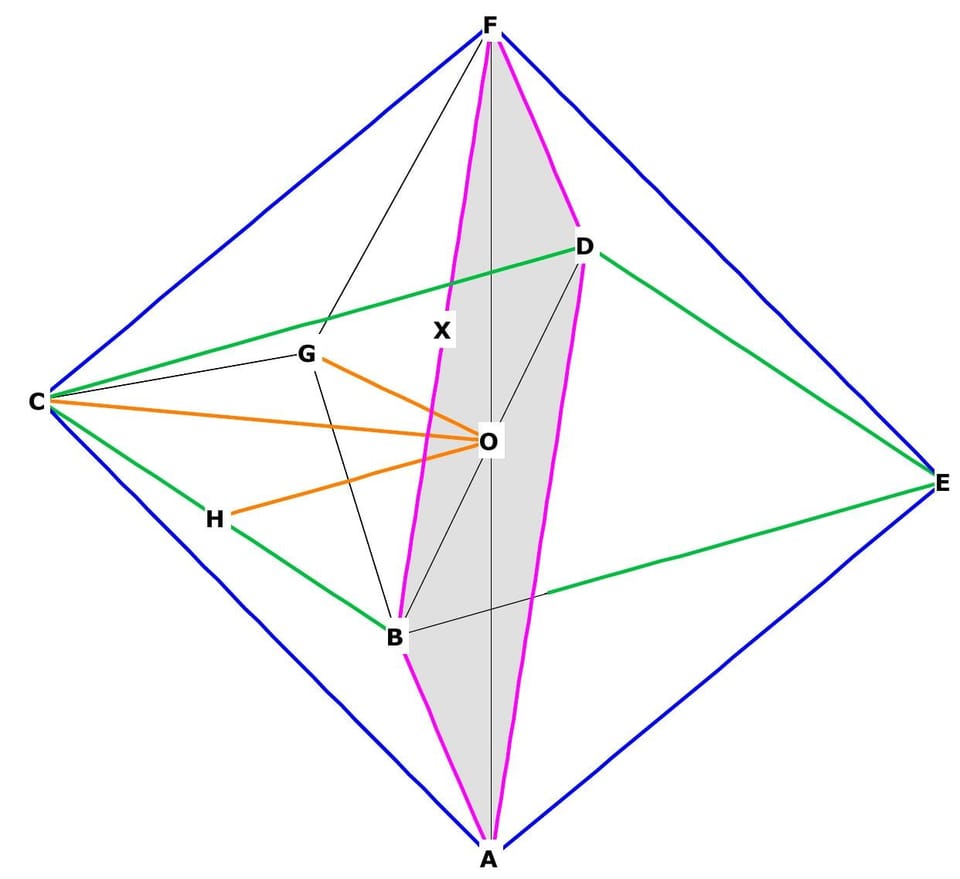
The researchers showed that an irregular octahedron can never produce a trefoil knot regardless of the cyclic order in which its six vertices are linked together.1 In an irregular octahedron, the three internal lines connecting non-adjacent corners, known as diagonals, form a connected three-step chain that shares vertices of degree three. Because an edge can never pierce the interior of a triangle with which it shares an endpoint, this geometric configuration prevents the loop from piercing all required interior triangles. As a result, every one of the 720 possible cyclic permutations of the vertices on an irregular octahedron produces nothing more than an unknotted loop.1
By contrast, when the six vertices form a regular octahedron, the three interior diagonals are completely disjoint from one another, crossing the interior of the solid without sharing vertices.1 Each diagonal slices through the middle of exactly two interior triangles formed by the other four points. Out of the 720 possible permutations of the six ordered points, exactly 12 cyclic orderings, which represent a single unoriented six-cycle through the corners, succeed in incorporating all three interior diagonals alongside the precise boundary edges needed to pierce all six consecutive triangles. The remaining 708 orderings collapse into ordinary unknots.1
How did the mathematicians calculate the exact odds of this geometric arrangement?
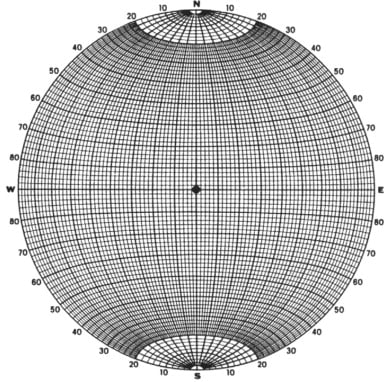
The calculation of the regular octahedron probability relies on transforming the three-dimensional sphere into a two-dimensional flat plane through stereographic projection, a geometric technique that maps points from a sphere onto a plane by tracing straight lines from a chosen pole.1 By fixing one of the six random spherical points at the north pole and projecting the remaining five points onto the equatorial plane, the problem converts into determining how often those five planar points span a five-sided polygon, a four-sided quadrilateral, or a three-sided triangle.1
In the projected plane, the points no longer follow a uniform distribution, but instead follow an explicit probability rule known as a beta-prime measure, where the probability density at coordinates x and y is given by 1 divided by pi times the quantity 1 plus x squared plus y squared squared.13 The authors demonstrated that the convex hull of the five points in the plane forms a triangle if and only if the original sixth point on the sphere had degree three in its three-dimensional hull, an outcome that can happen only within an irregular octahedron.1 This connection established that the probability of forming a regular octahedron equals 1 minus three times the probability that the five projected planar points form a triangle.1 Clayton told Primary that "If we end up with a triangle in the plane, then we know that the fixed point was a degree 3 vertex; that is, one which is connected to three edges. Since two out of the six vertices of the irregular octahedron are degree 3, there's a 2/6 = 1/3 chance that the irregular octahedron projects to a triangle (and no chance that the regular octahedron does). Since the probability of the irregular octahedron is 1 minus the probability of the regular octahedron, this gives the connection."
Finding the chance that five random planar points form a triangle reduces to computing the expected squared probability content of a random triangle formed by the first three points, representing the likelihood that the remaining two independent points both land inside it.1 Joseph Geisz, Chris Peterson, and Clayton Shonkwiler deployed Stokes theorem, a foundational calculus identity that converts an integral over a surface into an integral over its bounding loop, alongside the Blaschke-Petkantschin formula from integral geometry to calculate this expected area.13 Clayton said in response to questions from Primary that "It's a hard integral! You have to integrate over the triangle formed by three points, then integrate over all possible positions of the three points. In principle, it's an 8-dimensional integral. Using Stokes' theorem cuts it down to a 5-dimensional integral, and the Blaschke–Petkantschin formula gets rid of another dimension, so we've cut the number of dimensions in half."
This integration yielded an exact probability of 15 divided by 4 times pi squared, or roughly 0.379954, that the six spherical points form a combinatorially regular octahedron.13 Multiplying this figure by 12 divided by 720 yielded the final exact trefoil probability of 1 divided by 16 times pi squared.3 Explaining the appearance of the constant factor in the denominator, Clayton said that "Fundamentally, this boils down to the fact that the surface area of the sphere is 4π, though I don't have a good intuitive explanation of why one should have expected this particular answer."
What does this result leave unanswered about other random knot models?
This exact probability value applies specifically to random jump polygons whose vertices are chosen independently and uniformly across a two-dimensional sphere, and it cannot predict the exact knotting frequencies of polygons whose edges have fixed, equal lengths or whose paths follow discrete lattices.1 Clayton explained that "Beyond six vertices, there's no longer the strong correlation between which type of convex hull you get and what knots you can get. There are also more knot types and more convex hull types. For fixed edge lengths, the vertices are no longer necessarily on the convex hull, so the connection is even weaker." In an equilateral hexagon where all six straight sticks must have identical unit lengths, for instance, the vertices cannot move independently across a single sphere. Earlier research by Kathleen Hake using symplectic geometry showed that the knotting probability for equilateral hexagons is bounded above by the quantity 14 minus 3 times pi divided by 192, which is less than 1 divided by 42, or approximately 0.0238. That upper bound is nearly four times higher than the exact 0.00633 value determined for the unconstrained spherical model, reflecting how different geometric constraints reshape knotting chances.1
The spherical jump model also operates under the mathematical simplification that the connecting rods can pass freely through one another during random generation rather than repelling one another like physical material strands. In biological macromolecules and physical polymer melts, self-avoidance prevents segments from occupying the same physical coordinates. Lattice investigations by E. J. Janse van Rensburg and Andrew Rechnitzer on cubic grids have shown that while unknots decay exponentially with polygon length, the relative likelihoods of different prime knots appear to approach universal amplitude ratios, such as a long polygon being roughly 28 times more likely to form a trefoil than a figure-eight knot.56 The spherical six-point result provides an exact benchmark for an idealized geometric model, but physical systems require accounting for finite thickness, excluded volume, and long-range chemical interactions.
The preprint by Joseph Geisz, Chris Peterson, and Clayton Shonkwiler is currently posted to the arXiv preprint server and has not yet undergone peer review.13 While the mathematical derivation builds on established theorems in integral geometry and combinatorial topology, the analysis is limited strictly to closed polygons with exactly six edges, the minimal stick number required to tie a trefoil. The authors note that the probability distribution for five points under the planar beta-prime measure also satisfies the curious property that the odds of forming a triangle exactly equal the odds of forming a pentagon, with each occurring with probability 1 divided by 3 minus 5 divided by 4 times pi squared, or about 0.20668, while a quadrilateral occurs with probability 1 divided by 3 plus 5 divided by 2 times pi squared, or about 0.58664.1 Addressing this balance, Clayton told Primary that "It really just reflects the fact that the irregular octahedron has 2 vertices of degree 3 and 2 of degree 5. So the probability of picking a vertex of degree 3 to project from (producing a triangle) is the same as the probability of picking a vertex of degree 5 (and getting a pentagon)."
How could exact geometric probabilities change how scientists study complex polymers?
Establishing an exact closed-form knot probability gives mathematicians and statistical physicists a rigorous baseline against which numerical simulations and approximate knotting theories can be tested. For decades, researchers modeling the topological entanglements of DNA rings inside viral capsids or synthetic polymer rings have relied on Monte Carlo sampling, where computer algorithms generate millions of random paths to estimate knot frequencies. Having an exact analytical solution for six-vertex spherical knots provides a reference point for validating these sampling algorithms, ensuring that numerical techniques preserve true measure-preserving properties in geometric spaces.
The connection established between three-dimensional knotting and planar Sylvester-type problems also opens new analytical avenues for studying convex hulls. In 1864, the mathematician James Joseph Sylvester asked for the probability that four points chosen at random in the plane form the vertices of a convex quadrilateral, igniting a century-long exploration of geometric probability. By linking the combinatorial classification of three-dimensional octahedra to five-point beta-prime polygons in the plane, the Colorado State University authors demonstrated that modern tools from integral geometry can solve multi-point problems for non-compact probability distributions.1 Regarding the foundational role of the sphere in this calculation, Clayton told Primary that "The fact that it's on the sphere is what allows us to use stereographic projection. The fact that it was uniform led to this specific beta-prime distribution. It's probably the case that other distributions on the sphere would lead to nice distributions on the plane, so maybe you could use a similar approach for those problems, but it's not so clear to me what other spherical distributions you'd want to compute knotting probabilities for." Applying these integral techniques to random polygons with seven or eight vertices could eventually clarify how topological complexity accumulates as molecular loops grow longer.
The record
48 sentences trace to 5 sources and 1 contributor.
-
1
JG
 Joseph Geisz, Chris Peterson, Clayton Shonkwiler
Paper
· arxiv.org · 22 Sep 2026
Trefoil Probabilities and Polyhedra
Preprint · may not have been peer reviewed
See the source
-
2
A
arxiv.org
Paper
· arxiv.org
Knotting Probability of Equilateral Hexagons
Preprint · may not have been peer reviewed
See the source
-
3
A
arxiv.org
Paper
· arxiv.org
Trefoil Probabilities and Polyhedra
Preprint · may not have been peer reviewed
See the source
- 4 Contribution — Clayton Shonkwiler 11 statements added to this article
-
5
A
arxiv.org
Paper
· arxiv.org
On the universality of knot probability ratios
Preprint · may not have been peer reviewed
See the source
-
6
A
arxiv.org
Paper
· arxiv.org
On the universality of knot probability ratios
Preprint · may not have been peer reviewed
See the source
Other consulted pages1 page
arxiv.org1 page
Article history
-
Published 23 Nov 2026, 23:00Assembled by the Primary desk from 5 sources · 1 contributor · 48 cited sentences
-
Clayton Shonkwiler
- Go to the sentence: This connection established that the probability of forming a regular octahedron equals 1 minus three times the probability that the five projected planar points form a triangle.
- Go to the sentence: Clayton told Primary that "If we end up with a triangle in the plane, then we know that the fixed point was a degree 3 vertex; that is, one which is connected to three edges. Since two out of the six vertices of the irregular octahedron are degree 3, there's a 2/6 = 1/3 chance that the irregular octahedron projects to a triangle (and no chance that the regular octahedron does). Since the probability of the irregular octahedron is 1 minus the probability of the regular octahedron, this gives the connection."
- Go to the sentence: Joseph Geisz, Chris Peterson, and Clayton Shonkwiler deployed Stokes theorem, a foundational calculus identity that converts an integral over a surface into an integral over its bounding loop, alongside the Blaschke-Petkantschin formula from integral geometry to calculate this expected area.
- Go to the sentence: Clayton said in response to questions from Primary that "It's a hard integral! You have to integrate over the triangle formed by three points, then integrate over all possible positions of the three points. In principle, it's an 8-dimensional integral. Using Stokes' theorem cuts it down to a 5-dimensional integral, and the Blaschke–Petkantschin formula gets rid of another dimension, so we've cut the number of dimensions in half."
- Go to the sentence: Explaining the appearance of the constant factor in the denominator, Clayton said that "Fundamentally, this boils down to the fact that the surface area of the sphere is 4π, though I don't have a good intuitive explanation of why one should have expected this particular answer."
- Go to the sentence: This exact probability value applies specifically to random jump polygons whose vertices are chosen independently and uniformly across a two-dimensional sphere, and it cannot predict the exact knotting frequencies of polygons whose edges have fixed, equal lengths or whose paths follow discrete lattices.
- Go to the sentence: Clayton explained that "Beyond six vertices, there's no longer the strong correlation between which type of convex hull you get and what knots you can get. There are also more knot types and more convex hull types. For fixed edge lengths, the vertices are no longer necessarily on the convex hull, so the connection is even weaker."
- Go to the sentence: The authors note that the probability distribution for five points under the planar beta-prime measure also satisfies the curious property that the odds of forming a triangle exactly equal the odds of forming a pentagon, with each occurring with probability 1 divided by 3 minus 5 divided by 4 times pi squared, or about 0.20668, while a quadrilateral occurs with probability 1 divided by 3 plus 5 divided by 2 times pi squared, or about 0.58664.
- Go to the sentence: Addressing this balance, Clayton told Primary that "It really just reflects the fact that the irregular octahedron has 2 vertices of degree 3 and 2 of degree 5. So the probability of picking a vertex of degree 3 to project from (producing a triangle) is the same as the probability of picking a vertex of degree 5 (and getting a pentagon)."
- Go to the sentence: By linking the combinatorial classification of three-dimensional octahedra to five-point beta-prime polygons in the plane, the Colorado State University authors demonstrated that modern tools from integral geometry can solve multi-point problems for non-compact probability distributions.
- Go to the sentence: Regarding the foundational role of the sphere in this calculation, Clayton told Primary that "The fact that it's on the sphere is what allows us to use stereographic projection. The fact that it was uniform led to this specific beta-prime distribution. It's probably the case that other distributions on the sphere would lead to nice distributions on the plane, so maybe you could use a similar approach for those problems, but it's not so clear to me what other spherical distributions you'd want to compute knotting probabilities for."