Recurrent stellar explosion will mask its early radio flash behind surrounding gas
Astronomers modeling the upcoming eruption of T Coronae Borealis find thick debris will shroud a brilliant initial burst of radio waves for weeks
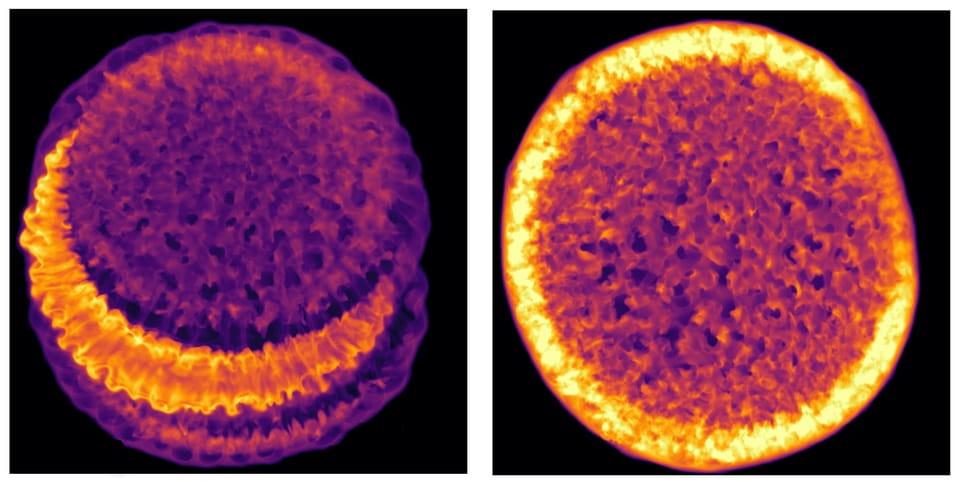
A binary star system known as T Coronae Borealis is nearing a thermonuclear outburst, but the early radio glow will conceal the true physical structure of the explosion.1 In this celestial pair, a compact white dwarf star periodically siphons material from an evolved red giant companion until the accumulated hydrogen detonates in a runaway nuclear reaction. When the resulting blast wave tears outward, it plunges directly into thick clouds of gas previously cast off by the red giant. The earliest radio signal will show a distorted shape, because surrounding debris selectively obscures parts of the expanding volume.1 As the nearest symbiotic recurrent nova to Earth, this interacting binary offers a rare opportunity to study how astrophysical shock waves evolve and how cosmic shocks accelerate charged particles up to relativistic speeds.1
Before radio telescopes can detect the event, several physical steps must unfold in sequence. First, hydrogen-rich gas pulled from the red giant collects on the white dwarf until extreme pressure triggers a runaway nuclear explosion. Second, this blast hurls a shell of matter outward into the circumbinary medium, the gas environment surrounding both stars.1 Third, the collision between the fast-moving ejecta and slower circumstellar gas creates an expanding forward shock wave. Fourth, this shock wave accelerates electrons, which spiral through magnetic fields and generate intense radio emissions known as synchrotron radiation.1 Finally, that radiation must pass through the dense envelope of shocked gas and ejected debris, which absorbs the radio waves until the expanding cloud thins out into interstellar space.
According to a preprint posted on September 24, 2026, to the arXiv server by O. Petruk and colleagues, the intrinsic radio outburst will be extraordinarily bright on its first day, yet almost entirely hidden from view.1 The researchers modeled the forthcoming eruption to predict its radio emission and assess how observations can probe the surrounding environment and particle acceleration.1 The paper reports that unabsorbed radio fluxes could reach between 100 and 1,000 janskys, a standard unit of radio flux density, at gigahertz frequencies during the first day of the outburst.1 Dense ejecta and shocked circumbinary gas will strongly absorb this radiation, reducing the observable radio brightness by several orders of magnitude.1
Why will the initial radio signal remain hidden?
Dense stellar gas and expanding explosion debris absorb the initial radio wave emissions, drastically dampening the observable brightness during the first days of the event.1 The authors found that early radio morphology should not be interpreted directly as intrinsic shock geometry, because free-free absorption selectively obscures regions of the three-dimensional emitting volume.1 Free-free absorption occurs when free electrons in a hot plasma absorb passing radio photons while colliding with ions, preventing the signal from escaping outward.
The masking effect prevents observers from taking early telescope images at face value. Oleh, an author of the study, said in response to questions from Primary that a single-frequency image at one early epoch cannot cleanly distinguish absorption from intrinsic asymmetry. Oleh explained that absorption is strongly frequency-dependent because denser parts of the surrounding material remain opaque for longer at lower frequencies, progressively revealing the underlying emission as the ejecta expand and optical depth decreases. If observers trace the morphology across multiple frequencies and epochs, an apparent asymmetry that changes with frequency and disappears as the source becomes optically thin points to absorption, whereas a persistent spatial deformity across transparent channels points to an intrinsically lopsided blast.
The source will gradually clear as the explosion expands into space. According to the preprint, the system becomes largely transparent at gigahertz frequencies within about one month after the explosion begins.1 As the dense material disperses, the radio spectral index, which measures how brightness changes across different frequencies, will evolve from positive values caused by absorption to an optically thin synchrotron value of about -0.5 after several weeks. Asked what could delay that spectral transition, Oleh told Primary that the shift would stall if the shock encountered a circumbinary medium that remained sufficiently dense and extended to keep free-free absorption high, such as a wind that is denser than predicted or extended clumps at larger radii.
What generates the delayed radio brightness?
High-energy electrons accelerated by the expanding forward shock wave produce synchrotron radiation as they spiral along magnetic field lines.1 The preprint indicates that non-thermal synchrotron radiation dominates the intrinsic radio emission throughout the first year following the eruption.1 In contrast, thermal free-free emission, which arises from random collisions between charged particles in heated gas, becomes important only if dense gas is concentrated in an equatorial ring around the binary system.1
The presence of such an equatorial structure remains unresolved in the system. Oleh told Primary that whether a dense accretion disk exists in this symbiotic binary is still an open question. To explore this, the researchers compared two models that differed only in whether a disk was included. Oleh noted that predicted light curves in both models proved surprisingly similar because reduced absorption in the disk-free configuration is counterbalanced by lower synchrotron emission, though spatial morphology and spectral index evolution still differ substantially across frequencies.
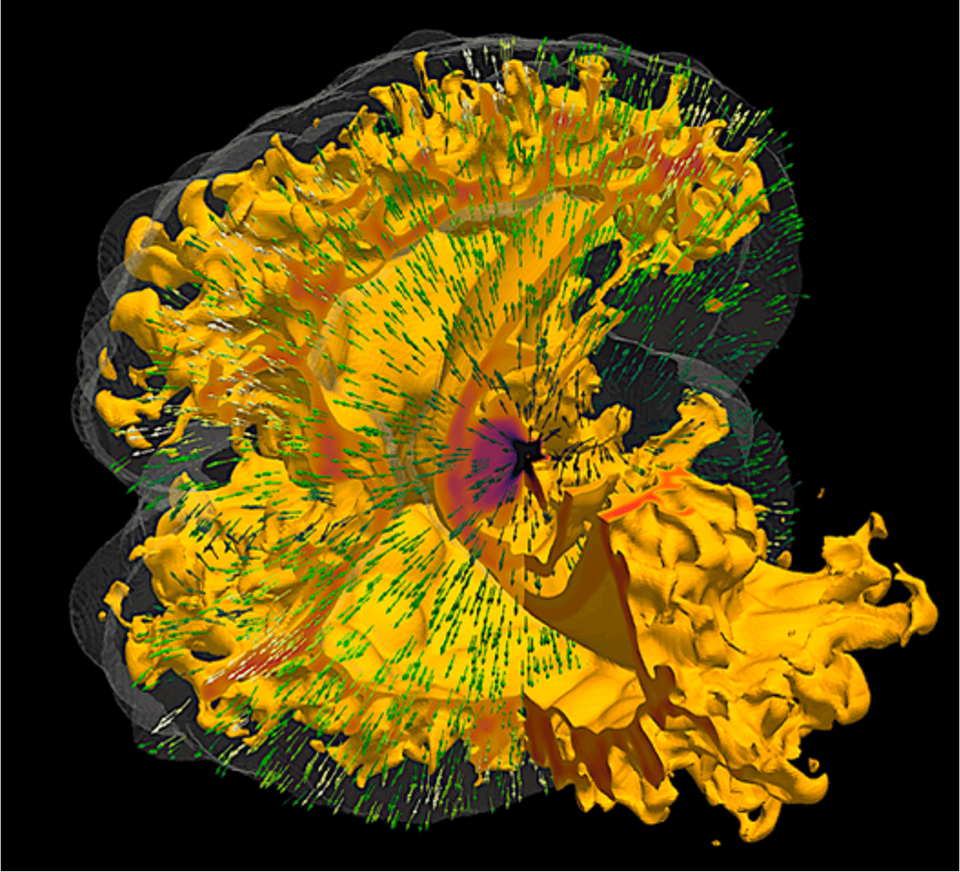
The researchers calculated these emissions by post-processing three-dimensional hydrodynamic simulations of nova explosions with a multi-zone model for particle acceleration.1 Their calculations incorporated synchrotron self-absorption, free-free absorption, and the Razin effect, which suppresses radio emissions when charged particles move through dense plasma.1 Oleh told Primary that the Razin effect acts as a secondary correction, reducing the 1-gigahertz flux by at most a factor of three during the first week, while absorption reduces observable flux by multiple orders of magnitude. Oleh added that the largest modeling uncertainty stems from the magnetic field in the shocked plasma, which governs synchrotron intensity, Razin suppression, and synchrotron self-absorption.
They also identified a brief polarized radio signal that could emerge during the first few days if the red giant star contributes its own magnetic field to the field generated by cosmic rays.1 Oleh told Primary that the critical factor is the ratio between the disordered magnetic field generated by cosmic rays and the ordered field carried by the red giant wind. The cosmic-ray field dominates across most of the system, yet the red giant ordered field can dominate in a localized region near the giant star. Because the forward shock sweeps through that immediate neighborhood within days, the resulting polarization signal will be brief.
What can upcoming observations measure?
Multi-frequency radio monitoring and polarization measurements during the early outburst can reveal the underlying density structure and magnetic fields of the stellar system.1 By tracking the radio spectrum from the earliest days of the eruption, astronomers can test theoretical models of particle acceleration in symbiotic recurrent novae under real-world conditions.1
These predictions are numerical simulations based on physical assumptions rather than direct observational records of the upcoming outburst. The model outputs depend on idealized configurations of stellar wind densities, blast energies, and magnetic structures that may differ from the actual environment around the binary stars. In addition, the findings are drawn from a preprint posted to the arXiv server on September 24, 2026, which has not yet completed peer review. A failure to detect high flux immediately after the outburst would not rule out the model, because dense gas is expected to obscure early emissions. As Oleh explained, evidence against the model would instead require sensitive multi-frequency light curves that fail to show the predicted frequency-dependent peak as the gas thins.
Astronomers are now preparing ground-based radio observatories to monitor T Coronae Borealis the moment optical telescopes confirm the eruption has started. Early multi-frequency tracking and polarimetry will provide an immediate test of how shock waves accelerate particles in the nearest symbiotic recurrent nova system.1 Oleh described the upcoming event as a rare opportunity, noting that with an outburst recurring roughly once every 80 years, the system serves as a real-time laboratory for studying cosmic-ray acceleration.
The record
34 sentences trace to 1 source and 1 contributor.
-
1
OP
 O. Petruk, T. Kuzyo, S. Orlando, L. Chomiuk, F. Bocchino, M. Miceli, V. Beshley
Paper
· arxiv.org · 24 Sep 2026
Radio component of the multi-messenger emission from the anticipated T Coronae Borealis outburst
Preprint · may not have been peer reviewed
See the source
- 2 Contribution — Oleh Petruk 25 statements added to this article
Other consulted pages1 page
Article history
-
Published 23 Nov 2026, 23:00Assembled by the Primary desk from 1 source · 1 contributor · 34 cited sentences
-
Oleh Petruk
- Go to the sentence: The earliest radio signal will show a distorted shape, because surrounding debris selectively obscures parts of the expanding volume.
- Go to the sentence: As the nearest symbiotic recurrent nova to Earth, this interacting binary offers a rare opportunity to study how astrophysical shock waves evolve and how cosmic shocks accelerate charged particles up to relativistic speeds.
- Go to the sentence: The paper reports that unabsorbed radio fluxes could reach between 100 and 1,000 janskys, a standard unit of radio flux density, at gigahertz frequencies during the first day of the outburst.
- Go to the sentence: Dense ejecta and shocked circumbinary gas will strongly absorb this radiation, reducing the observable radio brightness by several orders of magnitude.
- Go to the sentence: Dense stellar gas and expanding explosion debris absorb the initial radio wave emissions, drastically dampening the observable brightness during the first days of the event.
- Go to the sentence: The authors found that early radio morphology should not be interpreted directly as intrinsic shock geometry, because free-free absorption selectively obscures regions of the three-dimensional emitting volume.
- Go to the sentence: Oleh, an author of the study, said in response to questions from Primary that a single-frequency image at one early epoch cannot cleanly distinguish absorption from intrinsic asymmetry.
- Go to the sentence: Oleh explained that absorption is strongly frequency-dependent because denser parts of the surrounding material remain opaque for longer at lower frequencies, progressively revealing the underlying emission as the ejecta expand and optical depth decreases.
- Go to the sentence: If observers trace the morphology across multiple frequencies and epochs, an apparent asymmetry that changes with frequency and disappears as the source becomes optically thin points to absorption, whereas a persistent spatial deformity across transparent channels points to an intrinsically lopsided blast.
- Go to the sentence: Asked what could delay that spectral transition, Oleh told Primary that the shift would stall if the shock encountered a circumbinary medium that remained sufficiently dense and extended to keep free-free absorption high, such as a wind that is denser than predicted or extended clumps at larger radii.
- Go to the sentence: In contrast, thermal free-free emission, which arises from random collisions between charged particles in heated gas, becomes important only if dense gas is concentrated in an equatorial ring around the binary system.
- Go to the sentence: Oleh told Primary that whether a dense accretion disk exists in this symbiotic binary is still an open question.
- Go to the sentence: Oleh noted that predicted light curves in both models proved surprisingly similar because reduced absorption in the disk-free configuration is counterbalanced by lower synchrotron emission, though spatial morphology and spectral index evolution still differ substantially across frequencies.
- Go to the sentence: Their calculations incorporated synchrotron self-absorption, free-free absorption, and the Razin effect, which suppresses radio emissions when charged particles move through dense plasma.
- Go to the sentence: Oleh told Primary that the Razin effect acts as a secondary correction, reducing the 1-gigahertz flux by at most a factor of three during the first week, while absorption reduces observable flux by multiple orders of magnitude.
- Go to the sentence: Oleh added that the largest modeling uncertainty stems from the magnetic field in the shocked plasma, which governs synchrotron intensity, Razin suppression, and synchrotron self-absorption.
- Go to the sentence: They also identified a brief polarized radio signal that could emerge during the first few days if the red giant star contributes its own magnetic field to the field generated by cosmic rays.
- Go to the sentence: Oleh told Primary that the critical factor is the ratio between the disordered magnetic field generated by cosmic rays and the ordered field carried by the red giant wind.
- Go to the sentence: The cosmic-ray field dominates across most of the system, yet the red giant ordered field can dominate in a localized region near the giant star.
- Go to the sentence: Because the forward shock sweeps through that immediate neighborhood within days, the resulting polarization signal will be brief.
- Go to the sentence: Multi-frequency radio monitoring and polarization measurements during the early outburst can reveal the underlying density structure and magnetic fields of the stellar system.
- Go to the sentence: By tracking the radio spectrum from the earliest days of the eruption, astronomers can test theoretical models of particle acceleration in symbiotic recurrent novae under real-world conditions.
- Go to the sentence: As Oleh explained, evidence against the model would instead require sensitive multi-frequency light curves that fail to show the predicted frequency-dependent peak as the gas thins.
- Go to the sentence: Early multi-frequency tracking and polarimetry will provide an immediate test of how shock waves accelerate particles in the nearest symbiotic recurrent nova system.
- Go to the sentence: Oleh described the upcoming event as a rare opportunity, noting that with an outburst recurring roughly once every 80 years, the system serves as a real-time laboratory for studying cosmic-ray acceleration.