Early clues shape physical movement across the cortex and thalamus
Advance warnings let brain circuits prepare directional actions before a final command arrives, with the thalamus signaling ahead of the cortex.

An animal moving through a changing environment rarely acts from a complete standstill. When an early hint reveals what is about to happen, the nervous system prepares for the physical demand long before the final command arrives. A runner crouches before the starting gun, and a predator shifts its balance when prey turns toward an escape route. This capacity to turn advance clues into physical readiness allows actions to unfold faster and more accurately when the decisive moment strikes.
Preparing a movement in advance sounds straightforward, but it creates a delicate mechanical challenge for the brain. The nervous system must assemble a specific motor plan and hold it in reserve without letting the muscles fire too soon. If the preparatory signal is too weak, the animal gains no advantage when the cue arrives. If the signal is too strong, the animal risks committing to an incorrect action before the final instruction confirms the right choice.
For an advance hint to successfully guide an action, the brain must complete a chain of four events in sequence. First, a sensory cue provides context indicating which movement will likely be needed. Second, the brain translates that contextual hint into an internal representation of the upcoming action. Third, the animal holds that prospective plan in working memory while keeping the physical response suppressed. Fourth, when a final instruction signal appears, the nervous system promptly releases the prepared movement.
How does advance warning shape a physical movement?
Advance warning improves behavioral accuracy and triggers small, directional movements before the official instruction ever arrives.1 In a preprint posted to the bioRxiv server, D. Hähnke and colleagues examined this process by training mice on a contextual response-planning task, a behavioral test designed to measure how advance information shapes subsequent decisions.1 In the experiment, auditory cues either predicted an upcoming instructed movement or left the identity of the required response unresolved until a later instruction sound played.1
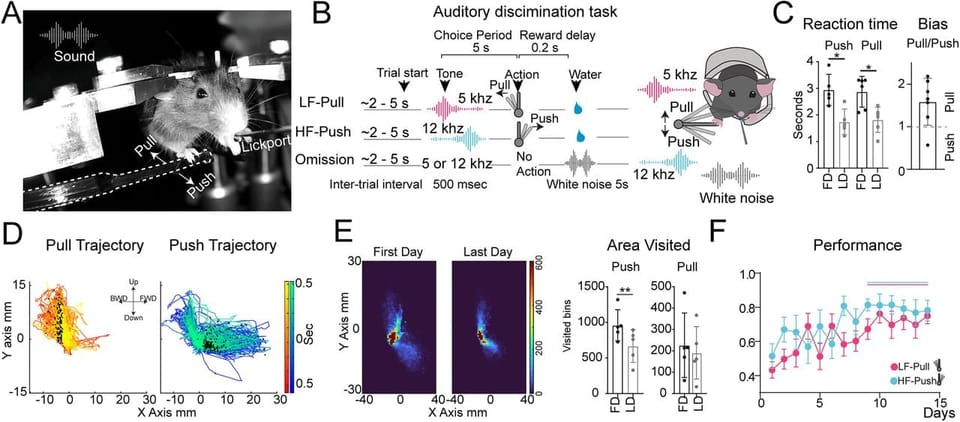
Predictive contexts gave the animals a clear behavioral advantage.1 The authors reported that mice achieved higher accuracy when the preceding auditory cues signaled the correct movement in advance compared to when the context left the response ambiguous.1 Simon, a researcher on the project, noted in response to questions from Primary that baseline performance was already strong, observing that "behavioural accuracy in ambiguous trials was also very high (above 90%), which was even improved with predictive cues. Since the animals already performed near ceiling, the behavioural gains for predictive cues were small, but significant" when measured against the uninformative baseline.
The mice also produced subthreshold, directionally biased movements during this waiting period, meaning their bodies leaned toward the target direction before the instruction onset occurred.1 These subtle physical twitches confirmed that the animals actively used the contextual cues to prepare their actions during the preparatory window.1 Simon told Primary that the physical bias was not an unexpected complication, explaining that "it was an important and intended confirmation that the task we trained the animals to do indeed tapped into response planning" during the pre-movement delay.
What happens when the thalamus and cortex track the same goal?
The prelimbic cortex and the mediodorsal thalamus divide the cognitive work of planning by activating on distinct timelines.1 The prelimbic cortex, an area within the prefrontal cortex involved in high-level decision-making, works closely with the mediodorsal thalamus, a subcortical hub with extensive connections across the cognitive control network.13 D. Hähnke and colleagues monitored both structures using extracellular recordings, an electrophysiological method that detects the electrical pulses fired by individual cells and local clusters.1
Both brain regions tracked the prospective response side, but the mediodorsal thalamus acted earlier in the sequence.1 Extracellular recordings revealed prospective response-side information in both the prelimbic cortex and the mediodorsal thalamus, yet the mediodorsal thalamus represented the future movement direction earlier during the context epoch.1 Simon told Primary that the exact neural pathway driving this early subcortical activity remains unknown, remarking that "that's an important question for future research. We don't have an answer to that with the present data set" from the current recordings.
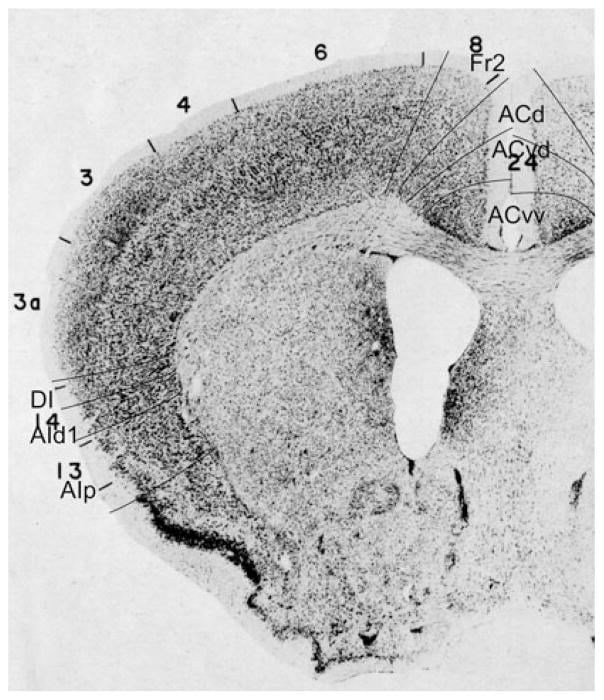
The mediodorsal thalamus also showed a planning-related temporal advance after instruction onset, shifting its neural activity earlier in time when the animal had already received advance warning.1 Explaining how this temporal change was established, Simon told Primary that the team quantified the signal across the entire population: "We used an analysis that quantified how much information the neuronal activity carried about the upcoming response. In trials with predictive context, that information increased earlier that in trials with uninformative cues. We pooled all neurons across recording sessions, meaning we did not perform this analysis on a per-session basis" when measuring the timeline shift.
The prelimbic cortex carried out a complementary role by maintaining stable information across the transition to action.1 The authors found that the prelimbic cortex exhibited enhanced coding during the instruction epoch and showed stronger cross-epoch generalization, maintaining a consistent neural code from the preparatory context into the final instruction period.1 This persistent representational bridging across epochs was concentrated within sparse neuronal subpopulations, small groups of cortical cells that sustained the directional plan across the entire planning window.1 Simon noted that future perturbation studies could directly test this connection: "If we had a way to selectively inhibit this small group of neurons and if we then still saw that the planning signals generalised across epochs, we would have to conclude that the sparse population was not mechanistically involved in the carry-over" from the context stage to execution.
What does the experiment leave unresolved?
The findings represent an observational study in animal models and have not yet undergone peer review. The study, authored by D. Hähnke, A. Ranganath, X. Wang, S. Ayasreh Fierro, T. W. Bernklau, and S. N. Jacob, was posted as a preprint on the bioRxiv server. While the extracellular recordings document clear correlations between neural firing patterns and animal behavior, the recordings alone cannot demonstrate whether silencing the sparse cortical neurons or thalamic pathways would abolish the planning advantage.1 Furthermore, the experiments examined mice responding to auditory tones in a laboratory task, which cannot capture how complex animals navigate shifting natural environments with competing sensory inputs.1
Caution is also required when interpreting the scope of the neural network involved. When asked about potential overinterpretations of the findings, Simon warned against concluding "that the two regions we studied were the only ones critically involved in response planning" across the whole brain.
The complementary dynamics nevertheless suggest how prefrontal and thalamic circuits coordinate flexible action planning.1 The mediodorsal thalamus provides an early signal that helps advance the timing of motor choices, showing that subcortical circuits actively participate in organizing behavior.1 Future work will need to test whether direct manipulation of these thalamocortical connections disrupts preparatory movements, clarifying how the brain coordinates internal expectations with immediate sensory triggers.
The record
31 sentences trace to 2 sources and 1 contributor.
-
1
HD
 Hähnke, D., Ranganath, A., Wang, X., Ayasreh Fierro, S., Bernklau, T. W., Jacob, S. N.
Paper
· biorxiv.org · 11 Sep 2026
Complementary prefrontal and thalamic representational dynamics during response planning
Preprint · may not have been peer reviewed
See the source
- 2 Contribution — Simon 14 statements added to this article
-
3
N
 nature.com
Paper
· nature.com
Thalamic circuits for independent control of prefrontal signal and noise - Nature
Journal article
See the source
Other consulted pages1 page
Article history
-
Published 23 Nov 2026, 23:00Assembled by the Primary desk from 2 sources · 1 contributor · 31 cited sentences
-
Simon, a researcher on the project
- Go to the sentence: The authors reported that mice achieved higher accuracy when the preceding auditory cues signaled the correct movement in advance compared to when the context left the response ambiguous.
- Go to the sentence: Simon, a researcher on the project, noted in response to questions from Primary that baseline performance was already strong, observing that "behavioural accuracy in ambiguous trials was also very high (above 90%), which was even improved with predictive cues. Since the animals already performed near ceiling, the behavioural gains for predictive cues were small, but significant" when measured against the uninformative baseline.
- Go to the sentence: The mice also produced subthreshold, directionally biased movements during this waiting period, meaning their bodies leaned toward the target direction before the instruction onset occurred.
- Go to the sentence: These subtle physical twitches confirmed that the animals actively used the contextual cues to prepare their actions during the preparatory window.
- Go to the sentence: Simon told Primary that the physical bias was not an unexpected complication, explaining that "it was an important and intended confirmation that the task we trained the animals to do indeed tapped into response planning" during the pre-movement delay.
- Go to the sentence: Extracellular recordings revealed prospective response-side information in both the prelimbic cortex and the mediodorsal thalamus, yet the mediodorsal thalamus represented the future movement direction earlier during the context epoch.
- Go to the sentence: Simon told Primary that the exact neural pathway driving this early subcortical activity remains unknown, remarking that "that's an important question for future research. We don't have an answer to that with the present data set" from the current recordings.
- Go to the sentence: The mediodorsal thalamus also showed a planning-related temporal advance after instruction onset, shifting its neural activity earlier in time when the animal had already received advance warning.
- Go to the sentence: Explaining how this temporal change was established, Simon told Primary that the team quantified the signal across the entire population: "We used an analysis that quantified how much information the neuronal activity carried about the upcoming response. In trials with predictive context, that information increased earlier that in trials with uninformative cues. We pooled all neurons across recording sessions, meaning we did not perform this analysis on a per-session basis" when measuring the timeline shift.
- Go to the sentence: This persistent representational bridging across epochs was concentrated within sparse neuronal subpopulations, small groups of cortical cells that sustained the directional plan across the entire planning window.
- Go to the sentence: Simon noted that future perturbation studies could directly test this connection: "If we had a way to selectively inhibit this small group of neurons and if we then still saw that the planning signals generalised across epochs, we would have to conclude that the sparse population was not mechanistically involved in the carry-over" from the context stage to execution.
- Go to the sentence: While the extracellular recordings document clear correlations between neural firing patterns and animal behavior, the recordings alone cannot demonstrate whether silencing the sparse cortical neurons or thalamic pathways would abolish the planning advantage.
- Go to the sentence: Caution is also required when interpreting the scope of the neural network involved.
- Go to the sentence: When asked about potential overinterpretations of the findings, Simon warned against concluding "that the two regions we studied were the only ones critically involved in response planning" across the whole brain.