Biochar and beneficial microbes sustain crop yields with less synthetic fertilizer
Pairing carbon-rich biochar with beneficial soil bacteria allows farmland to maintain grain yields under reduced synthetic nitrogen, helping restore tired soils while curbing fertilizer runoff into surrounding waterways.
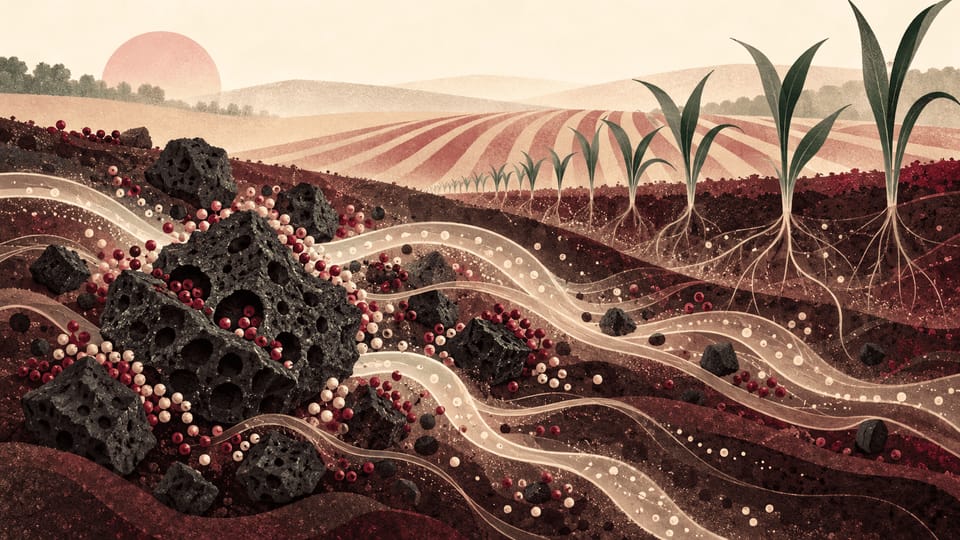
Modern agriculture relies heavily on synthetic nitrogen fertilizers, yet crops take up only a fraction of what farmers spread across their acreage. Long-term intensive agricultural practices, including imbalanced fertilizer application and repeated soil disturbance, can affect soil structure, organic matter and microbial functioning. Excessive nitrogen application can also contribute to nutrient leaching, soil acidification and water pollution. Farmers seeking biological alternatives frequently spray liquid inoculants containing living, beneficial bacteria onto their fields, expecting these organisms to cycle nutrients naturally. In open fields, however, laboratory-bred bacteria almost immediately perish because they face harsh competition from entrenched native microbes, lack stable moisture, and get eaten by predatory protozoa before establishing functioning colonies.
This persistent failure leaves farmers trapped between two conflicting pressures: reducing expensive chemical applications that damage long-term soil fertility and maintaining high crop harvests. Agricultural soils that lose biological activity require ever-greater quantities of synthetic inputs to produce the same quantity of grain, worsening groundwater contamination and soil acidification. Finding a practical method to keep introduced bacteria alive in field conditions could break that cycle, allowing growers to trim synthetic nitrogen use while restoring living biological activity to exhausted ground.
For a biological amendment to nourish crops, added bacteria must survive in the root zone and continuously process bound nutrients into accessible food. Soil microorganisms contribute to nitrogen cycling through organic matter decomposition and nitrogen mineralization. During ammonification, organic nitrogen is converted into ammonium, which can subsequently be converted into nitrite and nitrate through microbial nitrification. When bacteria are introduced into bare soil without physical shelter, predatory protozoa and harsh environmental swings rapidly wipe them out. Charcoal produced by heating crop straw under low-oxygen conditions, known as biochar, provides an intricate network of microscopic chambers. Biochar provides a porous habitat that may support microbial attachment and improve protection against environmental stresses, including moisture and temperature fluctuations. Its effects on microbial survival and activity depend on biochar properties, microbial strains and soil conditions.
How does porous charcoal shield living microbes in agricultural soils?
Porous biochar acts as a protective physical sanctuary that keeps beneficial bacteria alive and chemically active in depleted soil. In a review published in Frontiers in Agronomy in September 2026, Arushi Padiyal, Abhishek Kumar, and their colleagues across Indian agricultural institutions documented how combining biochar with microbial inoculants improves soil properties and plant growth far more consistently than applying either agent on its own.
Laboratory experiments confirm that this physical framework directly alters soil biology. In a study published in Frontiers in Microbiology in May 2025, Tao Zheng, Xianhuai Huang, Xiaoyu Zhou, Jizi Wu, Muhammad Aqeel Kamran, Xiongsheng Yu, and Jing Qian tested how rapeseed straw biochar, rice straw biochar, and the plant-promoting bacterium Bacillus subtilis shaped dryland soil collected from peanut acreage.1 Over a 90-day static incubation, the researchers observed that adding soil amendments enhanced bacterial richness by 3.02% to 7.07% and increased microbial biomass nitrogen by 3.7 to 9.3 times compared to untreated control soil.1 Rapeseed straw biochar or the microbial agent alone also boosted soil urease activity to roughly 40.3 micrograms of ammonium nitrogen per gram of soil per hour at the conclusion of the incubation period.1
That spike in microbial nitrogen was dynamic rather than permanent over the course of the incubation. Abhishek, a researcher at Maharishi Markandeshwar University and an author of the review, told Primary that the absolute baseline value in the unamended control soil was 6.66 milligrams per kilogram at day 30, whereas the unamended control at day 90 stood at 4.16 milligrams per kilogram. Abhishek stated that the surge in microbial biomass nitrogen "did not plateau; it peaked at Day 30 and declined substantially by Day 90." This early burst indicates that the initial introduction of carbon and microbes temporarily supercharges biological activity, after which available nutrients slowly stabilize.
Can biological partnerships replace synthetic nitrogen fertilizer?
Field and pot experiments demonstrate that pairing biochar with microbial inoculants can offset a moderate reduction in synthetic fertilizer without sacrificing harvest volume. In an investigation published in Frontiers in Plant Science in April 2026, a research group including Qiang Zhang, Mengxuan Gu, Gexing Li, Haoran Jing, Mengying Qi, Hao Li, Mengjie Li, Lingling Ding, Zhi Li, Pengfei Wei, Xiaona Ji, Tao Zhu, and Haiying Zhao evaluated the combination on rice crops grown under differing nitrogen inputs.3
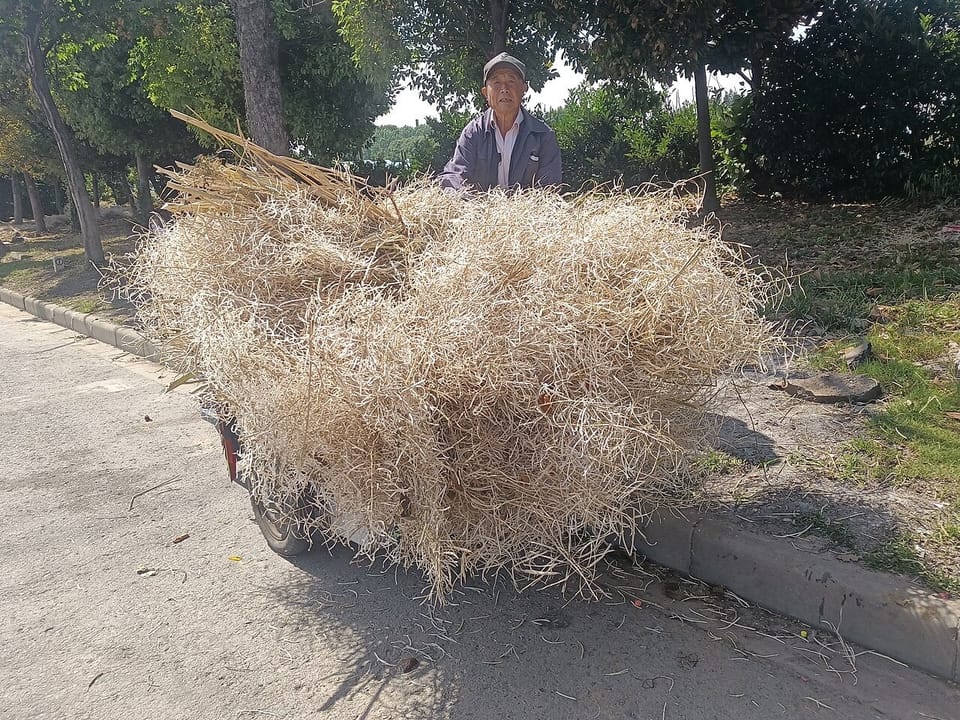
The researchers applied 7.5 tonnes per hectare of biochar alongside a multi-strain inoculant comprising Azotobacter chroococcum, Bacillus subtilis, and Bacillus amyloliquefaciens to the rice cultivar Nanjing 9108.3 When synthetic nitrogen was reduced by 20%, the combined treatment increased rice yield by 4.1% to 4.9% compared to conventional chemical fertilizer alone, while improving nitrogen partial factor productivity by 28.6% to 30.0%.3 Genetic sequencing revealed that this moderate reduction enriched beneficial bacterial phyla, including Proteobacteria and Actinobacteria, which accelerated soil nutrient cycling.3
The choice of dosage in that experiment represented an initial test rather than a fixed agricultural standard. Abhishek told Primary that the paper by Zhang and colleagues provides no indication that the dosage of 7.5 tonnes per hectare "was specifically established from prior dose-response trials or field constraints." Abhishek noted that this volume "should be regarded as the experimental rate selected by the researchers, rather than as a universally optimal or predetermined dosage."
Abhishek also cautioned against viewing biological inoculants as a total substitute for industrial fertilizers. Abhishek told Primary that the findings demonstrate that biochar-microbial partnerships can "partially substitute for synthetic N inputs while maintaining or improving productivity under appropriate field conditions." Abhishek pointed out that biological partnerships should currently be viewed as "a complementary strategy for reducing synthetic nitrogen dependence, rather than a universal replacement for mineral N fertilizer," because the degree of success depends heavily on local climate, crop genetics, and baseline soil nutrients.
Where do the limits of biological soil amendments lie?
Biological soil treatments cannot compensate for extreme nutrient starvation, and their efficacy depends strictly on maintaining an adequate baseline of soil fertility. In the rice trials conducted by Qiang Zhang and colleagues, reducing synthetic nitrogen fertilizer by 40% caused crop yields to drop by 3.9% to 4.6% despite the application of biochar and microbial inoculants.3 At that steep reduction level, populations of key bacterial phyla declined, prompting the microbial community to shift resources from active nutrient mineralization toward basic survival maintenance.3
That interpretation of cellular behavior, however, goes beyond what the measurements directly showed. Abhishek told Primary that the paper "does not directly demonstrate that microbes literally 'diverted energy from nutrient cycling to basic survival'; that wording is an interpretation of the observed reduction in microbial functional potential." Abhishek explained that the experimental evidence more directly supports "a weakening of microbial functional capacity and nutrient-cycling potential under severe N limitation." Abhishek added that the 40% reduction level marks "an experimentally observed threshold under the conditions tested" where biological assistance could no longer compensate for missing nutrients, and should not be seen as "a universal biological limit."
These experimental findings reflect specific crop cultivars and soil environments tested in controlled pots and single-season plots. Indoor static incubation isolates microbes from the temperature extremes, rainfall leaching, and heavy machinery compaction that shape real farm fields. In addition, the trials did not follow the long-term physical durability of biochar pores or verify whether inoculated bacterial strains survive across successive growing seasons. Translating these early successes into dependable farming practices will require testing whether the benefits persist across varied soil chemistries and different annual crop rotations.
Proving that beneficial bacteria are the sole drivers of yield protection remains an open scientific question. Abhishek told Primary that if a subsequent growing season showed that Proteobacteria and Actinobacteria remained enriched under the treatment while the gains in nutrient cycling and crop yield disappeared, that result "would cast doubt on the conclusion that these phyla were the direct drivers of the nutrient-cycling benefit." Such an outcome would suggest that other microbial groups or broader soil interactions were responsible for the observed productivity. For agricultural planners and farmers seeking to curb chemical pollution, the current evidence points toward an achievable path: trimming synthetic fertilizer by modest margins while letting microbial partnerships sustain the soil.
The record
19 sentences trace to 2 sources and 1 contributor.
-
1
F
 Frontiers
Third-party reporting
· frontiersin.org · 27 May 2025
Frontiers | Biochar and Bacillus subtilis co-drive dryland soil microbial community and enzyme responses
See the source
- 2 Contribution — Abhishek Kumar 16 statements added to this article
-
3
F
Frontiers
Third-party reporting
· frontiersin.org · 14 Apr 2026
Frontiers | Synergistic effects of biochar and microbial inoculants on rice productivity and soil fertility are mediated by a nitrogen-dependent microbial pathway
See the source
Other consulted pages1 page
frontiersin.org1 page
Article history
-
Published 24 Nov 2026, 15:34Assembled by the Primary desk from 2 sources · 1 contributor · 19 cited sentences
-
Abhishek Kumar
- Go to the sentence: Over a 90-day static incubation, the researchers observed that adding soil amendments enhanced bacterial richness by 3.02% to 7.07% and increased microbial biomass nitrogen by 3.7 to 9.3 times compared to untreated control soil.
- Go to the sentence: Abhishek, a researcher at Maharishi Markandeshwar University and an author of the review, told Primary that the absolute baseline value in the unamended control soil was 6.66 milligrams per kilogram at day 30, whereas the unamended control at day 90 stood at 4.16 milligrams per kilogram.
- Go to the sentence: Abhishek stated that the surge in microbial biomass nitrogen "did not plateau; it peaked at Day 30 and declined substantially by Day 90."
- Go to the sentence: The researchers applied 7.5 tonnes per hectare of biochar alongside a multi-strain inoculant comprising Azotobacter chroococcum, Bacillus subtilis, and Bacillus amyloliquefaciens to the rice cultivar Nanjing 9108.
- Go to the sentence: When synthetic nitrogen was reduced by 20%, the combined treatment increased rice yield by 4.1% to 4.9% compared to conventional chemical fertilizer alone, while improving nitrogen partial factor productivity by 28.6% to 30.0%.
- Go to the sentence: Genetic sequencing revealed that this moderate reduction enriched beneficial bacterial phyla, including Proteobacteria and Actinobacteria, which accelerated soil nutrient cycling.
- Go to the sentence: Abhishek told Primary that the paper by Zhang and colleagues provides no indication that the dosage of 7.5 tonnes per hectare "was specifically established from prior dose-response trials or field constraints."
- Go to the sentence: Abhishek noted that this volume "should be regarded as the experimental rate selected by the researchers, rather than as a universally optimal or predetermined dosage."
- Go to the sentence: Abhishek told Primary that the findings demonstrate that biochar-microbial partnerships can "partially substitute for synthetic N inputs while maintaining or improving productivity under appropriate field conditions."
- Go to the sentence: Abhishek pointed out that biological partnerships should currently be viewed as "a complementary strategy for reducing synthetic nitrogen dependence, rather than a universal replacement for mineral N fertilizer," because the degree of success depends heavily on local climate, crop genetics, and baseline soil nutrients.
- Go to the sentence: In the rice trials conducted by Qiang Zhang and colleagues, reducing synthetic nitrogen fertilizer by 40% caused crop yields to drop by 3.9% to 4.6% despite the application of biochar and microbial inoculants.
- Go to the sentence: At that steep reduction level, populations of key bacterial phyla declined, prompting the microbial community to shift resources from active nutrient mineralization toward basic survival maintenance.
- Go to the sentence: Abhishek told Primary that the paper "does not directly demonstrate that microbes literally 'diverted energy from nutrient cycling to basic survival'; that wording is an interpretation of the observed reduction in microbial functional potential."
- Go to the sentence: Abhishek explained that the experimental evidence more directly supports "a weakening of microbial functional capacity and nutrient-cycling potential under severe N limitation."
- Go to the sentence: Abhishek added that the 40% reduction level marks "an experimentally observed threshold under the conditions tested" where biological assistance could no longer compensate for missing nutrients, and should not be seen as "a universal biological limit."
- Go to the sentence: Abhishek told Primary that if a subsequent growing season showed that Proteobacteria and Actinobacteria remained enriched under the treatment while the gains in nutrient cycling and crop yield disappeared, that result "would cast doubt on the conclusion that these phyla were the direct drivers of the nutrient-cycling benefit."