High dimensions distort shared patterns across paired datasets
Statistical algorithms cross-referencing massive biological tables can split single pathways into duplicates or mistake isolated noise for shared cellular programs, according to a mathematical analysis of partial least squares.
When modern laboratories measure thousands of molecular markers across blood samples, they frequently link two massive tables of information, such as twenty thousand gene readouts alongside thousands of protein levels. Finding strong correlations between two matrices would seem to isolate the biological processes they hold in common. In reality, high-dimensional spaces alter how variables interact. When measured features vastly outnumber enrolled subjects, random noise masquerades as coordinated activity, and genuine relationships bend into distorted projections. Methods designed to extract shared variation can end up mistaking private fluctuations inside a single dataset for joint biological signals, or splitting a single biological process into duplicate components.
These mathematical hazards form the focus of an analytical study posted on September 29, 2026, to the arXiv preprint server by Victor L eger and Florent Chatelain, researchers at Universit e Grenoble Alpes, CNRS, Grenoble INP, and the GIPSA-lab in Grenoble, France. The authors applied random matrix theory to establish the asymptotic behavior and theoretical boundaries of Partial Least Squares, a widely used data integration technique originally introduced in the 1960s by the statistician Hermann Wold.
Why does cross-referencing vast datasets produce unexpected errors?
Cross-referencing high-dimensional data matrices causes subtle geometric errors because sample sizes cannot restrain background noise across thousands of parallel measurements. To extract common information, algorithms calculate a normalized sample cross-covariance matrix between two data blocks, searching for paired directions that maximize the shared covariance between the projected variables. When a patient cohort contains only a few hundred individuals while each person contributes tens of thousands of data points, standard sample covariances fail to settle onto their true population values. The sequence of operations explains why this failure occurs. An experimental trial collects a predictor matrix and a response matrix from the same participants, projecting both tables along coordinate vectors to evaluate covariation. Mathematical procedures then isolate directions yielding the largest cross-covariance, repeating the search under orthogonality requirements to uncover subsequent layers of coordinated behavior.
Biological variance adds independent noise into every coordinate. In high-dimensional regimes where the number of predictors and responses grow proportionally with the sample size, the aggregate noise pushes eigenvalues away from zero and creates an artificial floor of spurious correlations, known in spectral analysis as the noise bulk. Below a precise mathematical threshold, the estimated directions remain hopelessly entangled with the bulk distribution, offering no meaningful alignment with the underlying latent structures that generated the observations.1 Florent said in response to questions from Primary that "what surprised us most was the actual strength of the spikes produced in the cross-covariance matrix by shared components, which allows even relatively weak joint signals to quickly cross the detection threshold." Florent explained that "for perfectly aligned joint components, the spike magnitude depends on both the sum and the product of the individual signal strengths."
When does the algorithm confuse separate variations for shared signals?
Partial least squares confuses separate variations for joint signals whenever a single data block contains dominant individual-specific structures that exceed the critical detection threshold. In biological systems, one matrix often contains substantial independent variability, including technical batch effects or tissue-specific programs. L eger and Chatelain established that the singular value decomposition variant of the algorithm, known as PLS-SVD, can spuriously align its leading singular vectors with these uninformative, dataset-specific components.1 When this uninformative alignment happens, the resulting singular vectors fail to correlate with any shared deterministic direction beyond the single dataset that generated them.1 Florent told Primary that "the main caution for practitioners, especially in biological network studies, concerns spurious spikes driven by strong individual (single-block) components." Florent observed that "When a single data block contains a dominant individual signal, it can generate an artificial spike in the cross-covariance matrix." If analysts take these features at face value, Florent noted, "they risk misinterpreting single-block features as genuine cross-block biological interactions."
A second distortion occurs when joint components are genuinely present but only partially aligned across datasets. Under partial alignment, the algorithm can produce two distinct pairs of dominant singular vectors for a single underlying shared process.1 This spurious duplication inflates the apparent rank of the joint latent space, leading scientists to conclude that two separate biological mechanisms are operating when only one exists. The authors proved that this duplication artifact vanishes completely only when the underlying latent components are perfectly aligned.1 Florent explained the mechanism driving this split in response to questions from Primary: "In ideal, noise-free measurements, where we directly observe the low-rank signals of interest, this duplication phenomenon never occurs. It is driven entirely by the presence of noise." When alignment is incomplete, unaligned signal elements can "interact or 'resonate' with the high-dimensional noise.. This constructive interaction produces secondary, duplicated spikes in the empirical spectrum, effectively splitting a single underlying shared component into two distinct singular vector pairs."
Even when components are perfectly aligned, a third structural limitation warps the recovered directions. The paper demonstrates that the singular vectors produced by the algorithm systematically skew away from the true latent directions of the shared signal.1 This angular distortion persists asymptotically, refusing to disappear as sample sizes and feature dimensions grow in fixed proportion. The skewness attenuates only when the signal strength approaches infinity or under rare symmetric conditions, meaning empirical estimates inevitably carry a permanent noise-induced bias.1 Florent emphasized that "In PLS, the asymptotic behavior of a given spike depends on the other shared spikes, and the deterministic directions along which the singular vectors align are generally non-orthogonal."
Why does partial least squares still outperform principal component analysis?
Partial least squares outperforms separate principal component analysis because it pools the cross-covariance between both datasets simultaneously, yielding strictly greater statistical power to detect joint signals.1 When analysts apply principal component analysis independently to each data matrix, the method searches only for directions of maximum internal variance within each isolated table. That approach struggles when a joint biological effect is subtle compared to independent background noise inside a specific assay.
The mathematical comparison derived by L eger and Chatelain demonstrates that whenever independent principal component analysis successfully detects all joint signals across both individual matrices, the cross-covariance approach is mathematically guaranteed to detect them as well.1 Furthermore, the singular values emerging from the joint cross-covariance matrix exhibit strictly larger spectral separation from the noise bulk than the corresponding eigenvalues produced by separate principal component analyses.1 The joint method pulls faint signals further from the random background, lowering the barrier to confirm that a shared process exists.
This detection advantage encounters boundaries under challenging experimental conditions. Florent told Primary that "Even though PLS-SVD generally offers a detection advantage, that edge can vanish under specific conditions." Florent explained that "if the shared components in each individual block are quite strong individually, but the coupling or alignment between them is too weak, PLS may fail to recover them." In that situation, Florent added, "the corresponding spikes in the cross-covariance matrix drop below the random matrix theory detection threshold, rendering the joint structure invisible to the method." While separate analyses might identify strong signals within each isolated block, Florent noted that "matching or pairing them from the outputs of the two separate PCAs becomes extremely challenging."
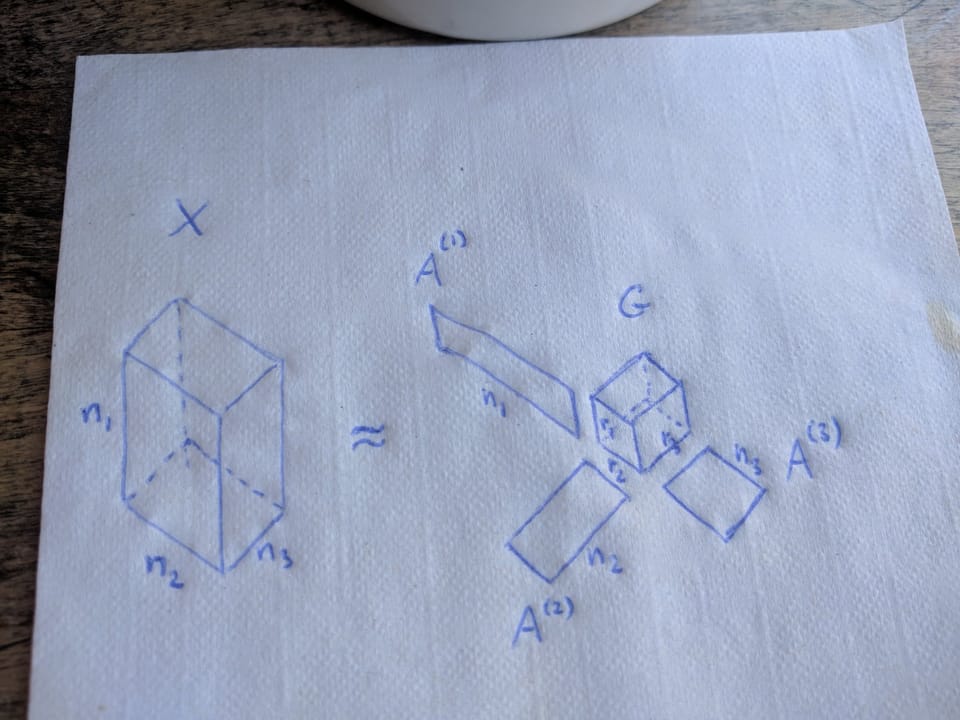
This theoretical advantage confirms why the methodology has sustained decades of practical popularity across chemometrics, spectrometric calibration, cancer subtype classification, and genomic therapy prediction. The mathematical model decomposes both data tables into three distinct parts: joint latent components, individual-specific components, and unstructured Gaussian noise.1 This structure connects directly to existing integrative frameworks such as Joint and Individual Variation Explained, known as JIVE, providing a rigorous mathematical foundation that encompasses the core operations of two-block dimension reduction.1 Florent observed that for studies seeking to integrate more than two assays simultaneously, "tensor methods, such as Tucker decompositions, a.k.a. Higher-Order Singular Value Decompositions (HOSVD), provide a natural generalization to matrix frameworks."
What do these mathematical limits mean for future data analysis?
These mathematical boundaries define clear operational limits for data integration while providing a blueprint for designing more reliable algorithms. The proofs characterize the asymptotic behavior of the singular value decomposition formulation of partial least squares under the assumption that variable dimensions and sample counts expand toward infinity at fixed, positive ratios. The analysis assumes that global noise matrices behave isotropically, without accounting for highly structured or heavy-tailed experimental errors that may arise in messy clinical samples.1 The work is currently a preprint (which may not have been peer reviewed) posted to arXiv and has not yet completed formal peer review.1
Messy clinical samples often introduce systematic shifts that violate these isotropic assumptions. Florent said in response to questions from Primary that "When strongly correlated batch effects are present, they indeed break the isotropic noise assumption." Drawing on single-matrix findings under correlated noise, Florent pointed out that batch effects alter the background through bulk distortion and bulk fragmentation, noting that "Both distortion and fragmentation make recovering true signal spikes far more challenging."
For computational biologists and analytical chemists, these mathematical boundaries clarify what data integration tools can accomplish. Analysts cannot treat empirical weights as faithful representations of true biological effect sizes without correction, because spurious duplication and skewed vectors distort downstream tasks such as selecting biomarker genes. The open problem facing mathematical statisticians is developing regularized estimators that suppress individual-specific artifacts while retaining the heightened detection sensitivity of cross-covariance analysis. By delineating the exact spectral threshold where true spikes separate from background noise, this analysis provides the quantitative groundwork needed to design algorithms that cleanly untangle genuine cooperative biology from high-dimensional statistical noise.
The record
31 sentences trace to 1 source and 1 contributor.
-
1
VL
 Victor Léger, Florent Chatelain
Paper
· arxiv.org · 30 Sep 2026
High-Dimensional Partial Least Squares: Spectral Analysis and Fundamental Limitations
Preprint · may not have been peer reviewed
See the source
- 2 Contribution — Florent Chatelain 21 statements added to this article
Other consulted pages1 page
ideas.repec.org1 page
cv.hal.science1 page
jmlr.org1 page
mlanthology.org1 page
Article history
-
Published 24 Nov 2026, 15:33Assembled by the Primary desk from 1 source · 1 contributor · 31 cited sentences
-
Florent Chatelain, researchers at Universit e Grenoble Alpes
- Go to the sentence: Below a precise mathematical threshold, the estimated directions remain hopelessly entangled with the bulk distribution, offering no meaningful alignment with the underlying latent structures that generated the observations.
- Go to the sentence: Florent said in response to questions from Primary that "what surprised us most was the actual strength of the spikes produced in the cross-covariance matrix by shared components, which allows even relatively weak joint signals to quickly cross the detection threshold."
- Go to the sentence: Florent explained that "for perfectly aligned joint components, the spike magnitude depends on both the sum and the product of the individual signal strengths."
- Go to the sentence: Florent told Primary that "the main caution for practitioners, especially in biological network studies, concerns spurious spikes driven by strong individual (single-block) components."
- Go to the sentence: Florent observed that "When a single data block contains a dominant individual signal, it can generate an artificial spike in the cross-covariance matrix."
- Go to the sentence: If analysts take these features at face value, Florent noted, "they risk misinterpreting single-block features as genuine cross-block biological interactions."
- Go to the sentence: Under partial alignment, the algorithm can produce two distinct pairs of dominant singular vectors for a single underlying shared process.
- Go to the sentence: Florent explained the mechanism driving this split in response to questions from Primary: "In ideal, noise-free measurements, where we directly observe the low-rank signals of interest, this duplication phenomenon never occurs. It is driven entirely by the presence of noise."
- Go to the sentence: When alignment is incomplete, unaligned signal elements can "interact or 'resonate' with the high-dimensional noise.. This constructive interaction produces secondary, duplicated spikes in the empirical spectrum, effectively splitting a single underlying shared component into two distinct singular vector pairs."
- Go to the sentence: The skewness attenuates only when the signal strength approaches infinity or under rare symmetric conditions, meaning empirical estimates inevitably carry a permanent noise-induced bias.
- Go to the sentence: Florent emphasized that "In PLS, the asymptotic behavior of a given spike depends on the other shared spikes, and the deterministic directions along which the singular vectors align are generally non-orthogonal."
- Go to the sentence: Furthermore, the singular values emerging from the joint cross-covariance matrix exhibit strictly larger spectral separation from the noise bulk than the corresponding eigenvalues produced by separate principal component analyses.
- Go to the sentence: Florent told Primary that "Even though PLS-SVD generally offers a detection advantage, that edge can vanish under specific conditions."
- Go to the sentence: Florent explained that "if the shared components in each individual block are quite strong individually, but the coupling or alignment between them is too weak, PLS may fail to recover them."
- Go to the sentence: In that situation, Florent added, "the corresponding spikes in the cross-covariance matrix drop below the random matrix theory detection threshold, rendering the joint structure invisible to the method."
- Go to the sentence: While separate analyses might identify strong signals within each isolated block, Florent noted that "matching or pairing them from the outputs of the two separate PCAs becomes extremely challenging."
- Go to the sentence: This structure connects directly to existing integrative frameworks such as Joint and Individual Variation Explained, known as JIVE, providing a rigorous mathematical foundation that encompasses the core operations of two-block dimension reduction.
- Go to the sentence: Florent observed that for studies seeking to integrate more than two assays simultaneously, "tensor methods, such as Tucker decompositions, a.k.a. Higher-Order Singular Value Decompositions (HOSVD), provide a natural generalization to matrix frameworks."
- Go to the sentence: The analysis assumes that global noise matrices behave isotropically, without accounting for highly structured or heavy-tailed experimental errors that may arise in messy clinical samples.
- Go to the sentence: Florent said in response to questions from Primary that "When strongly correlated batch effects are present, they indeed break the isotropic noise assumption."
- Go to the sentence: Drawing on single-matrix findings under correlated noise, Florent pointed out that batch effects alter the background through bulk distortion and bulk fragmentation, noting that "Both distortion and fragmentation make recovering true signal spikes far more challenging."