Pirate grog would require impossible acid chemistry to melt metal tankards
A study of video game corrosion reveals that dissolving a pewter mug in 35 seconds would demand acid ten times more concentrated than pure industrial sulfuric acid.

A metal vessel holding a drink ought to remain solid for decades. In the Caribbean waters of classic adventure games, however, pirate grog behaves like an industrial disaster in a cup. A pewter tankard filled with the beverage melts away in half a minute, forcing anyone carrying it to run between tavern and jail while frantically decanting the corrosive fluid into fresh cups before the bottom drops out.1 The conceit makes for an engaging puzzle, but it also presents a severe physical puzzle about what kind of fluid could destroy solid metal on such a brief human timescale.
Corrosion normally operates as a quiet, gradual process. In everyday life, acids eat away at metals over days, months, or years, held back by chemical equilibrium and the speed at which dissolved particles can drift through liquid. When an acid attacks a solid metal surface, several physical events must happen in strict sequence. Positively charged hydrogen ions, known as protons, must first travel through the fluid to reach the unreacted metal boundary. Once they arrive at the interface, those protons pull electrons away from the surface atoms, converting neutral metal into soluble ions that dissolve into the fluid while releasing hydrogen gas. Finally, those newly formed metal ions must clear away from the surface to allow fresh acid to reach the unreacted metal beneath. Because each step takes time and crowding at the boundary slows the arrival of fresh reactants, ordinary chemical solutions cannot bore through a solid drinking vessel in the span of an average breath.
To find out what would happen if those physical limits were pushed to their extreme, Patrizio Raffa, a chemical engineer at the ENTEG Institute within the University of Groningen, decided to work backward from the fictional destruction. In a study released on the Journal of Geek Studies platform, Raffa treated the rapid disappearance of a pirate tankard as an inverse engineering problem, calculating the minimum chemical intensity needed to explain the observed damage.1
How fast does the drink destroy a solid vessel?
A standard pewter drinking vessel filled with grog perforates in approximately 35 seconds.1 Raffa established this baseline by timing the puzzle sequence in the 2009 release of The Secret of Monkey Island: Special Edition, recording the interval between filling the vessel at the Scumm bar and its complete collapse.1 The vessel in question resembles a traditional tavern tankard, which historically consisted primarily of pewter, a malleable alloy made predominantly of tin.1 For the purposes of the calculation, Raffa assumed the fictional mug had a wall thickness of two millimetres, a standard ballpark dimension for historical drinking tankards, and treated the alloy as pure tin.
Perforating a two-millimetre wall of solid tin in 35 seconds requires the inner surface of the vessel to recede at an average speed of 57.1 micrometres per second. Because tin has a density of 7,310 kilograms per cubic metre and a molar mass of 0.11871 kilograms per mole, that recession speed translates to an average metal loss of approximately 3.52 moles of tin per square metre every second. In terms of raw mass, the metal must vanish at an average rate of roughly 41.8 milligrams per square centimetre per second across the exposed area.
To put that speed into perspective, published laboratory experiments examining tin dissolution in dilute 0.05-molar acid under oxidising conditions record metal loss rates of around one milligram per square centimetre per hour. The rate required to match the tavern puzzle is approximately 150,000 times larger than those laboratory measurements. While the experimental reference involved milder acid and different exposure conditions, the comparison highlights the extraordinary rate of chemical destruction depicted on the screen.1
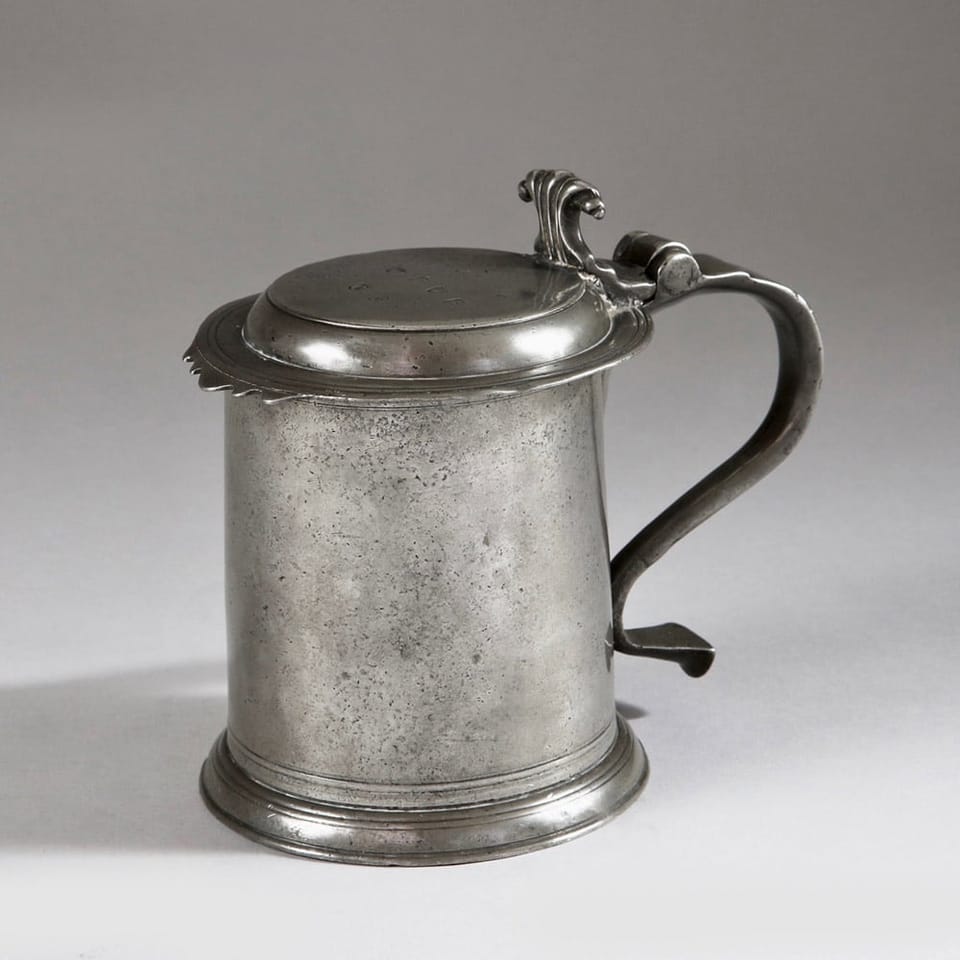
Real historical drinking vessels often contained significant proportions of lead rather than pure tin. Asked about this material simplification, Patrizio told Primary that “the calculation could still be applied to the diffusion-limited acid dissolution of lead” by adjusting density and atomic mass values, because lead also oxidises predominantly to a divalent cation. However, Patrizio noted that real tin and lead surfaces can form protective crusts, pointing out that “the formation of a passivation layer on the metal surface, probably composed of various metal oxides” would protect the surface and slow or halt dissolution entirely.
Could ordinary acid supply enough chemical punch?
Ordinary acid solutions cannot supply enough protons to sustain such rapid corrosion under stagnant conditions.1 In the simplified chemical model, every atom of dissolving tin consumes two protons while releasing one tin ion and producing hydrogen gas. To keep the metal vanishing at 3.52 moles per square metre per second, the fluid directly touching the metal must deliver an average proton flux of roughly 7.04 moles per square metre per second over the entire 35-second interval.
In a stationary liquid, molecules move primarily through diffusion, the passive physical process by which particles spread from areas of high concentration to areas of low concentration. As protons react at the metal wall, they deplete the liquid closest to the surface, creating a boundary layer where concentration drops toward zero. The further the reaction proceeds, the thicker this depleted zone becomes, meaning fresh protons have to travel across a wider gap to reach unreacted metal. Raffa applied Fick’s first law of diffusion, which governs how concentration gradients drive molecular flow, together with a transient model of planar diffusion where the depleted layer thickens as the square root of time.
Taking the standard proton diffusion coefficient in dilute water at room temperature as 9.3 billionths of a square metre per second, Raffa calculated that supplying the necessary proton flux requires an initial bulk acid concentration of approximately 382.6 moles per litre. That calculated value exceeds any possible concentration achievable in conventional aqueous chemistry.
For comparison, concentrated industrial sulfuric acid at 98 percent purity by weight possesses a density of roughly 1.84 grams per cubic centimetre and delivers about 36.8 moles per litre of stoichiometric proton equivalents, which is the total quantity of acidic hydrogen atoms available to react. The concentration demanded by the stagnant diffusion model is more than ten times higher than pure commercial sulfuric acid.1 In response to questions from Primary, Patrizio said that “this value is far beyond any physically meaningful aqueous proton concentration” because such an extreme state leaves almost no water behind. Patrizio explained that “in nearly pure sulfuric acid, protons would be associated with sulfuric acid molecules and diffuse through the acid” rather than behaving like isolated hydronium ions in dilute water.
What does the simplified transport model leave out?
Fluid motion and complex recipe ingredients would substantially alter how reactants reach the dissolving metal. As tin dissolves and releases hydrogen gas, rising gas bubbles would create local agitation, stirring the fluid near the vessel wall. Similarly, as a runner carries a full mug through city streets, physical sloshing would induce fluid convection, mixing the contents and bringing fresh reactants to the metal surface far faster than passive diffusion alone. In the game itself, running or standing still does not alter the 35-second timer, but in the real physical world, mechanical mixing would significantly lower the acid concentration required to maintain a given rate of attack.
Evaluating that convective stirring in detail reveals clear mechanical boundaries. Patrizio told Primary that “sloshing is not a particularly effective way to stir the liquid, so hydrogen evolution would likely have the greatest effect on the process.” Patrizio noted that if vigorous bubbling thinned the depleted boundary layer tenfold, from one millimetre down to 0.1 millimetres, the required acid concentration would also drop tenfold, though the resulting value would still hover near the threshold of pure sulfuric acid.
The physical recipe introduces additional chemical complications. Furthermore, the analysis models grog as an aqueous acid solution, even though the fictional recipe contains an unpredictable mixture of kerosene, propylene glycol, rum, acetone, battery acid, axle grease, red dye, and pepperoni.1 Several of these oily components, such as kerosene and grease, do not mix with water and would float or coat the metal surface, forming protective barriers that would impede acid contact. Patrizio explained to Primary that “the system would have to be considered phase separated into a water-rich phase, where the metal corrosion would actually happen, and an organic-rich phase, that would affect the contact surface between water and metal.”
The calculations also cannot rule out non-acidic dissolution routes. Concentrated sulfuric acid can act as an oxidising agent, though water introduced from rum or battery acid would dilute it. If the drink’s mysterious proprietary component, known simply as Scumm, acts as a potent oxidant, it could drive corrosion through a different chemical mechanism entirely, though evaluating that pathway would require knowing its specific molecular behaviour.1 Patrizio told Primary that a hypothetical pathway where Scumm absorbs electrons “would not produce hydrogen at the metal surface,” bypassing the sluggish reaction steps that typically slow down tin corrosion in non-oxidising acids.
Why did the prison lock melt even faster?
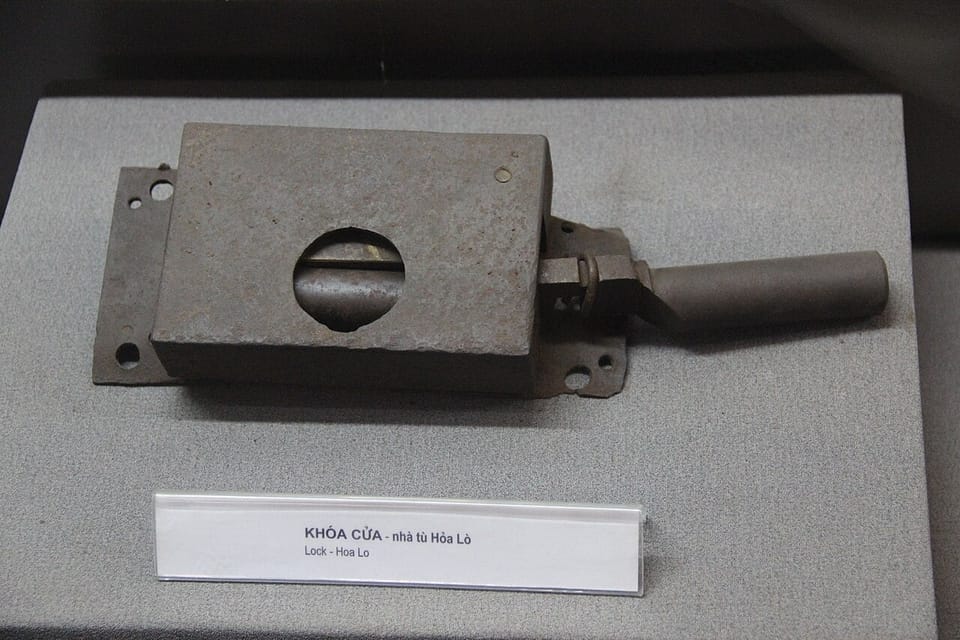
A prison lock can fail quickly because opening a mechanical latch requires destroying only a tiny structural pin. After transferring grog across multiple cups, the protagonist pours the remaining liquid over a jail cell lock, which dissolves in less than two seconds. While melting an entire iron lock in two seconds would demand even more absurd chemistry than the pewter mug, defeating the lock does not require dissolving its complete bulk.
Under transient diffusion, the depth of metal removed scales with the square root of time elapsed.1 In two seconds, the liquid would corrode approximately 24 percent of the thickness it removes in 35 seconds, which corresponds to roughly 0.5 millimetres of the two-millimetre benchmark wall. If the internal locking mechanism relied on a thin spring, a delicate retaining pin, or a poorly cast iron component, corroding half a millimetre of metal could easily compromise the latch and release the mechanism. Patrizio told Primary that “the most plausible explanation is not that the whole lock dissolves, but that an unusually reactive liquid attacks a very thin, already vulnerable section and causes mechanical failure.” Alternatively, as Raffa noted, the local island authorities may simply have purchased substandard security hardware from an untrustworthy merchant.1
The study provides a quantitative demonstration of how narrative license stretches chemical principles. While grog remains chemically impossible as an ordinary aqueous beverage, framing its destructive power through transport phenomena grounds the fantasy in real physical laws. For curious players and chemists alike, the calculation confirms that the pirate leaders were entirely accurate when they warned that the concoction is far too caustic for human consumption.
The record
22 sentences trace to 1 source and 1 contributor.
- 1 The science of Monkey Island: can grog dissolve a metal mug that fast? See the source
- 2 Contribution — Patrizio Raffa 14 statements added to this article
Other consulted pages1 page
bohrium.com1 page
research.rug.nl1 page
Article history
-
Published 24 Nov 2026, 15:34Assembled by the Primary desk from 1 source · 1 contributor · 22 cited sentences
-
Patrizio Raffa, a chemical engineer at the ENTEG Institute within the University of Groningen
- Go to the sentence: For the purposes of the calculation, Raffa assumed the fictional mug had a wall thickness of two millimetres, a standard ballpark dimension for historical drinking tankards, and treated the alloy as pure tin.
- Go to the sentence: Asked about this material simplification, Patrizio told Primary that “the calculation could still be applied to the diffusion-limited acid dissolution of lead” by adjusting density and atomic mass values, because lead also oxidises predominantly to a divalent cation.
- Go to the sentence: Taking the standard proton diffusion coefficient in dilute water at room temperature as 9.3 billionths of a square metre per second, Raffa calculated that supplying the necessary proton flux requires an initial bulk acid concentration of approximately 382.6 moles per litre.
- Go to the sentence: The concentration demanded by the stagnant diffusion model is more than ten times higher than pure commercial sulfuric acid.
- Go to the sentence: In response to questions from Primary, Patrizio said that “this value is far beyond any physically meaningful aqueous proton concentration” because such an extreme state leaves almost no water behind.
- Go to the sentence: Patrizio explained that “in nearly pure sulfuric acid, protons would be associated with sulfuric acid molecules and diffuse through the acid” rather than behaving like isolated hydronium ions in dilute water.
- Go to the sentence: Patrizio told Primary that “sloshing is not a particularly effective way to stir the liquid, so hydrogen evolution would likely have the greatest effect on the process.”
- Go to the sentence: Patrizio noted that if vigorous bubbling thinned the depleted boundary layer tenfold, from one millimetre down to 0.1 millimetres, the required acid concentration would also drop tenfold, though the resulting value would still hover near the threshold of pure sulfuric acid.
- Go to the sentence: Furthermore, the analysis models grog as an aqueous acid solution, even though the fictional recipe contains an unpredictable mixture of kerosene, propylene glycol, rum, acetone, battery acid, axle grease, red dye, and pepperoni.
- Go to the sentence: Patrizio explained to Primary that “the system would have to be considered phase separated into a water-rich phase, where the metal corrosion would actually happen, and an organic-rich phase, that would affect the contact surface between water and metal.”
- Go to the sentence: If the drink’s mysterious proprietary component, known simply as Scumm, acts as a potent oxidant, it could drive corrosion through a different chemical mechanism entirely, though evaluating that pathway would require knowing its specific molecular behaviour.
- Go to the sentence: Patrizio told Primary that a hypothetical pathway where Scumm absorbs electrons “would not produce hydrogen at the metal surface,” bypassing the sluggish reaction steps that typically slow down tin corrosion in non-oxidising acids.
- Go to the sentence: Under transient diffusion, the depth of metal removed scales with the square root of time elapsed.
- Go to the sentence: Patrizio told Primary that “the most plausible explanation is not that the whole lock dissolves, but that an unusually reactive liquid attacks a very thin, already vulnerable section and causes mechanical failure.”