Cycles in prime gaps follow predictable dynamic rules
A three-step recursion turns Eratosthenes sieve into a dynamic system, showing that gap patterns expand in fixed ratios that match century-old conjectures.
Prime numbers appear along the number line with an unpredictability that has challenged mathematicians for millennia. Looked at in sequence, the spaces separating these numbers expand and contract without an obvious governing melody. Beneath this apparent disorder, however, lies an orderly geometric progression. When composite numbers are systematically filtered out using the ancient method known as Eratosthenes sieve, the spaces between surviving candidate numbers organize into repeating cycles of gaps that expand according to strict mathematical rules.1
Understanding the frequency of these prime gaps represents one of the central quests of modern number theory. If mathematicians can determine how often particular gap sizes or sequences of consecutive gaps occur, they can resolve longstanding open questions about whether prime pairings like twin primes persist indefinitely.2 For more than a century, number theorists have relied on probabilistic heuristics to estimate how prime clusters behave across expanding magnitudes.21 Finding a deterministic mechanism that explains why these clusters appear in specific proportions could transform statistical conjectures into verifiable dynamical laws.
The mechanism generating these patterns unfolds through an orderly sequence of steps during the filtering process. All whole numbers greater than one begin in numerical order as potential candidates. A mathematician marks the smallest remaining candidate as prime and eliminates its subsequent multiples from the list.1 When an eliminated multiple drops out, the numbers flanking it lose their barrier, causing two adjacent spaces to fuse into one larger space.1 Fred B. Holt, an independent mathematician based in Seattle, Washington, noted in response to questions from Primary that composite numbers drop out in an orderly progression, stating that any non-prime number has two or more prime factors and will be eliminated when multiples of its smallest prime factor are removed. As filtering advances prime by prime, surviving candidates form a periodic sequence whose spaces repeat in a closed loop.1 Because each new prime removes candidates at regular intervals across this loop, spaces merge in a strictly determined order from one stage to the next.1
In a research paper posted to the preprint server arXiv on September 24, 2026, Holt showed that this filtering process behaves as a discrete dynamic system.1 Holt demonstrated that a three-step recursion generates each subsequent cycle of gaps directly from the preceding cycle without using external arithmetic data.1 Holt told Primary that this dynamic transformation holds across every stage, stating that the three-step recursion is shown to hold for all subsequent primes, without exception. By analyzing how adjacent gaps merge during this recursion, Holt formulated exact models for populations and relative proportions of gap sequences across all later stages of the sieve.1 These models reveal that relative populations of gap patterns converge toward fixed constants that agree with predictions conjectured in 1923 by British mathematicians G. H. Hardy and J. E. Littlewood.
How does an ancient filtering method generate repeating cycles?
Eratosthenes sieve generates repeating cycles because removing multiples of primes produces a modular pattern of surviving numbers that recurs across intervals equal to the product of those primes.1 The candidate numbers that survive the removal of multiples for all primes up to a given prime are termed rough numbers.1 For instance, when the sieve has removed all multiples of the prime two and the prime three, surviving candidates leave a cycle of gaps spanning six units with a length of two distinct gaps.1 Across every subsequent interval of six units, the distance from one candidate to the next alternates between four units and two units.1
This repeating structure expands rapidly as larger primes enter the sieve. Across each stage, the total span of the cycle equals the primorial of that prime, the product of all primes up to that point.1 The number of gaps in the cycle matches Euler's totient function for that primorial, tallying how many integers within the span share no common factor with those primes.1 After filtering through the prime five, the cycle spans 30 units and contains eight separate gaps, following the sequence of six, four, two, four, two, four, six, and two units.1 French mathematician Alphonse de Polignac identified these periodic gap cycles in 1849, and smaller cycles have long assisted wheel factorization algorithms.1
The transition from one cycle of gaps to the next follows a three-step recursion that Holt detailed in the preprint.1 In the first step, the algorithm identifies the next prime by adding one unit to the first gap of the current cycle.1 In the second step, the algorithm creates an expanded sequence by concatenating a quantity of identical copies of the current cycle equal to that new prime.1 In the third step, the algorithm executes gap fusions by combining adjacent gaps at positions determined by multiplying the new prime by each gap in the current cycle.1 This removes multiples of the new prime, merging the gaps flanking each eliminated multiple.1 Holt told Primary that this arithmetic product precisely identifies which numbers drop out, explaining that the element-wise product marks the candidates that are multiples of the current prime to be eliminated, while copies from the second step cover the full span of the new cycle.
Why do prime gap patterns grow in predictable ratios?
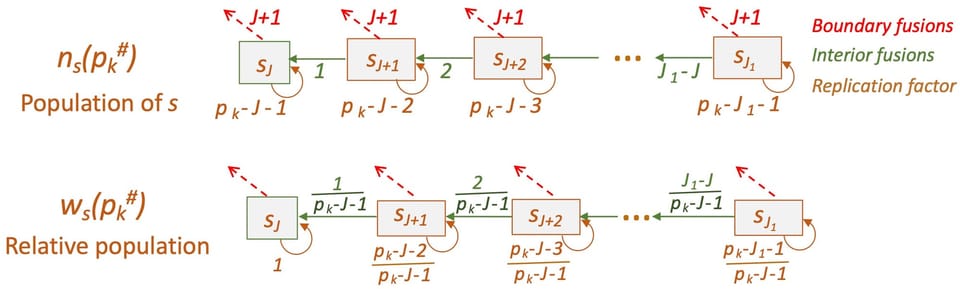
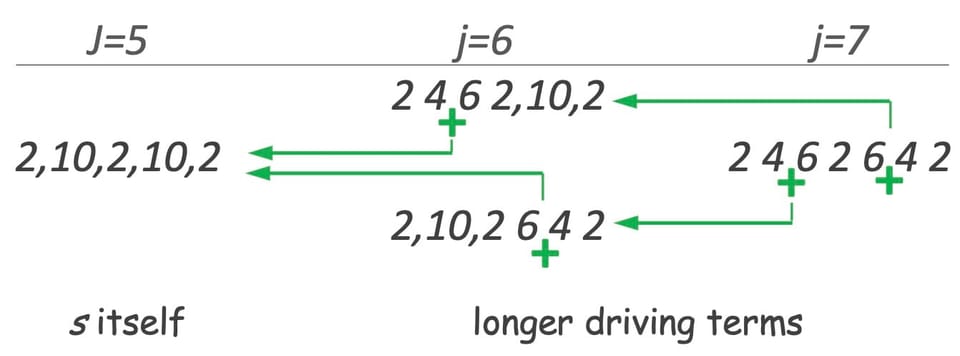
Prime gap patterns grow in predictable ratios because the dynamic recursion duplicates existing gap sequences before eliminating candidates through modular arithmetic.1 In number theory, a sequence of consecutive gaps is called a constellation, with an individual gap representing a constellation of length one.1 When copies of a cycle concatenate in the second step of the recursion, every constellation duplicates once for each copy.1 Fusions in the third step eliminate certain instances while creating new ones when longer sequences, termed driving terms, collapse into the target pattern. For example, a five-gap constellation of two, 10, two, 10, and two arises from a seven-gap sequence when adjacent pairs of four and six merge into 10.1 Fusions altering outer borders eliminate the instance, while interior fusions shorten the sequence into the desired constellation.1
When a constellation spans a distance smaller than twice the next prime in the sieve, the Chinese Remainder Theorem ensures that every possible fusion occurs in a separate concatenated copy of the cycle. Under this geometric condition, Holt showed that relationships between a constellation and its driving terms form a discrete Markov chain, where future transitions depend solely on current states.1 Holt told Primary that once this geometric threshold is met, the evolution of relative populations is entirely deterministic, adding that even if a constellation has not yet appeared, it will approach its indicated relative population compared to other constellations of the same length.1 This structure yields exact population models across all subsequent stages of the sieve.1 Factoring out baseline growth reveals a relative population metric that settles into a fixed constant determined solely by the odd prime factors dividing spans between boundary fusions.
Holt proved that all admissible constellations of a given length share the same underlying growth rate across sieve cycles.1 Consequently, the ratio between populations of any two admissible constellations of equal length approaches a positive constant determined entirely by their respective odd prime factors.1 Holt told Primary that this ratio remains immune to secondary geometrical variations, emphasizing that the ratio is determined solely by the primes dividing any span within the constellations and is unaffected by qualities such as symmetry or oscillations.
How does the dynamic model connect with classic conjectures?
The dynamic model aligns with classic conjectures because its asymptotic formulas reproduce the exact density coefficients predicted by G. H. Hardy and J. E. Littlewood in their 1923 conjecture on prime tuples. In that paper, Hardy and Littlewood proposed that the frequency of any admissible prime constellation could be estimated through a product series accounting for how the constellation distributes across prime residue classes.1 Holt demonstrated that the dynamic system reaches asymptotic relative populations equal to the singular series coefficients calculated by Hardy and Littlewood.
This dynamic perspective builds on earlier foundation work by Holt and Helgi Rudd, who posted an abstract to arXiv in August 2014 establishing that gap recursions could provide explicit enumerations of constellations across stages of Eratosthenes sieve. In that paper, Holt and Rudd reported that examining gap cycles across sieve stages provided mathematical evidence toward the twin prime conjecture, Polignac's conjecture, questions posed by Paul Erdős and Pál Turán, and the asymptotic estimates in Conjecture B of the 1923 Hardy-Littlewood paper.2 The September 2026 preprint formalizes this dynamic framework into complete proofs, presenting closed-form eigenvalue solutions for small constellations across all subsequent cycles.1
A notable finding in Holt's work is that Eratosthenes sieve treats all admissible constellations of identical length fairly over infinite scales.1 Because transition dynamics depend only on constellation length, constellations of equal length differ only in their initial starting populations.1 Holt evaluated the model for individual gaps up to a width of 82 units, setting an initial filtering stage based on the prime 37.1 To associate dynamic parameters with numerical scales, Holt applied Mertens' Third Theorem, a nineteenth-century formula relating prime products to logarithmic rates.1 Using this connection, Holt calculated a quadratic density statistic over survival intervals and reported that first-order estimates for individual prime gaps agreed with empirical samples of primes up to a numerical ceiling of 5.677 times 10 to the 14th power.1 Holt told Primary that computational ceilings rather than mathematical limits capped this comparison, stating that the experimental data has been limited by computational resources, both CPU and memory.
What remains uncertain about prime distribution in the real numbers?
The dynamic model cannot provide exact counts of prime gaps along localized sections of the number line because it models candidate numbers across the entire primorial cycle rather than within the narrow window where primes survive. In Eratosthenes sieve, candidate numbers surviving a filtering stage remain verified primes only within the squared interval extending from the current prime squared up to the square of the next prime.1 Beyond that survival window, candidate numbers can still be eliminated by larger primes in later stages.1 To bridge this divide, Holt adopted an assumption that instances of a constellation distribute approximately uniformly throughout each cycle, yielding initial estimates. Holt told Primary that the recursive copying mechanism supports this working assumption, stating that researchers hypothesize to first order that copies of any constellation are uniformly distributed across the current cycle, with no evidence yet of any contrary bias. In addition, the findings appear in a preprint posted to the arXiv mathematics archive and have not completed peer review.1
Despite these boundaries, the discrete dynamic formulation provides a cautionary framework for evaluating computational data in number theory. Holt pointed out that the asymptotic equilibrium described by the dynamic system emerges across enormous numerical magnitudes that far exceed current supercomputing limits.1 Holt told Primary that small-scale observations reflect this unfolding trajectory, explaining that experimental samples show populations of small gaps evolving according to the models. Holt noted that relative populations of gaps of six, 10, 12, and 30 grow rapidly enough across experimental ranges to validate the dynamic framework, and added that this progression clarifies digit biases documented in 2016 by Robert Lemke Oliver and Kannan Soundararajan. When statistical samples of relatively small primes exhibit apparent imbalances between different gap lengths, researchers might mistake transient initial behaviors for permanent mathematical laws.1 Holt made Jupyter notebooks openly accessible through an online software repository to allow other researchers to examine the underlying eigenstructure and run independent simulations of gap cycles.1
The record
55 sentences trace to 2 sources and 1 contributor.
-
1
FB
 Fred B. Holt
Paper
· arxiv.org · 24 Sep 2026
Discrete dynamics of Eratosthenes sieve
Preprint · may not have been peer reviewed
See the source
-
2
A
arxiv.org
Paper
· arxiv.org
Eratosthenes sieve and the gaps between primes
Preprint · may not have been peer reviewed
See the source
- 3 Contribution — Fred B. Holt 16 statements added to this article
Other consulted pages1 page
ar5iv.labs.arxiv.org1 page
arxiv.org1 page
nature.com1 page
terrytao.wordpress.com2 pages
Article history
-
Published 24 Nov 2026, 15:34Assembled by the Primary desk from 2 sources · 1 contributor · 55 cited sentences
-
Fred B. Holt, an independent mathematician based in Seattle
- Go to the sentence: When an eliminated multiple drops out, the numbers flanking it lose their barrier, causing two adjacent spaces to fuse into one larger space.
- Go to the sentence: Fred B. Holt, an independent mathematician based in Seattle, Washington, noted in response to questions from Primary that composite numbers drop out in an orderly progression, stating that any non-prime number has two or more prime factors and will be eliminated when multiples of its smallest prime factor are removed.
- Go to the sentence: Holt demonstrated that a three-step recursion generates each subsequent cycle of gaps directly from the preceding cycle without using external arithmetic data.
- Go to the sentence: Holt told Primary that this dynamic transformation holds across every stage, stating that the three-step recursion is shown to hold for all subsequent primes, without exception.
- Go to the sentence: In the third step, the algorithm executes gap fusions by combining adjacent gaps at positions determined by multiplying the new prime by each gap in the current cycle.
- Go to the sentence: Holt told Primary that this arithmetic product precisely identifies which numbers drop out, explaining that the element-wise product marks the candidates that are multiples of the current prime to be eliminated, while copies from the second step cover the full span of the new cycle.
- Go to the sentence: Holt told Primary that once this geometric threshold is met, the evolution of relative populations is entirely deterministic, adding that even if a constellation has not yet appeared, it will approach its indicated relative population compared to other constellations of the same length.
- Go to the sentence: Holt proved that all admissible constellations of a given length share the same underlying growth rate across sieve cycles.
- Go to the sentence: Consequently, the ratio between populations of any two admissible constellations of equal length approaches a positive constant determined entirely by their respective odd prime factors.
- Go to the sentence: Holt told Primary that this ratio remains immune to secondary geometrical variations, emphasizing that the ratio is determined solely by the primes dividing any span within the constellations and is unaffected by qualities such as symmetry or oscillations.
- Go to the sentence: Using this connection, Holt calculated a quadratic density statistic over survival intervals and reported that first-order estimates for individual prime gaps agreed with empirical samples of primes up to a numerical ceiling of 5.677 times 10 to the 14th power.
- Go to the sentence: Holt told Primary that computational ceilings rather than mathematical limits capped this comparison, stating that the experimental data has been limited by computational resources, both CPU and memory.
- Go to the sentence: Holt told Primary that the recursive copying mechanism supports this working assumption, stating that researchers hypothesize to first order that copies of any constellation are uniformly distributed across the current cycle, with no evidence yet of any contrary bias.
- Go to the sentence: Holt pointed out that the asymptotic equilibrium described by the dynamic system emerges across enormous numerical magnitudes that far exceed current supercomputing limits.
- Go to the sentence: Holt told Primary that small-scale observations reflect this unfolding trajectory, explaining that experimental samples show populations of small gaps evolving according to the models.
- Go to the sentence: Holt noted that relative populations of gaps of six, 10, 12, and 30 grow rapidly enough across experimental ranges to validate the dynamic framework, and added that this progression clarifies digit biases documented in 2016 by Robert Lemke Oliver and Kannan Soundararajan.