A small star plunges through its dying giant companion in Andromeda
Observations of a binary system in the Andromeda Galaxy reveal orbital drag shedding energy inside a shared stellar envelope, testing theories of how close compact binaries form.
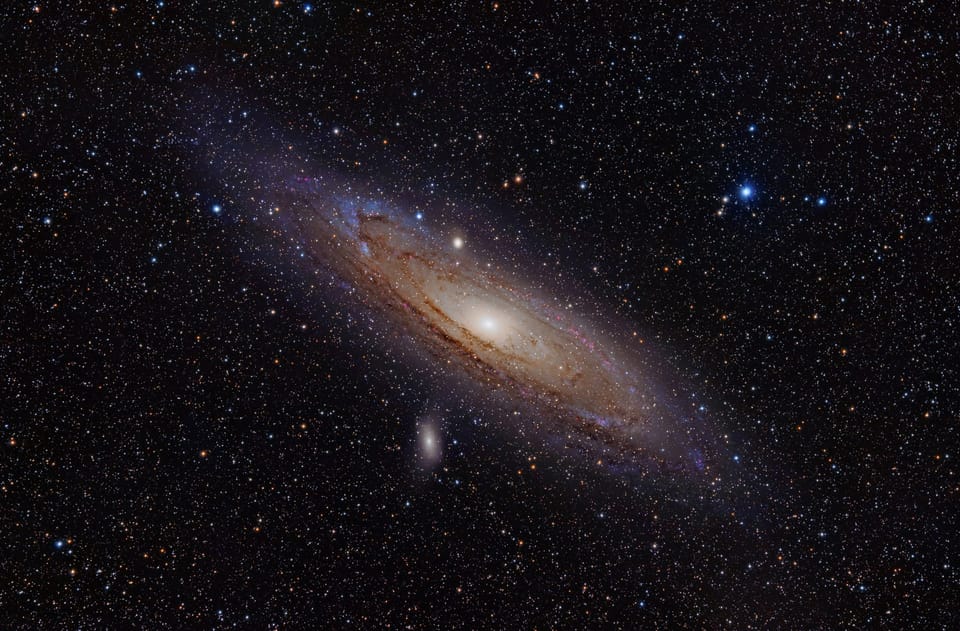
When two stars orbit each other closely, their peaceful coexistence eventually comes to an end as the more massive partner runs out of nuclear fuel. The ageing star swells outward into a red giant, expanding its outer layers by hundreds of times until its companion is completely engulfed. Trapped inside this tenuous ocean of gas, the smaller star begins a slow, destructive spiral inward, dragged by friction against the surrounding material. For decades, astrophysicists have used this scenario to explain how pairs of dead stellar remnants end up locked in impossibly tight orbits, but they had never caught a star in the middle of that plunge.
Now, long-term observations of an erupting system in the nearby Andromeda Galaxy have delivered the first direct view of a companion star spiralling through the extended atmosphere of its dying giant host.12 The interaction, known as common-envelope evolution, represents a pivotal crossroad in the life of binary stars.31 Depending on how much energy the spiralling companion transfers to the surrounding gas, the process can either fling the giant star's envelope away into space to leave behind an ultra-compact binary, or drag the companion down until it collides directly with the giant's dense core.13 Compact binaries produced by this process are the direct ancestors of gravitational wave mergers, X-ray binaries, and white dwarf pairs, making the mechanics of this intermediate stage central to modern astrophysics.32
How does orbital drag heat a shared stellar envelope?
Orbital decay inside a swollen companion occurs because the surrounding gas creates a persistent gravitational brake on the incoming star. In any binary system, each star moves through space according to the mutual gravitational pull between them. When the larger star expands, its outer envelope becomes a vast, convective cloud of low-density gas.21 As the smaller companion star moves through this medium faster than the gas itself is rotating, the material ahead of it is deflected and compressed behind its path, forming a gravitational wake. This turbulent wake exerts a backward pull, forcing the companion to bleed away its orbital speed and sink deeper into the host star.31
The law of conservation of energy dictates that the companion's lost gravitational potential energy cannot simply vanish. As the star descends deeper into the gravitational well of the giant, that lost orbital energy transforms into heat and kinetic energy inside the envelope.31 If the gas can radiate this thermal energy away efficiently through convection, the envelope remains relatively stable while brightening steadily over several years.23 If the energy accumulates faster than the envelope can disperse it, the resulting pressure triggers a catastrophic expansion or an outright dynamical eruption that blows the surrounding material into interstellar space.
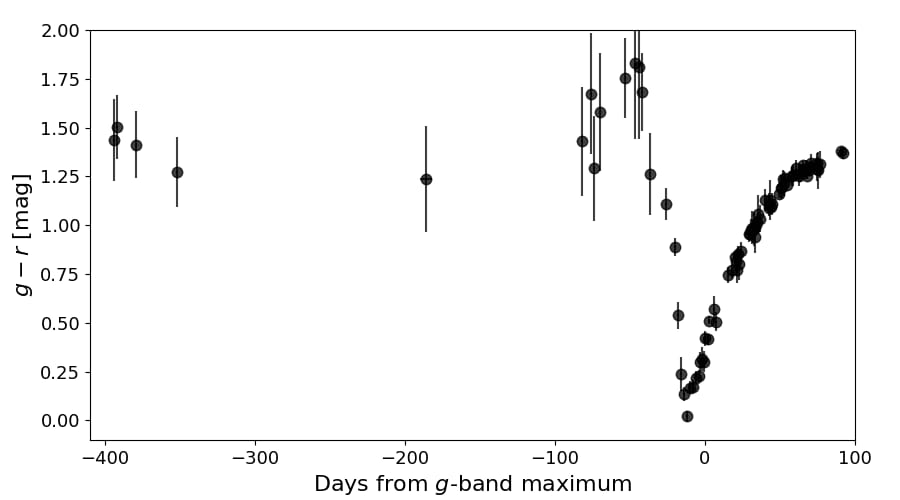
Astronomers led by Viraj Karambelkar of Columbia University tracked this exact sequence in a binary system designated AT 2025abao, situated in the Andromeda Galaxy.12 In a study published on 18 November 2026 in the journal Nature, the authors report that the primary star is an asymptotic giant branch star, a late evolutionary stage where a star roughly seven times the mass of the Sun swells to immense dimensions.1 Archival images revealed no significant variability in the star between 1989 and 2018.1 Beginning in 2018, however, the system began to brighten gradually over a seven-year period, undergoing two distinct episodes in which its optical brightness increased by a factor of two to three.1
Ordinary stellar winds escaping from the primary star could not account for this persistent excess luminosity, according to the paper.1 Instead, Karambelkar and colleagues calculated that the excess light matched the energy dissipated by frictional drag as a companion star of about 0.7 solar masses moved through the outer envelope.12 The authors calculated that this drag released roughly 3×1038 ergs per second, providing direct empirical evidence of energy dissipation during the inspiral stage of common-envelope evolution.12
What caused the system to suddenly explode into a luminous red nova?
A catastrophic collision between the inward-falling star and the dense central core terminated the prolonged brightening phase in late 2025. On 17 October 2025, amateur astronomer Koichi Itagaki detected a sudden optical flash in the Andromeda Galaxy.1 Within 25 days of that discovery, AT 2025abao brightened approximately 100-fold in red light, and its surface temperature surged to about 8,000 kelvin.1 Spectroscopic measurements recorded fast-moving gas decelerating from roughly 900 kilometres per second to 150 kilometres per second as the newly ejected material slammed into outer gas shells shed prior to the outburst.13
This sudden outburst exhibited the classical spectroscopic hallmarks of a luminous red nova, an explosive transient associated with stellar mergers.13 Karambelkar and colleagues concluded that the companion star completed its plunge to the primary star's helium core in fewer than 10 orbits, merging with the core and launching a powerful shock wave outward.12 Despite the intensity of the explosion, the authors report that only about 10 percent of the giant's loose envelope was completely unbound from the system, escaping at roughly 10 times the primary star's escape speed.12
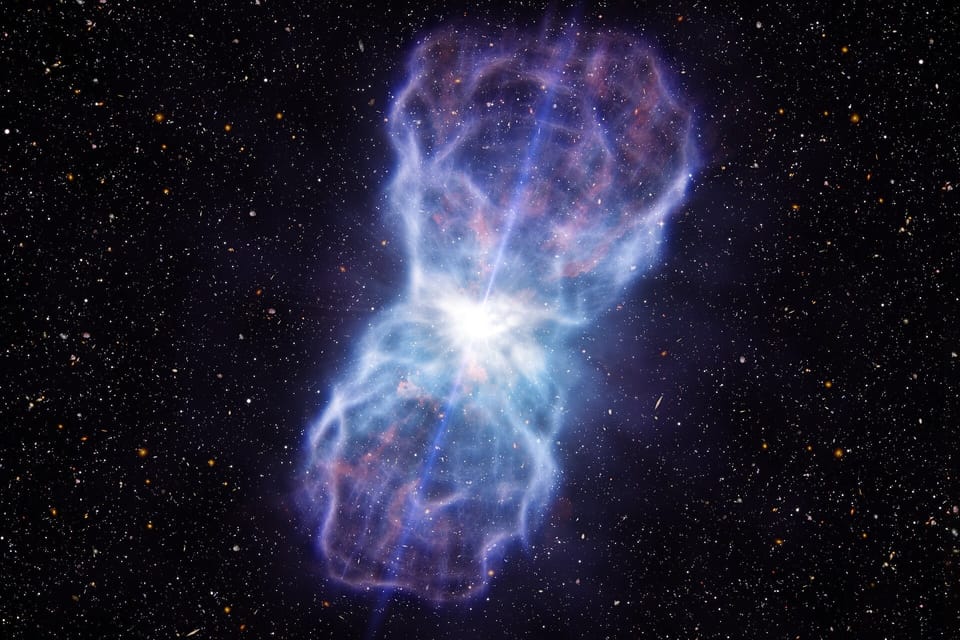
This measurement provides an empirical test for a long-standing theoretical parameter known as alpha, which quantifies the fraction of released orbital energy that actually helps unbind a common envelope.12 The team constrained alpha to lie between 0.01 and 0.4, aligning with estimates derived from known post-common-envelope binary systems.12 The authors noted that standard single-parameter models fail to capture the real physical interaction, because a significant fraction of the energy in the final plunge was channelled into launching a small fraction of the mass at extreme velocity rather than gently lifting the entire envelope away.1
Did the companion star truly merge or did it survive?
Competing hydrodynamical models suggest the companion star may have avoided a complete merger, remaining intact in an eccentric orbit around the primary core.31 In a study published on 23 October 2026 in The Astrophysical Journal Letters, an independent research group led by Zhuo Chen of the Chen-Ning Yang Institute for Advanced Study at Tsinghua University modelled the same multi-year event and reached an alternative conclusion.1 Chen and colleagues interpreted the eight-year precursor as a main-sequence star moving through the dense stellar wind of a 6.9-solar-mass asymptotic giant branch star, deriving a larger companion mass of approximately 1.4 solar masses.1
Radiation hydrodynamic simulations conducted by Chen's team indicated that the companion plunged into the envelope and launched a shock, yielding a total ejecta mass of about 0.92 solar masses with only about 0.57 solar masses becoming gravitationally unbound.3 Crucially, their models indicated that the main-sequence companion and the primary core survived without merging for at least 400 days following the onset of the envelope interaction.31 If confirmed, this scenario would make AT 2025abao the first observed system caught in the direct act of forming a close compact binary rather than undergoing a total merger.3
The conclusions drawn from AT 2025abao remain bounded by the fact that neither team observed the secondary companion directly. The giant star outshone its companion by a factor of roughly 18,000, forcing researchers to infer companion masses, orbital trajectories, and the final merger outcome through numerical simulations of the observed light curves and dust shells.1 Because different physical assumptions regarding wind density and drag coefficients yield divergent endings, the current data cannot definitively settle whether a tight binary survived.13 Furthermore, measurements of a single event in the Andromeda Galaxy cannot establish how frequently giant stars swallow their companions across the wider stellar population.1
Astronomers plan to distinguish between these competing interpretations through sustained follow-up observations across multiple wavelengths. Karambelkar and colleagues noted that if the system underwent a true merger, the circumstellar dust shell should continue expanding steadily, whereas a surviving binary could induce periodic radial velocity shifts in spectral lines and distinctive pulsations in the remaining envelope.1 Next-generation wide-field survey facilities, including the Vera C. Rubin Observatory and the Nancy Grace Roman Space Telescope, are projected to identify dozens of similar common-envelope inspirals across approximately 100 Milky Way-like galaxies within 49 million light years, providing the sample size needed to map the ultimate fates of close binary stars.12
The record
35 sentences trace to 3 sources.
-
1
SB
 Science Blog Research Desk
Document
· scienceblog.com · 25 Nov 2026
AT 2025abao observations provide first direct evidence of common-envelope inspiral, revealing frictional energy dissipation as a star spirals inside its giant companion’s envelope
See the source
-
2
N
 nature.com
Paper
· nature.com
An inspiral of a star inside a common envelope with its giant companion - Nature
Journal article
See the source
- 3 Unravelling the Nature of AT2025abao: From Precursor to Final Fate - IOPscience See the source