Two kinds of macrophages may decide whether gastric tumors yield to immunotherapy
A shift in the cellular balance inside stomach tumors explains why immune checkpoint drugs help only some patients, pointing toward new combination treatments.
When immune cells enter a malignant tumor, their presence alone does not ensure that cancer cells will die. For years, cancer medicine treated the presence of immune defenders as an encouraging sign that the body was ready to fight back. In the stomach, however, tumors often grow unchecked even when surrounded by swarms of white blood cells. Therapies designed to strip away the biochemical cloaks that tumors use to hide frequently fail in gastric cancer, leaving doctors with little guidance on which patients will respond.
Gastric cancer remains one of the leading causes of cancer death across the globe.1 Over the past decade, immune checkpoint inhibitors, drugs that release biological brakes on killer T cells so they can destroy malignant tissue, have become part of standard treatment.12 Yet these therapies produce durable benefits in only a minority of gastric cancer patients.12 Finding out why some tumors resist treatment requires looking closely at the cellular environment where the clash takes place.
That surrounding environment, known as the tumor microenvironment, is an intricate ecosystem containing blood vessels, structural tissue, and diverse immune cells.12 Among the most abundant of these are macrophages, large scavenger cells whose classical duty is to engulf cellular debris and foreign invaders.1 In cancer, macrophages can adopt radically opposing roles. When guided by activating chemical signals, they recruit killer cells and attack the tumor.1 When exposed to alternative biochemical cues, they turn into suppressive shields that protect cancer cells from immune destruction.1
For an immune checkpoint inhibitor to eradicate a tumor, a precise sequence of events must unfold in order. First, killer immune cells known as CD8-positive T cells must penetrate the tumor tissue.12 Second, those T cells must receive activating chemical instructions from neighbouring helper cells rather than suppressive signals that force them into exhaustion. Third, the checkpoint drug must release the specific inhibitory molecular receptors that cancer cells use to switch the killer cells off. If nearby scavenger cells are pumping out compounds that disarm T cells before the drug can act, the entire defensive cascade breaks down.
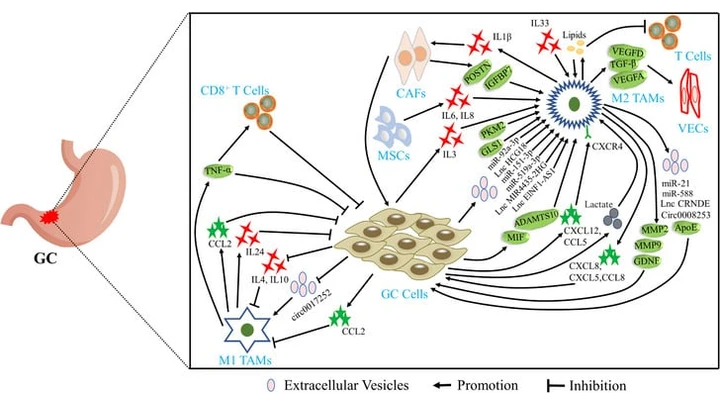
A study published in the peer-reviewed journal Science Bulletin demonstrates that the balance between two distinct macrophage states determines whether gastric tumors resist or succumb to immunotherapy.12 Rather than the simple presence or absence of macrophages, the critical factor is the numerical ratio between an immune-activating population and an immunosuppressive population.21 Patients whose gastric tumors harbor a higher proportion of activating macrophages relative to suppressive ones experience significantly higher response rates and longer progression-free survival following checkpoint blockade.12
How do opposing scavenger cells shape the stomach tumor ecosystem?
Opposing macrophage populations influence gastric tumors by sending contradictory molecular instructions to nearby cancer-killing T cells. The researchers identified one population that carries high levels of a signaling protein named CXCL10, designating these cells Mac-CXCL10.13 CXCL10 functions as a chemical beacon that attracts killer T cells into tissue.1 In stomach tumors, these Mac-CXCL10 cells assemble directly alongside CD8-positive T cells that are responding to interferon, a class of signaling proteins that coordinates immune attacks.12 The study characterizes this partnership as an interferon-responsive immune hub, a local microenvironment where scavenger cells and killer cells mutually reinforce anti-tumor activity.12
The second population of macrophages operates in direct opposition to this defensive network. Designated Mac-OLR1 because the cells display high quantities of a surface receptor protein called OLR1, these cells are embedded in an immunosuppressive microenvironment.12 The researchers found that Mac-OLR1 cells rely heavily on lipid metabolic programs, the internal cellular machinery that processes fats.12 In the dense, oxygen-deprived space of a growing tumor, metabolic stress and the accumulation of oxidized lipids appear to push scavenger cells into this lipid-heavy state.12
Once settled into this suppressive mode, Mac-OLR1 macrophages manufacture and release prostaglandin E2, a bioactive lipid signaling molecule abbreviated as PGE2.12 According to the study, prostaglandin E2 directly interferes with T cells by dampening their response to interferon and blunting their cytotoxic attack against cancer cells.12 By neutralizing the very killer cells that checkpoint blockade seeks to unleash, these lipid-laden macrophages build a biochemical wall around the tumor.
What did single-cell profiling reveal about patient survival?
Single-cell analysis of more than 240,000 cells collected from gastric cancer patients showed that the ratio between Mac-CXCL10 and Mac-OLR1 directly tracks with clinical outcomes.12 Traditional tissue profiling methods grind whole biopsy samples together, blending distinct cellular messages into an unreadable average. By reading the gene expression profiles of hundreds of thousands of individual cells separately, the study mapped the fine cellular composition of stomach tumors.1
This high-resolution atlas showed that neither macrophage subtype exists in absolute isolation. Instead, tumors carry varying mixtures of both. When the analysis compared patient outcomes against these cellular ratios, individuals with a higher Mac-CXCL10 to Mac-OLR1 ratio achieved longer progression-free survival, defined as the duration of time patients lived before their tumors began growing again. Conversely, patients whose tumors were dominated by the lipid-handling Mac-OLR1 population faced early progression and failed to respond to checkpoint blockade.
What are the limits of the current evidence?
The findings stem from an observational cellular atlas and cannot on their own prove that shifting macrophage ratios directly causes tumors to shrink. The initial publication release does not state the total number of patients who contributed the 240,000 analyzed cells, nor does it specify how treatment outcomes were clinically measured across the cohort.1 Furthermore, the report does not indicate whether the predictive power of this macrophage ratio has been confirmed in an independent, prospectively gathered validation group.1 While the cellular correlations are strong, prospective clinical trials will be necessary to establish whether the ratio functions as a reliable predictive biomarker in hospital practice.12
Can altering macrophage behavior make immunotherapy work for more patients?
Modifying the chemical signals that govern macrophage metabolism could potentially turn treatment-resistant gastric tumors into responsive ones. Because prostaglandin E2 is produced through biological pathways that are already well-characterized and targeted by existing anti-inflammatory medications, researchers are eager to determine whether blocking PGE2 synthesis can restore T cell sensitivity to interferon.1 The study suggests that shutting down lipid metabolic pathways or interrupting PGE2 signaling could dismantle the suppressive microenvironment that Mac-OLR1 cells maintain.12
If clinical testing confirms this mechanism, physicians could eventually use the Mac-CXCL10 to Mac-OLR1 ratio as a diagnostic screen before administering checkpoint inhibitors.1 Patients whose tumors show unfavorable ratios could receive adjuvant therapies designed to inhibit prostaglandin E2 or disrupt lipid processing, shifting the balance of their immune microenvironment toward protective hubs before starting immunotherapy. For a malignancy where checkpoint inhibitors currently help only a fortunate few, uncovering how scavenger cells switch from allies to adversaries provides a tangible path toward more effective combination treatments.
The record
28 sentences trace to 3 sources.
-
1
S
 scientificinquirer
Document
· scientificinquirer.com · 25 Nov 2026
Two Kinds of Macrophages May Decide Whether Gastric Tumors Respond to Immunotherapy
See the source
-
2
E
 eurekalert.org
Third-party reporting
· eurekalert.org
Why some gastric tumors resist immunotherapy — and how macrophages tip the balance?
See the source
-
3
E
eurekalert.org
Third-party reporting
· eurekalert.org
Schematic illustration of binary macrophage states associated with interferon-responsive immune activation and PGE₂-related immunosuppressive features and their relationship with differential responses to immunotherapy in gastric cancer.
See the source