A carved ivory king reveals the groomed world of Norse rulers
A tenth-century gaming piece carved from walrus tusk portrays an intricately styled beard and parted hair, aligning with archaeological records of grooming tools to challenge assumptions about Viking appearance.
Popular imagination often pictures Norse seafarers as feral raiders who emerged from northern waterways with tangled matted hair and unkempt beards. Historical depictions on runic stones and silver coins contributed to this impression by presenting human faces in stark, highly stylized outlines or rough archetypes rather than realistic facial portraits.1 Yet physical human hair in any ancient society required deliberate physical labor to grow, clean, trim, and preserve. When individuals invested labor and rare materials into hair arrangement, those coiffures functioned as visible statements of social standing, gender identity, and authority across the community.2
Understanding how historical peoples presented themselves matters because personal adornment reflects the legal rules and social hierarchies of their time. In early medieval Scandinavia, physical grooming was tied to public respect and social standing, where an untended face could invite public ridicule or legal penalties.3 Everyday presentation established who held power in communal gatherings and who commanded respect among peers. Until recently, surviving Scandinavian art from the era offered few naturalistic representations of how high-ranking individuals styled their facial hair and hair in three dimensions.
The physical chain of evidence that reconstructs personal styling begins with the tools recovered from settlement dirt and cemetery mounds. For an individual to sustain a complex haircut or braided beard, several practical conditions had to align. First, specialized craftworkers had to manufacture precise grooming tools from hard animal bone and antler using fine saws and rasps.24 Second, individuals needed regular access to water, soap, and assistance to wash and comb their hair. Third, maintaining a shaped cut required frequent trimming rather than uncontrolled growth. Finally, artisans translated those accepted grooming conventions into valuable objects that depicted how leaders were expected to appear.
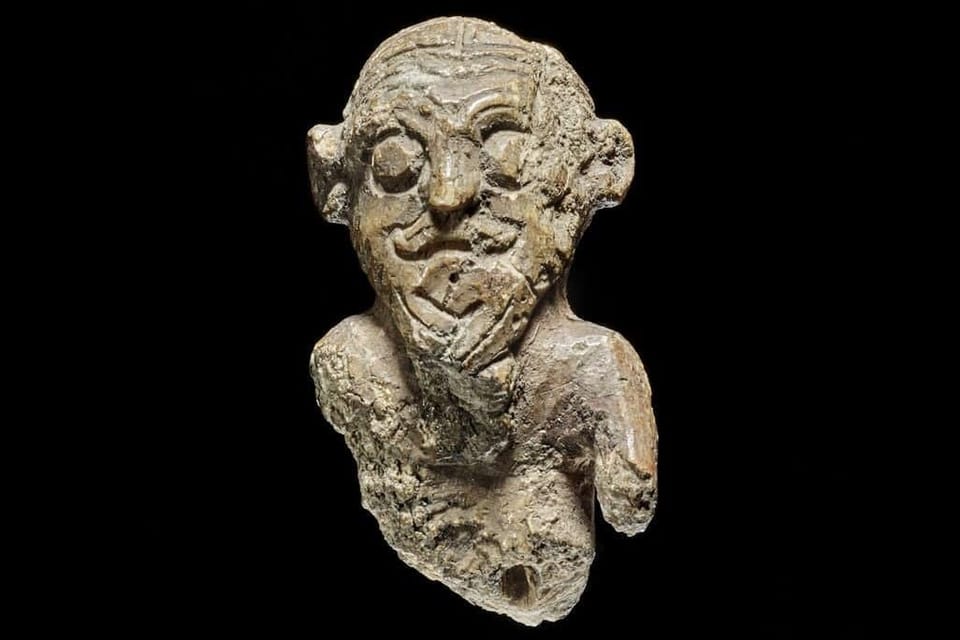
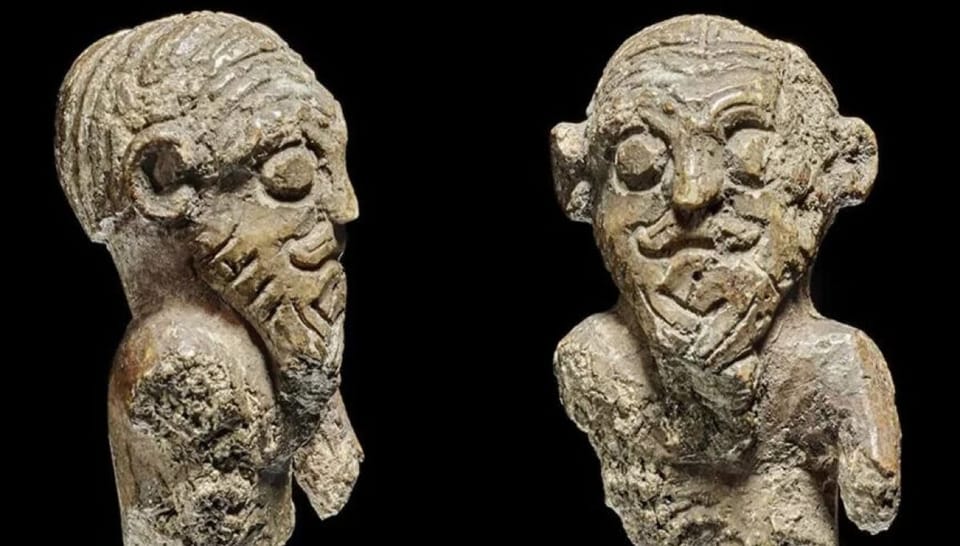
A tenth-century carving recovered from museum storage in Denmark provides a remarkably detailed look at this grooming tradition.1 The miniature portrait shows a man with hair parted neatly along the crown of his head and cropped short at the back, exposing his ears with a subtle curl above one ear.1 His facial hair features prominent sideburns running into a broad mustache, accompanied by a long goatee that hangs from his chin in a deliberate braid.1 Carved from expensive Arctic walrus tusk, the miniature served as the king piece in the traditional strategy board game known as Hnefatafl.1
How do artifacts show the way Norse leaders groomed?
Archaeological evidence from graves across northern Europe demonstrates that Norse people carried dedicated personal hygiene kits throughout their lives and into burial. Peter Pentz, a curator at the National Museum of Denmark who published an analysis of the walrus ivory piece in the journal Medieval Archaeology, noted that the carving depicts an elite man with a meticulously arranged coiffure and braided goatee. The miniature originated in a high-status burial mound at Flygstad in southern Norway, where excavators uncovered it alongside spherical bone gaming pieces, a bone die, a spearhead, a spur, and a sword fragment.1
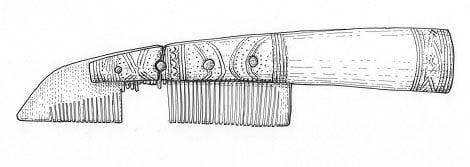
The grooming displayed on the carving aligns directly with tools that archaeologists routinely discover during domestic and cemetery excavations. Dr Steve Ashby, a medieval archaeologist at the Department of Archaeology at the University of York, documented that double-sided combs carved from deer and reindeer antler were among the most common everyday possessions found in Scandinavian towns like York. Excavations across Scandinavian settlements frequently recover bone combs, iron razors, tweezers, toothpicks, and miniature ear spoons designed to extract wax.145 According to research published by the National Museum of Denmark, these personal care items were so prized that owners often kept them inside dedicated protective cases attached to their belts.53
Written medieval accounts reinforce the physical record of regular personal care among Scandinavian travellers. A thirteenth-century chronicle attributed to the English abbot John of Wallingford recorded that Danish men living in England bathed every Saturday, combed their hair daily, and laundered their garments regularly.145 Writing in the tenth century, the Arabic traveller Ibrahim al-Turtushi observed that both male and female inhabitants of the southern Danish trading centre of Hedeby wore eye makeup to enhance their appearance.15 In Old Norse legal codes such as the Icelandic Gragas, deliberately dirtying another person or pushing someone into mud or waste carried severe legal punishments, indicating that cleanliness was protected by community laws.
Why did facial hair carry such weight in Viking society?
Facial hair and long tresses served as primary markers of masculine authority, legal status, and social maturity across early medieval Scandinavia. In Old Norse literary records such as Njal’s Saga, a man unable to grow facial hair faced open mockery, earning insulting nicknames that questioned his masculinity and authority.3 Elisabeth Arwill-Nordbladh, an archaeologist at the University of Gothenburg writing in Internet Archaeology, documented that hairstyles established gendered identities and social rank throughout late Iron Age Scandinavia. Long hair required years of dedicated maintenance, transforming personal grooming into a public demonstration of resources and self-discipline.
The gesture of holding or stroking a beard appears on several miniature metal figurines from the Viking Age, suggesting a ritualized visual language of male status. In his analysis of early medieval carvings, Pentz argued that king pieces in board games often displayed deliberate beard-holding poses to symbolize royal leadership, masculine vigor, and patriarchal authority.1 Rather than representing an uncalculated wild beard, the long chin beard on the Flygstad ivory king is bound into a tidy braid, keeping the facial hair controlled and orderly during daily activity. Board games like Hnefatafl pitted a central king and his small retinue against a larger surrounding force, turning strategic play into a reflection of court politics where the king piece commanded the center of the table.1
The choice of walrus ivory for the Flygstad king piece reflects an enormous investment of wealth and effort. Walrus tusks, known across northern trade routes as ivory, had to be harvested in perilous hunting expeditions in Arctic waters and carried across long maritime routes. Whoever commissioned or owned the gaming piece possessed the economic resources to secure imported ivory and hire a master carver capable of rendering individualized facial expressions. The small face exhibits slight creases and an alert expression, departing sharply from the blank, schematic human outlines typical of the era.
What can a single ivory carving leave unanswered?
The Flygstad figurine represents a single luxury artifact from an elite burial mound, which means it cannot reveal the standard appearance of everyday agricultural laborers across the Norse world. While the carving provides an intricate three-dimensional look at one hairstyle, it remains a solitary miniature piece that could portray an idealized aristocratic concept rather than a portrait of an actual living person. Pentz noted that although the piece dates to the late tenth century, coinciding with the reign of the Danish king Harald Bluetooth between around 958 and 985, there are no verified historical likenesses of Harald Bluetooth to confirm whether the carving depicts that monarch or an anonymous regional chieftain. Furthermore, while ancient DNA studies from 2018 have tracked medieval walrus ivory trade from eastern sources to Greenland, the exact geographic origin of the ivory used in this particular figurine has not been scientifically determined.1
The miniature also belonged to a specific upper-class gaming context that may not reflect how Norse people dressed during raiding or strenuous outdoor labor. Archaeologists examining Viking metal figurines in a 2025 study published in the journal Antiquity documented that small human figurines were frequently handled, altered, and in some instances intentionally broken or decapitated during use.1 Such objects carried complex symbolic roles in play, ritual, and status display that went beyond simple naturalistic portraiture. Skeletons from the period also reveal that ordinary people endured intense physical wear, joint pain, and dental wear from coarse grain diets, presenting a far harsher day-to-day reality than the polished image of an ivory king.5
How does the find reshape our view of northern history?
Recognizing that Norse leaders maintained complex coiffures, parted hair, and braided goatees replaces cinematic caricatures with the documented material habits of medieval seafaring communities. The physical evidence shows that early Scandinavians valued deliberate personal grooming as an essential component of their public identity and political standing. Archaeological investigations by the University of York into bone and antler combs demonstrate that antler carving was a specialized urban craft supported by long-distance trade networks across Scandinavia and Britain.4 Grooming aids were not peripheral novelties; they were core personal possessions carried by seafarers alongside their iron blades.
Future chemical and biomolecular investigations of surviving ivory pieces and organic materials promise to clarify the craft networks that shaped these objects. Researchers continue to apply molecular methods pioneered at the BioArCh laboratory at the University of York to identify whether antler and ivory originated from local herds or distant Arctic hunting grounds. As additional small-scale carvings and grooming kits receive microscopic and metallurgical analysis, archaeologists will gain a clearer picture of how artistic styles and grooming fashions spread across northern European trading settlements.
The record
20 sentences trace to 5 sources.
-
1
MA
 Mihai Andrei
Document
· zmescience.com · 24 Nov 2026
Forget the wild-haired savages. Here’s what Vikings really looked like
See the source
-
2
Y
 york.ac.uk
Third-party reporting
· york.ac.uk
Why Vikings cared about their hair
See the source
- 3 Internet Archaeol. 42. Arwill-Nordbladh. Viking Age Hair See the source
- 4 Hurstwic: Health and Medicine in the Viking Age See the source
- 5 Appearance See the source