Alloy crystal facets can guide carbon dioxide into cleaner fuels
Mapping binding energies across individual crystal faces could help chemists steer greenhouse gas reactions toward valuable liquids, according to a computational screening of hundreds of metallic alloys.

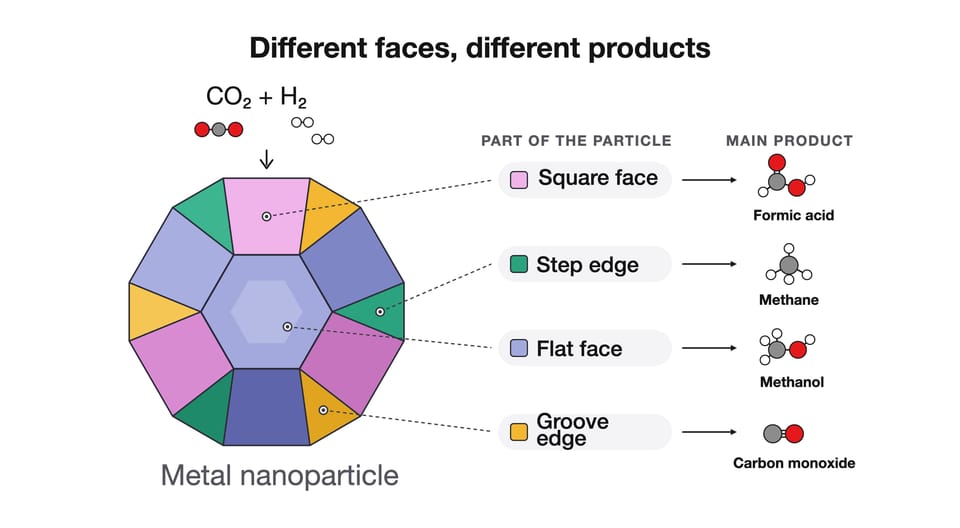
Converting carbon dioxide into valuable chemicals presents one of the central puzzles of modern industrial chemistry. The molecule itself is exceptionally stable, built with sturdy double bonds between carbon and oxygen that resist chemical transformation. Coaxing it to react with hydrogen gas over tiny metallic nanoparticles can yield valuable compounds, yet steering the reaction toward one specific outcome remains notoriously difficult. A slight difference in how atoms settle onto a metal surface can divert the chemistry from producing liquid methanol into producing gaseous methane, carbon monoxide, or formic acid.1
Controlling that chemical destination carries immense practical value. Methanol serves as a versatile chemical feedstock and liquid energy carrier, while methane can feed into existing natural gas infrastructure, and formic acid finds use in chemical synthesis and fuel cells. When a catalyst lacks selectivity, it churns out complex mixtures that require energy-intensive separation or produces low-value byproducts. Designing solid catalysts that favour one precise chemical pathway has traditionally required years of trial and error in the laboratory.
The underlying mechanism depends on a delicate sequence of surface interactions. A carbon dioxide molecule drifting through a reactor must first collide with the catalyst and adhere to its metallic surface. Hydrogen gas molecules must simultaneously land and split into reactive single atoms on adjacent sites. As these fragments migrate across the metal, chemical bonds between carbon and oxygen break apart step by step while fresh bonds to hydrogen atoms assemble. If the metallic surface binds the incoming molecules too weakly, the reactants bounce away before any reaction occurs. If the surface grips them too tightly, reaction intermediates remain glued in place, smothering the active sites and preventing further chemistry. Only surfaces with balanced binding energies allow the intermediate fragments to rearrange and release the desired finished product into the surrounding gas.
In a preprint posted to the arXiv server on September 11, 2026, Prajwal Pisal, Ondřej Krejčí, and Patrick Rinke reported a computational framework that tracks how individual crystal faces across hundreds of alloys influence this binding balance. While earlier computational screenings analyzed catalytic surfaces with uniform averages, the authors examined how energy distributions vary across specific exposed geometric facets.1 By combining facet-specific adsorption patterns with geometric particle models, Prajwal Pisal, Ondřej Krejčí, and Patrick Rinke identified alloy surfaces linked to selective yields of methanol, methane, formic acid, and carbon monoxide.
Why does converting carbon dioxide require precise surface control?
Chemical reactions on solid catalysts occur at atomic coordinates where reactants settle into specific electronic valleys. On any given alloy nanoparticle, those landing coordinates differ widely depending on how metal atoms pack together at the exterior. A flat terrace presents a different electronic environment from a stepped edge or a corner atom, meaning an intermediate molecule binds with varying strength across different spots on the same particle. Earlier computational screenings typically compressed these diverse environments into bulk averages, obscuring how specific local structures drive catalytic outcomes.1
Ondřej Krejčí said in response to questions from Primary that moving past bulk averages represented "a certain improvement from our previous work, where we had looked at materials in terms of almost all possible facets and our prediction for materials activity was based on averaging over all the facets." Ondřej Krejčí explained that evaluating individual crystal faces provides deeper insight into catalytic behavior and "allows to engineer the performance of a single material catalyst, just by trying to change the surface area of the facets."
The physical cause of this variation rests on local atomic geometry and elemental mixing. Prajwal Pisal, the lead author of the study, explained that the selective steering of intermediate molecules depends on two basic factors: atomic coordination number, which measures the count of immediate neighbours surrounding a surface atom, and local elemental composition. Prajwal Pisal said in response to questions from Primary that atoms on a flat terrace have many neighbours and bind molecules weakly, whereas atoms at an edge have fewer neighbours and grip reactants and intermediates more strongly. When different metals combine in an alloy, the elemental identity modifies that grip even across identical coordinates. Prajwal Pisal noted that a facet whose coordination and composition combine to grip carbon monoxide tightly enough will strip away its oxygen atom to produce methane, while milder binding allows the intermediate to retain oxygen and yield methanol.
How do individual crystal faces alter chemical binding?
Individual crystallographic facets expose unique geometric arrangements of atoms that dictate how tightly reactant molecules can adhere. In the preprint, Prajwal Pisal, Ondřej Krejčí, and Patrick Rinke extended a metric known as an adsorption energy distribution, which charts the spread of binding energies across diverse surface coordinates, to individual crystallographic facets. To account for how real nanoparticles present themselves in physical space, the authors combined these facet-resolved fingerprints with Wulff constructions, a geometric method that calculates the relative abundance of each crystal face based on surface energy.1 This step enabled the authors to evaluate how much of a particle's total area exposes facets capable of driving specific chemical steps.
To calculate these distributions without introducing human bias, the researchers automated how surface coordinates were sampled. Prajwal Pisal told Primary that the team used an existing computational tool named fairchem to identify high-symmetry landing coordinates based on surface topology. The simulation maintained approximately 8 angstroms of separation between periodic copies of each surface to prevent adjacent molecules from interacting and skewing energy calculations. Coordinates that converged within about 0.1 angstrom of one another were merged into single sites, preventing duplicate counting of identical energy valleys.
What did the computational screening reveal across hundreds of alloys?
The computational evaluation examined 226 metals and alloys, including elemental metals, binary pairings, and previously unexamined ternary combinations.1 To map the adsorption behavior across this collection, Prajwal Pisal, Ondřej Krejčí, and Patrick Rinke modeled more than 2,600 crystallographically distinct surfaces, computing about 1.4 million adsorption configurations. Carrying out such calculations with traditional quantum chemistry would demand prohibitive computing time, so the researchers used machine-learned force fields trained on data from the Open Catalyst Project to predict binding energies across the surfaces.1 Ondřej Krejčí told Primary that "the usage of pre-trained machine-learned potentials was what even allowed the study of such a big size."
Through distribution-based similarity comparisons and principal component analysis of mathematical moments within the energy curves, the authors identified distinct composition and facet pairings tied to specific catalytic behaviors.1 Certain alloy faces produced binding environments favorable for synthesizing methanol, while other combinations favored methane, formic acid, or carbon monoxide.1 The resulting analysis links the geometric layout of an alloy's crystal faces directly to qualitative selectivity trends among C1 products, which are molecules containing a single carbon atom.1 Ondřej Krejčí clarified in response to questions from Primary that "our workflow does not provide explicit insights into the reaction pathway." Ondřej Krejčí explained that connecting reactant and product binding energies with catalytic selectivity emerged naturally from the automated screening, reproducing trends already established in existing literature.
The broad search also generated unexpected similarities that prompted additional analysis. Prajwal Pisal told Primary that several crystal faces of pure silver ranked near the top of the similarity list for methanol synthesis when compared against a zinc-doped copper baseline, even though silver is widely recognised in chemistry literature as an ineffective methanol catalyst that produces carbon monoxide instead. Prajwal Pisal explained that two surfaces can produce similar statistical values when an entire adsorption landscape is condensed into a single index, demonstrating why large computational rankings serve to generate shortlists rather than definitive chemical conclusions.
Ondřej Krejčí offered an expanded perspective on the silver results, clarifying that while initial similarity matching showed overlap between silver and copper, a secondary unsupervised learning analysis grouped materials into distinct product regimes. Ondřej Krejčí told Primary that "our fingerprint does not have such a blind spot," noting that deeper clustering separated materials that favour different reaction pathways once multi-dimensional distributions were fully evaluated.
What limits the current model in practical reactors?
Calculations from machine-learned force fields describe static surface energies rather than the dynamic conditions of physical reactors. The reported screening relies on machine-learned force fields trained on standard datasets, which approximate underlying physical forces but can carry prediction errors when evaluating novel atomic combinations.1 Furthermore, the model assumes nanoparticles maintain equilibrium shapes described by thermodynamic Wulff models, whereas real catalytic particles in operating reactors experience high temperatures, intense pressures, and chemical restructuring that alter surface geometry over time.1 The paper is an arXiv preprint posted on September 11, 2026, and has not undergone formal peer review.
These static approximations represent a known boundary of the framework. Prajwal Pisal told Primary that the Wulff constructions depict zero-Kelvin equilibrium conditions in a vacuum, whereas actual industrial reactors operate under heat and chemical atmospheres that cause particles to reshape. Prajwal Pisal noted that calculating the exact temperature or pressure where dynamic restructuring breaks the static assumption requires intensive operando modeling, making direct experimental testing under reaction conditions necessary. Ondřej Krejčí told Primary that while operating conditions heavily alter facet areas, comprehensive dynamic simulations covering temperature, coverage, and substrates remain computationally unavailable. As a result, the authors provided Wulff constructions as an initial guide, allowing experimentalists to evaluate whether high-performing theoretical facets might be stabilized through chemical doping.
Prajwal Pisal added that energy windows separating chemical selectivity categories often span only a few tenths of an electron volt, meaning selectivity behaves as a continuous gradient rather than a rigid boundary. Ondřej Krejčí confirmed that resolving differences this narrow sits "on the edge of quality of our workflow", explaining that the team engineered quantum-mechanical checks to confirm predictions against experimental records.
By pinpointing specific alloy compositions and facet pairings that favor individual chemical products, the framework provides experimentally testable candidates for laboratory chemists to synthesize and verify.1 Prajwal Pisal identified KIn9Co2(001) as a leading candidate predicted by the model to yield methanol, noting that verifying the prediction requires synthesising particles that demonstrably expose that specific crystal face. Ondřej Krejčí observed that preparing such complex ternary alloys is inherently challenging, adding that "the fact that the facet is predicted to have zero area could make it even harder." If an experimental test of an exposed facet instead yields carbon monoxide or methane, or shows no catalytic activity, Prajwal Pisal observed that such an outcome would demonstrate that adsorption energy similarity alone cannot fully govern real catalytic performance.
The record
27 sentences trace to 1 source and 2 contributors.
-
1
PP
 Prajwal Pisal, Ondřej Krejčí, Patrick Rinke
Paper
· arxiv.org · 11 Sep 2026
Selectivity- and Activity-Aware Catalyst Descriptors for CO$_2$ Hydrogenation on Alloy Nanocatalysts using Machine-Learned Force Fields
Preprint · may not have been peer reviewed
See the source
- 2 Contribution — Ondrje Krejci 5 statements added to this article
- 3 Contribution — Prajwal Pisal 18 statements added to this article
Other consulted pages3 pages
arxiv.org3 pages
- Machine Learning Accelerated Descriptor Design for Catalyst Discovery in CO2 to Methanol Conversion
- Selectivity- and Activity-Aware Catalyst Descriptors for "CO"_"2"^"" Hydrogenation on Alloy Nanocatalysts using Machine-Learned Force Fields
- Machine Learning Accelerated Descriptor Design for Catalyst Discovery in CO2 to Methanol Conversion
research.aalto.fi2 pages
Article history
-
Published 27 Nov 2026, 16:31Assembled by the Primary desk from 1 source · 2 contributors · 27 cited sentences
-
Ondrje Krejci
- Go to the sentence: Earlier computational screenings typically compressed these diverse environments into bulk averages, obscuring how specific local structures drive catalytic outcomes.
- Go to the sentence: Carrying out such calculations with traditional quantum chemistry would demand prohibitive computing time, so the researchers used machine-learned force fields trained on data from the Open Catalyst Project to predict binding energies across the surfaces.
- Go to the sentence: Prajwal Pisal told Primary that several crystal faces of pure silver ranked near the top of the similarity list for methanol synthesis when compared against a zinc-doped copper baseline, even though silver is widely recognised in chemistry literature as an ineffective methanol catalyst that produces carbon monoxide instead.
- Go to the sentence: As a result, the authors provided Wulff constructions as an initial guide, allowing experimentalists to evaluate whether high-performing theoretical facets might be stabilized through chemical doping.
- Go to the sentence: Prajwal Pisal added that energy windows separating chemical selectivity categories often span only a few tenths of an electron volt, meaning selectivity behaves as a continuous gradient rather than a rigid boundary.
-
Prajwal Pisal, lead author
- Go to the sentence: Prajwal Pisal, the lead author of the study, explained that the selective steering of intermediate molecules depends on two basic factors: atomic coordination number, which measures the count of immediate neighbours surrounding a surface atom, and local elemental composition.
- Go to the sentence: Prajwal Pisal said in response to questions from Primary that atoms on a flat terrace have many neighbours and bind molecules weakly, whereas atoms at an edge have fewer neighbours and grip reactants and intermediates more strongly.
- Go to the sentence: When different metals combine in an alloy, the elemental identity modifies that grip even across identical coordinates.
- Go to the sentence: Prajwal Pisal noted that a facet whose coordination and composition combine to grip carbon monoxide tightly enough will strip away its oxygen atom to produce methane, while milder binding allows the intermediate to retain oxygen and yield methanol.
- Go to the sentence: To account for how real nanoparticles present themselves in physical space, the authors combined these facet-resolved fingerprints with Wulff constructions, a geometric method that calculates the relative abundance of each crystal face based on surface energy.
- Go to the sentence: Prajwal Pisal told Primary that the team used an existing computational tool named fairchem to identify high-symmetry landing coordinates based on surface topology.
- Go to the sentence: The simulation maintained approximately 8 angstroms of separation between periodic copies of each surface to prevent adjacent molecules from interacting and skewing energy calculations.
- Go to the sentence: Coordinates that converged within about 0.1 angstrom of one another were merged into single sites, preventing duplicate counting of identical energy valleys.
- Go to the sentence: Prajwal Pisal told Primary that several crystal faces of pure silver ranked near the top of the similarity list for methanol synthesis when compared against a zinc-doped copper baseline, even though silver is widely recognised in chemistry literature as an ineffective methanol catalyst that produces carbon monoxide instead.
- Go to the sentence: Prajwal Pisal explained that two surfaces can produce similar statistical values when an entire adsorption landscape is condensed into a single index, demonstrating why large computational rankings serve to generate shortlists rather than definitive chemical conclusions.
- Go to the sentence: The reported screening relies on machine-learned force fields trained on standard datasets, which approximate underlying physical forces but can carry prediction errors when evaluating novel atomic combinations.
- Go to the sentence: Furthermore, the model assumes nanoparticles maintain equilibrium shapes described by thermodynamic Wulff models, whereas real catalytic particles in operating reactors experience high temperatures, intense pressures, and chemical restructuring that alter surface geometry over time.
- Go to the sentence: Prajwal Pisal told Primary that the Wulff constructions depict zero-Kelvin equilibrium conditions in a vacuum, whereas actual industrial reactors operate under heat and chemical atmospheres that cause particles to reshape.
- Go to the sentence: Prajwal Pisal noted that calculating the exact temperature or pressure where dynamic restructuring breaks the static assumption requires intensive operando modeling, making direct experimental testing under reaction conditions necessary.
- Go to the sentence: Prajwal Pisal added that energy windows separating chemical selectivity categories often span only a few tenths of an electron volt, meaning selectivity behaves as a continuous gradient rather than a rigid boundary.
- Go to the sentence: By pinpointing specific alloy compositions and facet pairings that favor individual chemical products, the framework provides experimentally testable candidates for laboratory chemists to synthesize and verify.
- Go to the sentence: Prajwal Pisal identified KIn9Co2(001) as a leading candidate predicted by the model to yield methanol, noting that verifying the prediction requires synthesising particles that demonstrably expose that specific crystal face.
- Go to the sentence: If an experimental test of an exposed facet instead yields carbon monoxide or methane, or shows no catalytic activity, Prajwal Pisal observed that such an outcome would demonstrate that adsorption energy similarity alone cannot fully govern real catalytic performance.