Information in complex systems flows across three separate channels
A cryptographic perspective reveals that traditional measures conflate shared history and joint computation with direct driving, offering a cleaner way to track influence across living and financial networks.
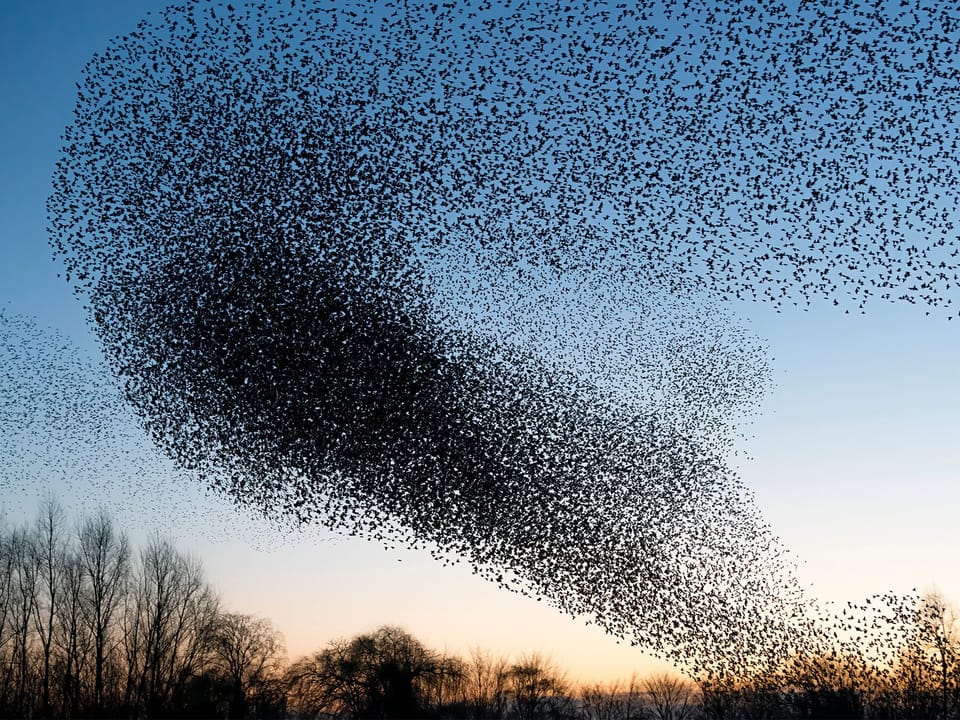
When a flock of starlings wheels across an evening sky, every bird turns in what looks like instantaneous coordination. A casual observer watching the aerial maneuver naturally assumes that a leader at the front initiates the turn and sends a direct signal rippling backward down the formation. Yet nature rarely operates through simple one-way commands. In large networks, whether composed of flocking animals, firing neurons in the human brain, regulating genes within a cell, or fluctuating share prices on an exchange floor, the visible coordination between two moving parts can emerge from entirely different mechanisms that look identical from the outside.1
Understanding who influences whom across these networks is fundamental to diagnosing how they operate and predicting how they respond to disruption. If an analyst mistakes two components that are merely reacting to the same environmental cue for a master and a servant, an intervention aimed at the supposed master will fail to alter the behavior of the follower. Conversely, if two signals produce an outcome only when combined, tracking either signal in isolation will reveal no hint of their true joint power. For decades, researchers across biology, physics, and economics have attempted to trace influence by measuring information flow, treating it as a single quantity moving through a pipe from one variable to another.
The intuitive reason this single-stream view breaks down becomes clear when examining the chain of events required for one event to influence another. Consider two components observed over time, an upstream sender and a downstream receiver. For a direct, unassisted message to pass between them, the sender must produce an action, that action must travel across a physical or statistical channel, and the receiver must alter its state in response, without relying on its own previous habit. Alternatively, both components might mirror each other simply because an unobserved external pulse strikes them simultaneously, creating the illusion of transmission without any direct interaction. Finally, the receiver might alter its behavior only when the sender's current action intersects with the receiver's own internal memory, like a combination lock that requires two tumblers to align before it springs open. Each of these three situations represents an entirely different physical arrangement, yet standard statistical diagnostics frequently lump them together into one number.
Ryan G. James, Blanca Daniella Mansante Ayala, Bahti Zakirov, and James P. Crutchfield, Modes of Information Flow, Entropy in press [2026], report that information flow between time series is not a unitary phenomenon. Instead, the authors establish that information moving from the past of one process to the present of another splits into three qualitatively distinct modes: intrinsic flow, shared flow, and synergistic flow.1 Intrinsic flow occurs when the past of the first variable directly predicts the present of the second in a manner that the second variable's own history cannot explain.1 Shared flow arises when the past of either variable predicts the future outcome equally well, typical of synchronized systems or those driven by a common external source.1 Synergistic flow appears when neither variable's past can predict the outcome on its own, but the two histories together unlock complete predictability.1 Explaining the physical foundation for this tripartite structure, James said in response to questions from Primary that "information splitting into intrinsic, shared, and synergistic channels is the natural dichotomy that follows from tracking possible causal influences between two present events and a resulting third output."
Why do simple measures of influence mislead?
Traditional diagnostic tools confuse distinct modes of coordination because mathematical conditioning does not simply subtract unwanted background correlations. Historically, analysts relied on time-delayed mutual information to detect interactions between an earlier observation of a sender and a later observation of a receiver.1 While mutual information, measured universally in bits, accounts for nonlinear relationships without assuming an underlying linear model, it cannot distinguish between genuine exchange and passive correlation created by shared history. In an earlier 2016 paper published in Physical Review Letters, Ryan G. James, Nix Barnett, and James P. Crutchfield demonstrated that transfer entropy, a widely used conditional metric designed to correct for this background sharing, also fails to quantify true communication flow, either overestimating influence or missing polyadic dependencies among multiple interacting components.

Transfer entropy attempts to isolate direct influence by measuring the statistical dependence between a sender's past and a receiver's present while conditioning on the receiver's own past.1 The foundational assumption behind this calculation was that conditioning on historical variables acts subtractively, neatly filtering out shared common history. As Ryan G. James, Blanca Daniella Mansante Ayala, Bahti Zakirov, and James P. Crutchfield report in Modes of Information Flow, Entropy in press [2026], conditioning probability distributions is not a subtractive operation. In nonlinear and context-dependent environments, conditioning on a shared variable can actively create statistical dependence where none existed before.1 James told Primary that "the failure was to not distinguish between conditional independence and conditional dependence--two events can either appear independent or dependent, given new information. These contradictory relations correspond to different structures of causal relationship. That is, transfer entropy misidentifies causal interdependence."
The canonical illustration of this failure occurs in a basic logical exclusive-OR operation, where the receiver's present state equals the exclusive-OR sum of the sender's previous state and the receiver's own previous state.1 If the sender's past state is a fair coin toss of zero or one, knowing that past state provides zero bits of information about the receiver's present state when considered in isolation, yielding a time-delayed mutual information of zero. Similarly, knowing the receiver's past state in isolation provides zero predictive power over its present state.1 However, observing both past states simultaneously provides complete predictability, yielding one full bit of information. In this synergistic scenario, transfer entropy registers a full bit of apparent flow, incorrectly categorizing joint computation as an intrinsic transmission from the sender alone.
Conversely, in a perfectly synchronized system where the receiver's present state mirrors the negation of its own past and the negation of the sender's past, time-delayed mutual information records one bit of shared connection. Yet because the receiver's own history already predicts its next state, conditioning on that history in a transfer entropy calculation drives the result down to zero. The transfer entropy ignores the persistent shared coordination, while time-delayed mutual information conflates it with direct driving. The researchers found that neither metric can isolate what is truly moving between the two components.1
How does cryptography separate direct signals from shared noise?
Borrowing principles from classical secret key agreement allows analysts to isolate unique, direct connections by treating the rest of a complex system as an eavesdropper. To cut through the mutual confounding of shared and synergistic interactions, the authors introduce what they term the cryptographic flow ansatz. Under this framing, genuine intrinsic information flow exists between an earlier sender observation and a later receiver observation exactly when those two variables can agree upon a shared secret key that remains hidden from an observer who possesses all the past information of the surrounding system.
In classical cryptography, three parties are commonly designated as Alice, Bob, and Eve.1 Alice observes a sequence of random variables, Bob observes a second sequence, and an eavesdropper named Eve monitors a third sequence while listening to any public communication Alice and Bob exchange.1 The secret key agreement rate represents the maximum rate at which Alice and Bob can distill identical private keys from their local measurements and public discussions such that Eve's information about the key approaches zero.1 In the context of a dynamical system, Alice represents the sender's past, Bob represents the receiver's present, and Eve represents the receiver's own history alongside any other monitored channels.1

Because calculating the exact secret key agreement rate requires optimizing over all conceivable distillation protocols and public conversations, computing it directly from observational time series is mathematically intractable.1 To overcome this practical hurdle, Ryan G. James, Blanca Daniella Mansante Ayala, Bahti Zakirov, and James P. Crutchfield employ an established mathematical upper bound known as intrinsic mutual information.1 This metric calculates the conditional mutual information between the sender and receiver after passing the eavesdropper's observations through an optimal local corrupting channel. By minimizing the conditional mutual information over all possible local degradations of the eavesdropper's data, the calculation systematically strips away both the superficial correlations induced by common drivers and the phantom dependencies induced by conditional synergy.
With this cryptographic quantity in hand, the entire structure of information exchange resolves into a clean algebraic decomposition. Intrinsic flow is directly measured by the intrinsic mutual information between the sender's past and the receiver's present given the receiver's past.1 Shared flow is obtained by taking the standard time-delayed mutual information and subtracting the intrinsic flow. Synergistic flow is obtained by taking the classic transfer entropy and subtracting that same intrinsic flow. When applied to standard test benchmarks where sender and receiver states are known, this three-way decomposition assigns a clean value of one bit to intrinsic flow in purely driven systems, one bit to shared flow in synchronized systems, and one bit to synergistic flow in exclusive-OR couplings, resolving ambiguities that persisted under previous methodologies.
What can a three-way split reveal about living networks?
Partitioning informational movement into three distinct channels provides scientists with a principled way to decode how natural and social collectivities organize their behaviors. In biological settings such as gene expression networks, where specific regulatory proteins modulate other genes while responding to ambient metabolic signals, decomposing statistical links reveals whether two genes are directly interacting, responding in tandem to nutrient shifts, or functioning as joint logic gates. The authors report that their framework applies across a wide variety of domains, including coupled chaotic dynamical systems, leader-follower dynamics in animal groups, asymmetric flows, and financial market indices.1
The findings presented in Modes of Information Flow, Entropy in press [2026], come with specific constraints regarding their scope and application. The paper has been accepted for publication in Entropy, a peer-reviewed journal known for publishing on information theory and complex systems [1]. In practical empirical data analysis, calculating intrinsic mutual information requires optimizing over corruption probabilities across discrete state spaces, which becomes computationally demanding as the number of recorded variables grows. Furthermore, because intrinsic mutual information acts as a mathematical upper bound rather than an exact realization of the secret key agreement rate, it can occasionally overestimate intrinsic transmission in distributions where the true achievable key rate is strictly smaller than the bound. Pointing to this gap, James told Primary that "the gap between the upper bound and achievable secret key rates can vary in time for nonstationary processes. Thus, for these, the intrinsic mutual information will not give tight estimates. Though, in settings where one knows the origin of nonstationarity, this can be corrected for to achieve tighter bounds." The framework also assumes that the underlying stochastic processes generate sufficiently stable, stationary statistics to allow empirical probability distributions to be accurately sampled.
Addressing the estimation challenges that arise when scaling to larger systems, James noted that "there is not yet a broadly accepted theory and so no general empirical scalings are known. For example, estimates from (i) nonparametric k-nearest neighbor, (ii) neural network, and (iii) kernel density methods differ. A practical approach is to compare estimates using each of these methods." In financial markets, separating intrinsic shocks from market-wide shared rhythms allows analysts to detect when a single firm's trading shifts genuinely influence sector peers rather than merely reflecting macroeconomic trends. In neuroscience, where neural assemblies fire in dense, highly recurrent patterns across the connectome, determining whether coordinated firing reflects direct synaptic driving, shared neuromodulatory tone, or collective synergy can clarify how cognitive processing occurs across distributed circuits.
Future investigations will likely focus on developing faster numerical approximations for the intrinsic mutual information optimization and scaling the cryptographic flow framework to massive polyadic datasets. James noted that the current approach represents an initial baseline, stating that "the tripartite decomposition must be generalized to work for more complicated systems than two-input, one output channels. For example, information flow modes become more combinatorially-more elaborate in networks of many communicating agents." By treating information flow as a multifaceted phenomenon rather than a single fluid stream, researchers gain a sharper lens on how complex networks compute, communicate, and maintain coherence in an unpredictable world.
The record
33 sentences trace to 1 source and 1 contributor.
-
1
RG
 Ryan G. James, Blanca Daniella Mansante Ayala, Bahti Zakirov, James P. Crutchfield
Paper
· arxiv.org · 1 Oct 2026
Modes of Information Flow
Preprint · may not have been peer reviewed
See the source
- 2 Contribution — James P. Crutchfield 9 statements added to this article
Other consulted pages2 pages
arxiv.org2 pages
dblp.dagstuhl.de1 page
dblp.org1 page
link.aps.org1 page
pmc.ncbi.nlm.nih.gov1 page
Article history
-
Published 27 Nov 2026, 16:31Assembled by the Primary desk from 1 source · 1 contributor · 33 cited sentences
-
James P. Crutchfield, modes of Information Flow
- Go to the sentence: Instead, the authors establish that information moving from the past of one process to the present of another splits into three qualitatively distinct modes: intrinsic flow, shared flow, and synergistic flow.
- Go to the sentence: Explaining the physical foundation for this tripartite structure, James said in response to questions from Primary that "information splitting into intrinsic, shared, and synergistic channels is the natural dichotomy that follows from tracking possible causal influences between two present events and a resulting third output."
- Go to the sentence: In nonlinear and context-dependent environments, conditioning on a shared variable can actively create statistical dependence where none existed before.
- Go to the sentence: James told Primary that "the failure was to not distinguish between conditional independence and conditional dependence--two events can either appear independent or dependent, given new information. These contradictory relations correspond to different structures of causal relationship. That is, transfer entropy misidentifies causal interdependence."
- Go to the sentence: In practical empirical data analysis, calculating intrinsic mutual information requires optimizing over corruption probabilities across discrete state spaces, which becomes computationally demanding as the number of recorded variables grows.
- Go to the sentence: Furthermore, because intrinsic mutual information acts as a mathematical upper bound rather than an exact realization of the secret key agreement rate, it can occasionally overestimate intrinsic transmission in distributions where the true achievable key rate is strictly smaller than the bound.
- Go to the sentence: Pointing to this gap, James told Primary that "the gap between the upper bound and achievable secret key rates can vary in time for nonstationary processes. Thus, for these, the intrinsic mutual information will not give tight estimates. Though, in settings where one knows the origin of nonstationarity, this can be corrected for to achieve tighter bounds."
- Go to the sentence: Addressing the estimation challenges that arise when scaling to larger systems, James noted that "there is not yet a broadly accepted theory and so no general empirical scalings are known. For example, estimates from (i) nonparametric k-nearest neighbor, (ii) neural network, and (iii) kernel density methods differ. A practical approach is to compare estimates using each of these methods."
- Go to the sentence: James noted that the current approach represents an initial baseline, stating that "the tripartite decomposition must be generalized to work for more complicated systems than two-input, one output channels. For example, information flow modes become more combinatorially-more elaborate in networks of many communicating agents."