Invisible dark photons could quietly swallow energy from decaying Higgs bosons
Heavier hypothetical carriers of a dark force would escape particle detectors while siphoning energy away from accompanying photons, blunting standard collider searches.

When an unstable subatomic particle disintegrates, the energy it held does not vanish into the void. In ordinary high-energy physics, that energy divides neatly among lighter debris whose paths, charges, and electrical discharges can be recorded by massive electronic sensors. Yet physicists have long suspected that the universe contains an entire sector of hidden matter that interacts with ordinary atoms so feebly that existing instruments register nothing when it passes through. If a known particle decays into one of these invisible entities alongside an ordinary photon, the visible photon must carry away only a fraction of the original energy, leaving the rest unaccounted for as a lopsided gap in the balance sheet of the collision.1
The Higgs boson, the particle that gives mass to fundamental constituents of nature, offers a remarkably clean vantage point for witnessing such a hidden transformation. Because the Higgs boson couples to the mass of other states, theoretical physicists suspect it could act as a bridge, or portal, between familiar particles and a hypothetical dark sector. If a dark photon exists and carries mass, a Higgs boson could theoretically transform into a pair consisting of a single photon of light and one invisible dark photon.1 Confirming or ruling out that process would fundamentally alter understanding of cosmic matter, offering a plausible candidate for the unseen dark matter that holds galaxies together while explaining why previous laboratory experiments have failed to catch it directly.
The underlying mechanism follows a clear chain of physical events. Inside a particle accelerator, two energetic protons collide head-on, creating a Higgs boson through interactions among gluons, the carrier particles of the strong nuclear force. If the Higgs boson subsequently decays into a visible photon and a massive invisible vector boson, the two daughter particles must fly apart in opposite directions within the Higgs rest frame. The total mass of the Higgs boson, fixed at approximately 125 gigaelectronvolts, is shared between them according to the laws of kinematics, meaning that as the mass of the invisible dark photon increases, the energy left over for the visible photon decreases. The visible photon strikes the detector calorimeter and deposits its energy, while the massive dark photon flies silently through the instrument without touching any sensor, leaving behind an apparent imbalance known as missing transverse momentum.1
New research posted to the arXiv preprint server extends this picture to heavier hypothetical states.1 Physicists Waqas Ahmed of Hubei Polytechnic University, Ammara Ahmad of Khalifa University of Science and Technology, and Shabbar Raza of the Federal Urdu University of Arts, Science and Technology examined how searches for such decays behave when the dark photon carries substantial mass.1 Their calculations show that current search strategies remain effective for dark photons with masses up to about 40 gigaelectronvolts, but rapidly lose sensitivity when the dark photon weighs 50 gigaelectronvolts or more, because the accompanying visible photon becomes too soft to satisfy the detector selection criteria.1
Why would a dark photon conceal itself from particle detectors?
A dark photon could evade electronic detection if it couples to ordinary matter with extreme weakness or if it decays into even lighter hidden particles before reaching sensor layers. In conventional electromagnetism, photons interact directly with electrically charged particles, causing electrons to scatter and ionizing matter in ways that leave clear electronic signals in silicon trackers and crystal calorimeters. A dark photon, by contrast, is associated with a separate, hypothetical Abelian gauge symmetry, often labelled as an additional dark force. If this dark vector mixes only very weakly with the standard electromagnetic field, its interaction with atomic nuclei and electrons is suppressed by orders of magnitude, allowing it to travel through metres of steel and active electronics without leaving a trace.1
Theoretical work on hidden sectors has shown that a massive force carrier in the dark sector could also explain astrophysical anomalies while remaining elusive in terrestrial laboratories. When dark matter particles interact through an exchange of a light or moderately heavy mediator boson, their mutual annihilation rate can experience a quantum-mechanical enhancement at low velocities without disturbing the abundance established in the early universe.2 In such frameworks, the carrier itself may decay dominantly into leptons or invisible states, or live long enough to exit collider detectors entirely.21 For collider physics, whether the dark photon escapes intact or decays immediately into lighter invisible dark particles makes little practical difference: in both cases, the particle carries momentum out of the apparatus undetected.
The central experimental challenge is that collider searches rely on fixed thresholds to separate genuine rare signals from mundane particle noise. To keep the immense rate of background collisions manageable, modern triggers require the visible photon and the missing transverse momentum to exceed predefined values. When the dark photon is massless, the photon receives exactly half of the Higgs boson mass, or 62.5 gigaelectronvolts of energy in the rest frame, comfortably clearing the standard experimental cutoffs. As the hypothesized mass of the invisible daughter particle climbs toward 70 gigaelectronvolts, the momentum imparted to the visible photon drops to roughly 43 gigaelectronvolts, pushing typical decay products below the thresholds where the detector is programmed to record them.
How does mass shift the experimental balance of the collision?
Increasing the mass of the invisible dark photon systematically compresses the kinetic energy available to the visible photon, shifting the reconstructed event properties toward detector operational boundaries. Ahmed, Ahmad, and Raza calculated the exact rest-frame kinematic scales for eight distinct mass benchmarks, spanning zero to 70 gigaelectronvolts in steps of 10 gigaelectronvolts.1 At zero mass, the rest-frame photon momentum sits at 62.5 gigaelectronvolts, and the theoretical upper edge of the transverse mass variable reaches 125.0 gigaelectronvolts, matching the mass of the Higgs boson. At a mass of 40 gigaelectronvolts, the photon momentum remains relatively energetic at 56.1 gigaelectronvolts, with a transverse mass edge of 112.2 gigaelectronvolts. By the time the dark photon mass reaches 70 gigaelectronvolts, however, the rest-frame photon momentum declines to 42.9 gigaelectronvolts, and the transverse mass endpoint contracts to 85.8 gigaelectronvolts.
This kinematic compression has immediate consequences for the probability that an event will be captured and selected. In their simulation of Higgs production via gluon-gluon fusion, the authors evaluated the relative acceptance of the signal by taking the ratio of the selection efficiency at a given dark photon mass to the selection efficiency for the massless benchmark.1 Through a mass of approximately 40 gigaelectronvolts, this acceptance ratio remains nearly constant and close to unity within statistical precision. Beyond that point, the efficiency drops sharply: the relative acceptance falls to 0.888 for a mass of 50 gigaelectronvolts, to 0.736 for 60 gigaelectronvolts, and to 0.524 for 70 gigaelectronvolts, representing an effective loss of nearly half the signal sensitivity at the highest mass tested.1
The first figure (acceptance_ratio_png, figure 2 of our paper) shows how the heavier invisible particle reduces the fraction of signal events that survive the experimental selection.
To survive the experimental trigger at these higher masses, the decaying Higgs boson must possess substantial initial motion across the beam axis. In proton-proton collisions, a Higgs boson produced through gluon-gluon fusion is occasionally jolted by the emission of an energetic quark or gluon, known as quantum chromodynamic recoil radiation.1 This kick boosts the entire Higgs system in the transverse plane, providing the daughter photon with additional laboratory momentum that can lift it above the 50 gigaelectronvolt analysis threshold. Consequently, events that pass the selection criteria at high dark photon masses are no longer representative of typical Higgs decays at rest; instead, they are drawn almost exclusively from the boosted recoil tail of the production distribution.
What can the recast data tell physicists about rare Higgs decays?
The statistical interpretation of these simulated events yields the first mass-dependent upper limits on this decay channel derived from public Run 3 collision records. The ATLAS Collaboration, operating at the Large Hadron Collider at CERN, previously searched for Higgs decays into a photon and missing transverse momentum using 135 inverse femtobarns of proton-proton collision data gathered at a centre-of-mass energy of 13.6 teraelectronvolts.1 For the conventional benchmark of a massless dark photon, the ATLAS experiment reported an observed 95% confidence-level upper limit of 1.4% on the branching fraction, alongside an expected limit of 1.2%, based on a post-fit background prediction of 11,298 events and an observed count of 11,327 events in the signal region.
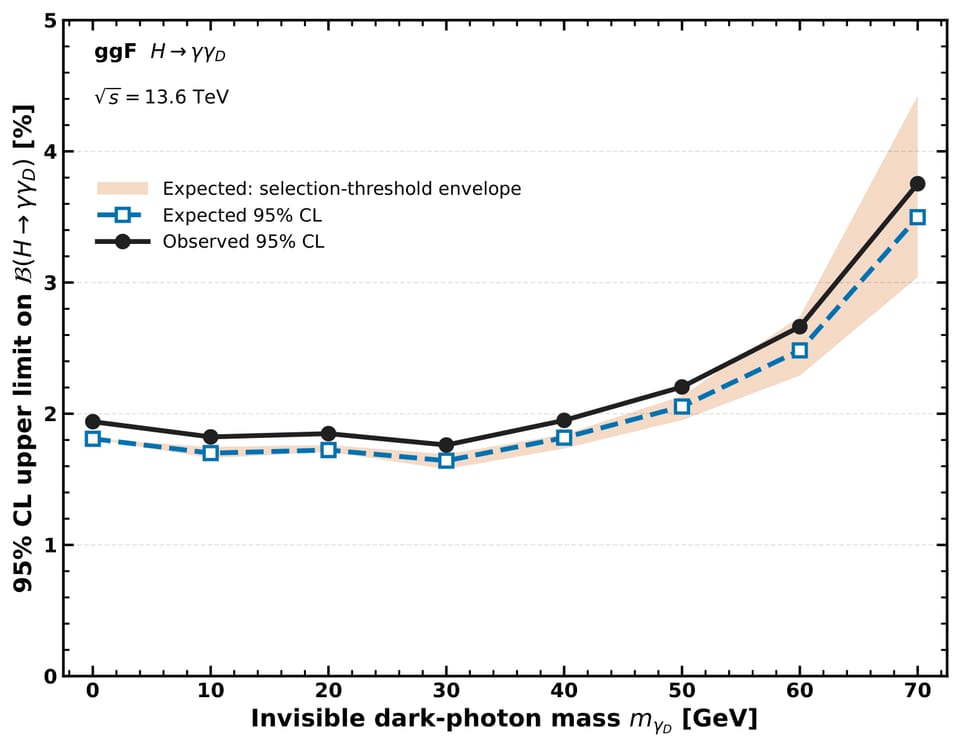
Ahmed, Ahmad, and Raza mapped those experimental numbers onto their massive vector framework by anchoring their calculations to the published massless gluon-fusion signal yield of 166 events for a 1% branching fraction.1 By propagating the mass-dependent acceptance into a profile-likelihood statistical model, the authors derived upper limits across the mass spectrum. For an invisible dark photon mass of 30 gigaelectronvolts, their recast yields an expected 95% confidence-level limit of 1.64% and an observed limit of 1.76% on the Higgs branching fraction.1 As the mass increases and detector acceptance degrades, the constraint weakens correspondingly, culminating in an expected limit of 3.50% and an observed limit of 3.75% at a mass of 70 gigaelectronvolts.1
The second figure (simplified_ggf_br_limits, figure 5 of our paper) translates that reduced acceptance into weaker constraints on the Higgs branching fraction.
These numbers show that while current data place stringent limits on light dark photons, the experimental net loosens considerably as the hypothetical state grows heavier. For particles lighter than 40 gigaelectronvolts, the Higgs boson cannot decay into a photon and an invisible dark photon more than roughly one to two times per 100 decays without producing an observable signal in the Run 3 data. For heavier states near 70 gigaelectronvolts, the allowed window widens by more than a factor of two, leaving substantial parameter space open for theoretical models that incorporate weakly coupled, massive hidden vectors.
What are the boundaries of these findings?
The results describe the mathematical response of an idealized detector selection rather than an official measurement conducted inside the ATLAS experimental collaboration. The research relies on a fast detector simulation and leading-order matrix element calculations matched to parton showers, using a common sample of 200,000 pre-matching hard events generated with software tools.1 Crucially, the authors evaluated only the gluon-gluon fusion production channel, which accounts for roughly 68% of the public signal composition in the ATLAS selection, while omitting other production mechanisms such as vector-boson fusion, which makes up about 23%, and associated production with weak bosons, which constitutes the remaining 9%.
Furthermore, several complex experimental discriminants used by the experimental collaboration cannot be reconstructed from public information alone. The ATLAS analysis employs specialized variables, including a hard-scatter vertex discriminant and an object-based missing-momentum significance, that lack exact counterparts in simplified simulation packages.1 The authors operated under the explicit assumption that the efficiency of these omitted requirements does not vary strongly with dark photon mass once kinematic selections are applied, an assumption that is most reliable at low masses and becomes more fragile at high masses where events depend heavily on recoil radiation. We have submitted our paper to PRD and waiting for the refree response.
Refining these constraints will require experimental collaborations to deploy specialized, mass-sensitive triggers and to combine all Higgs production channels. As the Large Hadron Collider continues its Run 3 operations, collecting larger datasets, lowering the transverse momentum threshold for photons accompanied by missing energy could prevent heavy dark photon signals from slipping through the cracks. Future analyses that model higher-order quantum corrections and incorporate advanced jet-tagging techniques may reveal whether the elusive dark sector has been hiding in plain sight within the quietest decays of the Higgs boson.
The record
19 sentences trace to 2 sources.
-
1
WA
 Waqas Ahmed, Ammara Ahmad, Shabbar Raza
Paper
· arxiv.org · 22 Sep 2026
Probing Massive Invisible Dark Photons in Higgs Decays via Gluon--Gluon Fusion at ATLAS Run 3
Preprint · may not have been peer reviewed
See the source
- 2 A theory of dark matter | Phys. Rev. D See the source
Other consulted pages1 page
arxiv.org3 pages
- Probing Massive Invisible Dark Photons in Higgs Decays via Gluon–Gluon Fusion at ATLAS Run 3
- Search for dark photons from Higgs boson decays in the gluon–gluon fusion channel in proton–proton collisions at √𝑠=13.6 TeV with the ATLAS detector
- Probing Massive Invisible Dark Photons in Higgs Decays via Gluon--Gluon Fusion at ATLAS Run 3