Assisted spoon feeding preserves dementia nutrition better than feeding tubes
Careful hand assistance at mealtimes helps individuals with advanced dementia maintain greater muscle reserve and nutritional scores than nasogastric tubes, even as overall physical decline continues.

When a person reaches the advanced stages of dementia, eating often becomes one of the final daily functions to falter. Families and nursing home attendants frequently assume that inserting a plastic tube through the nose directly into the stomach offers a reliable safeguard against physical wasting. Mechanically delivering liquid formula appears to guarantee that the body receives every required calorie, whereas feeding someone by hand requires patience and substantial staff time. Yet clinical observations indicate that artificial tube feeding does not halt frailty, and assisted spoon feeding often preserves a resident's physical reserves more effectively.
Understanding why manual assistance preserves physical condition requires examining how the nervous system coordinates digestion. To process food, an individual must first see, smell, and anticipate a meal, which prompts salivary glands and the stomach to release digestive secretions. The mouth must then chew each bite, blending food with saliva before moving it to the back of the throat. Neurological reflexes must close the airway tightly so the swallow safely propels nutrients into the esophagus. In advanced dementia, progressive brain damage disrupts this muscular sequence, causing individuals to tire quickly, hold food in their mouths, or cough when drinking liquids.
A study published in the journal American Journal of Alzheimer's Disease & Other Dementias provides systematic evidence on how these two feeding methods compare over six months.1 Researchers Dr. Anny Chen, Ju-I Chang, and Man-Hua Yang evaluated residents living with severe dementia across Taiwan to determine how nasogastric tube feeding and assisted oral feeding influence nutritional status and muscle mass over time.
Why does eating become difficult in late-stage dementia?
Eating becomes difficult in late-stage dementia because progressive neurodegeneration impairs the neurological reflexes required to coordinate chewing and swallowing. This swallowing impairment, known clinically as dysphagia, causes food or saliva to enter the airway without passing safely into the esophagus. As loss of muscular control worsens, individuals often consume fewer mouthfuls, raising concerns about acute malnutrition and weight loss.
Care teams then face a difficult choice between inserting a nasogastric tube, meaning a flexible catheter passed through the nose into the stomach, or committing staff to assisted oral feeding, which involves spooning meals and thickened liquids by hand. While a tube provides a rapid route for formula, it can cause physical agitation and mucosal irritation, whereas assisted hand feeding allows an individual to experience familiar tastes and social interaction during mealtimes.

Man-Hua Yang, a study author, explained to Primary that normal sensory and motor engagement supports digestion in ways mechanical delivery cannot duplicate. Oral feeding preserves the normal sequence of seeing, smelling, tasting, chewing, and swallowing food, Man-Hua Yang said, noting that these sensory and motor processes may help stimulate appetite, salivary secretion, gastrointestinal responses, and normal mealtime participation. Man-Hua Yang added that assisted feeding allows caregivers to adjust the pace, texture, portion size, and food preferences according to the resident's responses, which may improve actual intake and tolerance. In contrast, nasogastric tube feeding bypasses much of the oral phase of eating and may bring discomfort, agitation, reflux, and tube complications.
What did the six-month comparison reveal?
Assisted oral feeding preserved higher overall nutritional scores and greater calf muscle circumference than nasogastric tube feeding across a half-year observation period.1 To capture these changes, Dr. Anny Chen, Ju-I Chang, and Man-Hua Yang evaluated residents using the Mini Nutritional Assessment, a scoring questionnaire measuring food intake and mobility, alongside calf circumference, a clinical tape measurement tracking muscle reserve. While residents receiving assisted oral feeding maintained higher scores on both metrics, the authors reported that nutritional levels and muscle mass declined significantly across both study groups over time.1
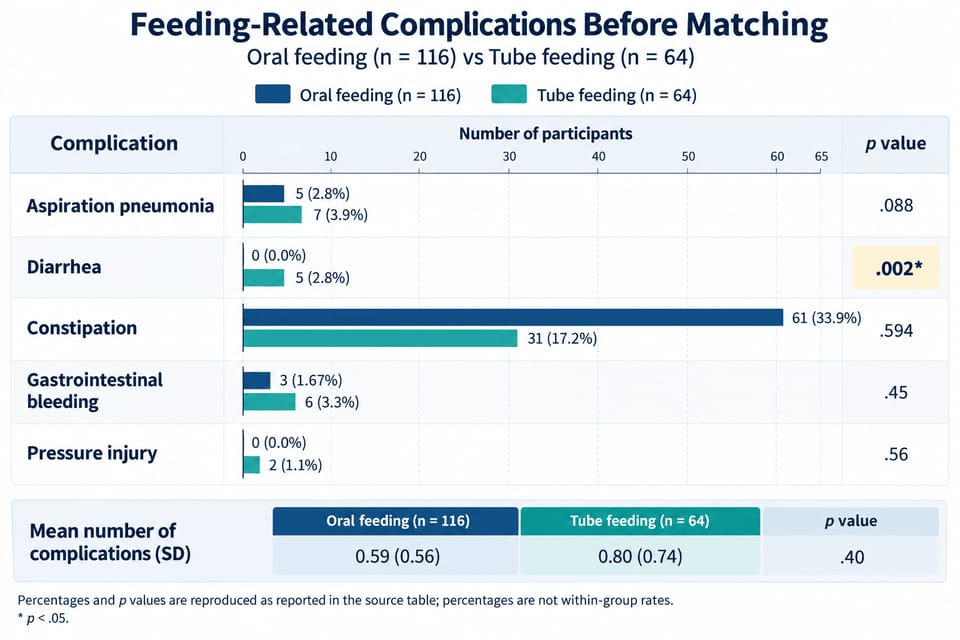
To isolate the influence of feeding methods, the researchers recruited 180 residents diagnosed with severe dementia across 13 long-term care facilities in Taiwan.1 The researchers applied propensity-score matching, a statistical pairing technique that balances participants across known background characteristics, yielding a final cohort of 112 residents divided evenly between oral feeding and tube feeding.1 Participants were assessed at baseline, three months, and six months, with longitudinal trends evaluated through generalized estimating equations, a statistical model designed to track repeated measurements in the same individuals over multiple time points.1
Statistical models indicated that the difference in nutritional status between the two groups remained consistent after accounting for other clinical factors. According to the paper, the authors observed no significant associations between nutritional trajectories and participant age, sex, chronic-disease count, dementia duration, or functional stage measured by the Functional Assessment Staging tool, an eight-level clinical scale used to grade dementia progression.1
Addressing that lack of correlation, Man-Hua Yang told Primary that all participants in the investigation already had severe cognitive impairment, specifically stage 6 or 7 on the functional staging tool. Because the range of dementia severity was narrow, Man-Hua Yang noted, there may not have been enough variation to detect a clear relationship between the staging score and nutritional decline. Furthermore, the duration of dementia does not always reflect current physical decline, because the condition progresses at different rates across individuals. Swallowing ability, comorbidities, infections, and general frailty exert substantial influence on nutritional status beyond the recorded diagnosis duration.
Dr. Anny Chen told Primary that these physical measurements should not be mistaken for definitive muscle preservation. "Calf circumference is an indirect indicator of muscle reserve, while the MNA assesses overall nutritional status, including functional domains; neither directly confirms muscle preservation," Dr. Anny Chen said in response to questions from Primary. She added that statistical tests tracking changes over time showed no significant interaction between the feeding route and the rate of physical wasting. "Importantly, the feeding-modality-by-time interaction for calf circumference was not significant, meaning that we did not demonstrate slower muscle decline with assisted oral feeding," Dr. Anny Chen said.
What can the observational data tell families?
Observational records cannot establish a definitive cause because subtle differences in underlying dementia severity between residents may have influenced who received a feeding tube.1 Dr. Anny Chen and colleagues noted in their paper that residual imbalance in dementia severity limits causal inference, meaning that individuals assigned to nasogastric tubes may have had more advanced neurological decline that statistical matching could not fully remove.1 The investigation observed existing care practices across facilities without randomly assigning residents to feeding methods.1
Man-Hua Yang cautioned against interpreting the observational findings as proof of a metabolic or digestive superiority. Our study did not directly test a physiological or metabolic mechanism, so I would be cautious about claiming that spoon feeding inherently has a digestive advantage over tube feeding, Man-Hua Yang said. Residents who were still able to eat orally may have possessed better residual physical function or lower frailty than those who required tubes, leaving an imbalance in dementia severity that persisted despite statistical adjustment. Dr. Anny Chen agreed that metabolic claims remain unsupported by the evidence. "Our study assessed MNA scores and calf circumference rather than absorption, so we cannot attribute the observed nutritional differences to a digestive advantage of oral feeding," Dr. Anny Chen told Primary.
Recruitment constraints also limited the scope of the statistical matching. Man-Hua Yang stated that matching was based specifically on sex, age, and years of dementia, because recruiting participants with severe dementia was challenging and the sample size was limited. Coordinating with long-term care facilities during the COVID-19 pandemic introduced additional obstacles, preventing the researchers from incorporating facility-level care practices into the matching algorithm. Differences in institutional routines may therefore have contributed to residual confounding. Dr. Anny Chen emphasized that substantial clinical disparities remained between the matched groups. "In our study, considerable imbalance remained after the primary propensity-score matching: 98.2% of residents receiving NG feeding were at FAST stage 7, compared with 23.2% receiving assisted oral feeding," Dr. Anny Chen said.
Furthermore, because nutritional scores and muscle circumference decreased across all 112 matched residents over six months, the data show that neither feeding method halts the physical wasting inherent to terminal dementia.1 Man-Hua Yang told Primary that the study cannot identify a specific stage of dementia where assisted oral feeding ceases to provide an advantage, because all participants had advanced disease. Both groups showed ongoing physical decline over time, demonstrating that assisted oral feeding does not stop underlying deterioration.
For clinicians and families, these observations reinforce international guidance that favors careful hand feeding over artificial tubes in late-stage dementia. Dr. Anny Chen noted that clinical guidance from the European Society for Clinical Nutrition and Metabolism advises against tube feeding in severe dementia, while the American Geriatrics Society recommends careful hand feeding. Guidance from the National Institute for Health and Care Excellence similarly discourages routine enteral tubes except for potentially reversible conditions. "The central principle is to prioritise comfort, the person’s wishes and shared decision-making, rather than automatic tube placement," Dr. Anny Chen said. "Nutritional care remains important for addressing reversible causes of poor intake and supporting comfort, rather than expecting a change in feeding route to halt deterioration," Dr. Anny Chen told Primary. Man-Hua Yang noted that feeding decisions should focus on individual swallowing safety, functional condition, comfort, and care goals. Future prospective studies, Man-Hua Yang added, could incorporate urine-based biomarkers to track nutritional changes with greater objectivity while examining how swallowing function interacts with overall neurological decline.
The record
30 sentences trace to 1 source and 2 contributors.
-
1
LA
 Lu-Yen Anny Chen, Ju-I Chang, Man-Hua Yang
Official record
· pubmed.ncbi.nlm.nih.gov · 7 Sep 2026
Feeding Modality and Longitudinal Nutritional Status in Severe Dementia: A Matched Cohort Study
See the source
- 2 Contribution — Man-Hua Yang 13 statements added to this article
- 3 Contribution — Dr. Anny Chen 15 statements added to this article
Other consulted pages4 pages
pmc.ncbi.nlm.nih.gov3 pages
- Comparison of survival and pneumonia risk in advanced dementia patients on nasogastric tube feeding versus careful hand feeding - PMC
- Feeding Modality and Longitudinal Nutritional Status in Severe Dementia: A Matched Cohort Study - PMC
- Nasogastric tube feeding versus assisted hand feeding in-home healthcare older adults with severe dementia in Taiwan: a prognosis comparison - PMC
Article history
-
Published 27 Nov 2026, 20:16Assembled by the Primary desk from 1 source · 2 contributors · 30 cited sentences
-
Dr. Anny Chen
- Go to the sentence: Dr. Anny Chen told Primary that these physical measurements should not be mistaken for definitive muscle preservation.
- Go to the sentence: "Calf circumference is an indirect indicator of muscle reserve, while the MNA assesses overall nutritional status, including functional domains; neither directly confirms muscle preservation," Dr. Anny Chen said in response to questions from Primary.
- Go to the sentence: She added that statistical tests tracking changes over time showed no significant interaction between the feeding route and the rate of physical wasting.
- Go to the sentence: "Importantly, the feeding-modality-by-time interaction for calf circumference was not significant, meaning that we did not demonstrate slower muscle decline with assisted oral feeding," Dr. Anny Chen said.
- Go to the sentence: Observational records cannot establish a definitive cause because subtle differences in underlying dementia severity between residents may have influenced who received a feeding tube.
- Go to the sentence: Residents who were still able to eat orally may have possessed better residual physical function or lower frailty than those who required tubes, leaving an imbalance in dementia severity that persisted despite statistical adjustment.
- Go to the sentence: Dr. Anny Chen agreed that metabolic claims remain unsupported by the evidence.
- Go to the sentence: "Our study assessed MNA scores and calf circumference rather than absorption, so we cannot attribute the observed nutritional differences to a digestive advantage of oral feeding," Dr. Anny Chen told Primary.
- Go to the sentence: Dr. Anny Chen emphasized that substantial clinical disparities remained between the matched groups.
- Go to the sentence: "In our study, considerable imbalance remained after the primary propensity-score matching: 98.2% of residents receiving NG feeding were at FAST stage 7, compared with 23.2% receiving assisted oral feeding," Dr. Anny Chen said.
- Go to the sentence: Both groups showed ongoing physical decline over time, demonstrating that assisted oral feeding does not stop underlying deterioration.
- Go to the sentence: Dr. Anny Chen noted that clinical guidance from the European Society for Clinical Nutrition and Metabolism advises against tube feeding in severe dementia, while the American Geriatrics Society recommends careful hand feeding.
- Go to the sentence: Guidance from the National Institute for Health and Care Excellence similarly discourages routine enteral tubes except for potentially reversible conditions.
- Go to the sentence: "The central principle is to prioritise comfort, the person’s wishes and shared decision-making, rather than automatic tube placement," Dr. Anny Chen said.
- Go to the sentence: "Nutritional care remains important for addressing reversible causes of poor intake and supporting comfort, rather than expecting a change in feeding route to halt deterioration," Dr. Anny Chen told Primary.
-
Man-Hua Yang, a study author
- Go to the sentence: In contrast, nasogastric tube feeding bypasses much of the oral phase of eating and may bring discomfort, agitation, reflux, and tube complications.
- Go to the sentence: Assisted oral feeding preserved higher overall nutritional scores and greater calf muscle circumference than nasogastric tube feeding across a half-year observation period.
- Go to the sentence: While residents receiving assisted oral feeding maintained higher scores on both metrics, the authors reported that nutritional levels and muscle mass declined significantly across both study groups over time.
- Go to the sentence: The researchers applied propensity-score matching, a statistical pairing technique that balances participants across known background characteristics, yielding a final cohort of 112 residents divided evenly between oral feeding and tube feeding.
- Go to the sentence: According to the paper, the authors observed no significant associations between nutritional trajectories and participant age, sex, chronic-disease count, dementia duration, or functional stage measured by the Functional Assessment Staging tool, an eight-level clinical scale used to grade dementia progression.
- Go to the sentence: Furthermore, the duration of dementia does not always reflect current physical decline, because the condition progresses at different rates across individuals.
- Go to the sentence: Swallowing ability, comorbidities, infections, and general frailty exert substantial influence on nutritional status beyond the recorded diagnosis duration.
- Go to the sentence: Dr. Anny Chen and colleagues noted in their paper that residual imbalance in dementia severity limits causal inference, meaning that individuals assigned to nasogastric tubes may have had more advanced neurological decline that statistical matching could not fully remove.
- Go to the sentence: Residents who were still able to eat orally may have possessed better residual physical function or lower frailty than those who required tubes, leaving an imbalance in dementia severity that persisted despite statistical adjustment.
- Go to the sentence: Coordinating with long-term care facilities during the COVID-19 pandemic introduced additional obstacles, preventing the researchers from incorporating facility-level care practices into the matching algorithm.
- Go to the sentence: Differences in institutional routines may therefore have contributed to residual confounding.
- Go to the sentence: Furthermore, because nutritional scores and muscle circumference decreased across all 112 matched residents over six months, the data show that neither feeding method halts the physical wasting inherent to terminal dementia.
- Go to the sentence: Both groups showed ongoing physical decline over time, demonstrating that assisted oral feeding does not stop underlying deterioration.