Uneven energy landscapes decide when moving quantum waves freeze
A study of quasiperiodic lattices shows that the statistical bias of energy barriers controls whether quantum particles remain trapped or spread across a material.
When a quantum wave moves through an imperfect material, the atomic landscape determines whether it keeps traveling or grinds to a halt.1 In perfectly repeating crystals, particles glide unimpeded across the lattice. In completely disordered environments, such as glass, random obstacles scatter the wave until its scattered parts interfere destructively with one another, trapping the particle in a tight region.1 For decades, physicists believed that introducing smooth, repeating spatial correlations into the landscape was the primary requirement to break that trap and permit movement in one-dimensional systems.1
Yet in many structured materials, that intuition fails. Under certain conditions, strengthening the spatial correlations across an energy landscape can actually freeze particles faster, while landscapes with identical spatial patterns can behave in opposite ways.1 Understanding why requires looking beyond spatial alignment to examine how the different energy values themselves are distributed across the system.
On September 15, 2026, Adithya J D, Dr. Ranjan Modak, and Shaon Sahoo, physicists at the Indian Institute of Technology Tirupati in India, posted a theoretical study to the preprint server arXiv that identifies this missing factor.1 By analyzing an extended mathematical model of a one-dimensional lattice, the authors demonstrated that bias, which is the uneven frequency with which different potential energy values occur across lattice sites, plays a decisive role alongside spatial correlation in determining whether quantum states remain trapped or spread through the chain.1
How do energy landscapes trap moving quantum particles?
Quantum waves traveling through a solid halt when destructive interference cancels out their forward momentum across scattered pathways. To see why this cancellation occurs, consider the physical chain of events that governs single-particle transport along a one-dimensional path. A quantum particle residing on one site must hop to an adjacent site, propelled by quantum tunneling. Each site presents a local on-site energy barrier that either elevates or depresses its local potential. When every site along the chain has the identical energy barrier, the particle hops continuously from neighbor to neighbor, extending its wave across the entire crystal without ever getting reflected into confinement.
When the local barriers vary unpredictably from site to site, the particle scatters each time it attempts to hop.1 In a one-dimensional system subjected to completely random, uncorrelated variations, every wave crest bouncing forward encounters scattered crests returning backward.1 These wavelets cancel each other out everywhere except within a tiny patch, causing what physicists call Anderson localization, a phenomenon in which all quantum states become localized and trapped around specific locations.
Escaping this complete trap in one dimension requires building order into the variations. In quasiperiodic systems, the site energy barriers are not purely random; they follow an incommensurate mathematical pattern that never strictly repeats, creating spatial correlations between distant sites.1 A particle navigating these correlated barriers can avoid destructive interference, allowing delocalized states, in which the wave function extends across the entire length of the system, to survive alongside localized ones.1
The standard framework for exploring this balance has long been the Aubry-André model, an established theoretical benchmark that describes non-interacting quantum particles moving through a one-dimensional quasiperiodic potential.1 In that traditional system, the energy barrier at each site follows a single smooth cosine pattern. When the overall potential strength is low, every quantum state in the system is delocalized.1 Once that potential strength crosses a precise threshold, every single state abruptly becomes localized.1 This sharp transition has made the model a cornerstone of condensed matter physics, yet its simplicity hides a deeper puzzle about how spatial correlations operate.
Why do spatial patterns fail to predict when waves freeze?
Spatial correlation measures how closely the energy barrier at one site resembles the barrier at another site separated by a given distance. In the standard Aubry-André model, increasing the overall strength of the potential increases the numerical value of these two-point spatial correlations across the lattice.1 If spatial correlations alone encouraged particles to move, a stronger potential should make it easier for quantum states to extend across the system. The opposite happens: cranking up the potential strength causes the entire spectrum of states to localize completely, confining every particle to a small pocket of the chain.1
Shaon told Primary that this exact contradiction prompted their investigation. As Shaon explained, the team initially set out to examine spatial correlations, calculating them numerically and analytically, only to discover that the correlation increases quadratically with potential strength. Shaon said that this raised a puzzling question because if stronger spatial correlations are generally associated with delocalization, physicists must explain why increasing the potential strength leads to stronger correlations while driving the system toward localization.
Dr. Ranjan Modak told Primary that standard physical intuition broke down around this exact behavior. Dr. Ranjan Modak said: "It started with a paradox. In the Aubry-André model, cranking up the potential strength increases correlation, yet the system localizes more, not less. The familiar rule that “more correlation means more delocalization” simply breaks down. Chasing the reason, we found that bias, not correlation, holds the key, and built a new framework for localization around it."
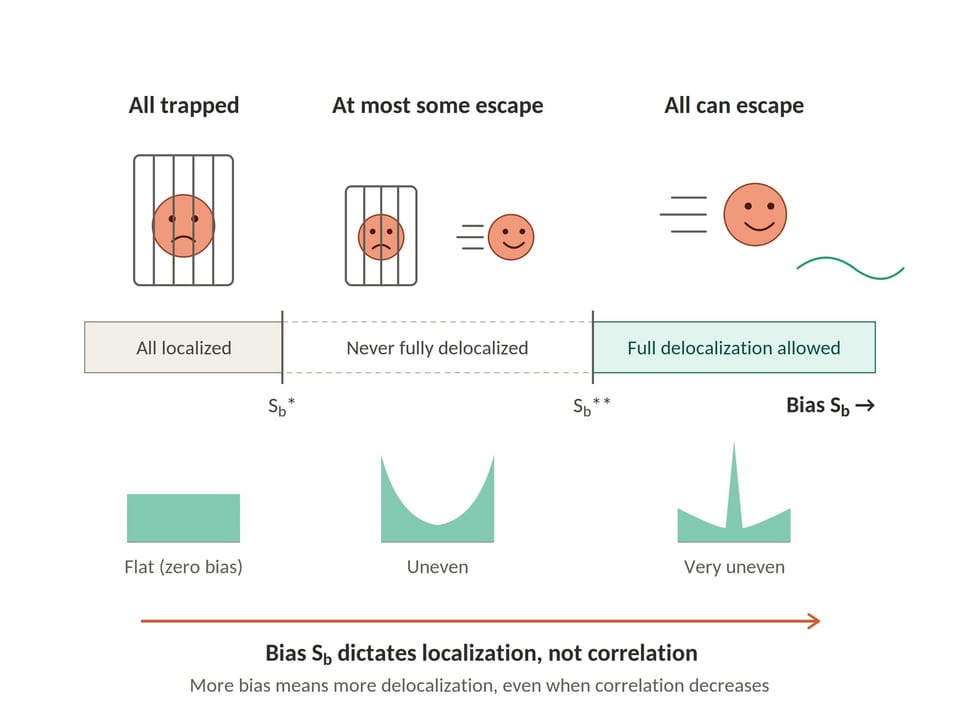
Dr. Ranjan Modak emphasized that the community had long relied on a narrow perspective. Dr. Ranjan Modak told Primary: "In one-dimensional non-interacting fermionic systems, Anderson’s paradigm says any disorder localizes all states, and correlated disorder has long been seen as the main route out. The prevailing intuition is simple: the stronger the correlation, the better the odds of delocalization. We show this intuition is incomplete. The decisive parameter is not correlation but bias. Strikingly, strongly correlated disorder with zero bias still localizes, while a system with weaker correlation but sufficient bias can escape localization. Bias, not correlation, sets the fate of transport."
Spatial correlation alone cannot explain this reversal. To explain what happens, the authors introduced an independent measure termed potential bias. In their formulation, bias measures the non-uniform distribution of potential values within the permitted range of energy values.1 If an energy landscape samples all values within its range with equal frequency, the distribution is uniform and the bias is zero.1 If the landscape spends far more time near specific values, such as lingering near the minimum and maximum boundaries of the potential, the distribution becomes non-uniform and the bias takes a positive value.1
The researchers quantified this behavior by defining a mathematical bias parameter, which evaluates the variance in the empirical probability of finding potential values in distinct energy bins across the lattice.1 When the potential distribution across the chain is flat, this variance vanishes. When the distribution clusters around preferred values, the bias parameter rises. By tracking this parameter, the authors found that increasing the potential strength in the standard model suppresses the bias, and this loss of bias counteracts the spatial correlations, driving the system into a localized state.14
Addressing the stability of this mathematical metric, Shaon told Primary that the team discretized the continuous probability distribution using a fixed bin width of 0.001. Shaon noted that the conclusions remained unchanged when testing different bin widths, confirming that the partition scheme reliably captures the underlying variance.
Earlier work by Dr. Ranjan Modak and Shaon Sahoo with Arpita Goswami and Pallabi Chatterjee, published in Physical Review B in 2025, explored related localization phenomena in a two-leg ladder geometry where an Aubry-André chain acted as a bath coupled to a standard tight-binding subsystem. That earlier study showed that varying the potential strength across the coupled ladder generated transitions between delocalized, localized, and weakly delocalized fractal phases, and established connections to a generalized Aubry-André model. The current study departs from that ladder geometry to examine the single-chain structure directly, isolating the statistical distribution of the potential itself.1
Challenged on whether the Aubry-André localization transition was already adequately explained by mathematical self-duality, Dr. Ranjan Modak told Primary that such mathematical symmetry is not a universal mechanism. Dr. Ranjan Modak said: "Self-duality explains localization only in a few special quasiperiodic models. Our bias-based framework requires no such symmetry and applies to any correlated disorder, with Aubry-André emerging as just one special case."
What did the extended Aubry-André model reveal?
Extending the model revealed that potential bias controls mobility edges and sets strict numerical boundaries for wave transport. To systematically test how bias and correlation interact, Adithya, Dr. Ranjan Modak, and Shaon Sahoo constructed an extended version of the Aubry-André model.1 In their system, the on-site potential at each lattice site is deformed by a continuous tuning parameter, denoted by the Greek letter theta. By varying theta between zero and infinity, the authors could alter both the spatial correlation and the bias of the potential without altering its fundamental symmetry or its zero average potential.
When theta equals one, the model matches the standard Aubry-André system, preserving its sharp transition where all states localize simultaneously at a potential strength of 2 in units of the hopping amplitude. When theta shifts away from one, this collective behavior fractures.1 The boundaries between localized and extended states become dependent on the energy of each specific state, creating mobility edges where localized and delocalized states coexist within the same energy spectrum.
The authors tracked this coexistence using the inverse participation ratio, an established computational measure that quantifies how concentrated a quantum wave function is across lattice sites. For a fully delocalized state, the inverse participation ratio approaches zero as the system size grows toward infinity, scaling inversely with the number of sites.1 For a localized state, the ratio remains a finite number between zero and one regardless of how large the system becomes.1 In their numerical calculations across chains ranging from 1,000 to 2,000 sites, the authors observed that when theta exceeds one, delocalized states persist in the middle of the spectrum even when the potential strength is pushed well above the traditional threshold of 2.
Through this deformed framework, the authors identified two critical bias thresholds that govern the system.1 Below the lower bias threshold, the entire spectrum of quantum states becomes completely localized, preventing any transport.14 Below the higher bias threshold, at most a fraction of the states can be delocalized, meaning the entire spectrum cannot achieve complete delocalization.14 Broadly, an increasing bias promotes delocalization across the lattice, helping particles escape confinement.1
Shaon told Primary that these thresholds reflect genuine physical boundaries rather than numerical artifacts. Shaon said: "We believe that the bias thresholds identified in our study are not artifacts of the numerical limitations of our calculations. We have checked their stability with respect to both the system size and the bin width used in discretizing the continuous potential distribution. Furthermore, we investigated a separate, independent zero-bias quasiperiodic model and found that its localization behavior is consistent with the predictions of the framework developed in our main study. These additional checks provide further support for the physical significance of the identified bias thresholds."
Explaining why an uneven distribution of potentials protects traveling waves, Shaon told Primary that strong bias pushes a system closer to uniform propagation. Shaon said: "For a quasiperiodic system with nonzero spatial correlations, a large bias implies that certain potential values occur more frequently than others. In the limiting case of maximal bias, the potential approaches a uniform value across the lattice, corresponding to a translationally invariant system and hence delocalized eigenstates. As the bias is reduced, the potential becomes progressively more varied across the lattice, and the character of the eigenstates can change accordingly, with different portions of the spectrum exhibiting extended, fractal, or localized behavior. In the opposite limit of very small or vanishing bias, the potential becomes increasingly balanced between its different values. In this regime, spatial correlations alone are insufficient to sustain delocalization, and we expect the eigenstates to become localized. This expectation is supported by our independent zero-bias quasiperiodic model, in which all eigenstates are found to be localized even at very weak potential strength."
To test whether correlation alone could ever sustain delocalized states without bias, the researchers analyzed a quasiperiodic test model specifically engineered to possess zero bias.1 In that configuration, the potential values were uniformly distributed, eliminating any bias while preserving long-range spatial correlations. The result was stark: even when the potential strength was set to very weak values, all quantum states in the system immediately localized.1 Despite the presence of spatial correlations, the zero-bias model mimicked the Anderson localization typically found only in completely random, uncorrelated disorder.1
Dr. Ranjan Modak told Primary that this result proved correlation cannot overcome a uniform energy spread. Dr. Ranjan Modak said: "It is pleasantly surprising to us. Anderson showed that in one dimension, any amount of uncorrelated disorder localizes every state. We show this principle reaches much further: even correlated disorder localizes all states, as long as it is bias-free. Correlation alone cannot rescue transport; only bias can."
What remains unknown about particle transport in complex materials?
The findings describe single quantum particles moving through idealized, frozen one-dimensional lattices and cannot predict behavior in complex experimental samples. The calculations model non-interacting fermions operating under perfect mathematical conditions, meaning they do not account for thermal vibrations or electronic interactions that alter wave coherence in real crystals. The paper is an unrefereed preprint posted to arXiv that has not yet undergone formal peer review.14 Additionally, the bias framework relies on continuous energy distributions, leaving its applicability to discrete lattices an open question.1
As the authors noted, the bias parameter relies on the assumption that probabilities associated with different potential values change as parameters like potential strength or theta vary.1 In specific configurations, such as when theta is set to zero or in mosaic lattice models where potential values remain fixed at discrete values regardless of potential strength, the bias parameter cannot track changes in localization.1 Asked about this limitation, Dr. Ranjan Modak told Primary that extending the formulation to discrete systems represents an active line of research. Dr. Ranjan Modak said: "For now, our framework covers continuous disorder distributions. Discrete distributions are the natural next step, and we expect a suitably defined bias parameter to carry the framework over intact."
Interparticle forces introduce another major barrier to generalized predictions. Shaon told Primary that the single-particle bias distribution is expected to lose predictive power when particle interactions become comparable to or larger than the single-particle localization energy scale, where many-body correlations take over. Dr. Ranjan Modak agreed that tackling interacting particles presents steep mathematical hurdles. Dr. Ranjan Modak told Primary: "Extending this framework to interacting systems is a formidable challenge. The Hilbert space grows exponentially with system size, which severely limits numerical simulations and makes reliable statements about the thermodynamic limit extremely difficult. Nevertheless, this is a natural next step, and work in this direction is currently underway."
If confirmed by further research, the role of potential bias offers a new design principle for quantum simulation experiments. Platforms such as ultracold atoms held in optical lattices, photonic waveguide arrays, and superconducting circuit processors can synthesize tailor-made quasiperiodic potentials with exquisite precision.1 Instead of focusing solely on the wavelength and spatial periodicity of interfering laser beams or circuit components, experimentalists could shape the statistical distribution of energy barriers to control where and when quantum waves are permitted to travel.
Realizing that degree of control in the laboratory remains an unresolved experimental challenge. Shaon told Primary that while independent control over bias and correlation would be desirable, it is not currently clear which experimental platform provides a clean route to tune both properties independently. Physicists will also need to examine how the introduction of particle-particle interactions modifies the influence of bias, testing whether the distribution of potential values continues to govern the transition into many-body localized phases.1
The record
72 sentences trace to 2 sources and 2 contributors.
-
1
AJ
 Adithya J D, Ranjan Modak, Shaon Sahoo
Paper
· arxiv.org · 15 Sep 2026
Bias and Correlations in Quasiperiodicity: Impact on Localization in an Extended Aubry-André Model
Preprint · may not have been peer reviewed
See the source
- 2 Contribution — Shaon Sahoo 22 statements added to this article
- 3 Contribution — Dr. Ranjan Modak 12 statements added to this article
-
4
A
arxiv.org
Paper
· arxiv.org
Bias and Correlations in Quasiperiodicity: Impact on Localization in an Extended Aubry-André Model
Preprint · may not have been peer reviewed
See the source
Other consulted pages2 pages
arxiv.org1 page
Article history
-
Published 27 Nov 2026, 20:18Assembled by the Primary desk from 2 sources · 2 contributors · 72 cited sentences
-
Dr. Ranjan Modak
- Go to the sentence: By analyzing an extended mathematical model of a one-dimensional lattice, the authors demonstrated that bias, which is the uneven frequency with which different potential energy values occur across lattice sites, plays a decisive role alongside spatial correlation in determining whether quantum states remain trapped or spread through the chain.
- Go to the sentence: The opposite happens: cranking up the potential strength causes the entire spectrum of states to localize completely, confining every particle to a small pocket of the chain.
- Go to the sentence: Dr. Ranjan Modak told Primary that standard physical intuition broke down around this exact behavior.
- Go to the sentence: Dr. Ranjan Modak emphasized that the community had long relied on a narrow perspective.
- Go to the sentence: Challenged on whether the Aubry-André localization transition was already adequately explained by mathematical self-duality, Dr. Ranjan Modak told Primary that such mathematical symmetry is not a universal mechanism.
- Go to the sentence: Dr. Ranjan Modak told Primary that this result proved correlation cannot overcome a uniform energy spread.
- Go to the sentence: Dr. Ranjan Modak said: "It is pleasantly surprising to us. Anderson showed that in one dimension, any amount of uncorrelated disorder localizes every state. We show this principle reaches much further: even correlated disorder localizes all states, as long as it is bias-free. Correlation alone cannot rescue transport; only bias can."
- Go to the sentence: Additionally, the bias framework relies on continuous energy distributions, leaving its applicability to discrete lattices an open question.
- Go to the sentence: Asked about this limitation, Dr. Ranjan Modak told Primary that extending the formulation to discrete systems represents an active line of research.
- Go to the sentence: Dr. Ranjan Modak said: "For now, our framework covers continuous disorder distributions. Discrete distributions are the natural next step, and we expect a suitably defined bias parameter to carry the framework over intact."
- Go to the sentence: Dr. Ranjan Modak agreed that tackling interacting particles presents steep mathematical hurdles.
- Go to the sentence: Dr. Ranjan Modak told Primary: "Extending this framework to interacting systems is a formidable challenge. The Hilbert space grows exponentially with system size, which severely limits numerical simulations and makes reliable statements about the thermodynamic limit extremely difficult. Nevertheless, this is a natural next step, and work in this direction is currently underway."
-
Shaon Sahoo, physicists at the Indian Institute of Technology Tirupati in India
- Go to the sentence: Under certain conditions, strengthening the spatial correlations across an energy landscape can actually freeze particles faster, while landscapes with identical spatial patterns can behave in opposite ways.
- Go to the sentence: In the standard Aubry-André model, increasing the overall strength of the potential increases the numerical value of these two-point spatial correlations across the lattice.
- Go to the sentence: Shaon told Primary that this exact contradiction prompted their investigation.
- Go to the sentence: As Shaon explained, the team initially set out to examine spatial correlations, calculating them numerically and analytically, only to discover that the correlation increases quadratically with potential strength.
- Go to the sentence: Shaon said that this raised a puzzling question because if stronger spatial correlations are generally associated with delocalization, physicists must explain why increasing the potential strength leads to stronger correlations while driving the system toward localization.
- Go to the sentence: In their formulation, bias measures the non-uniform distribution of potential values within the permitted range of energy values.
- Go to the sentence: The researchers quantified this behavior by defining a mathematical bias parameter, which evaluates the variance in the empirical probability of finding potential values in distinct energy bins across the lattice.
- Go to the sentence: Addressing the stability of this mathematical metric, Shaon told Primary that the team discretized the continuous probability distribution using a fixed bin width of 0.001.
- Go to the sentence: Shaon noted that the conclusions remained unchanged when testing different bin widths, confirming that the partition scheme reliably captures the underlying variance.
- Go to the sentence: Through this deformed framework, the authors identified two critical bias thresholds that govern the system.
- Go to the sentence: Broadly, an increasing bias promotes delocalization across the lattice, helping particles escape confinement.
- Go to the sentence: Shaon told Primary that these thresholds reflect genuine physical boundaries rather than numerical artifacts.
- Go to the sentence: Shaon said: "We believe that the bias thresholds identified in our study are not artifacts of the numerical limitations of our calculations. We have checked their stability with respect to both the system size and the bin width used in discretizing the continuous potential distribution. Furthermore, we investigated a separate, independent zero-bias quasiperiodic model and found that its localization behavior is consistent with the predictions of the framework developed in our main study. These additional checks provide further support for the physical significance of the identified bias thresholds."
- Go to the sentence: Explaining why an uneven distribution of potentials protects traveling waves, Shaon told Primary that strong bias pushes a system closer to uniform propagation.
- Go to the sentence: Shaon said: "For a quasiperiodic system with nonzero spatial correlations, a large bias implies that certain potential values occur more frequently than others. In the limiting case of maximal bias, the potential approaches a uniform value across the lattice, corresponding to a translationally invariant system and hence delocalized eigenstates. As the bias is reduced, the potential becomes progressively more varied across the lattice, and the character of the eigenstates can change accordingly, with different portions of the spectrum exhibiting extended, fractal, or localized behavior. In the opposite limit of very small or vanishing bias, the potential becomes increasingly balanced between its different values. In this regime, spatial correlations alone are insufficient to sustain delocalization, and we expect the eigenstates to become localized. This expectation is supported by our independent zero-bias quasiperiodic model, in which all eigenstates are found to be localized even at very weak potential strength."
- Go to the sentence: To test whether correlation alone could ever sustain delocalized states without bias, the researchers analyzed a quasiperiodic test model specifically engineered to possess zero bias.
- Go to the sentence: The result was stark: even when the potential strength was set to very weak values, all quantum states in the system immediately localized.
- Go to the sentence: Despite the presence of spatial correlations, the zero-bias model mimicked the Anderson localization typically found only in completely random, uncorrelated disorder.
- Go to the sentence: Shaon told Primary that the single-particle bias distribution is expected to lose predictive power when particle interactions become comparable to or larger than the single-particle localization energy scale, where many-body correlations take over.
- Go to the sentence: Platforms such as ultracold atoms held in optical lattices, photonic waveguide arrays, and superconducting circuit processors can synthesize tailor-made quasiperiodic potentials with exquisite precision.
- Go to the sentence: Shaon told Primary that while independent control over bias and correlation would be desirable, it is not currently clear which experimental platform provides a clean route to tune both properties independently.
- Go to the sentence: Physicists will also need to examine how the introduction of particle-particle interactions modifies the influence of bias, testing whether the distribution of potential values continues to govern the transition into many-body localized phases.