Nightjars sacrifice cruising efficiency to catch insects in the dark
Wind tunnel tests reveal that European nightjars compromise high-speed flight efficiency to stay agile while hunting, generating unexpected thrust during the wing upstroke.
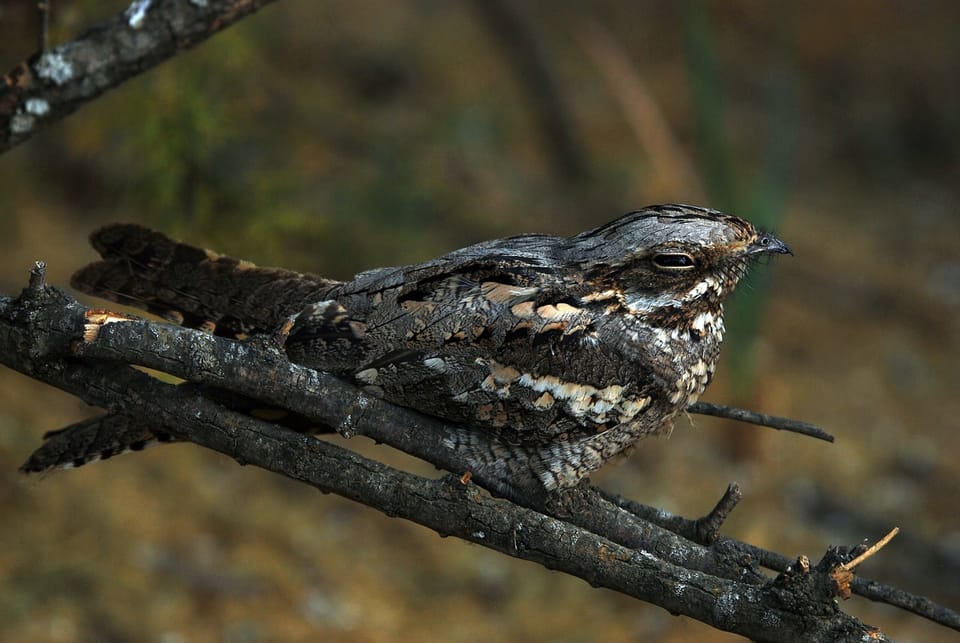
A bird that crosses continents twice a year might seem destined to possess wings tuned for pure aerodynamic efficiency. Covering thousands of kilometres between European breeding areas and wintering grounds in southern Africa demands enormous energy, and any mechanical waste increases the fuel an animal must store and burn.12 Yet the European nightjar carries a wing shape that appears noticeably imperfect for long-distance travel, giving up aerodynamic performance at high cruising speeds in order to stay aloft at a crawl.12
The nocturnal insectivore, known scientifically as Caprimulgus europaeus, survives by balancing two conflicting lifestyles.21 During the day it rests motionless on the ground or along tree limbs, relying on mottled plumage to avoid predators.12 At dusk, the bird takes to the air to capture flying beetles and moths with a wide mouth.12 That twilight foraging requires sudden changes of direction, hovering, and slow glides through the dark.12 Migration, by contrast, favors steady, streamlined cruising. Because the wing mechanics required for slow, precise maneuvers oppose those needed for swift travel, the bird cannot maximize both skills at once.
To generate lift, a flapping wing pushes air downward, creating an upward force that counters gravity and supports the bird's mass. Moving forward requires thrust, produced by pushing air backward to overcome the aerodynamic resistance of the body and plumage. At very low flight speeds, wings must sweep through deep strokes and maintain large surface areas near the tips to accelerate sufficient air downward. At faster forward speeds, however, broad wing tips create oversized swirling air pockets known as tip vortices, which shed turbulent energy and drag the bird backward. A bird specialized exclusively for migration carries slender, tapered wings that minimize those tip vortices at speed, whereas an agile hunter benefits from broad outer wings that generate substantial lift when airspeed drops.
A study conducted by researchers at Lund University in Sweden showed that the nightjar resolves this conflict by accepting an aerodynamic penalty during transit.12 Testing birds across a range of flight speeds in a specialized wind tunnel, the researchers found that broad wing tips shed double vortex structures at cruising speeds, reducing the aerodynamic efficiency of lift generation.21 In addition, the measurements revealed that the nightjar produces forward thrust during the upward stroke of its wingbeat, an aerodynamic mechanism rarely observed in birds.21

How does hawking insects clash with long-distance flight?
Hunting airborne insects at dusk demands flight maneuvers that directly undermine the aerodynamics of efficient distance travel. The paper reports that European nightjars are relatively heavy for birds capable of sustained slow flight and hovering, averaging about 71 grams across measured individuals.2 To stay aloft without stalling, the species relies on long wings with an aspect ratio of 7.5, calculated as wingspan divided by mean wing chord.2 Although that aspect ratio places the bird among species with moderately slender wings, its outer wing tips remain unusually broad compared with migratory specialists or hovering hummingbirds.2
The researchers discovered that this broad wing tip shape becomes costly once the bird accelerates to cruising pace. When the nightjar flies at higher speeds, the broad outer feathers shed two distinct vortices from the wing tip during the downstroke.2 According to the study, this double tip vortex pattern correlates with a decline in span efficiency, an aerodynamic metric describing how effectively a wing generates lift relative to an ideal planar wing.2 Mean span efficiency during the downstroke was measured at 0.72, and the value decreased systematically as airspeed increased across the experimental range of 2.6 to 11 meters per second.2
Christoffer Johansson, an associate professor at Lund University, reported that this pattern exposes a biological trade-off between competing survival tasks.1 The bird accepts reduced lift efficiency at faster cruising speeds because the broad tip geometry provides the essential lift required to hover and turn sharply during twilight feeding bouts.12 Because nightjars must hawk active insects to replenish their energy stores, the evolutionary pressure to forage successfully outweighs the penalty of spending additional aerodynamic power during migration flights across desert barriers and open seas.1
Why do nightjars generate thrust during the upstroke?
Nightjars produce forward thrust on the upstroke because their wing anatomy prevents them from folding their wings tightly against their bodies during the recovery phase of a wingbeat. In most typical bird species, the downward stroke delivers both lift and propulsion, while the upward stroke functions as an inactive reset.12 Most birds pull their wings inward during this upward motion, bending the wrist and elbow joints to reduce surface area and minimize aerodynamic drag while raising the feathers for the next stroke.1
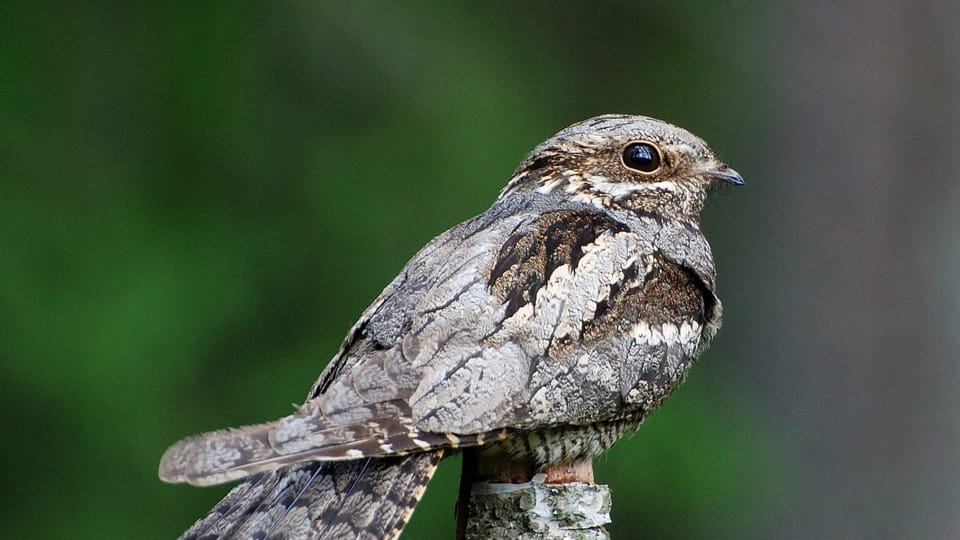
High-speed kinematic recordings revealed that nightjars maintain an extended wing posture throughout the upstroke, folding their flight feathers only to a restricted degree.12 To prevent this broad, extended surface from acting as a massive air brake, the bird executes a rapid downward pitch of the outer hand wing during the second half of the upstroke. This fanning movement forces air backward and creates reversed vortex loops behind the outer wing.2 As a result, the outer wing acts like a propeller blade, generating forward propulsion while moving upward through the air.
The wake measurements recorded in the study confirmed that this mechanism produces a distinct second peak of thrust during each wingbeat cycle.2 Aerodynamic force estimates showed that the minimum vertical lift coincided with this secondary thrust surge during the upstroke.2 Fourier frequency analysis demonstrated that the secondary thrust peak occurred at twice the wingbeat frequency and generated approximately 45 percent of the power delivered by the primary downstroke thrust peak across all measured speeds.2 Johansson noted that this form of upstroke thrust production was previously attributed primarily to bats and hummingbirds, demonstrating that unrelated flying organisms can converge on similar fluid dynamic solutions when anatomical wing folding is constrained.12
What limits the conclusions from the wind tunnel?
Wind tunnel experiments cannot capture the entire complexity of wild nocturnal foraging flights and transcontinental migration journeys. The aerodynamic conclusions presented in the study rest on wake measurements collected from three individual nightjars flying within a enclosed testing chamber under steady airflow.2 Free-flying nightjars encounter turbulent weather fronts, shifting wind shears, thermal updrafts, and darkness across thousands of kilometers, conditions that alter how an animal uses energy during actual migration.
The published data also represent aerodynamic power calculated from velocity vector fields in the wake, rather than direct physiological measurements of oxygen consumption or muscle metabolism. Power normalized by vertical force followed a shallow U-shaped curve across airspeeds, reaching a minimum power requirement of 0.65 watts per newton near 9.3 meters per second.2 Although the mechanical calculations illustrate how forces are balanced, they do not directly record how internal metabolic conversion efficiency changes across varying ambient temperatures and fat reserves.
These aerodynamic measurements show that animal bodies reflect functional compromises among ecological needs rather than singular perfection for one task. Johansson noted that understanding how nightjars generate thrust with limited wing folding could also assist engineers who are designing flapping robotic drones.1 Small bio-inspired aircraft often face identical dilemmas, requiring stable low-speed hovering alongside efficient transit flight. The research team plans to examine whether other bird species that possess constrained wing folding also exploit active upstroke propulsion.1
The record
30 sentences trace to 2 sources.
-
1
S
 scientificinquirer
Document
· scientificinquirer.com · 26 Nov 2026
The Nightjar’s Wings Are a Compromise, Not a Masterpiece of Migration
See the source
-
2
J
 journals.plos.org
Third-party reporting
· journals.plos.org
Nightjars trade off cruising speed efficiency for hovering capabilities and link upstroke thrust production with restricted wing folding
See the source