Interlocking geometric webs always resolve into classical calculus functions
A newly proven conjecture demonstrates that balancing relations across overlapping geometric foliations can always be computed using standard integration and exponentiation.
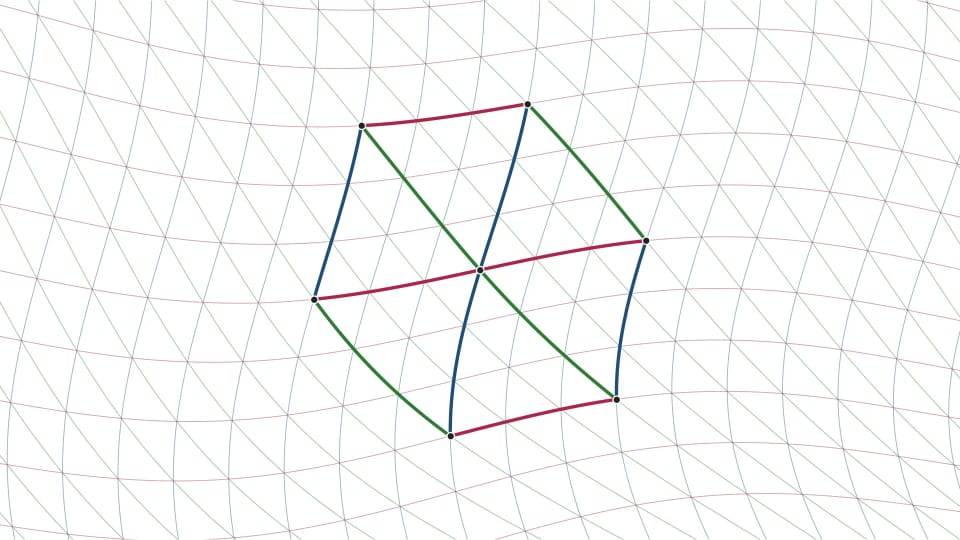
When several independent mathematical patterns overlap across a geometric surface, they often constrain each other in unexpected ways. A person drawing several distinct families of smooth curves across a plane might ask whether it is possible to assign a specific numerical value to every curve so that the values cancel out wherever the curves cross. For centuries, analysts studied functional equations that enforce such balances, seeking to determine what kinds of mathematical formulas can possibly satisfy them. What begins as a question about overlapping geometric lines quickly transforms into an inquiry about the ultimate limits of algebraic solvability.
Understanding these interlocking balances matters because they govern the boundary between simple mathematical functions and equations whose solutions escape traditional computation. If the functions satisfying these geometric constraints required infinitely complex or non-elementary operations, mathematicians would face severe barriers when classifying geometric shapes and their differential equations. Knowing that these relationships remain expressible using the familiar operations of standard calculus ensures that geometric structures do not produce wildly intractable functional behavior.
In a preprint posted on the arXiv server on September 17, 2026, mathematicians Gabriel Fazoli and Jorge Vitório Pereira established that every local abelian relation of a codimension-one web on a smooth complex projective manifold is defined over a Liouvillian extension of the underlying function field. Their mathematical result resolves a longstanding conjecture in web geometry without requiring any special assumptions about maximal rank or algebraic origins.
How do intersecting geometric curves create balance?
An intersecting geometric web creates balance when distinct functions evaluated along each family of curves sum to zero across an entire region. In the formal language of geometry, a web consists of multiple foliations, which are decompositions of a space into parallel leaves or slices, superimposed on a single space. When Gabriel Fazoli and Jorge Vitório Pereira examined a web formed by k distinct foliations of codimension one on a complex manifold of dimension at least two, each foliation could be locally described by the level sets of an analytic function.1 An abelian relation occurs when one selects a closed differential one-form along each foliation such that the sum of these one-forms vanishes identically everywhere.1
The study of such relations traces back to Augustin-Louis Cauchy, who in his 1821 Cours d'analyse investigated functional equations where a function evaluated at a product equals the sum of its values at the individual components.1 The only continuous solutions to that basic prototype on positive real numbers are constant multiples of the logarithm.1 One step past the logarithm sits the dilogarithm function, which underpins the five-term functional equation discovered by Niels Henrik Abel in the early nineteenth century.1 Abel expressed this relationship using what modern mathematicians designate as the Rogers dilogarithm, establishing a five-part identity that sums to a negative constant fraction of pi squared.
In geometric terms, Abel's five-term equation represents an abelian relation of Bol's five-web, a planar structure formed by superimposing four pencils of lines with a pencil of conics. During the 1930s, Wilhelm Blaschke and his mathematical school systematically developed web geometry, proving that the space of abelian relations for a k-web on a surface has a dimension bounded by the quantity k minus one times k minus two divided by two.1 Webs that attain this maximum theoretical bound connect directly to classical algebraic geometry through Abel's theorem on plane curves.1 Decades later, Shiing-Shen Chern and Phillip Griffiths revived the field by exploring whether higher-dimensional webs of maximal rank necessarily arise from algebraic curves.1
On spaces of dimension three or higher, Jean-Marc Trépreau established that maximal-rank webs in general position with at least twice as many foliations as the dimension are always algebraizable.1 On two-dimensional surfaces, however, this correspondence breaks down entirely.1 Bol's five-web achieves a maximal rank of six but fails to be algebraizable precisely because of its dilogarithmic relation.1 Such non-algebraizable configurations are known as exceptional webs, and mathematicians could not determine what class of mathematical transcendency their abelian relations might display, even for simple webs defined by rational functions.1
Regarding this historical impasse, Jorge said in response to questions from Primary that the new result does not isolate specific exotic formulas. Jorge explained that in the case of Bol's configuration, the machinery does not directly recover the familiar dilogarithmic formulas, clarifying that "it tells us that the relations can be expressed through reasonably elementary operations of calculus, without requiring us to identify the special functions involved." In his view, recovering explicit classical representations remains a distinct challenge, while the general theorem establishes that ordinary calculus operations suffice.
What makes a mathematical solution Liouvillian?
A mathematical solution is Liouvillian when it can be built from simple starting functions through basic operations of algebra, integration, and exponentiation.1 Joseph Liouville formalized this hierarchy in differential algebra to distinguish functions accessible by standard calculus from those requiring fundamentally new transcendental constructions. A differential field extension is classified as Liouvillian if it is assembled via a finite sequence of steps, where each step adjoins an algebraic element, adjoins an integral known as a primitive, or adjoins the exponential of an integral.1
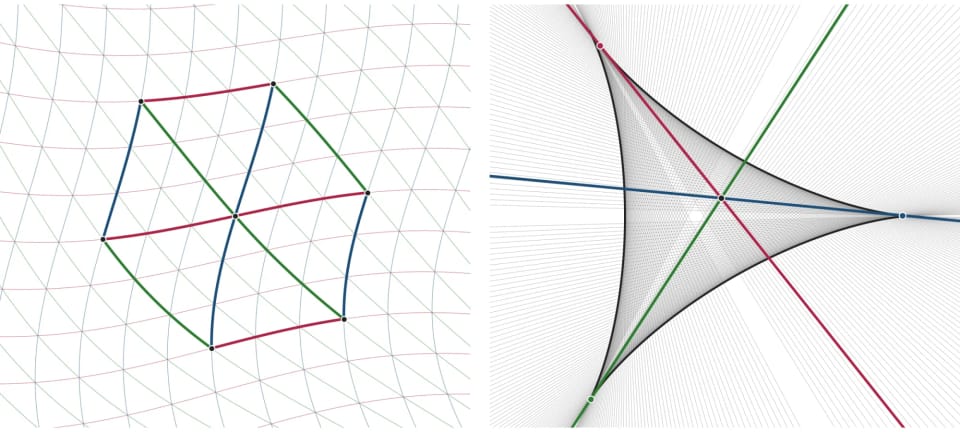
For decades, researchers conjectured that the abelian relations of any web defined over a given field must always live inside a Liouvillian extension of that field.1 Prior to the preprint by Gabriel Fazoli and Jorge Vitório Pereira, mathematicians had verified this conjecture in only three restricted situations.1 The property was known for hexagonal three-webs, whose single abelian relation is classically Liouvillian.1 It was also established for algebraic webs, where Abel's theorem guarantees that abelian relations come from abelian integrals, as well as for webs that possess an infinitesimal symmetry known as a transverse infinitesimal automorphism.1
Outside those specific cases, the general behavior of web relations remained completely unresolved. When a web possessed an arbitrary rank below the theoretical maximum, or lacked any infinitesimal symmetries, mathematicians had no general framework to rule out highly pathological transcendental expressions. The conjecture formulated in earlier literature proposed that every abelian relation must remain within the Liouvillian category, but proving this assertion required discovering an underlying rigidity in the differential equations governing the web.
How did the mathematicians prove the general conjecture?
Gabriel Fazoli and Jorge Vitório Pereira proved the conjecture by showing that the balance along a web forces each family of curves into a rigid geometric framework governed by linear differential equations.1 To analyze the problem on a smooth complex projective variety, the authors first passed to a finite decomposing cover, which untangles the web so that each individual foliation can be treated globally as a distinct factor permuted by a Galois group.1 Jorge told Primary that passing to a finite decomposing cover is standard practice in web geometry because "it allows us to separate the web into individual foliations and work with each of them directly, which makes the argument easier to organize." He noted that branching behaviors created no unexpected difficulties because the cover serves as an organizing tool rather than an analytical obstacle.
They then showed that the individual functional components that make up an abelian relation must satisfy a rational differential equation in the direction transverse to the leaves.1 This transverse differential equation forces each constituent foliation to admit a singular transverse affine structure, meaning it carries a flat meromorphic connection across its normal bundle. Drawing on a classical criterion established by Michael Singer, a codimension-one foliation on a projective variety admits a global Liouvillian first integral if and only if it is transversely affine.1 Gabriel Fazoli and Jorge Vitório Pereira used the elementary half of Singer's equivalence, where the presence of a transverse affine connection guarantees the existence of a Liouvillian first integral through basic integration.1
The authors then separated their investigation into two distinct geometric possibilities depending on whether each foliation admits a rational first integral.1 In the first case, when a foliation lacks any rational first integral, its transverse affine geometry is sufficiently rigid that every associated component of the abelian relation can be computed directly as an explicit Liouvillian expression.1 In the second case, when the foliation is given by a rational fibration over an algebraic curve, its components generate differential modules that descend to the base curve.1 Jorge observed that this algebraically integrable branch took the longest to resolve, explaining that "the difficult step was realizing that we should consider the differential modules generated by the components of an abelian relation."
By analyzing the resonances and linear dependencies that the overarching abelian relation imposes among these modules, the authors demonstrated that the components assemble into triangular differential systems.1 Jorge described the intuitive mechanism to Primary by noting that a shared building block must adapt to multiple geometric perspectives at once. As Jorge stated, "when both foliations admit rational first integrals, the intuition is a little like having a function that depends only on x, but also only on an independent variable y: there is very little room for variation." Once each shared submodule is reduced to rank one, the equations take on a triangular structure where each successive unknown depends only on preceding components, allowing mathematicians to solve the entire coupled system using an integrating factor followed by ordinary integration.
What limits remain in understanding these webs?
The new mathematical proof applies specifically to codimension-one webs on smooth complex projective spaces, leaving webs over general complex differential fields unsolved. The work of Gabriel Fazoli and Jorge Vitório Pereira is currently documented in a preprint that may not have been peer reviewed posted on arXiv, meaning it has not yet completed peer review in an academic journal.1 Furthermore, the techniques rely on global projective geometry, particularly the existence of rational functions and compact varieties, to control the differential modules.
As the authors explicitly pointed out, the broader conjecture remains open when webs are defined as local germs over arbitrary complex differential fields that do not arise from projective varieties.1 The proof demonstrates that projective geometry prevents wild transcendental divergence, but it cannot determine whether similar constraints hold in purely abstract analytic or formal settings. In the projective setting, however, the result provides an exhaustive qualitative classification, confirming that every germ of an abelian relation is reachable through elementary calculus operations regardless of the web rank.
Addressing these limits, Jorge said in response to questions from Primary that the underlying Liouvillian property is unlikely to fail outside projective spaces, but the specific proof technique ceases to function. He emphasized that the global algebraic geometry of base curves and fibers was indispensable for collapsing shared differential modules into trivial systems. Extending the theorem to webs of higher codimension poses even steeper hurdles, as Jorge noted that codimension-one foliations possess transverse dynamics modeled on curves, which leave far less room for dynamical complications. While degree-one relations in higher codimension might yield to similar methods under strict non-integrability assumptions, top-degree relations in higher codimension remain an open frontier where new transcendental phenomena could yet appear.
The record
39 sentences trace to 1 source and 1 contributor.
-
1
GF
 Gabriel Fazoli, Jorge Vitório Pereira
Paper
· arxiv.org · 21 Sep 2026
Abelian Relations are Liouvillian
Preprint · may not have been peer reviewed
See the source
- 2 Contribution — Jorge Vitório Pereira 14 statements added to this article
Other consulted pages1 page
arxiv.org1 page
Article history
-
Published 27 Nov 2026, 16:27Assembled by the Primary desk from 1 source · 1 contributor · 39 cited sentences
-
Jorge Vitório Pereira
- Go to the sentence: Such non-algebraizable configurations are known as exceptional webs, and mathematicians could not determine what class of mathematical transcendency their abelian relations might display, even for simple webs defined by rational functions.
- Go to the sentence: Regarding this historical impasse, Jorge said in response to questions from Primary that the new result does not isolate specific exotic formulas.
- Go to the sentence: Jorge explained that in the case of Bol's configuration, the machinery does not directly recover the familiar dilogarithmic formulas, clarifying that "it tells us that the relations can be expressed through reasonably elementary operations of calculus, without requiring us to identify the special functions involved."
- Go to the sentence: To analyze the problem on a smooth complex projective variety, the authors first passed to a finite decomposing cover, which untangles the web so that each individual foliation can be treated globally as a distinct factor permuted by a Galois group.
- Go to the sentence: Jorge told Primary that passing to a finite decomposing cover is standard practice in web geometry because "it allows us to separate the web into individual foliations and work with each of them directly, which makes the argument easier to organize."
- Go to the sentence: He noted that branching behaviors created no unexpected difficulties because the cover serves as an organizing tool rather than an analytical obstacle.
- Go to the sentence: In the first case, when a foliation lacks any rational first integral, its transverse affine geometry is sufficiently rigid that every associated component of the abelian relation can be computed directly as an explicit Liouvillian expression.
- Go to the sentence: Jorge observed that this algebraically integrable branch took the longest to resolve, explaining that "the difficult step was realizing that we should consider the differential modules generated by the components of an abelian relation."
- Go to the sentence: As Jorge stated, "when both foliations admit rational first integrals, the intuition is a little like having a function that depends only on x, but also only on an independent variable y: there is very little room for variation."
- Go to the sentence: Once each shared submodule is reduced to rank one, the equations take on a triangular structure where each successive unknown depends only on preceding components, allowing mathematicians to solve the entire coupled system using an integrating factor followed by ordinary integration.
- Go to the sentence: As the authors explicitly pointed out, the broader conjecture remains open when webs are defined as local germs over arbitrary complex differential fields that do not arise from projective varieties.
- Go to the sentence: Addressing these limits, Jorge said in response to questions from Primary that the underlying Liouvillian property is unlikely to fail outside projective spaces, but the specific proof technique ceases to function.
- Go to the sentence: He emphasized that the global algebraic geometry of base curves and fibers was indispensable for collapsing shared differential modules into trivial systems.
- Go to the sentence: Extending the theorem to webs of higher codimension poses even steeper hurdles, as Jorge noted that codimension-one foliations possess transverse dynamics modeled on curves, which leave far less room for dynamical complications.