Glacial outburst floods can lock Greenland ice into multiyear slowdowns
Enormous drainage events carve subglacial channels that strip lubricating water from bedrock, creating a persistent brake along the margins of the warming Greenland ice sheet.
When summer meltwater pools beneath a glacier, the trapped liquid usually acts as a hydraulic jack. Water trapped under immense weight pushes up against the frozen ceiling, easing the glacier off bedrock and allowing hundreds of thousands of tonnes of ice to slide swiftly toward the ocean. In a warming Arctic, that lubrication typically makes outlet glaciers accelerate year after year, hastening the delivery of ice into the sea.
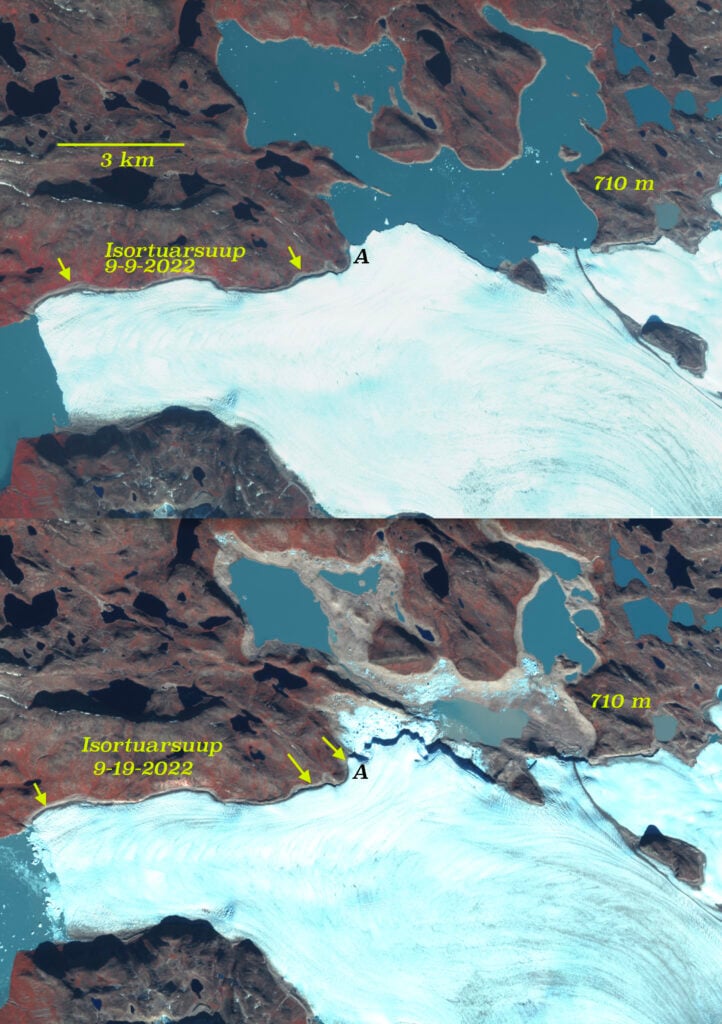
Along the southwestern flank of the Greenland ice sheet, an opposite rhythm unfolds beside the glacier Isortuarsuup Sermia.12 Repeated catastrophic drainage events from two ice-dammed side lakes repeatedly interrupt this expected acceleration, dropping the flow of the ice front to a fraction of its baseline speed for several consecutive years.12 Understanding how these sudden surges alter ice movement is vital for predicting how fast Greenland will lose mass as rising temperatures create more meltwater reservoirs along its fringes.
In a study published on November 24, 2026, in the journal Nature Communications, Yefan Wang and colleagues at the University of Edinburgh analysed satellite observations spanning nearly four decades from 1987 to 2022.12 Their records demonstrate that while the lower reaches of Isortuarsuup Sermia steadily speed up over multiannual intervals, each major glacial lake outburst flood abruptly reverses that trend, resetting the system into a sluggish state.21
The mechanics of this sudden slowdown depend on the plumbing that develops beneath the ice. Under ordinary conditions, water trickles through an inefficient network of small pockets across the bed, maintaining high basal water pressure that keeps the ice partly lifted off the rock. When a side lake suddenly bursts beneath the glacier, an immense torrent tears open a wide, tunnel-like drainage channel. That conduit carries water out so efficiently that it siphons lubricating liquid from the surrounding bedrock. Deprived of water pressure from below, the ice settles hard against the rough bedrock, generating intense friction that acts like an emergency brake.
Why does a sudden flood slow down a glacier?
Glacial outburst floods slow down ice flow by carving wide subglacial conduits that rapidly drain water away from the glacier bed.12 When water pressure drops across the interface between ice and rock, the ice sheet settles firmly against the bedrock, multiplying frictional resistance against forward motion.21 Yefan Wang and colleagues reported that the main drainage channel carved beneath Isortuarsuup Sermia reaches a width of approximately 1.5 kilometres.21 That wide channel acts as a low-pressure drain, drawing water from surrounding sections of the bed and leaving the rock dry relative to its pre-flood state.12
The researchers described the resulting dynamic as a sawtooth pattern.12 In the words of the paper, multi-year acceleration is terminated abruptly by high-magnitude lake-drainage that resets the glacier to a quiescent state for several years.21 Once the flood conduit drains the bed, stored water takes years to accumulate again under the ice, keeping friction high and preventing the glacier from returning to its peak speeds until basal pressures slowly recover.1
What happened during the September 2022 drainage?
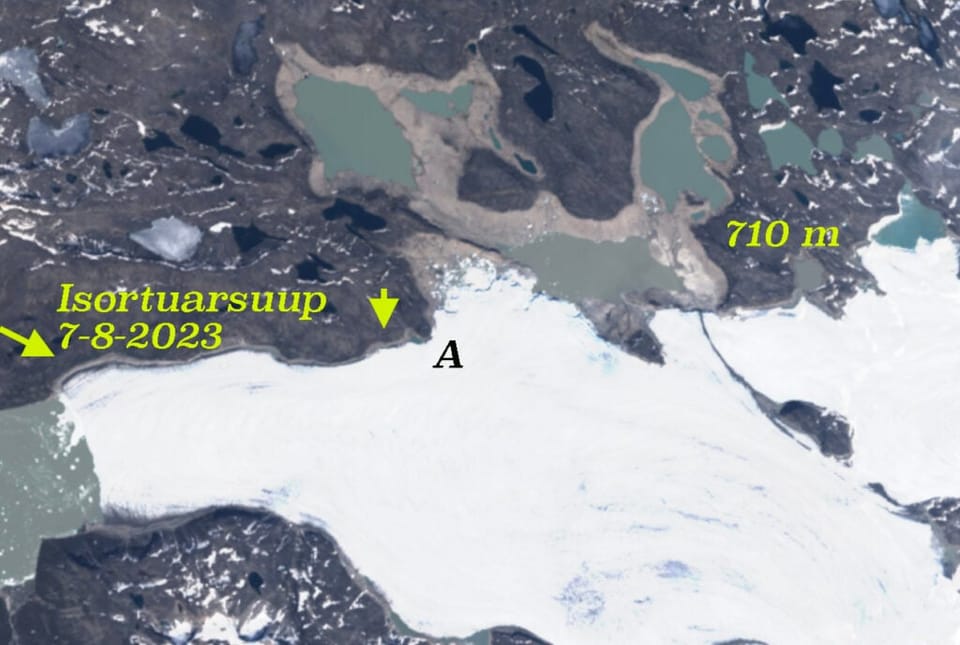
In September 2022, satellite records captured a massive flood when an ice-dammed basin known as North Lake emptied into the subglacial system of Isortuarsuup Sermia within roughly 20 hours.1 Supplementary satellite imagery showed North Lake completely full at 13:44 UTC on September 13, 2022, and almost entirely drained by 09:54 UTC on September 14, 2022.1 The Edinburgh researchers calculated that water escaped the basin at an average rate of approximately 17,000 cubic metres per second during the event.21
The drainage triggered an immediate convulsion followed by a lasting freeze on ice motion. Near the front of Isortuarsuup Sermia, annualised ice velocity spiked briefly from a pre-event baseline of about 200 metres per year to approximately 1,000 metres per year during the surge.21 As the flood carved its wide conduit and depressurised the subglacial system, ice motion collapsed over the subsequent years to roughly 50 metres per year, which represented a quarter of the speed measured before the flood.21
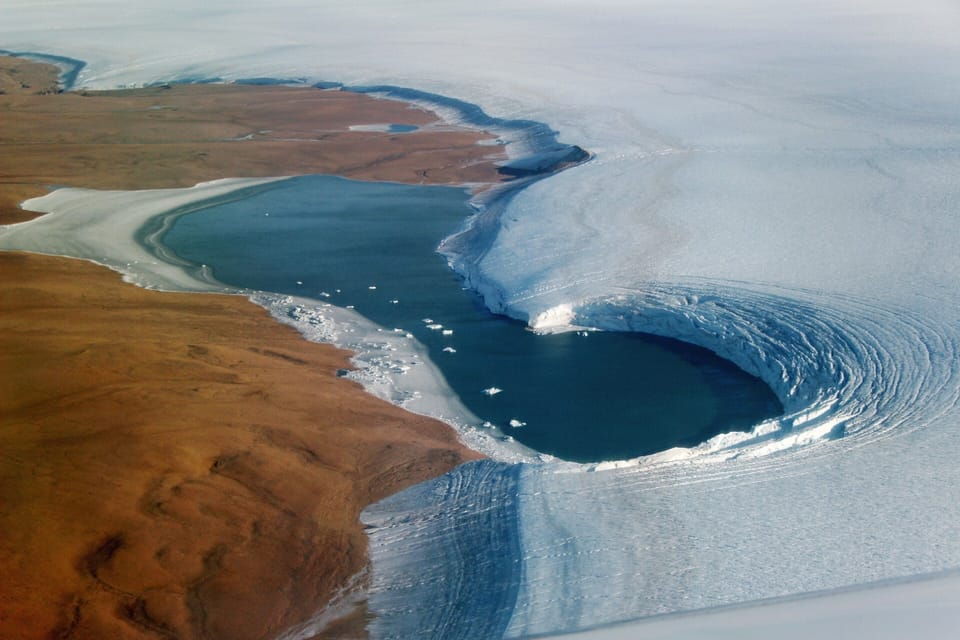
North Lake generates the largest floods observed along the glacier. In responses provided during the peer review process, the authors estimated the volume of North Lake at approximately 1.5 cubic kilometres, which is roughly five to 10 times the volume of South Lake, a smaller neighbour that holds between 0.14 and 0.29 cubic kilometres.1 North Lake occupies a basin of about 30 square kilometres and requires eight to 10 years to refill, pacing three distinct inter-flood intervals tracked between 1994 and 2002, 2003 and 2012, and 2013 and 2022.1 Even the smaller South Lake left an unmistakable imprint: after it drained in July 2016, ice speed at one measurement sector dropped by about 40 percent, falling from 153 metres per year to 92 metres per year.1
How do marginal lakes alter ice movement elsewhere?
Marginal lakes across the wider Greenland ice sheet generally cause outlet glaciers to speed up rather than slow down.31 A comprehensive assessment of 102 outlet glaciers across Greenland, led by Connie M. Harpur at the University of Leeds and published in April 2026 in Communications Earth & Environment, found that glaciers ending in lakes flowed 231 percent faster at their front margins than glaciers terminating on dry land during 2017.31 Furthermore, about 44 percent of those lake-terminating glaciers accelerated as they approached their termini, compared to only about 4 percent of land-terminating glaciers.31
Earlier observations at Isortuarsuup Sermia also recorded acceleration prior to the latest flood. In an April 2024 study published in the Journal of Glaciology, Ed Holt, Peter Nienow, and Encarni Medina-Lopez at the University of Edinburgh found that annual ice velocity at the front of Isortuarsuup Sermia increased by a factor of 2.5 between 2013 and 2021, reaching 214 metres per year with an uncertainty of 4 metres per year.41 That acceleration was linked to thinning ice where the glacier terminates in Isortuarsuup Tasia, a proglacial lake spanning approximately 60 square kilometres.41 The new findings by Wang and colleagues fit alongside those earlier measurements: while thinning near the terminus causes steady multiyear speedups, periodic outburst floods from flank lakes repeatedly interrupt that trend with sudden, multiyear decelerations.12
What limits the scope of these findings?
The observational results describe the behaviour of a single glacier system and two ice-marginal lakes.1 Satellite observations cannot show that the Greenland ice sheet as a whole is decelerating, and the authors explicitly noted that the local braking effect does not halt broader ice loss or offset global sea-level rise.1 Conditions directly beneath the glacier bed were not measured on site; instead, the subglacial friction mechanism was inferred entirely from surface velocity changes, elevation tracking, and lake drainage volumes observed from space.1
The physical subglacial conduits themselves do not remain open across the multiyear slowdown. In their published peer-review responses, the authors acknowledged that the 1.5-kilometre-wide drainage channel likely collapses under ice overburden pressure within days or weeks following a flood.1 They attributed the multiyear quiescent period to the prolonged loss of stored water across the bed rather than to a permanently open channel, though they noted they could not calculate bed deformation directly because reliable ice-thickness data for the glacier do not exist.1 In addition, while South Lake drains more frequently as its ice dam thins, satellite observations have not recorded any increase in flood frequency at North Lake, leaving future drainage rates uncertain.1
The record
31 sentences trace to 4 sources.
-
1
SB
 Science Blog Research Desk
Document
· scienceblog.com · 26 Nov 2026
Nearly four decades of satellite data show repeated outburst floods from ice-marginal lakes beside a Greenland glacier reset its flow to a slow state for several years
See the source
-
2
N
 nature.com
Paper
· nature.com
Cyclical high-magnitude lake drainage slows Greenland ice sheet motion - Nature Communications
Journal article
Download the document
- 3 Ice-marginal proglacial lakes enhance outlet glacier velocities across Greenland - PMC See the source
- 4 Terminus thinning drives recent acceleration of a Greenlandic lake-terminating outlet glacier | Journal of Glaciology | Cambridge Core See the source