Group-living rodents concentrate social hormones in early auditory brainstem circuits
Auditory brainstem nuclei involved in sound localization exhibit variation in oxytocin and vasopressin immunoreactive puncta across six rodent species with distinct social systems, suggesting that neuropeptide distribution in early auditory pathways may vary with social organization.

An animal moving through a dense colony must immediately distinguish between friendly contact calls, mating displays, and alarms sounded by territory rivals. For decades, neuroscientists treated the lower acoustic processing centres of the brainstem primarily as mechanical switchboards designed to measure acoustic timing, leaving the emotional and social relevance of those signals to higher forebrain areas. That separation overlooks how early sensory pathways might be tuned to support communal life. In animals that share burrows and cooperate in colonies, early auditory circuits may need to handle vocal communication with specialized chemical sensitivity.
The biological mechanism that connects sound perception to social response follows a direct physiological sequence. Sound waves vibrate the eardrum, fluid waves stimulate sensory cells in the inner ear, and auditory nerve fibers send electrical pulses directly into the brainstem. Within these lower brain clusters, specialized cells compare the minute timing and loudness differences between the two ears to locate sounds in physical space. When neuromodulatory chemicals are released into these hubs, they can adjust synaptic transmission, altering how sensitive individual neurons are to incoming vocal cues. If those chemical signals are amplified in species that navigate complex group dynamics, the earliest stages of hearing can be adjusted to match social demands.
A research team led by L. Joseph, L. Boren, G. E. Ingram, and E. A. McCullagh investigated whether this early sensory modulation tracks how wild animals live. In a preprint posted on the bioRxiv server and the (which may not have been peer reviewed) authors examined brainstem tissue from six wild-caught rodent species that follow three distinct social lifestyles: solitary, monogamous, or group-living.1
Why would hearing depend on an animal's social lifestyle?
Living in a colony requires rapid recognition of acoustic communication among familiar group members and intruding strangers. Hormones like oxytocin and vasopressin have established roles in regulating animal social behavior, pair bonding, and parental care in forebrain and midbrain regions, yet their presence in hindbrain structures has remained poorly understood.13 Prior reviews by Janet K. Bester-Meredith, Alexandria P. Fancher, and Grace E. Mammarella established that arginine vasopressin modulates sensory processing across olfactory, visual, and auditory systems in mammals, altering how animals evaluate environmental cues.3 The authors hypothesized that animals exposed to continuous social chatter maintain greater signaling infrastructure for these neuropeptides in their early auditory stations.
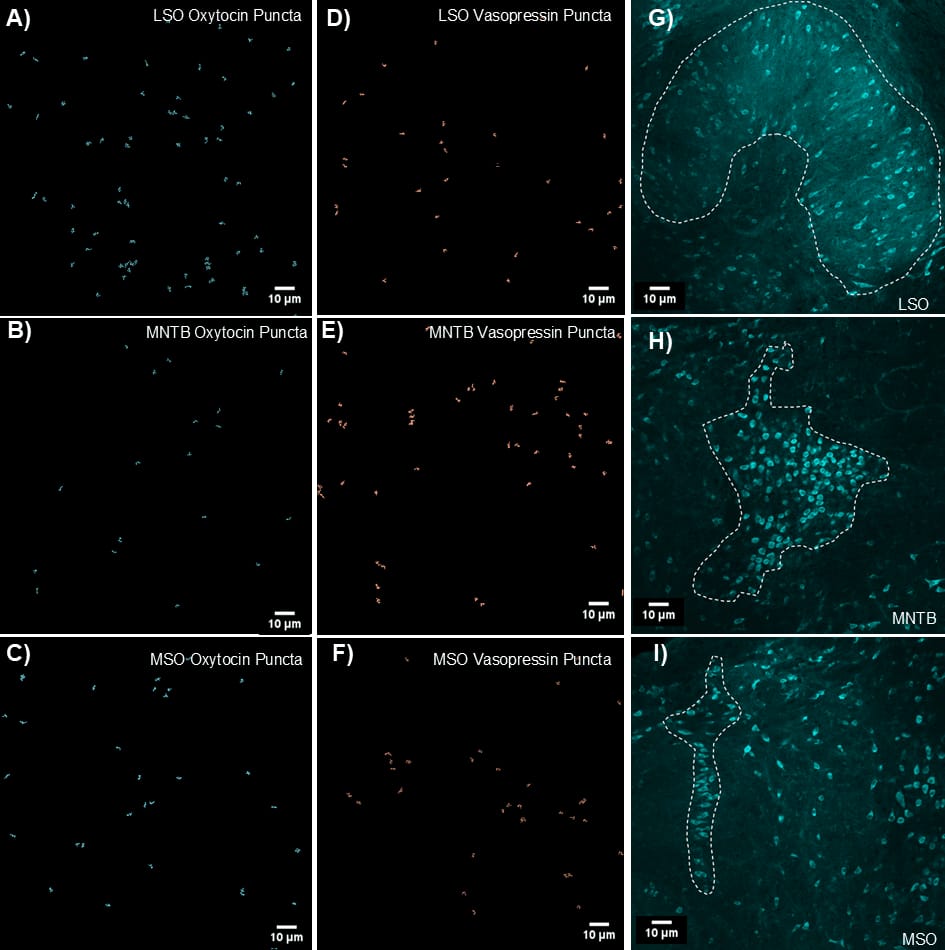
To test this idea, the researchers quantified immunoreactive puncta, which are microscopic focal clusters that mark the presence of oxytocin and vasopressin, across three distinct auditory brainstem nuclei.1 These structures included the lateral superior olive, the medial superior olive, and the medial nucleus of the trapezoid body.1 The lateral superior olive computes differences in sound intensity between both ears, the medial superior olive tracks microscopic timing differences, and the medial nucleus of the trapezoid body provides rapid inhibitory control to keep localization accurate.
To measure these features consistently across wild specimens, the investigators used standardized confocal imaging. Joseph, the lead author, said in response to questions from Primary that the team applied identical optical parameters across all specimens, imaging brain sections at 20 times magnification using a confocal microscope and defining nuclei using anatomical landmarks from the mouse brain atlas. The researchers then processed the images with standardized background subtraction and thresholding criteria. Joseph told Primary that "a greater number of puncta indicates more structures meeting our standardized detection criteria; it does not directly indicate greater peptide release or receptor availability."
Where do bonding hormones concentrate in the brainstem?
Group-living rodent species exhibited higher oxytocin and vasopressin puncta counts than monogamous and solitary species in both the lateral superior olive and the medial nucleus of the trapezoid body.1 Within the medial superior olive, oxytocin puncta counts did not differ among the three social groups.1 In contrast, vasopressin puncta counts in that same structure were higher in group-living species than in monogamous and solitary species.1
These chemical differences appeared independent of structural size changes. Total brain volume and the volumes of the medial nucleus of the trapezoid body and the medial superior olive differed significantly across individual species, but these volumetric measurements showed no pattern across social groups.1 Furthermore, the volume of the lateral superior olive showed no difference across species or sociality categories.1 The behavioral differences were reflected specifically in the density of neuropeptide markers rather than the gross physical expansion of auditory brain areas.
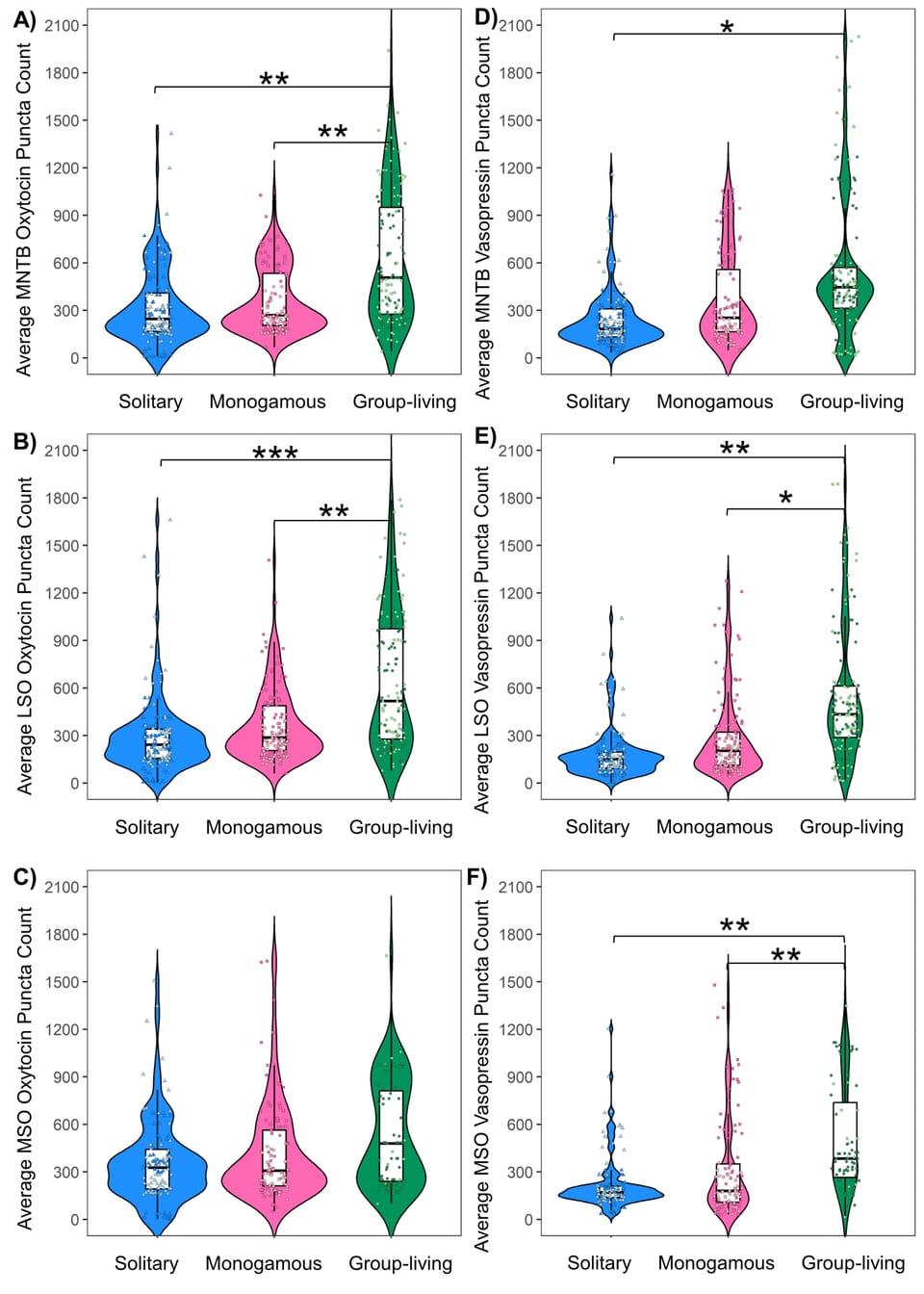
Addressing the divergence between the two neuropeptides in the medial superior olive, Joseph noted that vasopressin and oxytocin may play distinct roles in tuning acoustic information. Because the medial superior olive tracks interaural timing differences between the ears, Joseph told Primary that "the AVP pattern raises the possibility that vasopressinergic signaling may be particularly relevant to temporal aspects of auditory processing." However, Joseph emphasized that the anatomical distribution alone cannot explain the functional mechanism driving the difference between the two peptides.
What do these chemical patterns reveal about sensory processing?
Auditory brainstem pathways appear to integrate social information far earlier in the sensory hierarchy than conventional models described.1 The presence of oxytocin and vasopressin in early brainstem hubs implies that the neural circuits responsible for locating and filtering sounds can be modulated according to an animal's social environment and evolutionary history. Joseph told Primary that because oxytocin and vasopressin act as neuromodulators, signaling through their receptors could alter neuronal excitability or synaptic transmission in early pathways, modifying "the strength or timing of neural responses to sound."
The study has several clear boundaries. The data reflect an anatomical inventory of preserved tissue from wild-caught animals rather than a dynamic physiological measurement of hearing in living animals. Counting immunoreactive puncta indicates where peptide molecules accumulate, but it cannot measure real-time neural firing rates, electrical conductivity, or receptor sensitivity during active vocal communication. Furthermore, the analysis examined only six wild species, with two species representing each social organization, and did not employ an explicit phylogenetic comparative model. As a preprint, the findings have not yet undergone formal peer evaluation.
Joseph cautioned against broad extrapolations, telling Primary that "we cannot assume that this pattern applies broadly across mammals or other taxa groups." Greater immunoreactivity in group-living species identifies an anatomical association, Joseph explained, but "does not demonstrate that these peptides cause social organization or directly alter auditory processing."
Resolving whether these chemical clusters actively reshape perception will require electrophysiological recordings during pharmacological manipulation. Joseph told Primary that the decisive test involves measuring auditory responses in the brainstem while blocking oxytocin and vasopressin receptors. If blocking those receptors produces no measurable change in acoustic responses, that outcome would indicate the neuropeptides do not actively tune early hearing circuits. For sensory biologists, demonstrating a measurable functional shift would confirm that early auditory gateways are chemically tuned to match an animal's social world.
The record
20 sentences trace to 2 sources and 1 contributor.
-
1
JL
 Joseph, L., Boren, L., Ingram, G. E., McCullagh, E. A.
Paper
· biorxiv.org · 29 Sep 2026
Oxytocin and Vasopressin Immunoreactivity Differs Across Auditory Brainstem Nuclei in Rodents with Distinct Social Systems
Preprint · may not have been peer reviewed
See the source
- 2 Contribution — Joseph, L. 17 statements added to this article
-
3
F
 Frontiers
Third-party reporting
· frontiersin.org · 5 Feb 2015
Frontiers | Vasopressin Proves Es-sense-tial: Vasopressin and the Modulation of Sensory Processing in Mammals
See the source
Other consulted pages1 page
frontiersin.org2 pages
experts.okstate.edu1 page
pmc.ncbi.nlm.nih.gov1 page
Article history
-
Published 27 Nov 2026, 16:31Assembled by the Primary desk from 2 sources · 1 contributor · 20 cited sentences
-
Joseph, L., lead author
- Go to the sentence: In a preprint posted on the bioRxiv server and the (which may not have been peer reviewed) authors examined brainstem tissue from six wild-caught rodent species that follow three distinct social lifestyles: solitary, monogamous, or group-living.
- Go to the sentence: To test this idea, the researchers quantified immunoreactive puncta, which are microscopic focal clusters that mark the presence of oxytocin and vasopressin, across three distinct auditory brainstem nuclei.
- Go to the sentence: These structures included the lateral superior olive, the medial superior olive, and the medial nucleus of the trapezoid body.
- Go to the sentence: Joseph, the lead author, said in response to questions from Primary that the team applied identical optical parameters across all specimens, imaging brain sections at 20 times magnification using a confocal microscope and defining nuclei using anatomical landmarks from the mouse brain atlas.
- Go to the sentence: The researchers then processed the images with standardized background subtraction and thresholding criteria.
- Go to the sentence: Joseph told Primary that "a greater number of puncta indicates more structures meeting our standardized detection criteria; it does not directly indicate greater peptide release or receptor availability."
- Go to the sentence: Group-living rodent species exhibited higher oxytocin and vasopressin puncta counts than monogamous and solitary species in both the lateral superior olive and the medial nucleus of the trapezoid body.
- Go to the sentence: Within the medial superior olive, oxytocin puncta counts did not differ among the three social groups.
- Go to the sentence: In contrast, vasopressin puncta counts in that same structure were higher in group-living species than in monogamous and solitary species.
- Go to the sentence: Furthermore, the volume of the lateral superior olive showed no difference across species or sociality categories.
- Go to the sentence: Because the medial superior olive tracks interaural timing differences between the ears, Joseph told Primary that "the AVP pattern raises the possibility that vasopressinergic signaling may be particularly relevant to temporal aspects of auditory processing."
- Go to the sentence: Auditory brainstem pathways appear to integrate social information far earlier in the sensory hierarchy than conventional models described.
- Go to the sentence: Joseph told Primary that because oxytocin and vasopressin act as neuromodulators, signaling through their receptors could alter neuronal excitability or synaptic transmission in early pathways, modifying "the strength or timing of neural responses to sound."
- Go to the sentence: Furthermore, the analysis examined only six wild species, with two species representing each social organization, and did not employ an explicit phylogenetic comparative model.
- Go to the sentence: Joseph cautioned against broad extrapolations, telling Primary that "we cannot assume that this pattern applies broadly across mammals or other taxa groups."
- Go to the sentence: Greater immunoreactivity in group-living species identifies an anatomical association, Joseph explained, but "does not demonstrate that these peptides cause social organization or directly alter auditory processing."
- Go to the sentence: Joseph told Primary that the decisive test involves measuring auditory responses in the brainstem while blocking oxytocin and vasopressin receptors.