Hera steers itself through rubble around a battered asteroid
European engineers gave their deep-space probe onboard autonomy ahead of schedule as it begins mapping the chaotic debris left by a kinetic impact test.
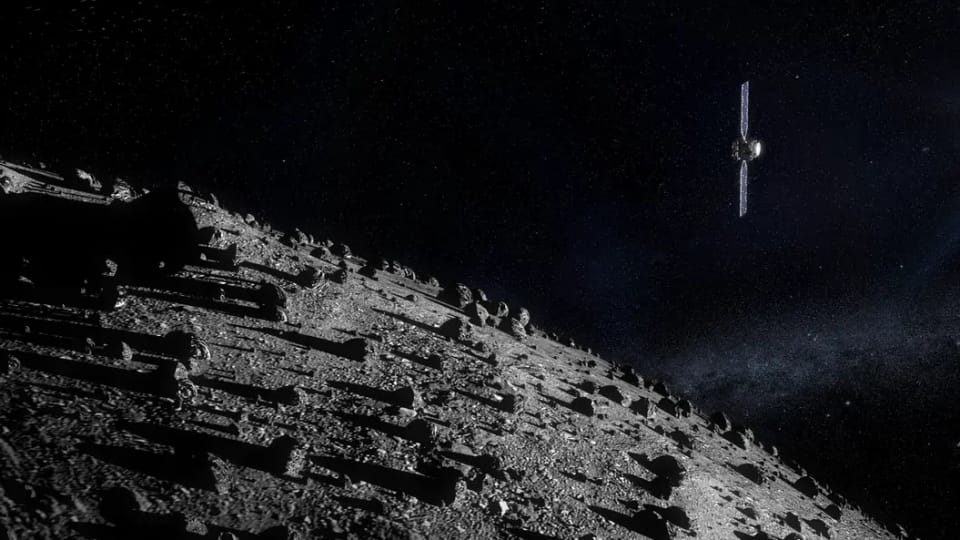
When a spacecraft travels hundreds of millions of kilometres into the solar system to inspect a pair of tumbling asteroids, ordinary remote control ceases to work. Radio signals travelling at the speed of light take several minutes to make the one-way crossing between ground antennas on Earth and the probe. If an unexpected obstacle appears in the flight path, or if an engine firing drifts slightly off course, instructions beamed from mission control would arrive far too late to avert disaster. Navigating close to an uncharted, irregular space rock requires a machine that can observe its surroundings, calculate its own position, and fire its thrusters without human intervention.
Understanding how small celestial bodies behave during close encounters is vital for planetary defence, the effort to protect Earth from potential asteroid impacts. In 2022, NASA demonstrated that striking an asteroid with a high-speed projectile could push it off course.12 Yet knowing that an impact alters an orbit does not explain how the target absorbed the shock, whether it fractured internally, or what debris fields linger around it. To turn an experimental strike into a predictable planetary defence technique, scientists must inspect the aftermath up close.
The physical sequence of such an investigation requires three steps. First, the probe must approach the binary asteroid system safely across interplanetary space. Second, onboard optical sensors must identify the target bodies against the blackness of deep space, tracking their shapes and apparent motions to determine distance and velocity. Third, onboard flight software must continuously calculate small corrective manoeuvres, adjusting the orientation and trajectory of the probe so that its cameras remain fixed on the tumbling targets while avoiding collision. That autonomous guidance loop, which allows the spacecraft to make navigational decisions locally, decides whether close-proximity operations succeed.
Now at its destination, the European Space Agency spacecraft Hera has commenced close-up studies of the Didymos binary asteroid system using fully autonomous navigation.13 Operational controllers activated the self-driving capability months earlier than original flight plans envisioned, relying on software developed by an industrial consortium led by the technology company GMV.14 Hera reached the binary asteroid system in November 2026 after more than two years of interplanetary flight, positioning itself to survey the consequences of humankind's first asteroid deflection experiment.25
How did an asteroid impact reshape Dimorphos?
Initial close-up observations from Hera show that Dimorphos underwent severe structural deformation when NASA's Double Asteroid Redirection Test spacecraft struck its surface.15 The European Space Agency unveiled the mission's first detailed images of Dimorphos on November 25, 2026, during an event at the Museum für Naturkunde in Berlin.16 Those images revealed that the 151-metre-diameter moonlet now has one face flattened with a stadium-sized crater, is tumbling chaotically along its path, and is encircled by hundreds of previously unknown boulders liberated during the collision.14
The target moonlet orbits Didymos, a larger asteroid measuring 730 metres across, in a solar orbit located 193.5 million kilometres from Earth at the time of arrival.15 Ground-based telescopes on Earth confirmed in September 2022 that the kinetic impact shortened the orbital period of Dimorphos around Didymos by about 33 minutes.51 While that orbital change proved that kinetic deflection works in principle, ground observations could not resolve the crater structure, measure the mass of the fragmented debris, or determine whether the internal rubble pile shifted shape as a coherent whole.
To answer those questions, Hera carried 12 scientific instruments and two suitcase-sized CubeSats, named Milani and Juventas, to perform close-range geological, gravitational, and internal structure measurements.26 As ESA Director General Josef Aschbacher stated regarding the international effort, NASA demonstrated that an asteroid can be deflected, and the European mission is now providing the detailed scientific investigation needed to understand how that deflection worked, transforming an experiment into a reliable defence capability.4
Why did engineers enable autonomous navigation early?
Engineers activated Hera's autonomous navigation months ahead of schedule because cruise tests confirmed that the onboard algorithms could track planetary bodies and orient the spacecraft without ground intervention.14 Under the initial mission baseline, operators planned to keep the spacecraft under conventional ground control throughout its arrival, reserving fully autonomous guidance, navigation, and control for the final, highest-risk close-proximity phases.14 Flight trials during the cruise phase eliminated the need for that cautious timetable.
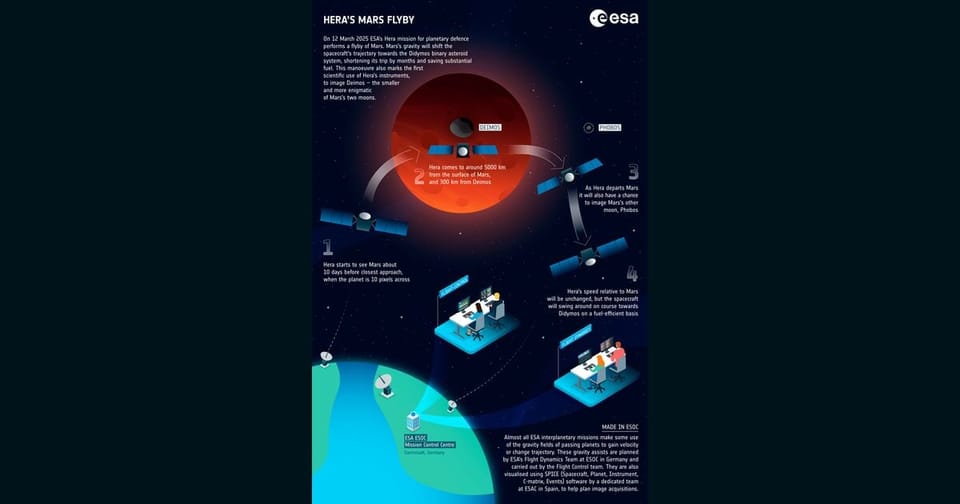
The flight software, known formally as the guidance, navigation, and control system, combines information from Hera's visual sensors and internal gyroscopes to calculate position relative to the target body.23 Just days after launch from Earth on October 7, 2024, flight controllers tested the system by commanding the autonomous pointing software to identify and track Earth.12 A second major milestone occurred in March 2025 during Hera's Mars flyby, when the navigation algorithms successfully used Mars as an optical target to calibrate autonomous tracking at high relative speed.12
Those in-flight results provided mission operators at the European Space Operations Centre in Darmstadt, Germany, with empirical verification that the software functioned reliably.21 Mariella Graziano, Flight Segment Strategy Director at GMV, explained that operators moved up validation activities to the initial post-launch days and the Mars flyby, validating a key solution for operations in a distant environment where the spacecraft must navigate without waiting for instructions from Earth.14
What can the mission measurements tell planetary scientists?
Hera's data can reveal the structural response of rubble-pile asteroids to kinetic impact, but the measurements cannot provide a universal blueprint for every future hazardous space rock. The findings describe how a specific 151-metre celestial body with its particular mineralogy and porosity reacted to a kinetic impactor of known mass and velocity. Asteroids across the solar system vary widely in internal cohesion, ranging from solid metallic bodies to loosely bound aggregates of gravel and dust, meaning that deflection efficiency will differ across different targets.
Furthermore, proximity operations around small asteroids involve chaotic gravitational fields that challenge long-term trajectory projections. Dimorphos and Didymos exert very weak gravitational pull, allowing secondary influences such as solar radiation pressure, the faint physical push of sunlight, to alter the paths of nearby objects.2 The upcoming deployment of the two CubeSats will test the limits of low-gravity navigation, as three independent craft operate simultaneously in close quarters amidst hundreds of unmapped boulders.21
Validating these physical models will determine how space agencies prepare for potential planetary threats over the coming decades. By measuring the crater volume, the exact post-impact mass, and the tumbling state of Dimorphos, researchers can calibrate numerical simulation codes used to calculate how much warning time and kinetic energy would be required to divert an asteroid on a collision course with Earth. Hera's autonomous exploration of Didymos marks the transition of planetary defence from an initial proof of concept into a rigorous, quantitative discipline.
The record
20 sentences trace to 6 sources.
-
1
GI
 GMV Innovating Solutions
Press release
· einpresswire.com · 26 Nov 2026
GMV, the architect of Hera’s autonomy after arrival at the Didymos-Dimorphos asteroid system
See the source
- 2 ESA’s Hera targets early arrival at Didymos asteroids See the source
-
3
X
 x.com
Third-party reporting
· x.com
ESA's Hera mission (@ESA_Hera) on X
See the source
- 4 GMV, the architect of Hera’s autonomy after arrival at the Didymos-Dimorphos asteroid system See the source
- 5 Watch live: Hera’s first images of post-impact asteroid Dimorphos See the source
- 6 Four years after NASA’s asteroid impact, ESA’s Hera reveals what happened to Dimorphos See the source