Quantum flows can shift the classical geometry of holographic spacetime
When quantum transformations alter the geometry of a gravitational universe, the subtle effects of interior quantum matter can overpower the classical area of space itself.

In theoretical physics, the idea that quantum information can weave the fabric of space and time has grown from a speculative conjecture into a central organizing principle. The most precise mathematical arena for exploring this relationship is the anti-de Sitter and conformal field theory correspondence, often called AdS/CFT or gauge-gravity duality.12 Under this framework, a higher-dimensional universe governed by quantum gravity, known as the bulk, is mathematically equivalent to a lower-dimensional quantum system living on its boundary, which contains no gravity at all.13 Physicists often compare this equivalence to an ordinary hologram, where a flat, two-dimensional plate contains all the information needed to reconstruct a complete, three-dimensional scene. Yet this translation is far from straightforward. For years, theorists assumed that whenever gravity becomes weak and classical geometry takes over, the subtle quantum details deep inside the bulk space would fade into secondary corrections. Now, that foundational intuition has been challenged by an analysis of how quantum flows alter classical geometry.
Understanding how quantum states on the boundary describe curved geometries in the bulk is essential for resolving the long-standing conflict between quantum mechanics and general relativity. To use the holographic dictionary to study black hole interiors and the quantum origins of spacetime, physicists need to understand which approximations remain reliable. In practical calculations, theorists routinely rely on semiclassical approximations, taking the limit where the gravitational coupling constant, denoted as G, approaches zero.13 In this limit, gravitational interactions become weak, and one expects the bulk spacetime to settle into a well-behaved classical background. Within this classical picture, the dominant contribution to entanglement entropy across a boundary region is expected to come strictly from the geometric area of an extremal surface in the interior, while bulk quantum fields provide only tiny, subdominant adjustments.
To see why this balance matters, one must examine the step-by-step causal chain that links boundary quantum information to the bulk interior. First, a physicist chooses a spatial subregion on the boundary and evaluates its quantum density matrix, which encodes all local statistical information. Second, taking the negative logarithm of this density matrix produces a mathematical operator known as the modular Hamiltonian, which measures the local distribution of quantum entanglement. Third, treating this modular Hamiltonian as an energy operator generates a transformation called modular flow, which acts like an intrinsic internal time evolution for that specific region. Fourth, according to the holographic dictionary, this boundary evolution must correspond to a dual transformation inside the bulk spacetime, known as bulk modular flow.13 Finally, under standard assumptions, this bulk transformation was believed to split neatly into two unequal parts: a massive classical term proportional to the area of an extremal surface divided by four times Newton's constant, and a minor, subdominant operator describing bulk quantum fields.
In a preprint posted to the arXiv server in September 2026, theorists Xi Dong and Donald Marolf of the University of California, Santa Barbara, alongside Pratik Rath of the Tata Institute of Fundamental Research in Mumbai, demonstrated that this subdominant assumption fails in broader physical settings.1 The researchers found that when boundary modular flow acts across states with differing classical backgrounds, the bulk modular Hamiltonian does not remain negligible.1 Instead, it can scale inversely with Newton's constant, growing as large as the geometric area term and even dominating the evolution.1 At the same time, the authors proved that under specific and mild conditions, when two states share the same restricted classical background, the classical geometry of the resulting transformed state can still be captured entirely by the classical flow generated by the geometric area alone.
Why did theorists expect quantum corrections to remain small?
The standard expectation of subdominance emerged from the Jafferis-Lewkowycz-Maldacena-Suh formula, commonly known as the JLMS relation. Formulated in earlier research by Daniel L. Jafferis, Aitor Lewkowycz, Juan Maldacena, and S. Josephine Suh, this relation directly equates the boundary modular Hamiltonian for a chosen boundary region to a sum of two bulk operators: the area operator of the associated Hubeny-Rangamani-Takayanagi surface divided by four times Newton's constant, and the bulk modular Hamiltonian associated with the entanglement wedge. In 2016, Xi Dong, Daniel Harlow, and Aron C. Wall proved that this relation underpins entanglement wedge reconstruction, establishing that the holographic mapping acts as an operator-algebra quantum error-correcting code.1 In that conventional code picture, researchers studied small perturbations, like gentle ripples of quantum matter, on top of a single, fixed classical background.1 Because the area term carries an explicit factor of one over Newton's constant, it naturally appears to dwarf the bulk quantum term as that constant approaches zero.
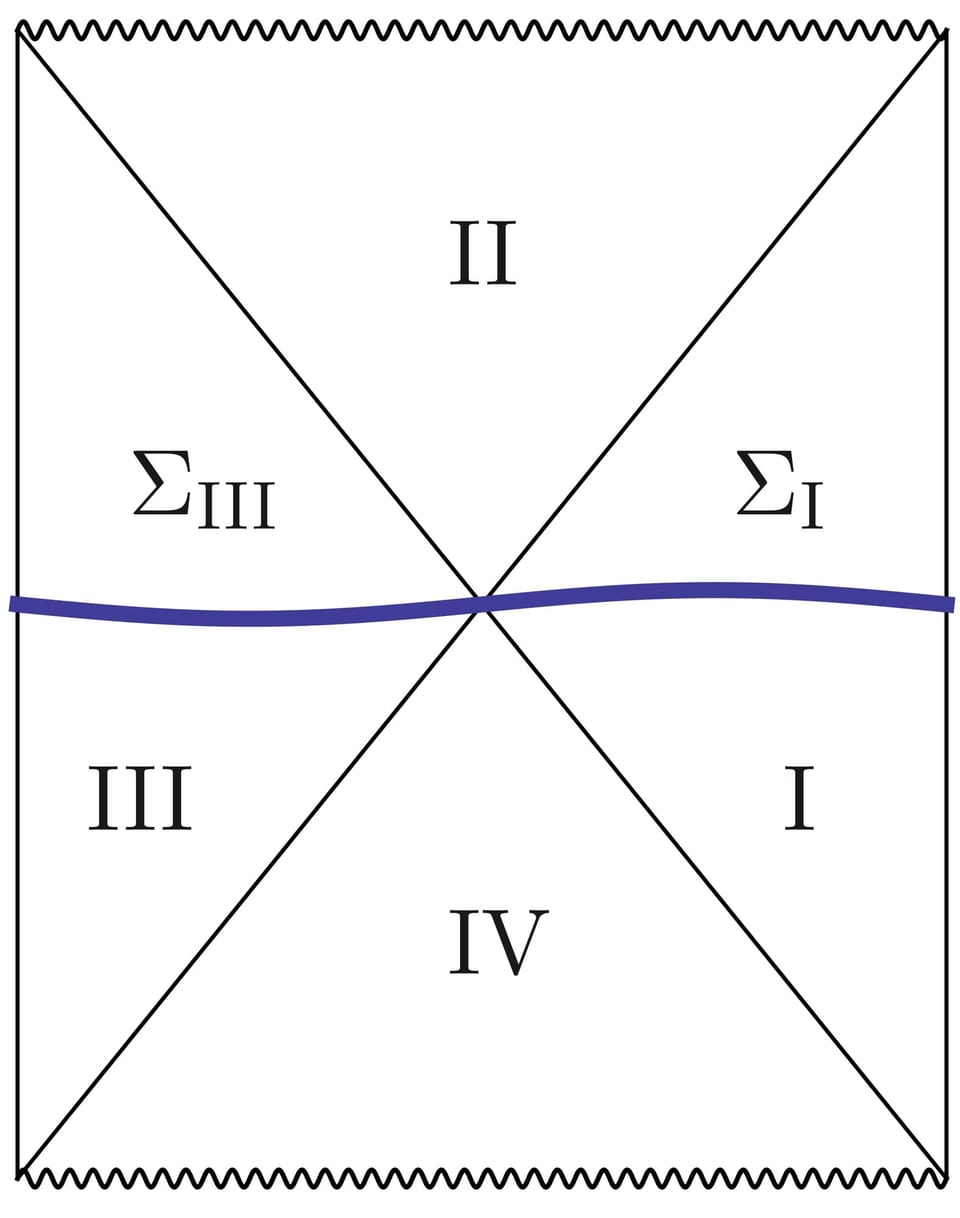
This traditional framework works well so long as the quantum state remains confined near that chosen background. However, Dong, Marolf, and Rath pointed out that the modular flow generated by the boundary modular Hamiltonian does not generally leave the background unchanged. The classical Hamiltonian flow generated by the geometric area operator modifies the initial data on a Cauchy slice, which is a spatial surface representing a single moment of time across the universe.1 Specifically, this flow introduces a localized delta-function jump in the extrinsic curvature orthogonal to the Hubeny-Rangamani-Takayanagi surface, producing what theorists call a boundary-condition-preserving kink transformation. Because this transformation alters the underlying classical geometry, an evolution that runs for finite flow parameters cannot remain within a small code subspace built around a single fixed background.1
Pratik Rath, a co-author of the preprint, explained that previous studies often overlooked this structural conflict by restricting attention to small perturbations around a single geometry. He noted that in earlier work exploring related geometric flows, researchers routinely treated modular evolution as an area-dominated process without examining whether the background could withstand the flow. As Pratik Rath told Primary, "When I wrote the earlier paper (https://arxiv.org/pdf/2007.00230), we ourselves made a casual comment that modular flow is well approximated by geometric area flow. Its taken all these years to carefully explain how the usual dominance of geometry over matter isn't the case for this question. Most people in the field have a knee-jerk reaction upon hearing this result and usually say this couldn't possibly be the case since it doesn't align with their usual intuition that geometric terms dominate matter corrections. The key point is that the dominance of geometry over matter depends on the question you are asking. In our paper, we carefully show this isn't in conflict with any result in the literature and yet shows very generally how the intuitive dominance of area over matter can be wrong."
Xi Dong agreed that the limitation lies in the scope of the code subspace rather than in quantum error correction itself. As Xi Dong told Primary, "It does not challenge quantum error correction itself. It shows that a code containing only small perturbations around one classical spacetime is too small for this question. The flow generated by the area term changes the classical geometry, so a finite transformation generally takes us outside that fixed-background code. To describe it, we need a larger code containing the relevant different backgrounds. Our construction provides such a framework under specified assumptions. The earlier fixed-background description remains useful within its regime of validity; it simply does not address transformations that change the background."
Furthermore, evaluating modular flows requires taking complex powers of the boundary density matrix. Because semiclassical states in gravity involve probabilities that are exponentially tiny, the logarithm and power functions become acutely sensitive to non-perturbative errors near zero eigenvalues. When two boundary states correspond to bulk backgrounds with distinct entanglement wedges, applying the modular flow of one state to another probes regions of the quantum spectrum where standard perturbative approximations break down completely.
How does a large code capture shifting spacetimes?
A large-code Hilbert space captures shifting spacetimes by joining together many smaller code sectors, allowing quantum error correction to describe multiple gravitational geometries at once. Rather than fixing a single background spacetime, the authors constructed a large Hilbert space by taking an orthogonal direct sum of many smaller code subspaces, labeled by an index alpha. Each small subspace is built by chopping quantum states into narrow windows of eigenvalues of the geometric area operator. Within each narrow window of width epsilon, the geometric area is tightly constrained, allowing the entanglement spectrum to remain approximately flat.1 This flatness ensures that an unprojected version of the JLMS relation holds to high accuracy within each individual sector, while the direct sum allows the overall large code to span many distinct gravitational backgrounds.
Addressing the necessity of moving beyond single-background models, Pratik Rath told Primary, "The framework that was usually used in AdS/CFT was to talk about a fixed background and small perturbations to it. Our framework significantly enlarges the regime where ideas from quantum information theory can be applied to quantum gravity. This is a setting which subsumes the usual semiclassical approximation on a fixed background, making it compatible with a collection of many different backgrounds. Background independence is a key feature expected of quantum gravity, and our work takes a step in the direction of formulating a framework that isn't tied to a single background geometry."
Constraining the geometric area with discrete windows prompted questions about whether a continuous spectrum could be handled directly. Donald, a co-author of the preprint, said in response to questions from Primary that "the continuum limit may work well, and we make arguments to this effect, but it requires even more complicated mathematics to control." Xi Dong expanded on this mathematical difficulty, noting that the window discretization is an analytical tool rather than a physical claim about quantum spacetime. As Xi Dong told Primary, "The main issue is maintaining control of the approximation as the windows become arbitrarily narrow. Modular flow is sensitive to errors near very small eigenvalues of the density matrix, so ordinary perturbative error estimates need not suffice. There is also an uncertainty-principle issue: sharply fixing area makes conjugate geometric data highly uncertain, so a complete classical geometry requires a superposition of many windows. The windows do not represent a claim that area is fundamentally discrete. We give arguments for a continuous-area description, but not a general proof of that limit. Removing the short-distance cutoffs used in our analysis is a separate question."
A crucial technical requirement identified by Dong, Marolf, and Rath is that the area window width must shrink faster than Newton's constant in the classical limit, a condition written mathematically as epsilon being little-o of G.1 Pratik Rath connected this requirement directly to earlier studies of fixed-area states in quantum gravity, pointing out that sharply localizing the area operator inherently disrupts semiclassical geometry. As Pratik Rath told Primary, "This idea goes back to the discussion of what are called fixed-area states in quantum gravity, formulated by myself and Akers, and simultaneously by Dong-Harlow-Marolf. When one fixes the area very sharply, it stops being a semiclassical geometry. This is analogous to how, by the Heisenberg uncertainty relation, measuring the position of a particle very accurately makes its velocity very uncertain. Nevertheless, fixed-area states have been very useful as a tool in trying to understand quantum gravity, and in applying ideas from quantum information theory like tensor networks to AdS/CFT. Our work is another such example where fixed-area states are the right language to formulate the framework."
This tight window restriction has two profound consequences for the physics of the spacetime. First, many separate windows are required to cover a single classical spacetime background.1 Second, because of quantum uncertainty, any bulk field observable whose classical Poisson bracket with the area is non-zero must fluctuate wildly within a single window.1 In physical terms, while observers can still measure field data that Poisson-commutes with the area, such as observables deep inside the bulk entanglement wedges or intrinsic metric properties on the surface itself, data conjugate to the area become completely uncertain. The authors termed the well-defined commuting subset of field data a restricted classical background.1
Within this large-code construction, the researchers defined a coarse-grained area operator that incorporates an explicit logarithmic correction proportional to four times Newton's constant multiplied by the logarithm of the window width.1 This correction directly reflects the normalization of the fixed-area gravitational path integral under the replica method, an analytical technique that computes entanglement entropy by evaluating path integrals on manifold replicas.1 By assembling these small sectors together into an overarching logical Hilbert space, the team formulated an exponentiated version of the JLMS relation.1 This enabled them to study finite modular flows that move between different classical backgrounds without losing mathematical control.
Can the bulk quantum operator overpower the classical area term?
The bulk modular Hamiltonian can achieve an order of one over Newton's constant and overpower the area term whenever modular flow connects quantum states that are peaked around distinct classical spacetimes. If the boundary modular Hamiltonian were always dominated by the geometric area term alone, any semiclassical boundary state would be well approximated by a single universal thermal-like density operator proportional to the exponential of the negative area operator divided by four times Newton's constant.1 As Dong, Marolf, and Rath emphasized, this naive expectation cannot possibly hold across the theory.1 Semiclassical states can be clearly distinguished by their one-point expectation values and their boundary entanglement entropies. For instance, in three-dimensional BTZ black hole spacetimes, the modular Hamiltonian exhibits quadratic dependence on the area rather than simple linear scaling.1
Pratik Rath noted that this non-linear behavior is not an artifact of three dimensions. When asked how likely that non-linear area scaling is to appear in higher-dimensional backgrounds, Pratik Rath told Primary: "This calculation can be repeated in higher dimensions in some approximation and using the Bekenstein-Hawking formula for black hole entropy, we will indeed find a non-linear behaviour generically." Xi Dong explained the physical reason for this non-linear scaling across different geometries. As Xi Dong told Primary, "The quadratic dependence is specific to the nonrotating BTZ example, but the underlying mechanism is more general. For a thermal boundary state, the modular Hamiltonian is proportional to the energy, up to an additive constant. In our static black-hole examples, the relation between energy and horizon area depends on the dimension and the family of solutions. That relation determines the area dependence of the modular Hamiltonian. Thus we should not expect a universal linear dependence on area. More general, nonthermal backgrounds require a separate analysis."
The discrepancy between the naive area-only approximation and the true boundary quantum state is accounted for precisely by the bulk modular Hamiltonian acting on the large code. When the boundary modular flow defined by one state acts upon a second state associated with a sufficiently different classical background, the bulk modular Hamiltonian receives massive contributions from the distant tail of the bulk entanglement spectrum. In these situations, the bulk quantum term scales as one over Newton's constant, matching or even exceeding the magnitude of the classical area operator. Explaining why this sensitivity emerges, Pratik Rath said in response to questions from Primary: "The key point we emphasize is to interpret the probability distribution over different geometries as part of the bulk quantum state. Semiclassical geometric descriptions are valid when computing quantities that aren't sensitive to the tails of this distribution. Modular flow is one situation where it can be sensitive to these tails. Another previously well studied instance is the Renyi entropy."
Xi Dong clarified how this mechanism operates without contradicting the established holographic dictionary. As Xi Dong told Primary, "It is important to distinguish the entropy of a state from the action of its modular Hamiltonian on other states. The area term can dominate the former without dominating the latter. When the state being transformed describes a sufficiently different classical geometry, it can probe configurations that are exponentially unlikely in the state defining the flow. Taking the negative logarithms of those probabilities produces a bulk contribution comparable to the area term. Thus the bulk term cannot always be neglected, even in the classical limit. This does not contradict the holographic relation; it shows why both terms are needed."

This large quantum contribution raised an apparent paradox regarding the geometry of modular flow. Earlier research had shown that when the modular flow of a boundary state acts on that same state, the semiclassical bulk geometry evolves strictly according to the classical Hamiltonian flow of the area operator, executing the boundary-condition-preserving kink transformation. If the bulk modular Hamiltonian is an order-one-over-G operator, one might have expected it to disrupt this clean geometric picture. Dong, Marolf, and Rath resolved this puzzle by analyzing states that share the same restricted classical background, differing only in the data conjugate to the area. Under these conditions, the authors proved that throughout an extensive range of flow parameters of order one, the action of the bulk modular Hamiltonian conspires in such a way that the resulting flowed state is still described by the classical background generated by the geometric area flow alone.1
Donald disputed that characterization, telling Primary: "This is not a conspiracy. The point is just that when the reference and target state are sufficiently well matched, the effect of the modular Hamiltonian is small. It turns out that having the two states peaked around the same classical background is a strong enough matching condition for this to work." Xi Dong likewise emphasized that the dominance of area flow applies strictly to the classical metric data rather than the full quantum state. As Xi Dong told Primary, "Modular flow is not ordinary time evolution, so I would not describe this as quantum operators matching classical gravitational forces. The issue is whether area flow alone correctly describes the change in the classical geometry. A large bulk modular contribution does not by itself imply that the classical description has failed. We show that when the two states match in the relevant classical data, and satisfy our additional assumptions, the leading change in geometry is still given by area flow. This concerns the classical geometry, not the full quantum state: the bulk term can still change quantum correlations."
Pratik Rath corroborated this perspective, pointing out that instability arises primarily from singular eigenvalue behavior in mismatched density matrices. As Pratik Rath told Primary, "In a previous paper (https://arxiv.org/abs/2203.11954), we had found examples where small eigenvalues in the density matrix made the relative entropy very unstable. The modular flow is very closely related and mirrors the same feature. Our alignment and stability conditions are meant to avoid such subtleties."
Donald also clarified the physical conditions under which this match can fail. Asked about states that violate the assumptions, Donald explained: "Generic physical states, like the vacuum, have essentially every mode of every field entangled between the two sides of a horizon. Those states work well. But if we intentionally disentangle a few modes in our reference state (and if we then use target states that have such entanglement), then the notion of modular flow is not well defined. Or, if the amount of entanglement in the reference state for those modes is non-zero, but is still very small, then the flow becomes very unstable." Xi Dong echoed that both geometric mismatch and quantum mode disentanglement can destabilize the transformation. As Xi Dong told Primary, "There are two distinct issues. First, the state defining the flow and the state on which it acts may differ in the classical data that our result requires to match. Black holes with different horizon areas provide a simple example. Second, even with matching geometries, the quantum states may fail our compatibility assumptions. For example, removing entanglement from some modes in the reference state while retaining it in the target state can make the flow undefined on that target state. Leaving a very small amount of entanglement can instead make the flow unstable. Neither issue implies that ordinary small quantum fluctuations automatically invalidate the geometric description."
What does this framework leave open for quantum gravity?
The conclusions presented by Dong, Marolf, and Rath are derived under a specific set of theoretical conditions and should not be read as an unrestricted solution to all quantum gravity flows. The entire investigation operates strictly within the leading order of bulk quantum corrections, treating higher-order quantum gravitational loops as negligible.1 Furthermore, the analysis relies on the semiclassical limit where Newton's constant G approaches zero, using ultraviolet cutoffs in both the boundary conformal field theory and the bulk spacetime to keep operator algebras well-defined.1 The authors also explicitly treated the boundary Hilbert space as a direct tensor product across subregions, putting aside subtle gauge-invariance constraints that could require decomposing the space into direct sums of products.
Turning on higher-order quantum gravitational loops introduces profound obstacles for this algebraic mapping. When asked where the classical flow description breaks down at higher loop orders, Donald told Primary: "At higher loop order, AdS/CFT probably does not correspond to a quantum code with exact complementary recovery. This is in part because fluctuations of the HRT surface become important."
Because this work is an analytical study posted as a theoretical preprint on the arXiv server, it has not yet undergone formal journal peer review.1 Its mathematical deductions depend directly on the structural validity of the large-code framework and the specific scaling chosen for the area windows. While the paper establishes how modular flow behaves when two states share a restricted classical background, it leaves open the precise geometrical fate of states when modular flow acts across backgrounds that differ substantially in their interior entanglement wedges. In such cases, the full physical interpretation of the dominant bulk modular Hamiltonian remains an active puzzle.
Looking ahead, the authors noted that this large-code formulation provides a rigorous path for exploring more complex holographic settings.1 These include quantum states that exist in macroscopic superpositions of distinct classical spacetimes, as well as configurations involving non-trivial quantum extremal surfaces, which are central to recent calculations of black hole radiation and the information paradox.1 However, extending the machinery to quantum extremal surfaces faces immediate technical hurdles. As Donald explained to Primary, "Our work is based on performing a perturbative expansion in Newton's constant G. But, by definition a `non-trivial' quantum extremal surface is one that disappears in the limit in which G vanishes. So analyzing that case would require a different starting point."
Xi Dong elaborated on this obstacle, pointing out that quantum surfaces far from classical surfaces require a new formulation. As Xi Dong told Primary, "The main obstacle is that the relevant quantum extremal surface need not be close to any classical extremal surface. In that case, an expansion around a classical surface is not the appropriate starting point. The large-code framework is more general than this particular expansion, however. One possibility is to use an effective area operator that incorporates a large matter-entropy contribution. We would then need to understand its flow and verify the assumptions controlling the approximation. This remains a direction for further work."
Pratik Rath emphasized an additional mathematical barrier that arises in evaporating black hole systems, where information is transferred from gravitational geometries into outgoing radiation. When asked about applying the large-code framework to such configurations, Pratik Rath told Primary: "In the context of evaporating black holes, it has been understood that a large number of semiclassical bulk states are mapped to a much smaller number of states in the CFT. In the language of quantum error correction, this is called a non-isometric code. There is not yet a derivation of an approximate JLMS formula in this context, and this would be the first step towards making progress in this context."
The record
107 sentences trace to 3 sources and 3 contributors.
-
1
XD
 Xi Dong, Donald Marolf, Pratik Rath
Paper
· arxiv.org · 15 Sep 2026
Modular flow and the area operator
Preprint · may not have been peer reviewed
See the source
-
2
A
arxiv.org
Paper
· arxiv.org
Reconstruction of Bulk Operators within the Entanglement Wedge in Gauge-Gravity Duality
Preprint · may not have been peer reviewed
See the source
-
3
A
arxiv.org
Paper
· arxiv.org
Relative entropy equals bulk relative entropy
Preprint · may not have been peer reviewed
See the source
- 4 Contribution — Xi Dong 8 statements added to this article
- 5 Contribution — Pratik Rath 11 statements added to this article
- 6 Contribution — Donald Marolf 9 statements added to this article
Other consulted pages3 pages
ar5iv.labs.arxiv.org3 pages
Article history
-
Published 27 Nov 2026, 20:18Assembled by the Primary desk from 3 sources · 3 contributors · 107 cited sentences
-
Pratik Rath
- Go to the sentence: Instead, it can scale inversely with Newton's constant, growing as large as the geometric area term and even dominating the evolution.
- Go to the sentence: Because this transformation alters the underlying classical geometry, an evolution that runs for finite flow parameters cannot remain within a small code subspace built around a single fixed background.
- Go to the sentence: As Pratik Rath told Primary, "When I wrote the earlier paper (https://arxiv.org/pdf/2007.00230), we ourselves made a casual comment that modular flow is well approximated by geometric area flow. Its taken all these years to carefully explain how the usual dominance of geometry over matter isn't the case for this question. Most people in the field have a knee-jerk reaction upon hearing this result and usually say this couldn't possibly be the case since it doesn't align with their usual intuition that geometric terms dominate matter corrections. The key point is that the dominance of geometry over matter depends on the question you are asking. In our paper, we carefully show this isn't in conflict with any result in the literature and yet shows very generally how the intuitive dominance of area over matter can be wrong."
- Go to the sentence: Addressing the necessity of moving beyond single-background models, Pratik Rath told Primary, "The framework that was usually used in AdS/CFT was to talk about a fixed background and small perturbations to it. Our framework significantly enlarges the regime where ideas from quantum information theory can be applied to quantum gravity. This is a setting which subsumes the usual semiclassical approximation on a fixed background, making it compatible with a collection of many different backgrounds. Background independence is a key feature expected of quantum gravity, and our work takes a step in the direction of formulating a framework that isn't tied to a single background geometry."
- Go to the sentence: A crucial technical requirement identified by Dong, Marolf, and Rath is that the area window width must shrink faster than Newton's constant in the classical limit, a condition written mathematically as epsilon being little-o of G.
- Go to the sentence: As Pratik Rath told Primary, "This idea goes back to the discussion of what are called fixed-area states in quantum gravity, formulated by myself and Akers, and simultaneously by Dong-Harlow-Marolf. When one fixes the area very sharply, it stops being a semiclassical geometry. This is analogous to how, by the Heisenberg uncertainty relation, measuring the position of a particle very accurately makes its velocity very uncertain. Nevertheless, fixed-area states have been very useful as a tool in trying to understand quantum gravity, and in applying ideas from quantum information theory like tensor networks to AdS/CFT. Our work is another such example where fixed-area states are the right language to formulate the framework."
- Go to the sentence: For instance, in three-dimensional BTZ black hole spacetimes, the modular Hamiltonian exhibits quadratic dependence on the area rather than simple linear scaling.
- Go to the sentence: When asked how likely that non-linear area scaling is to appear in higher-dimensional backgrounds, Pratik Rath told Primary: "This calculation can be repeated in higher dimensions in some approximation and using the Bekenstein-Hawking formula for black hole entropy, we will indeed find a non-linear behaviour generically."
- Go to the sentence: Explaining why this sensitivity emerges, Pratik Rath said in response to questions from Primary: "The key point we emphasize is to interpret the probability distribution over different geometries as part of the bulk quantum state. Semiclassical geometric descriptions are valid when computing quantities that aren't sensitive to the tails of this distribution. Modular flow is one situation where it can be sensitive to these tails. Another previously well studied instance is the Renyi entropy."
- Go to the sentence: As Pratik Rath told Primary, "In a previous paper (https://arxiv.org/abs/2203.11954), we had found examples where small eigenvalues in the density matrix made the relative entropy very unstable. The modular flow is very closely related and mirrors the same feature. Our alignment and stability conditions are meant to avoid such subtleties."
- Go to the sentence: When asked about applying the large-code framework to such configurations, Pratik Rath told Primary: "In the context of evaporating black holes, it has been understood that a large number of semiclassical bulk states are mapped to a much smaller number of states in the CFT. In the language of quantum error correction, this is called a non-isometric code. There is not yet a derivation of an approximate JLMS formula in this context, and this would be the first step towards making progress in this context."
-
Xi Dong
- Go to the sentence: The researchers found that when boundary modular flow acts across states with differing classical backgrounds, the bulk modular Hamiltonian does not remain negligible.
- Go to the sentence: As Xi Dong told Primary, "It does not challenge quantum error correction itself. It shows that a code containing only small perturbations around one classical spacetime is too small for this question. The flow generated by the area term changes the classical geometry, so a finite transformation generally takes us outside that fixed-background code. To describe it, we need a larger code containing the relevant different backgrounds. Our construction provides such a framework under specified assumptions. The earlier fixed-background description remains useful within its regime of validity; it simply does not address transformations that change the background."
- Go to the sentence: As Xi Dong told Primary, "The main issue is maintaining control of the approximation as the windows become arbitrarily narrow. Modular flow is sensitive to errors near very small eigenvalues of the density matrix, so ordinary perturbative error estimates need not suffice. There is also an uncertainty-principle issue: sharply fixing area makes conjugate geometric data highly uncertain, so a complete classical geometry requires a superposition of many windows. The windows do not represent a claim that area is fundamentally discrete. We give arguments for a continuous-area description, but not a general proof of that limit. Removing the short-distance cutoffs used in our analysis is a separate question."
- Go to the sentence: As Xi Dong told Primary, "The quadratic dependence is specific to the nonrotating BTZ example, but the underlying mechanism is more general. For a thermal boundary state, the modular Hamiltonian is proportional to the energy, up to an additive constant. In our static black-hole examples, the relation between energy and horizon area depends on the dimension and the family of solutions. That relation determines the area dependence of the modular Hamiltonian. Thus we should not expect a universal linear dependence on area. More general, nonthermal backgrounds require a separate analysis."
- Go to the sentence: As Xi Dong told Primary, "It is important to distinguish the entropy of a state from the action of its modular Hamiltonian on other states. The area term can dominate the former without dominating the latter. When the state being transformed describes a sufficiently different classical geometry, it can probe configurations that are exponentially unlikely in the state defining the flow. Taking the negative logarithms of those probabilities produces a bulk contribution comparable to the area term. Thus the bulk term cannot always be neglected, even in the classical limit. This does not contradict the holographic relation; it shows why both terms are needed."
- Go to the sentence: As Xi Dong told Primary, "Modular flow is not ordinary time evolution, so I would not describe this as quantum operators matching classical gravitational forces. The issue is whether area flow alone correctly describes the change in the classical geometry. A large bulk modular contribution does not by itself imply that the classical description has failed. We show that when the two states match in the relevant classical data, and satisfy our additional assumptions, the leading change in geometry is still given by area flow. This concerns the classical geometry, not the full quantum state: the bulk term can still change quantum correlations."
- Go to the sentence: As Xi Dong told Primary, "There are two distinct issues. First, the state defining the flow and the state on which it acts may differ in the classical data that our result requires to match. Black holes with different horizon areas provide a simple example. Second, even with matching geometries, the quantum states may fail our compatibility assumptions. For example, removing entanglement from some modes in the reference state while retaining it in the target state can make the flow undefined on that target state. Leaving a very small amount of entanglement can instead make the flow unstable. Neither issue implies that ordinary small quantum fluctuations automatically invalidate the geometric description."
- Go to the sentence: As Xi Dong told Primary, "The main obstacle is that the relevant quantum extremal surface need not be close to any classical extremal surface. In that case, an expansion around a classical surface is not the appropriate starting point. The large-code framework is more general than this particular expansion, however. One possibility is to use an effective area operator that incorporates a large matter-entropy contribution. We would then need to understand its flow and verify the assumptions controlling the approximation. This remains a direction for further work."
-
Donald Marolf, rath is that the area window width must shrink faster than Newton's constant in the classical limit
- Go to the sentence: Within each narrow window of width epsilon, the geometric area is tightly constrained, allowing the entanglement spectrum to remain approximately flat.
- Go to the sentence: Donald, a co-author of the preprint, said in response to questions from Primary that "the continuum limit may work well, and we make arguments to this effect, but it requires even more complicated mathematics to control."
- Go to the sentence: Under these conditions, the authors proved that throughout an extensive range of flow parameters of order one, the action of the bulk modular Hamiltonian conspires in such a way that the resulting flowed state is still described by the classical background generated by the geometric area flow alone.
- Go to the sentence: Donald disputed that characterization, telling Primary: "This is not a conspiracy. The point is just that when the reference and target state are sufficiently well matched, the effect of the modular Hamiltonian is small. It turns out that having the two states peaked around the same classical background is a strong enough matching condition for this to work."
- Go to the sentence: Asked about states that violate the assumptions, Donald explained: "Generic physical states, like the vacuum, have essentially every mode of every field entangled between the two sides of a horizon. Those states work well. But if we intentionally disentangle a few modes in our reference state (and if we then use target states that have such entanglement), then the notion of modular flow is not well defined. Or, if the amount of entanglement in the reference state for those modes is non-zero, but is still very small, then the flow becomes very unstable."
- Go to the sentence: The entire investigation operates strictly within the leading order of bulk quantum corrections, treating higher-order quantum gravitational loops as negligible.
- Go to the sentence: When asked where the classical flow description breaks down at higher loop orders, Donald told Primary: "At higher loop order, AdS/CFT probably does not correspond to a quantum code with exact complementary recovery. This is in part because fluctuations of the HRT surface become important."
- Go to the sentence: Looking ahead, the authors noted that this large-code formulation provides a rigorous path for exploring more complex holographic settings.
- Go to the sentence: As Donald explained to Primary, "Our work is based on performing a perturbative expansion in Newton's constant G. But, by definition a `non-trivial' quantum extremal surface is one that disappears in the limit in which G vanishes. So analyzing that case would require a different starting point."