Sculpted clouds around dying stars may not produce tight stellar pairs
A study of transitional stellar cores suggests dramatic bipolar gas clouds cannot shrink into planetary nebulae with close companion stars, forcing astronomers to rethink how cosmic hourglasses evolve.
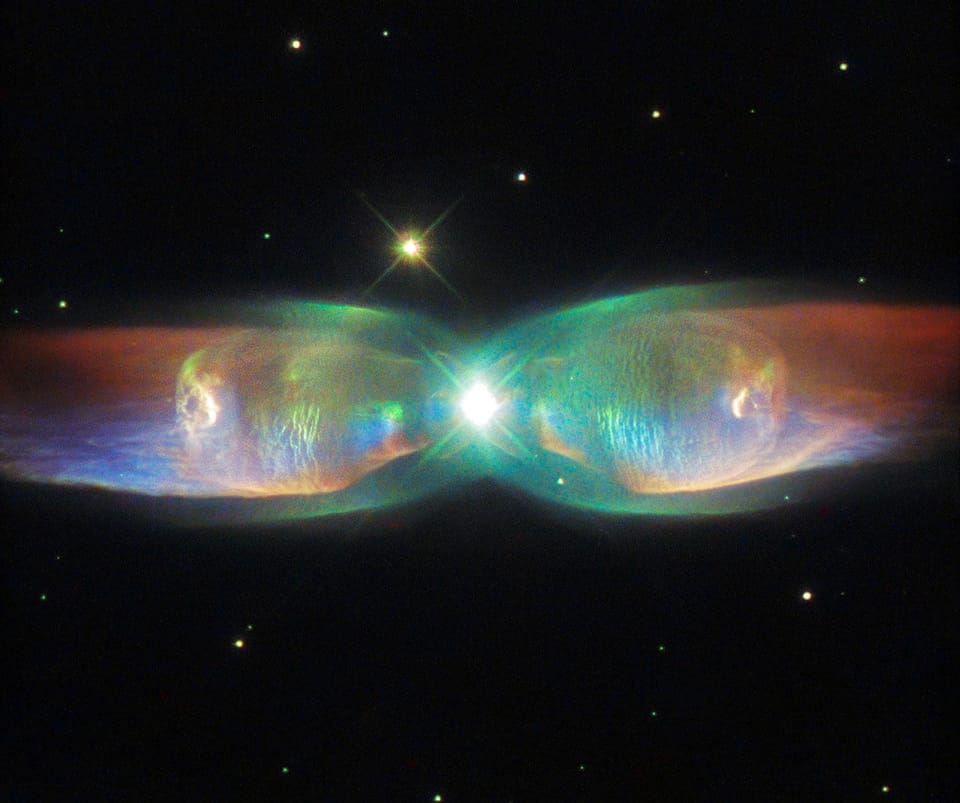
When an intermediate mass star exhausts its nuclear fuel, it swells into a cool, luminous giant before casting off its outer envelope into space.1 For decades, astronomers expected this dying breath to look roughly spherical, reflecting the rounded shape of the aging giant.1 Instead, telescopes reveal that the vast majority of glowing clouds shed by these dying stars are pinched at the waist, forming dramatic cosmic hourglasses, twisting jets, and intricate butterfly wings.1 These glowing remnants are planetary nebulae, and the prevailing view among astrophysicists has been that an orbiting companion star acts as an invisible sculptor, gravitationally stirring the escaping gas into tight, symmetrical funnels.1
The critical clue seemed to lie in the brief evolutionary bridge between the giant phase and the fully ionized planetary nebula: a phase known as a proto-planetary nebula. In this fleeting intermediate chapter, which lasts only a few thousand years, the star has finished blowing away its bulk atmosphere but has not yet grown hot enough to light up the gas with ultraviolet radiation.1 Images from space telescopes revealed that many proto-planetary nebulae already display sharp bipolar lobes, narrow equatorial collars, and point-symmetric jets.1 Because planetary nebulae with these identical shapes frequently contain pairs of stars orbiting each other every few days, astronomers widely assumed that the sculpted proto-planetary nebulae were the direct ancestors of those tight binary systems.1
A study posted to the arXiv preprint server by Todd C. Hillwig and Bruce J. Hrivnak of Valparaiso University alongside David Jones of the Instituto de Astrofisica de Canarias indicates that this tidy family tree breaks down under physical scrutiny.1 By comparing the calculated physical sizes of central stars in proto-planetary nebulae against the orbital spaces required for close stellar companions, the researchers determined that observed proto-planetary nebulae are unlikely to be the progenitors of planetary nebulae containing close binary stars.1 The finding challenges long-standing models of stellar evolution and forces astrophysicists to reconsider how some of the most striking objects in the night sky acquire their shapes.
How does an aging giant cast off its sculpted shroud?
The transformation of a dying star begins on the asymptotic giant branch, where a star several times the mass of the Sun reaches the end of its life.1 At this stage, the star possesses a dense carbon-oxygen core surrounded by helium-burning and hydrogen-burning shells, capped by an immense, loosely bound gaseous atmosphere. Eventually, stellar pulsations and radiation pressure lift this atmosphere away, sending a slow, broad wind of gas and dust drifting outward into the surrounding interstellar space.
To turn that slow spherical wind into an hourglass, physical forces must redirect the gas into two opposing directions while holding it back along the equator. In modern astrophysics, the most effective way to funnel this material is through a common envelope interaction.1 If the giant star has an orbiting companion, the swelling giant can engulf the smaller star within its diffuse atmosphere. As the two stellar bodies move inside the shared shroud of gas, friction drags the companion inward, transferring orbital energy and angular momentum to the giant envelope.1 This rapid transfer expels the equatorial gas into a dense ring, known as a torus, while clearing a path for narrow, high-velocity jets to blast through the poles.1
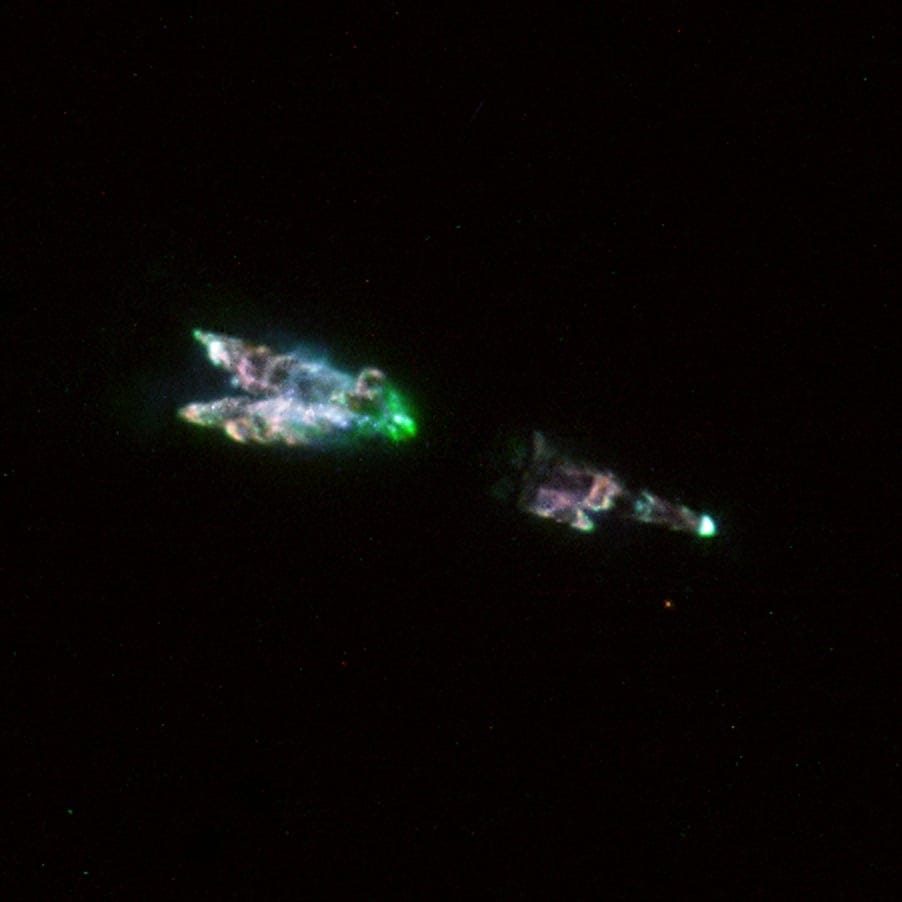
Once the bulk envelope is cleared, the surviving stellar core emerges into view, surrounded by the newly detached circumstellar cloud.1 At this instant, the object enters the proto-planetary nebula phase. The central star is still relatively cool, showing the spectral qualities of an F or G supergiant, and its light simply reflects off the cool dust grains in the expanding envelope.13 Over several millennia, the core steadily contracts and heats up, shifting from yellow to blue.1 When the central star reaches an effective temperature of roughly 30,000 Kelvin, it releases enough energetic ultraviolet photons to ionize the surrounding gas, causing the entire cloud to glow with characteristic emission lines as a true planetary nebula.1
Because the striking bipolar shapes appear during the proto-planetary stage, theorists deduced that whatever mechanism sculpted the gas had to act immediately during the initial ejection.1 Interacting wind models, where a late fast wind catches up and shapes an earlier slow wind, could not account for the sharp symmetry seen in clouds that had only just separated from their parent stars.1 Todd, an astronomer at Valparaiso University and lead author of the study, explained the nuance behind this breakdown to Primary.1 Todd said that some interacting wind approaches do not fail entirely, noting that if a fast wind strikes gas that has already been sculpted, the collision simply enhances those existing contours. Todd said that what actually breaks down is the concept that the fast wind itself acts as the sole or primary cause of nebular geometry, because telescopes detect intricate structures when the surrounding cloud has barely separated from the stellar surface.
Why do physical measurements break the evolutionary link?
Todd C. Hillwig, Bruce J. Hrivnak, and David Jones evaluated this picture by compiling structural, kinematic, and dimensional measurements for known proto-planetary nebulae and post-asymptotic giant branch stars.1 Their investigation hinged on examining whether the physical dimensions of the central stars could coexist with the tight orbital separations found in close binary planetary nebulae.1 If a system went through common envelope evolution to produce its bipolar lobes, the companion star must spiral inward to an orbit spanning only a few solar radii, completing a revolution every few hours or days.14
Todd C. Hillwig and colleagues examined expansion ages across nine well-studied proto-planetary nebulae where distances, angular dimensions, and gas velocities have been established.1 Based on updated parallaxes from the third data release of the Gaia spacecraft, the calculated expansion ages for these objects range from about 100 years to 4,000 years, with seven of the nine displaying ages under 2,000 years.1 In objects such as CRL 618, expansion ages measure between 100 and 422 years, while Hen 3-1475 shows an updated age of 805 years. Todd told Primary that determining exactly when a system crosses the boundary from a proto-planetary cloud to a young planetary nebula remains an observational challenge. Todd noted that the two older systems in the sample show hints of having crossed that threshold, but distinguishing between these rapid evolutionary phases remains difficult because stellar envelopes change very little across short astronomical windows.
Furthermore, observational data confirmed that the equatorial tori and polar jets formed at measurably different times, with the high-velocity jets typically appearing a few hundred years after the equatorial rings.1 Todd told Primary that the physical driver behind this time lag remains an open question under active research. Todd explained that while nearly all models credit magnetic fields with launching the polar jets, the delay between the ring and jet ejections could arise from gas falling back onto the central core or from the delayed assembly of an accretion disk circling the core or the entire stellar pair.
The researchers also reviewed the energetic properties of these expanding clouds.1 Measurements of kinetic energies and linear momenta in proto-planetary nebulae demonstrate that radiation pressure from the central star is insufficient to drive the observed outflows in at least 80 percent of studied objects.1 Todd told Primary that while radiation pressure could conceivably power the remaining 20 percent of systems within the margin of observational error, momentum transfer from an orbiting companion probably contributes across those cases as well. Driving such immense outflows requires not just a binary interaction, but an intense gravitational drag that pulls the companion star to an orbital separation of 10 solar radii or less.1 Todd clarified that 10 solar radii represents a practical physical ceiling dictated by the combined stellar masses rather than an arbitrary mathematical cutoff, because a companion must sink that deep into the gravitational well to transfer enough orbital energy to launch the observed outflows.
Here, Todd C. Hillwig and colleagues identified a fundamental physical contradiction. Using Gaia measurements compiled from candidate post-asymptotic giant branch stars, the authors analyzed the effective temperatures, luminosities, and resulting physical radii of 119 transitional stellar cores. They calculated that 91 of these 119 stars possess radii greater than 10 solar radii, with typical luminosities between 1,000 and 10,000 times the luminosity of the Sun. Many transitional stars with F and G spectral types span radii between 20 and 80 times that of the Sun. If the central core of an observed proto-planetary nebula still spans tens of solar radii, an accompanying secondary star cannot possibly reside on a tight orbit of less than 10 solar radii without being buried deep inside the primary star.1
What limits exist in the current observations?
The conclusions drawn by Todd C. Hillwig and colleagues depend on observational datasets that carry inherent astronomical uncertainties. The calculations of stellar radii rely on distances derived from Gaia parallaxes and assume that the central stars radiate as simple blackbodies. While the third Gaia data release offers unprecedented precision, distance estimates toward dust-enshrouded transitional stars can suffer from elevated astrometric noise. In the case of the nebula M 2-9, a high value for the renormalized unit weight error, a statistical metric indicating goodness of fit in the astrometric solution, renders its updated distance and age calculation highly uncertain.1
The sample size of proto-planetary nebulae with well-measured kinematic ages remains modest, comprising only nine thoroughly modeled systems in the primary age catalog.1 Some objects within transitional catalogs may also represent very young planetary nebulae whose central stars are just beginning to ionize the inner edge of their envelopes, where observational classification is difficult to determine precisely.1 Furthermore, the paper focuses primarily on elongated, bipolar, and multi-polar nebulae, leaving open questions about whether mildly elliptical or round systems follow completely different evolutionary tracks.1 Finally, the analysis is based on work that has undergone formal journal peer review and has been published by the Astronomical Journal (DOI 10.3847/1538-3881/aea3ee).
Where does the stellar evolutionary path go from here?
If proto-planetary nebulae with inflated supergiant cores cannot host companions on two-day orbits, astrophysicists must rethink how both classes of objects originate. One possibility raised by the research is that systems that undergo full common envelope spiraling do not linger as visible, luminous proto-planetary nebulae with extended F and G supergiant atmospheres. Instead, violent common envelope events may strip away the entire outer envelope almost instantaneously, leaving behind a bare, hot degenerate core that transitions rapidly to a planetary nebula on timescales too short to be caught in wide surveys.
Alternatively, the striking bipolar shapes seen in classical proto-planetary nebulae may arise from companions operating at wider orbital separations. Instead of plunging into a shared envelope, a companion star separated by several astronomical units could capture escaping gas through gravitational focusing, building an accretion disk that powers polar jets over several hundred years. In that scenario, the observed proto-planetary nebulae would eventually evolve into planetary nebulae with wide, multi-year binary central stars rather than the tight pairs detected in short-period surveys. Earlier radial velocity surveys by Bruce J. Hrivnak and colleagues, such as long-term studies monitoring bright proto-planetary nebulae over two decades, found that radial velocity shifts from close companions were absent, setting strict limits that any undetected orbital companions must have periods exceeding 25 to 30 years or possess low masses comparable to brown dwarfs.53
Todd told Primary that while astronomers remain convinced that proto-planetary nebulae involved binary companions at some stage, the secondary star may not survive the encounter. Todd said that the companion star could be ripped apart during the envelope ejection process, leaving behind no surviving secondary star to orbit the white dwarf. In that picture, the companion deposits all of its orbital energy to blast away the nebula and shape its bipolar lobes, destroying itself in the process. Untangling these competing channels will require deeper radial velocity monitoring of proto-planetary nebula central stars alongside refined hydrodynamic simulations of common envelope collisions.
The record
45 sentences trace to 4 sources and 1 contributor.
-
1
TC
 Todd C. Hillwig, Bruce J. Hrivnak, David Jones
Paper
· arxiv.org · 17 Sep 2026
Proto-Planetary Nebulae Are Not the Precursors of Planetary Nebulae With Close Binary Central Stars
Preprint · may not have been peer reviewed
See the source
- 2 Contribution — Todd C. Hillwig 17 statements added to this article
-
3
A
arxiv.org
Paper
· arxiv.org
Are Proto-Planetary Nebulae Shaped by a Binary? Results of a Long-Term Radial Velocity Study
Preprint · may not have been peer reviewed
See the source
-
4
A
arxiv.org
Paper
· arxiv.org
Observational Confirmation of a Link Between Common Envelope Binary Interaction and Planetary Nebula Shaping
Preprint · may not have been peer reviewed
See the source
-
5
A
arxiv.org
Paper
· arxiv.org
Where Are the Binaries? Results of a Long-Term Search for Radial Velocity Binaries in Proto-Planetary Nebulae
Preprint · may not have been peer reviewed
See the source
Other consulted pages1 page
ar5iv.labs.arxiv.org1 page
arxiv.org2 pages
research.iac.es1 page
veraenderlichesterne.wordpress.com1 page
Article history
-
Published 27 Nov 2026, 16:20Assembled by the Primary desk from 4 sources · 1 contributor · 45 cited sentences
-
Todd C. Hillwig
- Go to the sentence: By comparing the calculated physical sizes of central stars in proto-planetary nebulae against the orbital spaces required for close stellar companions, the researchers determined that observed proto-planetary nebulae are unlikely to be the progenitors of planetary nebulae containing close binary stars.
- Go to the sentence: Interacting wind models, where a late fast wind catches up and shapes an earlier slow wind, could not account for the sharp symmetry seen in clouds that had only just separated from their parent stars.
- Go to the sentence: Todd, an astronomer at Valparaiso University and lead author of the study, explained the nuance behind this breakdown to Primary.
- Go to the sentence: Todd said that some interacting wind approaches do not fail entirely, noting that if a fast wind strikes gas that has already been sculpted, the collision simply enhances those existing contours.
- Go to the sentence: Todd said that what actually breaks down is the concept that the fast wind itself acts as the sole or primary cause of nebular geometry, because telescopes detect intricate structures when the surrounding cloud has barely separated from the stellar surface.
- Go to the sentence: Based on updated parallaxes from the third data release of the Gaia spacecraft, the calculated expansion ages for these objects range from about 100 years to 4,000 years, with seven of the nine displaying ages under 2,000 years.
- Go to the sentence: Todd told Primary that determining exactly when a system crosses the boundary from a proto-planetary cloud to a young planetary nebula remains an observational challenge.
- Go to the sentence: Todd noted that the two older systems in the sample show hints of having crossed that threshold, but distinguishing between these rapid evolutionary phases remains difficult because stellar envelopes change very little across short astronomical windows.
- Go to the sentence: Furthermore, observational data confirmed that the equatorial tori and polar jets formed at measurably different times, with the high-velocity jets typically appearing a few hundred years after the equatorial rings.
- Go to the sentence: Todd told Primary that the physical driver behind this time lag remains an open question under active research.
- Go to the sentence: Todd explained that while nearly all models credit magnetic fields with launching the polar jets, the delay between the ring and jet ejections could arise from gas falling back onto the central core or from the delayed assembly of an accretion disk circling the core or the entire stellar pair.
- Go to the sentence: Measurements of kinetic energies and linear momenta in proto-planetary nebulae demonstrate that radiation pressure from the central star is insufficient to drive the observed outflows in at least 80 percent of studied objects.
- Go to the sentence: Todd told Primary that while radiation pressure could conceivably power the remaining 20 percent of systems within the margin of observational error, momentum transfer from an orbiting companion probably contributes across those cases as well.
- Go to the sentence: Driving such immense outflows requires not just a binary interaction, but an intense gravitational drag that pulls the companion star to an orbital separation of 10 solar radii or less.
- Go to the sentence: Todd clarified that 10 solar radii represents a practical physical ceiling dictated by the combined stellar masses rather than an arbitrary mathematical cutoff, because a companion must sink that deep into the gravitational well to transfer enough orbital energy to launch the observed outflows.
- Go to the sentence: Todd told Primary that while astronomers remain convinced that proto-planetary nebulae involved binary companions at some stage, the secondary star may not survive the encounter.
- Go to the sentence: Todd said that the companion star could be ripped apart during the envelope ejection process, leaving behind no surviving secondary star to orbit the white dwarf.