Stochastic game trees could yield to quantum calculation
A nested quantum framework shows how automated planning and games of chance could be solved with quadratic gains in both move branching and estimation accuracy.
Why do random events make game trees difficult to solve?
Two opponents sitting across a board game must plan several moves ahead to find a winning strategy. When each player knows all possible moves and the outcome is purely deterministic, finding the best move requires looking down a branching tree of choices, where one player seeks the highest possible payoff and the other seeks to minimize it. When random events intervene between turns, such as throwing dice in Backgammon or the tabletop game EinStein würfelt nicht, the decision tree suddenly becomes far harder to calculate. A player cannot simply choose the best path because chance introduces an average over every possible roll.
To determine the value of a board position, an analysis must track three alternating steps down through the layers of the tree. First, the player whose turn it is evaluates the position by picking the move with the highest value among all available choices. Next, an unpredictable event occurs, such as a die roll, which produces an expected outcome averaged across every possibility. Finally, the opponent chooses the move that leaves the first player with the minimum value. Repeating this process creates an expectiminimax tree, where deterministic choices alternate with probability calculations.
Evaluating such trees matters because practical decision making under competition and uncertainty mirrors this exact structure. Calculating the value of the game gives the expected payoff that both players can guarantee on average under optimal play, establishing whether a position is winning, losing, or drawn. In real board games, the number of potential positions grows exponentially with the depth of the tree. When exact calculation requires reading leaf values across the entire tree, evaluating deep games quickly exceeds the limits of standard computers.1
A new preprint posted to the arXiv preprint server by Marien Raat, Merlin Incerti-Medici, James R. Wootton, Evert van Nieuwenburg, and Daniel Bultrini presents a quantum algorithm that accelerates the search through these stochastic game trees.1 The researchers, working across Universiteit Leiden and the Swiss research company Moth, established a method that simultaneously reduces the cost of searching through player moves and the cost of sampling random outcomes.
How does the underlying chain of decisions work?
Evaluating an expectiminimax tree proceeds from the bottom up in a specific sequence of operations. At the very bottom of the game tree sit the leaves, which are the final game states whose numerical payoffs are evaluated by a scoring function. Just above the leaves, a player or a chance event determines the score of that branch. If it is a player's move, that player selects either the highest or the lowest score among the children. If it is a random event, the parent position receives the weighted average of its children's values. The calculated values then travel up the tree, layer by layer, until they arrive at the root to yield the overall value of the game.
To obtain an estimate of the root value within a specific error margin, a classical computer faces two distinct mathematical bottlenecks. For every layer of moves, the classical search must inspect each possible child branch to verify which one achieves the maximum or minimum. For every layer of chance, the classical algorithm must sample the possible outcomes repeatedly to compute an average, where obtaining a higher level of accuracy requires a number of samples proportional to the inverse square of the desired error.1 When alternating these steps down multiple levels of a tree, classical methods become trapped between checking wide sets of moves and repeatedly sampling deep layers of uncertainty.
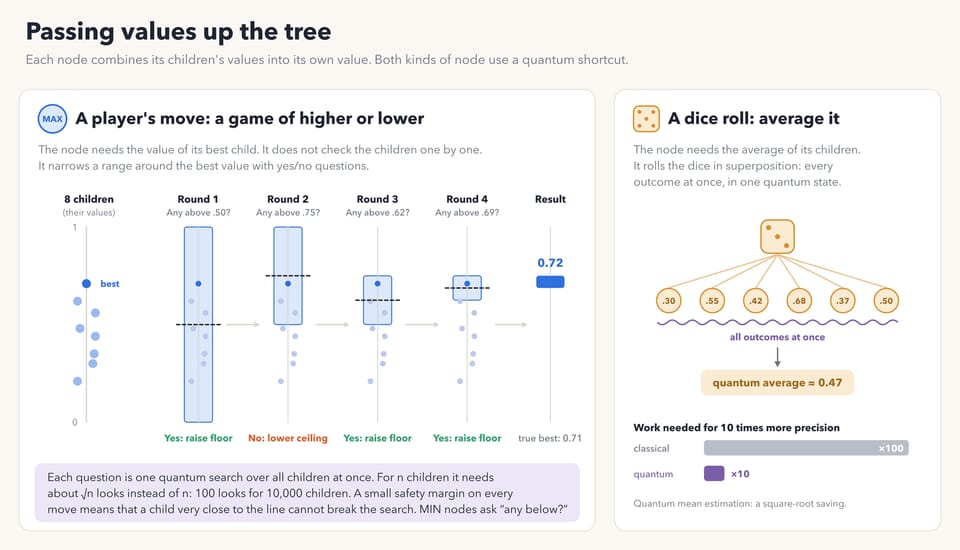
Earlier research had already found quantum solutions for both problems when considered in isolation. For purely adversarial games without dice, known as minimax trees, researchers developed quantum algorithms that evaluate the tree with a quadratic speedup over classical brute-force checking. In a 2007 paper posted to arXiv, Richard Cleve, Dmytro Gavinsky, and David L. Yonge-Mallo introduced a quantum algorithm for evaluating min-max trees that achieves a near-optimal query complexity close to the square root of the tree size.1 Separately, for sequences of purely random events without opposing players, quantum mean estimation techniques can estimate an expectation using queries proportional to the inverse of the error rather than its square.1
The central difficulty that Raat and colleagues tackled is that combining these two quantum tools naively fails. Both the mean estimator and the quantum search must be nested inside each other many times, so the errors from the probability estimations compound at every step. Splitting the error budget across c chance layers then costs about (c/ε)^c, which is worse than classical sampling.
How did the researchers preserve the quantum speedups?
The quantum algorithm designed by Raat, Incerti-Medici, Wootton, van Nieuwenburg, and Bultrini preserves both quantum speedups by joining a derandomized multilevel Monte Carlo estimator with a coherent binary search.1 Instead of treating every layer independently, their method synchronizes the precision across all depths so that the quadratic speedup in branching factor and the quadratic speedup in estimation accuracy both survive.
For the layers governed by chance, the researchers built upon a multilevel Monte Carlo framework where the value at a random node is computed as a telescoping sum of differences between consecutive levels of approximation. In this arrangement, the second moment of the difference between approximation levels falls by a factor of two with each step, while the cost of taking a single quantum sample grows by the square root of two.1 As a result, the total computational effort needed to estimate the chance nodes remains balanced across all levels.1 This structure holds the total cost of all chance layers to an inverse dependence on the error, rather than suffering an exponential penalty per layer.
For the deterministic layers where players choose their best move, the algorithm applies a coherent binary search over possible values instead of measuring individual children along the way. Standard quantum extremum searches rely on intermediate measurements, which collapse the quantum state and prevent the algorithm from being nested inside outer quantum estimation routines.1 The authors resolved this by using a fixed schedule of amplitude amplification that tests potential threshold values coherently without collapsing the superposition. This subroutine brackets the true maximum or minimum among candidate children without suffering the error amplification that would occur if it evaluated each child individually.
Daniel, a co-author of the preprint, explained to Primary how this interface avoids collapse across the alternating layers of the game tree. As Daniel told Primary, "The short version is that nothing in our algorithm measures anything until the very end. Every layer of the tree is built as a quantum circuit, and the layer above uses it as a piece of its own circuit. There is never a 'handover' of a single number. When a chance layer needs a sample of a child's value, it doesn't draw one. It runs the child's circuit once, in superposition over all the children. When a decision layer needs to compare a child against a threshold, it does the same. We measure at the root once, whose reading is the estimate of the game's value."
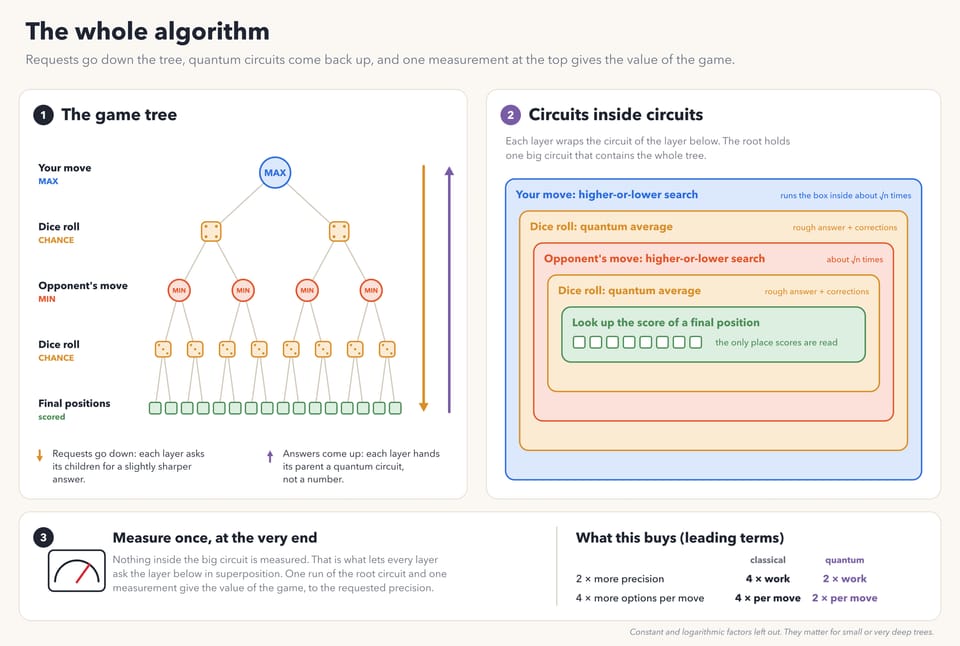
To connect these two algorithms together, the authors developed specific interface lemmas that bridge root-mean-square error guarantees and uniform error requirements. Under classical or standard quantum procedures, taking an extremum over several estimates with root-mean-square guarantees can, in the worst case, inflate the error by the square root of the branching factor. Daniel told Primary that an earlier formulation broke down because treating a maximum like a sum forced deeper nodes into extreme precision requirements. To maintain a root error within tolerance, each child branch originally had to be computed to high precision, which caused query costs to scale poorly. By using their coherent binary search to bracket the value directly, the researchers prevented this error inflation. Under the assumption that the tree has a constant depth with alternating layers of moves and chance, the quantum algorithm finds a quadratic improvement in the branching factor: its cost scales as deg^(m/2) against a classical cost of deg^m, where m is the number of move layers, while chance estimation still improves from an inverse-square dependence on the error to an inverse dependence.
What are the limits of the current result?
The mathematical results reported by the authors describe theoretical query complexity, counting only how many times an algorithm must query an oracle that provides the static evaluation of leaf positions.1 This metric measures the fundamental computational cost of evaluating board states, but it is not a physical demonstration on actual quantum computing hardware. Current quantum devices remain limited by noise and error rates, and executing the deep, coherent quantum circuits demanded by this recursive algorithm would require fault-tolerant quantum computers that do not yet exist.
When asked about physical runtimes and compiling the routines into fault-tolerant hardware, Daniel told Primary that the quantum approach faces significant overheads when compared against standard computers. As Daniel noted, a classical leaf evaluation takes nanoseconds to microseconds across parallel processor cores, whereas a quantum evaluation must run on error-corrected logical qubits that operate much more slowly. If this per-query slowdown exceeds the quadratic advantage in query count, the quantum system will lose in actual clock time.
The theoretical guarantees also depend on specific mathematical properties of the game tree. The passing functions that calculate node values from child states must satisfy Lipschitz continuity, meaning that a parent's value cannot change by more than a fixed multiple of the change in its children. The no-linear-blowup condition is a different assumption: it keeps values inside a fixed range. Expectiminimax trees satisfy both because taking averages, maxima, and minima preserve bounded ranges, but rules for combining child values that jump suddenly, for example a parent that switches from 0 to 1 when an average crosses a threshold, would violate these assumptions. Daniel clarified to Primary that this mathematical requirement applies to the passing functions that combine child values at parent nodes, rather than to the leaf scoring function itself. A game evaluation function at the leaves can be entirely discontinuous, jumping from winning to losing on a single piece movement, provided its outcomes remain within a known bounded range.
Furthermore, the authors note that the quadratic advantage in branching factor appears most clearly in trees that are relatively wide compared to their depth.1 Daniel told Primary that in deep, narrow trees with only a few choices per move, constant factors and logarithmic overheads wipe out the advantage in branching factor. Under the unoptimised constants proved in the paper, beating classical search on move branching requires trees with a minimal branching factor of about 10¹⁶ candidate moves per position, many orders of magnitude more than thousands and far larger than any standard board game. The authors believe this overhead can be optimized away and have started work on it, but that is not yet the case. The quadratic improvement in precision, however, holds across all tree depths and widths. The preprint represents theoretical computer science research that has been posted to the arXiv preprint repository and has not yet completed formal peer review.1
What comes next for stochastic decision algorithms?
Beyond board games such as Backgammon, the framework established in the paper provides a mathematical foundation for evaluating broader classes of stochastic multi-step decision processes. Because the algorithm functions for any tree structure governed by linear averaging at chance steps and Lipschitz functions with sublinear quantum routines at deterministic steps, its underlying mechanics extend to problems in automated planning, financial risk assessment, and game theory where competitive agents act amidst random environmental shocks.
Asymmetric trees are already covered, because the paper needs only an upper bound on the number of children per node. The paper asks for a better classical pruned algorithm for approximately evaluated trees, not quantum pruning. The open problems it lists are composing adaptive, variable-time subroutines to remove some log factors, and running the algorithm when the quantum computer holds only part of the tree at once, which might be the most practical of these.
The record
24 sentences trace to 1 source and 1 contributor.
-
1
MR
 Marien Raat, Merlin Incerti-Medici, James R. Wootton, Evert van Nieuwenburg, Daniel Bultrini
Paper
· arxiv.org · 29 Sep 2026
How fast can a parent estimate the value of their children? A quantum algorithm for stochastic games
Preprint · may not have been peer reviewed
See the source
- 2 Contribution — Daniel Bultrini 9 statements added to this article
Other consulted pages2 pages
postquantum.com1 page
cs.uwaterloo.ca1 page
mothquantum.com1 page
ar5iv.labs.arxiv.org1 page
Article history
-
Published 27 Nov 2026, 16:31Assembled by the Primary desk from 1 source · 1 contributor · 24 cited sentences
-
Daniel Bultrini
- Go to the sentence: The quantum algorithm designed by Raat, Incerti-Medici, Wootton, van Nieuwenburg, and Bultrini preserves both quantum speedups by joining a derandomized multilevel Monte Carlo estimator with a coherent binary search.
- Go to the sentence: Daniel, a co-author of the preprint, explained to Primary how this interface avoids collapse across the alternating layers of the game tree.
- Go to the sentence: As Daniel told Primary, "The short version is that nothing in our algorithm measures anything until the very end. Every layer of the tree is built as a quantum circuit, and the layer above uses it as a piece of its own circuit. There is never a 'handover' of a single number. When a chance layer needs a sample of a child's value, it doesn't draw one. It runs the child's circuit once, in superposition over all the children. When a decision layer needs to compare a child against a threshold, it does the same. We measure at the root once, whose reading is the estimate of the game's value."
- Go to the sentence: Daniel told Primary that an earlier formulation broke down because treating a maximum like a sum forced deeper nodes into extreme precision requirements.
- Go to the sentence: The mathematical results reported by the authors describe theoretical query complexity, counting only how many times an algorithm must query an oracle that provides the static evaluation of leaf positions.
- Go to the sentence: When asked about physical runtimes and compiling the routines into fault-tolerant hardware, Daniel told Primary that the quantum approach faces significant overheads when compared against standard computers.
- Go to the sentence: Daniel clarified to Primary that this mathematical requirement applies to the passing functions that combine child values at parent nodes, rather than to the leaf scoring function itself.
- Go to the sentence: Furthermore, the authors note that the quadratic advantage in branching factor appears most clearly in trees that are relatively wide compared to their depth.
- Go to the sentence: Daniel told Primary that in deep, narrow trees with only a few choices per move, constant factors and logarithmic overheads wipe out the advantage in branching factor.