Soil fuel cells need saturated dirt to generate steady electrical power
A device powered by soil bacteria kept running through a wider moisture range in the laboratory, but electrical output plummeted once buried in outdoor ground.
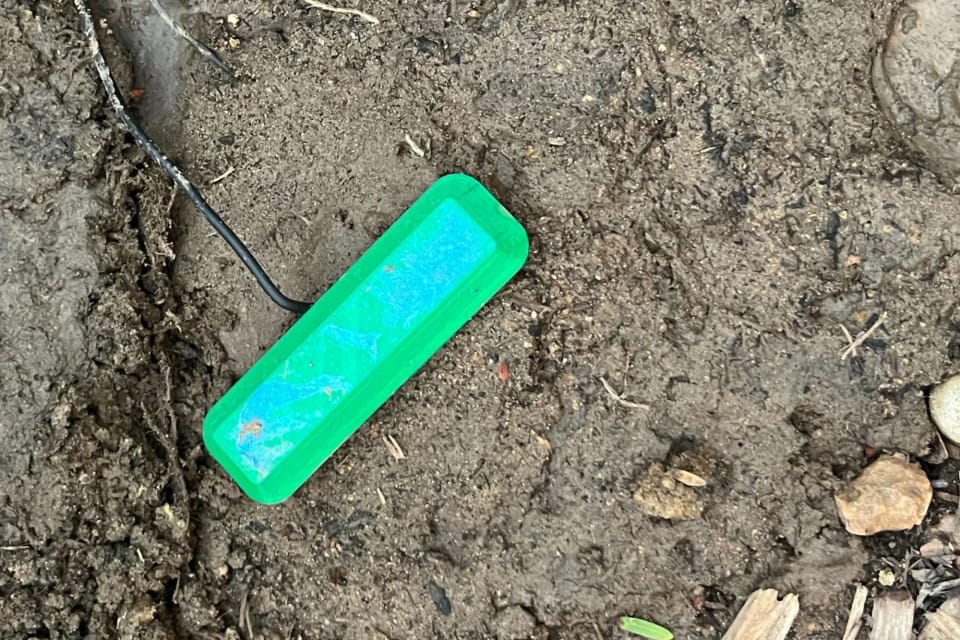
Across farm fields and wetlands, environmental monitoring relies on thousands of scattered electronic sensors that track conditions beneath the surface. Most of these devices depend on chemical batteries that eventually discharge or miniature solar panels that become covered in dust and mud. Replacing discharged batteries across hundreds of acres requires continuous maintenance, while discarded electronic parts leave toxic residues in agricultural ground. The dirt itself contains an unbroken biological cycle, where microscopic organisms constantly process decaying vegetation and shed electric charges into the surrounding earth.
To turn that natural biological activity into usable electricity, several conditions must line up in sequence. First, soil bacteria known as exoelectrogens feed on decayed organic carbon near an underground electrode, stripping away electrons as part of their normal metabolic process.12 Next, the microbes deposit those liberated electrons directly onto the buried conductive surface, which serves as an electrical anode. Those electrons then pass through an external electrical circuit to do useful work before arriving at a second electrode, the cathode, where oxygen consumes them and combines with ambient hydrogen ions to produce water.12 If the soil dries out, the microbes lose the water films they require to survive, while if the system floods completely, dissolved oxygen cannot easily reach the cathode to complete the chemical reaction.
Capturing electricity across fluctuating weather conditions has remained difficult because moisture and oxygen naturally work against one another in soil. A research team led by Northwestern University demonstrated a design modification intended to bridge this gap, publishing their findings in the Proceedings of the ACM on Interactive, Mobile, Wearable and Ubiquitous Technologies.12 By turning the cathode upright so that its top face remains in open air while its lower portion stays buried in damp ground, the device maintained electrical current across a slightly wider range of soil moisture than traditional horizontal designs.
How does an air-exposed cathode change underground power generation?
Arranging the fuel cell electrodes perpendicularly allows oxygen to reach the cathode from the atmosphere while the anode stays submerged in dense soil. Conventional soil fuel cells place both conductive plates horizontally beneath the surface, an arrangement that causes electrical generation to halt whenever surface water blocks atmospheric gases from reaching the buried cathode. In the study led by Northwestern alumnus Bill Yen and senior author George Wells, the team developed four successive physical geometries across two years of testing to prevent seasonal water from smothering the chemical reactions.12
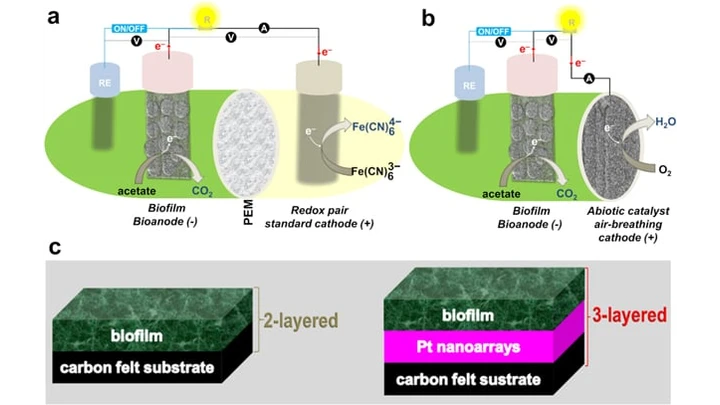
Their benchmark version, designated v0, matched the common MudWatt layout with horizontal electrodes.1 An intermediate version turned both conductive elements vertically but failed to establish steady electrical current.1 A subsequent prototype allowed groundwater to leak into its internal chamber.1 The final experimental configuration, called v3, sealed the internal chamber from soil intrusion while leaving one face of the cathode exposed to ambient air.12 Both electrodes were cut as 12.7-centimetre discs from 4.5-millimetre carbon felt, providing roughly 126.7 square centimetres of surface area per plate, spaced five centimetres apart, with a 30 percent wetproofed carbon cloth membrane protecting the cathode.1
Over 161 days of recorded laboratory operations, the v3 configuration generated an average electrical output of 26.5 microwatts, compared to an average of 14.7 microwatts produced by the flat v0 benchmark cell.1 The authors observed that the horizontal control cell stopped generating measurable current when volumetric water content, which measures the percentage of soil volume occupied by liquid water, dropped between 46 percent and 44 percent.1 By contrast, the v3 cell continued operating until soil moisture fell to approximately 42 percent volumetric water content.1 That four percent extension in operational moisture range enabled the prototype to survive dry intervals that deactivated conventional horizontal cells.1
What happens when microbial fuel cells leave the laboratory?
Moving the fuel cell from controlled laboratory conditions into outdoor ground caused its electrical production to drop sharply. For outdoor evaluation, the researchers constructed a mechanically reinforced unit, named v3.1, and incubated it in local dirt until it reached an operating potential of approximately 600 millivolts.1 They buried the cell beneath a potted pygmy date palm in a residential yard located in a Mediterranean climate zone, maintaining an electrical load with a 2-kilohm resistor.1 Within 24 hours of outdoor burial, the cell output fell from 186 microwatts to 4 microwatts, eventually settling between 1 and 1.5 microwatts during active yard irrigation.1
The outdoor deployment demonstrated that real garden soil behaves far less predictably than prepared laboratory containers. When volumetric water content in the yard soil dropped below 39 percent, the buried device produced essentially no measurable electrical current.1 The paper noted that the cell required a high threshold of 41 percent volumetric water content to sustain regular activity, which confines electrical generation to moments when soil is nearly saturated to field capacity.1 Because natural agricultural ground regularly dries well below that saturation mark between rainfalls, the prototype remains unable to operate in typical farming plots without frequent watering.1
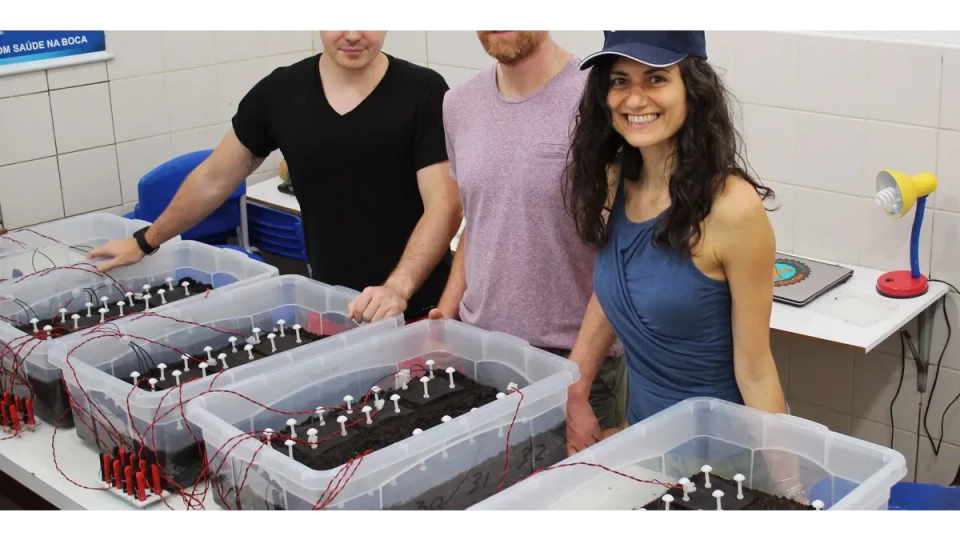
To evaluate practical sensing workloads, the authors connected a v3.1 cell in the laboratory to an analog sensor tag known as MARS.1 The tag consumed tiny amounts of power by modulating and reflecting an external 915-megahertz radio signal rather than generating its own radio transmission, a technique called backscatter communication. In bench tests, two separate software-defined radio units placed one metre apart broadcast and received the reflected signal.1 When researchers touched an insulated sensor wire, the tag altered its backscatter frequency, and a capacitive soil probe shifted the frequency by 2 kilohertz after a watering event.1 During a month-long drying cycle, the wireless tag functioned until the cell dropped to 0.781 microwatts at 179.8 millivolts and 41.5 percent volumetric water content.1
What are the limits of soil-powered computing?
The experimental results reflect short test periods under specific soil mixtures rather than a universal power source for commercial agriculture. The outdoor test ran for approximately seven days in a single residential location, measuring electrical output across a static resistor without any wireless transmitter or sensing hardware attached.1 Furthermore, the backscatter communication demonstrated in the laboratory relied on external mains-powered software radios located just one metre away, meaning the cell did not generate the primary radio wave. The authors reported that the 1 to 1.5 microwatts gathered in the outdoor yard would not generate enough energy to support the digital microcontroller systems evaluated in their computer simulations.1
Soil properties vary significantly across geographies, so a fuel cell operating in dense organic loam will produce different currents than one placed in sandy or compacted ground. The authors noted that soil chemistry differences prevent direct, absolute comparisons between their prototype and cells tested in unrelated field studies.1 While the researchers released their computer simulation scripts and hardware specifications in a public code repository, a fully biodegradable housing remains a conceptual proposal for future research rather than a fabricated device.13
How could biological power sources evolve for agricultural fields?
Making microbial fuel cells practical for general agriculture will require electrodes that continue operating in significantly drier ground. The research team calculated through simulations that their four percent gain in functional moisture range yielded roughly 40 percent more digital processing cycles and over 120 percent longer operating life for analog circuitry when compared against their own horizontal control.1 Sustaining continuous monitoring on working farms, however, requires cells that operate below 30 percent volumetric water content, where many crops thrive without waterlogging.
Long-term fuel supply presents an additional operational question for autonomous ground networks. During extended laboratory runs, the team detected no measurable drop in total organic carbon around the buried anodes, suggesting that routine plant root exudates and microbial decomposition could theoretically replenish nutrients indefinitely under adequate moisture.1 Testing whether that natural biological replenishment holds true over multiple growing seasons will determine whether dirt-powered fuel cells can ever eliminate batteries from field agriculture.1
The record
30 sentences trace to 3 sources.
-
1
JB
 Justin Brown
Document
· scienceblog.com · 26 Nov 2026
26.5 microwatts in the lab, about 1 to 1.5 in an irrigated yard: a soil fuel cell with one cathode face in air.
See the source
-
2
S
 sciencedaily.com
Third-party reporting
· sciencedaily.com
Scientists develop dirt-powered fuel cell that could replace batteries
See the source
- 3 GitHub - ka-moamoa/Practical_SMFC_Design_Guide: Repository for practical soil-powered computing. See the source