Surrogate human digital twins could predict workplace cognitive strain
Simulating how physical movement and mental processing interact inside virtual avatars could help safety engineers identify operational hazards before workers set foot in dangerous environments.
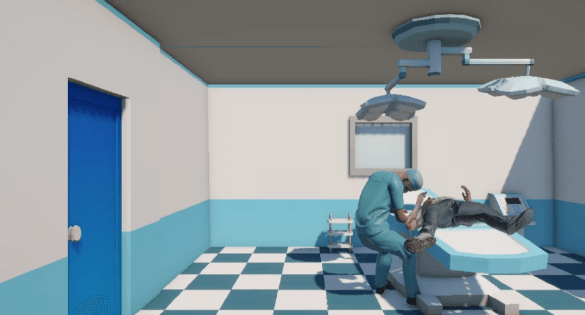
Evaluating how a person copes with a complex workplace has long forced engineers into an awkward compromise. Physical mannequins can show whether an arm reaches a control lever, while computer software can assess how quickly an operator spots an alert on a flat display screen. Neither approach captures what happens when a living body moves through physical space while simultaneously making rapid cognitive decisions under pressure.
Human thought does not function as an isolated computer processor inside the skull. Senses continuously gather signals from the environment, the nervous system interprets those signals against the body's physical posture and balance, and muscles execute movements that immediately alter what the eyes and ears experience next. When machinery or control rooms ignore this continuous loop between body and brain, operators face unexpected fatigue, mental strain, and operational mistakes.
To bridge the divide between physical ergonomics and cognitive science, researchers Tajbeed A. Chowdhury, Alexander L. Francis, and Daniel J. Strauss proposed creating surrogate human digital twins. In a perspective article published on September 20, 2026, in the journal Frontiers in Neuroergonomics, the authors argued that computational models must unite bodily perception with cognitive decision-making to evaluate human work environments safely and accurately.
Why does workplace design require modeling the entire body?
Human performance during complex tasks depends on continuous interaction between the physical body, sensory organs, and the surrounding environment. Traditional ergonomics focuses on mechanical factors, such as posture, seating height, and reach envelopes, treating the physical worker as a mechanical armature. At the same time, classical cognitive psychology often models decision-making as an abstract sequence of data processing steps, ignoring the physical effort required to gather sensory information.
Mr. Jose Trapero, a contributor who reviewed the framework, explained that established industrial evaluations systematically divide these domains. Standard ergonomic assessments, such as RULA and REBA, focus on reach and musculoskeletal strain while assuming motor execution occurs independently of mental demand, Trapero said in response to questions from Primary. Conversely, cognitive benchmarks measure reaction times or subjective task load on flat screens while largely overlooking how bodily orientation, movement, and physical fatigue continuously reshape sensory perception.

Neuroergonomics, the study of brain function during real-world physical activity, emerged to bridge that gap, yet observing living operators presents practical challenges. Placing human participants into experimental cockpits, high-risk industrial facilities, or prolonged emergency simulations carries substantial safety risks, high financial costs, and unavoidable ethical limits. Laboratory sensors attached to a person can also alter natural movement, distorting the mental workload researchers hope to observe.
How can a digital surrogate represent embodied thought?
A surrogate human digital twin simulates embodied perception by linking virtual sensory organs and motor systems directly to computational models of neural processing. In computational modeling, a digital twin serves as a dynamic virtual representation of an entity, updated through simulated or real-world feedback loops. In the context of neuroergonomics, an embodied surrogate accounts for both the physical mechanics of the body and the neurological processes that guide attention and action.
The perspective presented by Chowdhury, Francis, and Strauss explored how such virtual avatars can simulate embodied perception and cognition. Chowdhury and Strauss conduct research at Saarland University and htw saar in Saarbrücken, Germany, working across the Systems Neuroscience and Neurotechnology Unit and the Center for Digital Neurotechnologies Saar.3 Francis is based at Purdue University in West Lafayette, Indiana, within the Department of Speech, Language, and Hearing Sciences, bringing expertise in sensory communication and cognitive processing.3
To achieve realistic feedback between sensing and action, the computational architecture links perception to ongoing environmental input. Chowdhury told Primary that the central idea is that these two systems should not be treated as two separate systems that communicate occasionally but rather as one system continuously updating perception-action loop. Computationally, this process begins with observing an individual and their environment to gather multisensory input, which feeds into a generative model that maintains a probabilistic estimate of hidden cognitive states. Chowdhury said that during a simulation task, the digital twin should continuously predict what sensory evidence it expects to observe and compare those predictions with what is being sensed, using the resulting prediction error to update its belief about the current cognitive state.
Trapero pointed out that this structure reflects active inference, a theoretical framework in cognitive neuroscience where agents act to minimize differences between expected and incoming sensory signals. Modeling the operator as an embodied agent within a continuous perception-action loop captures how physical constraints and mental strain compound in real time, Trapero said, allowing engineers to identify situations where cognitive demand and physical positioning combine to cause operational errors that decoupled benchmarks typically overlook.
What are the limits of simulating human perception?
A conceptual perspective outlines theoretical principles rather than providing empirical benchmarks from live human experiments. The proposal by Chowdhury, Francis, and Strauss, published in the Augmented and Synthetic Neuroergonomics section of Frontiers in Neuroergonomics, established an architectural framework without presenting experimental data or validation against living subjects. The paper establishes an architectural framework, serving as a conceptual roadmap for how future computational models might unite bodily mechanics and cognition.
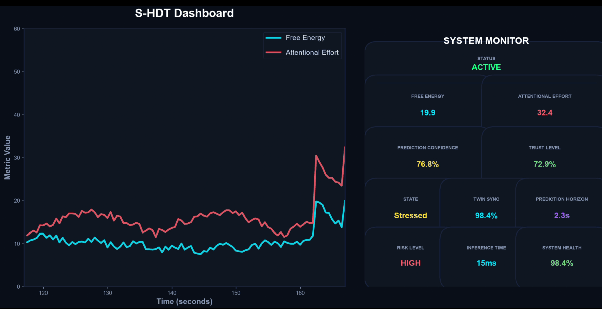
Substantial technical obstacles also complicate the inference of mental states strictly from bodily signals. Trapero noted that tracking cognitive strain only from sensory data presents serious challenges because different internal experiences often produce identical physical reactions. An elevated heart rate, dilated pupils, or a spike in sweat levels could indicate intense mental focus, but they could just as easily come from physical exertion, surprise, or changes in ambient temperature. Furthermore, physical movement by an active operator introduces noise into physiological sensors, making it difficult to isolate mental fatigue unless models combine physiological readings with detailed task context, such as worker objectives and workspace layout.
Significant boundaries also restrict what virtual avatars can reproduce. Chowdhury told Primary that workplace stressors that rely heavily on an individual’s personal history, social relationships, or culture would be difficult to map onto the simulated avatar. The researchers treat the predicted states as probabilistic surrogate representations rather than as direct measurements of human experience.
Omitting social dynamics and personal background leaves out some predictive detail, but Trapero noted that establishing a core foundation linking physical movement directly to cognitive processing is an essential initial step. Once that baseline perception-action loop demonstrates validity, models can gradually incorporate individual experience levels, stress resilience, and team dynamics. In practical engineering, calibrating individual expectations in real time requires substantial data and computing power, while probabilistic outputs require careful translation so safety engineers do not treat simulated estimates as absolute guarantees.
How will researchers test these virtual avatars?
Validating the framework will require testing its core predictive behavior against living operators under controlled experimental settings. Chowdhury said that a definitive sign of model failure would be a systematic failure under controlled experiments, where the surrogate does not provide any prediction or direction of cognitive state changes.
Trapero noted that establishing confidence in the architecture will require systematic evaluation across diverse work groups, varying levels of operator expertise, and varying degrees of physical and psychological stress. Crucially, validation must contrast goal-driven attention with stimulus-driven focus, alongside scenarios requiring different amounts of attentional effort. Trapero emphasized that setting a single universal accuracy threshold is impractical because required precision depends on operational stakes, requiring exceptionally high accuracy in safety-critical domains such as aviation while permitting wider margins during early workspace layout planning.
Until controlled empirical trials test these simulated states against real biological measurements, the surrogate human digital twin remains an unverified conceptual proposal for neuroergonomics. The framework offers an assistive conceptual roadmap for workplace design, but its eventual adoption depends on whether empirical experiments confirm that virtual prediction errors match the lived strain of human workers.
The record
21 sentences trace to 1 source and 2 contributors.
- 1 Contribution — Tajbeed 7 statements added to this article
- 2 Contribution — Mr. Jose Trapero 13 statements added to this article
-
3
F
 Frontiers
Document
· frontiersin.org · 21 Sep 2026
Using a surrogate human digital twin to model embodied perception and cognition for neuroergonomics
See the source
Other consulted pages2 pages
industry-science.com3 pages
snnu.uni-saarland.de1 page
Article history
-
Published 27 Nov 2026, 20:18Assembled by the Primary desk from 1 source · 2 contributors · 21 cited sentences
-
Mr. Jose Trapero, a contributor who reviewed the framework
- Go to the sentence: Standard ergonomic assessments, such as RULA and REBA, focus on reach and musculoskeletal strain while assuming motor execution occurs independently of mental demand, Trapero said in response to questions from Primary.
- Go to the sentence: Conversely, cognitive benchmarks measure reaction times or subjective task load on flat screens while largely overlooking how bodily orientation, movement, and physical fatigue continuously reshape sensory perception.
- Go to the sentence: Chowdhury told Primary that the central idea is that these two systems should not be treated as two separate systems that communicate occasionally but rather as one system continuously updating perception-action loop.
- Go to the sentence: Modeling the operator as an embodied agent within a continuous perception-action loop captures how physical constraints and mental strain compound in real time, Trapero said, allowing engineers to identify situations where cognitive demand and physical positioning combine to cause operational errors that decoupled benchmarks typically overlook.
- Go to the sentence: Trapero noted that tracking cognitive strain only from sensory data presents serious challenges because different internal experiences often produce identical physical reactions.
- Go to the sentence: An elevated heart rate, dilated pupils, or a spike in sweat levels could indicate intense mental focus, but they could just as easily come from physical exertion, surprise, or changes in ambient temperature.
- Go to the sentence: Furthermore, physical movement by an active operator introduces noise into physiological sensors, making it difficult to isolate mental fatigue unless models combine physiological readings with detailed task context, such as worker objectives and workspace layout.
- Go to the sentence: Omitting social dynamics and personal background leaves out some predictive detail, but Trapero noted that establishing a core foundation linking physical movement directly to cognitive processing is an essential initial step.
- Go to the sentence: Once that baseline perception-action loop demonstrates validity, models can gradually incorporate individual experience levels, stress resilience, and team dynamics.
- Go to the sentence: In practical engineering, calibrating individual expectations in real time requires substantial data and computing power, while probabilistic outputs require careful translation so safety engineers do not treat simulated estimates as absolute guarantees.
- Go to the sentence: Trapero noted that establishing confidence in the architecture will require systematic evaluation across diverse work groups, varying levels of operator expertise, and varying degrees of physical and psychological stress.
- Go to the sentence: Crucially, validation must contrast goal-driven attention with stimulus-driven focus, alongside scenarios requiring different amounts of attentional effort.
- Go to the sentence: Trapero emphasized that setting a single universal accuracy threshold is impractical because required precision depends on operational stakes, requiring exceptionally high accuracy in safety-critical domains such as aviation while permitting wider margins during early workspace layout planning.
-
Tajbeed
- Go to the sentence: In a perspective article published on September 20, 2026, in the journal Frontiers in Neuroergonomics, the authors argued that computational models must unite bodily perception with cognitive decision-making to evaluate human work environments safely and accurately.
- Go to the sentence: Chowdhury told Primary that the central idea is that these two systems should not be treated as two separate systems that communicate occasionally but rather as one system continuously updating perception-action loop.
- Go to the sentence: Computationally, this process begins with observing an individual and their environment to gather multisensory input, which feeds into a generative model that maintains a probabilistic estimate of hidden cognitive states.
- Go to the sentence: Chowdhury said that during a simulation task, the digital twin should continuously predict what sensory evidence it expects to observe and compare those predictions with what is being sensed, using the resulting prediction error to update its belief about the current cognitive state.
- Go to the sentence: Chowdhury told Primary that workplace stressors that rely heavily on an individual’s personal history, social relationships, or culture would be difficult to map onto the simulated avatar.
- Go to the sentence: The researchers treat the predicted states as probabilistic surrogate representations rather than as direct measurements of human experience.
- Go to the sentence: Chowdhury said that a definitive sign of model failure would be a systematic failure under controlled experiments, where the surrogate does not provide any prediction or direction of cognitive state changes.