Synthetic DNA strands hold programmable quantum spins at room temperature
Attaching light-sensitive dye molecules to custom genetic sequences turns flexible nucleic acids into nanoscale scaffolds for controllable quantum states.
How can biological molecules host controllable quantum states?
Quantum states of matter are notoriously delicate. For decades, the magnetic orientations of single electrons, known as spins, have been harnessed as tiny magnetic compasses and quantum information units primarily inside rigid solid-state crystals, such as synthetic diamond and silicon semiconductors.1 Those solid crystals provide a stable cage, protecting isolated spins from thermal noise and allowing them to be written with microwave pulses and read out using beams of light. Translating that same optical and magnetic control into flexible organic architectures has remained exceptionally difficult, because most chemical platforms cannot position individual quantum features at exact molecular addresses.
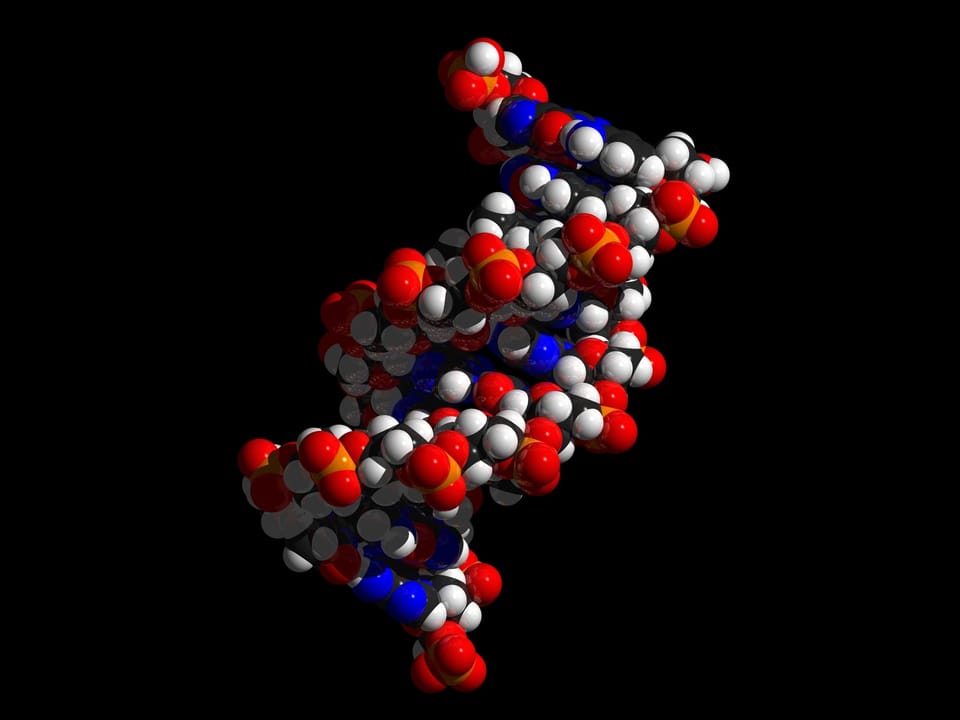
Biological machinery, by contrast, arranges matter with atomic accuracy. In living systems, molecules such as DNA assemble by following strict pairing rules, spacing chemical building blocks just fractions of a nanometer apart. If researchers could anchor optically active quantum spins to that molecular lattice, they could assemble complex spin arrays, build responsive nanoscale probes, and design molecular systems that respond directly to non-invasive magnetic signals.
The mechanism that makes optical spin readout possible in soft matter relies on a specific sequence of photochemical reactions. When a light-absorbing dye molecule absorbs an incoming photon, one of its electrons jumps into an excited state and moves toward an adjacent chemical group. This charge transfer leaves behind two unpaired electron spins, creating what physical chemists call a spin-correlated radical pair. Because these two spins originate from the same electronic event, their magnetic properties remain linked as they oscillate between different collective alignments. Sweeping a radiofrequency field across the system nudges the spins between those alignments, altering how quickly the radicals recombine and changing how the molecule interacts with light.

What did the researchers build on the genetic scaffold?
A research preprint posted on bioRxiv by K. Meng, C. Einholz, L. Krueger, M. Rosenow, and D. Bucher reports that synthetic strands of DNA can serve as a functional nanoscale scaffold for these optically addressable spin systems.1 The researchers synthesised short artificial DNA strands, known as oligonucleotides, and incorporated flavin chromophores directly into the molecular backbone.1 Upon illumination, these flavin units generated spin-correlated radical pairs within the DNA architecture.1
The authors reported that the resulting radical pairs could be manipulated with radiofrequency fields and interrogated through optically detected magnetic resonance, an analytical approach that tracks changes in optical emission while scanning electromagnetic frequencies.1 Using pulsed variants of this technique, the authors tracked spin dynamics occurring on sub-microsecond timescales under ordinary ambient room conditions.1 Dominik, the corresponding author of the project, told Primary that the optical signal produced by the system is surprisingly strong, explaining that "we observe a relatively large contrast that is comparable to, and in some cases exceeds, that achieved in solid-state systems."
Because synthetic DNA is assembled one nucleotide at a time, the researchers were able to adjust the surrounding chemical environment with single-base resolution. The preprint states that varying the surrounding DNA sequence allowed atomically precise tuning of both the magnetic resonance signal and the underlying spin chemistry.1 Dominik told Primary that "that the design works from scratch and highly reproducible." Furthermore, the higher-order shape of the molecule acted as a molecular control. When single strands wound together into a double-stranded helix, the contrast of the pulsed magnetic resonance response inverted, indicating a fundamental switch in the spin multiplicity of the radical pair precursor.1 Dominik explained that "since the electron transfer, forming the radical pair is faster for the double strand, it forms mainly the singlet, which leads to an inversion of the signal."
What are the limits of the current findings?
These findings remain an early laboratory demonstration and have been posted to a preprint server prior to formal peer review. While the researchers demonstrated several proof-of-concept implementations, including sensing, programmable radical pair positioning, and spin-enhanced molecular beacons, the work does not evaluate these assemblies inside living organisms.1 Dominik acknowledged that "we have not yet demonstrated these concepts in vivo" and noted that the architecture is "substantially more heterogeneous and subject to stronger environmental fluctuations" than crystalline lattices. Dominik added that "coherent control has not yet been demonstrated, which is important for the quantum technology applications."
Where could programmable molecular spins lead next?
The ability to direct quantum spins on a programmable molecular framework provides a flexible bridge between physical chemistry and synthetic biology. The authors suggest that because DNA synthesis and automated assembly are mature technologies, researchers can readily build patterned spin arrays with spatial configurations that are difficult to carve out of solid-state crystals. Dominik emphasized that "many potential applications do not necessarily require operation in vivo" and could operate in cell-free settings, including on-chip platforms or under cryogenic conditions.
Beyond quantum sensing, the authors project that the platform could support bioimaging agents and radiofrequency-controlled molecular switches capable of governing gene regulation.1 However, Dominik pointed out a remaining engineering constraint for regulatory switches, stating that "the main limitation is that optical excitation is still required."
The record
15 sentences trace to 1 source and 1 contributor.
-
1
MK
 Meng, K., Einholz, C., Krueger, L., Rosenow, M., Bucher, D.
Paper
· biorxiv.org · 20 Sep 2026
Optically addressable and programmable spins in DNA
Preprint · may not have been peer reviewed
See the source
- 2 Contribution — Dominik B. Bucher 11 statements added to this article
Other consulted pages1 page
ch.nat.tum.de1 page
portal.fis.tum.de1 page
Article history
-
Published 27 Nov 2026, 16:21Assembled by the Primary desk from 1 source · 1 contributor · 15 cited sentences
-
Dominik B. Bucher
- Go to the sentence: The authors reported that the resulting radical pairs could be manipulated with radiofrequency fields and interrogated through optically detected magnetic resonance, an analytical approach that tracks changes in optical emission while scanning electromagnetic frequencies.
- Go to the sentence: Using pulsed variants of this technique, the authors tracked spin dynamics occurring on sub-microsecond timescales under ordinary ambient room conditions.
- Go to the sentence: The preprint states that varying the surrounding DNA sequence allowed atomically precise tuning of both the magnetic resonance signal and the underlying spin chemistry.
- Go to the sentence: When single strands wound together into a double-stranded helix, the contrast of the pulsed magnetic resonance response inverted, indicating a fundamental switch in the spin multiplicity of the radical pair precursor.
- Go to the sentence: Dominik explained that "since the electron transfer, forming the radical pair is faster for the double strand, it forms mainly the singlet, which leads to an inversion of the signal."
- Go to the sentence: While the researchers demonstrated several proof-of-concept implementations, including sensing, programmable radical pair positioning, and spin-enhanced molecular beacons, the work does not evaluate these assemblies inside living organisms.
- Go to the sentence: Dominik acknowledged that "we have not yet demonstrated these concepts in vivo" and noted that the architecture is "substantially more heterogeneous and subject to stronger environmental fluctuations" than crystalline lattices.
- Go to the sentence: Dominik added that "coherent control has not yet been demonstrated, which is important for the quantum technology applications."
- Go to the sentence: Dominik emphasized that "many potential applications do not necessarily require operation in vivo" and could operate in cell-free settings, including on-chip platforms or under cryogenic conditions.
- Go to the sentence: Beyond quantum sensing, the authors project that the platform could support bioimaging agents and radiofrequency-controlled molecular switches capable of governing gene regulation.
- Go to the sentence: However, Dominik pointed out a remaining engineering constraint for regulatory switches, stating that "the main limitation is that optical excitation is still required."