Voyager 1 crosses one light-day while sending silent signals home
A communication breakdown leaves NASA tracking a carrier wave without readable science data just as the spacecraft enters an unprecedented corridor of deep space.
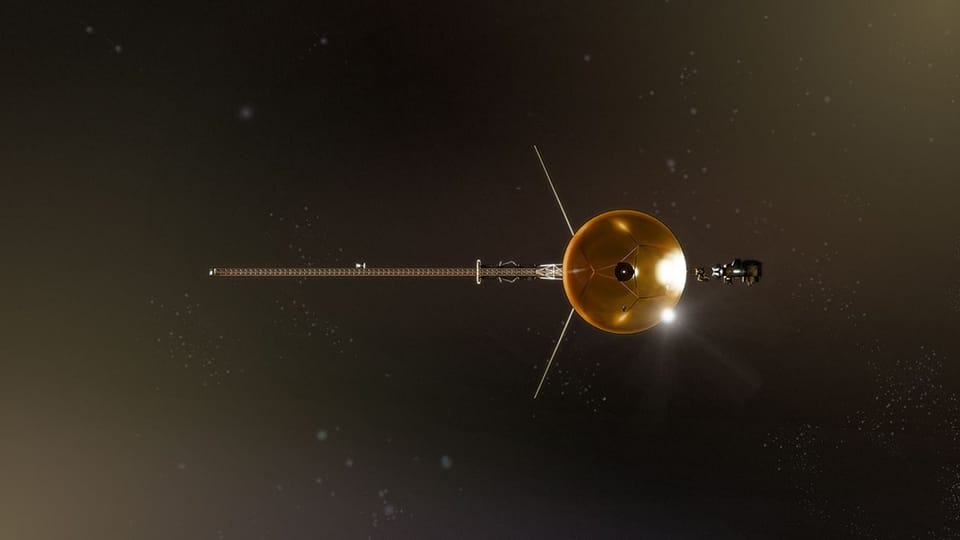
A radio signal crossing the solar system behaves much like a beam of light from a distant lighthouse. The beam itself shows that the lamp remains burning, but any message carried upon it depends on regular, structured pulses. When those pulses fail to register in sequence, the light still reaches the horizon while the information dissolves into an empty hum. Far past the planetary orbits, an artificial probe is now sending that exact form of blank transmission across billions of miles of cold space.
Voyager 1 has traveled farther from Earth than any other human-made machine, moving through the thin gas between stars where physical recovery is impossible.12 Because the craft operates entirely alone, every diagnostic assessment, software modification, and scientific measurement relies on a continuous exchange of radio transmissions. An unreadable signal leaves ground operators unable to monitor internal temperatures, assess fuel lines, or record cosmic radiation levels in real time. If the craft cannot restore meaningful communication, humanity risks losing its only operational contact with the outer perimeter of the interstellar frontier.
Radio communication across deep space requires two distinct elements working together. First, a transmitter aboard the spacecraft generates a continuous electromagnetic wave known as a carrier signal, tuned to a specific frequency that ground antennas can detect. Second, onboard instruments feed scientific readings and hardware status into a central computer, which organizes the digits into discrete packages called frames. These frames are modulated onto the carrier wave, and antennas on Earth must locate the starting marker of each frame to unpack the telemetry. If the spacecraft maintains its directional point and broadcasts the carrier wave without packaging the information, Earth receives a clear frequency lock that contains no usable data.
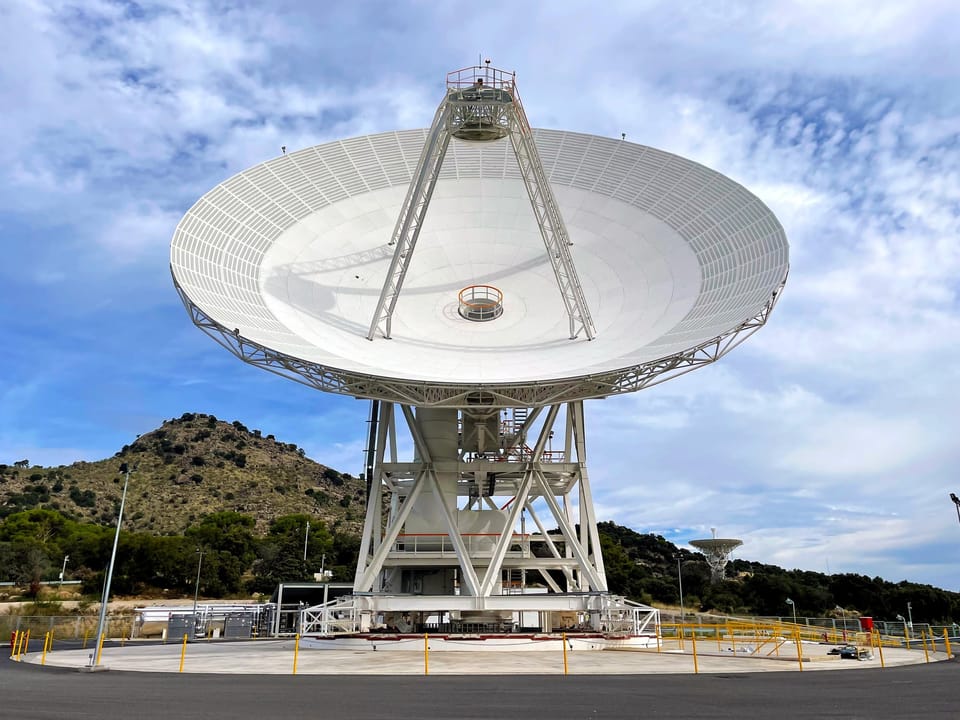
That breakdown occurred shortly before the spacecraft crossed a historic astronomical boundary. Engineers at the Jet Propulsion Laboratory confirmed that Voyager 1 surpassed a distance of one light-day from Earth on November 18, 2026, traveling at approximately 38,000 miles per hour, or about 61,155 kilometers per hour.1 That distance represents roughly 16.1 billion miles, equivalent to 25.9 billion kilometers, meaning a radio command traveling at the speed of light requires a full 24 hours to reach the spacecraft and another 24 hours to return.1 The milestone was confirmed on November 19, 2026, when an antenna near Madrid, Spain, received the delayed carrier wave.23

Why can NASA hear Voyager 1 without reading its data?
An unreadable broadcast occurs because the radio transmitter on Voyager 1 can maintain its carrier wave while the computer responsible for formatting telemetry fails to assemble data frames.24 On November 14, 2026, a Deep Space Network antenna in Canberra, Australia, locked on to the transmission from Voyager 1 and detected the carrier wave, but found no frame synchronization markers.42 Suzanne Dodd, the Voyager project manager at the Jet Propulsion Laboratory in Southern California, explained that the presence of the strong carrier signal confirms the probe is functioning mechanically, yet the missing frame synchronization prevents engineers from extracting engineering readings or scientific observations.23
The successful transmission of the carrier wave reveals that several critical systems remain intact. The Attitude and Articulation Control computer is properly keeping the high-gain dish antenna pointed directly at Earth across billions of miles.43 Broadcast hardware continues to convert available electrical current into radio frequencies without catastrophic power loss.42 Mission managers suspect the breakdown resides in a separate onboard flight computer tasked with collecting sensor measurements, translating them into binary blocks, and handing them to the transmitter.42 Without synchronized frames, ground stations encounter the equivalent of an open broadcast channel delivering silence.
Troubleshooting such an anomaly requires comparing current behavior against previous operational disruptions. In late 2023, Voyager 1 encountered a comparable fault when an onboard computer stopped returning readable telemetry while maintaining a carrier signal, an event that required months of code inspection to bypass damaged memory cells.24 Engineers are also examining whether the current outage shares an underlying origin with an incident in October 2026, when all communications ceased for approximately 48 hours before the spacecraft restored contact autonomously.24
What happened when the probe reached one light-day?
Deep Space Network tracking stations confirmed that Voyager 1 passed one light-day from Earth on November 18, 2026, even though the spacecraft had stopped transmitting usable measurements four days earlier.21 The milestone occurred at 5:16 a.m. Eastern Time, or 2:16 a.m. Pacific Time, representing a journey of more than 49 years since launch in 1977.1 Joe Westlake, director of the Heliophysics Division at NASA Headquarters in Washington, noted that while the spacecraft transformed planetary science during its grand tour of the outer planets, its current mission provides unique observations into how the Sun interacts with deep space.1
Light in a vacuum travels at roughly 186,000 miles per second, or 299,000 kilometers per second, covering the distance to the Moon in about 1.3 seconds and reaching Neptune in roughly four hours.1 Reaching one light-day means that the physical gap between Earth and Voyager 1 has widened to 24 light-hours, a small fraction of a full light-year, which spans 5.88 trillion miles, or 9.46 trillion kilometers.1 Ground controllers confirmed the crossing by combining the detected carrier frequency with orbital trajectory models calculated over decades of tracking.14
Because the spacecraft travels on a ballistic trajectory without propulsion engines capable of altering its velocity, mechanical failures cannot modify its arrival at spatial benchmarks.4 Voyager 1 entered interstellar space in 2012 by crossing the heliopause, the boundary where the solar wind gives way to interstellar matter.12 Linda Spilker, the Voyager project scientist at the Jet Propulsion Laboratory, observed that the probe continues to reveal how far the magnetic influence of the Sun extends beyond the heliosphere. Voyager 2, which launched on a different flight path, crossed into interstellar territory in 2018 and continues operating three scientific instruments.12
How do engineers repair a probe sixteen billion miles away?
Ground teams at the Jet Propulsion Laboratory must send diagnostic commands that take an entire day to travel outward and another day to return evidence of success.24 This 48-hour round-trip communication delay means that testing a single diagnostic hypothesis or reloading an instruction set requires multiple days of observation. Kareem Badaruddin, the Voyager mission manager, reported that the engineering team remains actively engaged in identifying the glitch despite the extreme operational constraints.23 The investigation involves interacting with vintage computing architectures created during the 1970s, long before modern programming languages and memory standards existed.23
Operational assessments must account for what these observations can and cannot demonstrate. Ground antennas can verify that Voyager 1 is powered, oriented toward Earth, and transmitting on its assigned radio frequency, but they cannot assess internal instrument temperatures or electrical margins until frame synchronization returns.23 The diagnostic process does not involve physical telemetry readouts, relying instead on indirect software deductions and historical system responses. NASA personnel cautioned that isolating the failure could require several weeks or longer, and eventual recovery remains subject to the survival of aging onboard processors.42
Beyond communications hurdles, Voyager 1 contends with a constantly diminishing electrical supply. The spacecraft generates power through radioisotope thermoelectric generators, which convert the thermal energy produced by decaying plutonium into electrical wattage.21 That power output decreases by approximately four watts each year.21 To extend operations, mission controllers have progressively deactivated non-essential heaters and secondary sensors, leaving only two active scientific devices on Voyager 1: a magnetometer and a plasma wave instrument.23
During the summer of 2026, engineers completed an intricate reconfiguration by deactivating three electrical devices and substituting three lower-power alternatives, preserving sufficient heat to prevent thruster fuel from freezing.21 The conservation program aims to sustain basic scientific operations through the 50th launch anniversary in 2027.21 While both Voyager probes will eventually fall silent as their nuclear generators deplete, ground operators continue attempting to restore readable data from humanity's most distant outpost.
The record
33 sentences trace to 4 sources.
-
1
N
 nasa.gov
Official record
· nasa.gov · 19 Nov 2026
NASA’s Voyager 1 Makes History Reaching One Light-Day From Earth - NASA
See the source
- 2 Voyager 1 Had a Mysterious Data Outage: NASA Is Still Looking for Answers See the source
- 3 Voyager 1 Had A Data Outage When It Hit One Light Day. It Still Does. See the source
-
4
NS
 NASA Science
Official record
· science.nasa.gov · 19 Nov 2026
Voyager 1 Engineers Analyze Data Issue, Ready to Confirm Light-day - NASA Science
See the source