Wormholes mimicking black holes expose different shapes to different tidal waves
Dynamical scalar tidal calculations reveal that deep throats split wave responses into two regimes, mimicking event horizons over finite observation windows.
When a massive body passes near another object in space, gravity pulls unevenly across the target.1 The side facing the companion experiences a stronger attraction than the far side, creating a differential stretch known as a tidal force.1 In planetary physics, this uneven pull lifts ocean tides on Earth and deforms rocky moons into ellipsoids, revealing their internal composition.1
In classical four-dimensional general relativity, isolated black holes behave differently. When immersed in a steady gravitational field generated by a distant mass, a black hole in vacuum does not develop any static deformation.12 The mathematical measures of this response, known as tidal Love numbers, evaluate to zero, acting as a unique mathematical signature of an event horizon.12
If an astronomical object lacks an event horizon, that resistance to tidal deformation can break down.12 In a theoretical study posted to the arXiv preprint server on September 11, 2026, physicists Sergey N. Solodukhin and Vagif Tagiev at the Denis Poisson Institute at the University of Tours investigated how hypothetical wormholes respond to dynamical tidal disturbances.1 Their calculations show that the resulting deformation splits into two separate behaviors determined by throat length.1
Understanding how a compact body responds to tidal forces requires tracking energy through space in distinct stages. When two bodies circle each other in a binary system, each generates a gravitational field that varies across its partner.1 That uneven pull induces a structural distortion in the companion.1 The altered mass distribution produces a secondary gravitational field, which reaches back across space to modify orbital motion.1 For an incoming wave, the disturbance travels from distant space toward the central object, encounters an energy barrier created by curved spacetime, and partially reflects toward infinity while partially transmitting inward.1 If the body contains an absorbing event horizon, the transmitted portion vanishes into the interior. If the object contains an open throat connecting to another universe, the transmitted wave traverses the interior, interacts with secondary boundaries, and can reflect back into the original universe.1
Why do black holes resist static tidal stretching?
Black holes in four-dimensional general relativity maintain vanishing static Love numbers because their event horizons absorb incoming gravitational disturbances without allowing reflected static distortions in exterior spacetime.12 Augustus Edward Hough Love formulated tidal response coefficients in the early twentieth century to describe Earth's deformation under lunar and solar gravitational pulls.1 In Newtonian physics, these dimensionless quantities measure the ratio between an induced multipole moment and an applied external tidal field, revealing internal properties like the equation of state of a neutron star. For a classical four-dimensional black hole in general relativity, however, a hidden symmetry in the perturbation equations forces every static tidal Love number to vanish.1
Because true black holes exhibit zero static tidal deformability, physicists consider Love numbers a direct test for alternative compact objects.12 Researchers designate hypothetical horizonless objects, including boson stars, gravastars, and traversable wormholes, as black-hole mimickers because their exterior fields can imitate black hole spacetimes.12 In a 2017 study, Vitor Cardoso and colleagues calculated static tidal Love numbers for several exotic compact objects and reported that these numbers do not vanish.1 Cardoso and his co-authors showed that as the outer boundary of an object approaches the would-be horizon radius, its static Love numbers exhibit a logarithmic scaling with that separation distance.21 That non-zero response suggested that gravitational wave observatories could identify mimickers during binary inspirals, where tidal deformations alter waveforms at the fifth post-Newtonian order relative to point-particle motion.1
Subsequent investigations into alternative gravity scenarios reinforced the notion that exotic geometries possess distinct tidal imprints. In a 2020 study of warped compactification within Randall-Sundrum braneworld models, theoretical physicist Hai Siong Tan demonstrated that the quadrupolar tidal Love number of braneworld black holes and wormholes is generically non-vanishing, offering a potential signature in gravitational waveforms emitted during compact binary mergers. Even so, most foundational treatments evaluated only static responses, leaving the frequency-dependent behavior of black-hole mimickers largely unexplored.
How do wormhole throats alter the passage of incoming waves?
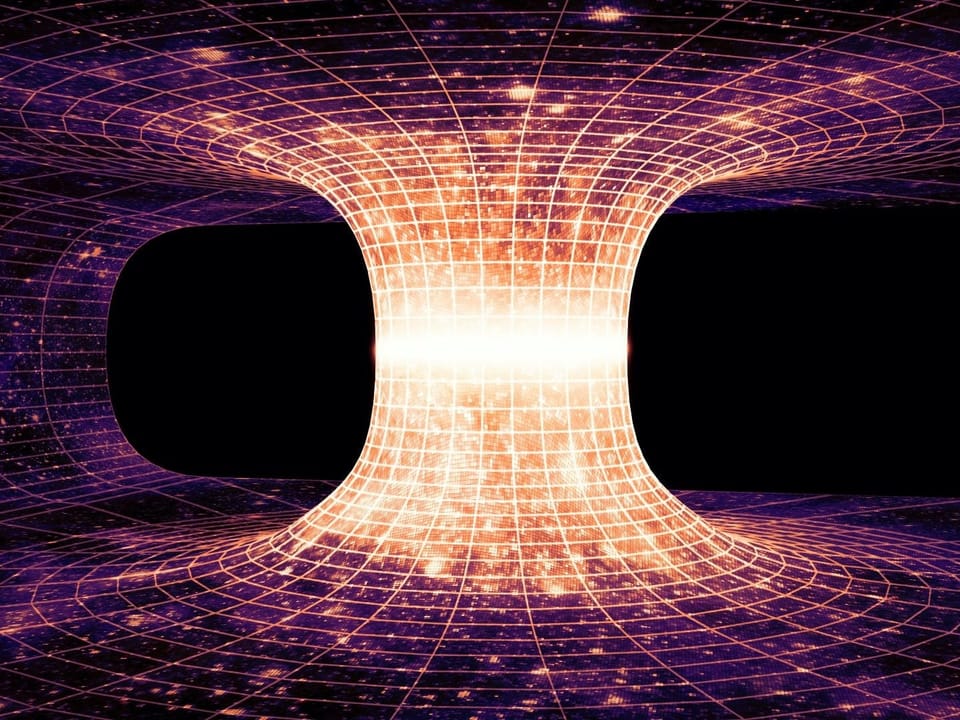
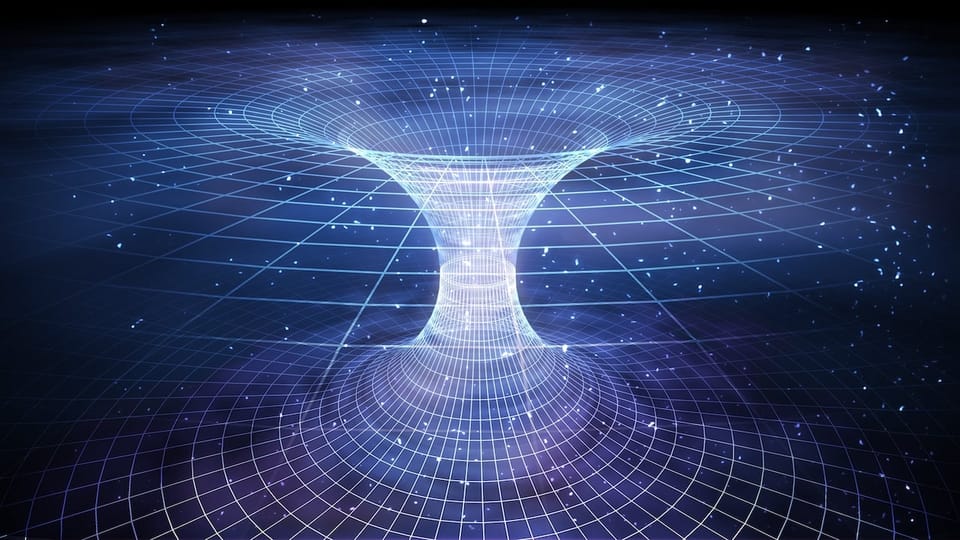
Wormhole throats introduce a second characteristic spatial scale into the gravitational potential that splits incoming wave perturbations into two separate frequency regimes.1 A standard black hole geometry features a single effective potential barrier near its photon sphere, governing how radiation scatters before entering the horizon.1 By contrast, a traversable wormhole connecting two asymptotically flat universes contains two distinct potential peaks, with one barrier on each side of the central throat.1 Theoretical physicist Paolo Pani told Primary that this potential structure appears broadly across such models, explaining that “The double peak structure of the potential is expected to be generic for wormholes geometries that closely mimic black holes, including both geometries studied in this paper. The distance between peaks and their relative heights can be model dependent, but the qualitative feature of the double peak is general.”
Solodukhin and Tagiev examined two specific models: a thin-shell Schwarzschild wormhole, formed by joining two black hole spacetimes just outside the Schwarzschild radius, and a Damour-Solodukhin wormhole, which introduces a smooth deformation parameter into the metric.1 In both geometries, the distance between the two peaks defines the throat length, which scales logarithmically with the parameter measuring deviation from a black hole.1 The physical scale separating these wave behaviors depends directly on that geometric deformation.1 Sergey, a co-author of the study, told Primary that “The two regimes are separated by a scale that logarithmicaly depends on the deformation parameter that differs the wormhole from a black hole.” Because the throat length scales as the logarithm of the inverse deformation parameter, a tiny deviation produces an extended spatial channel between the two potential barriers.1
This double-barrier landscape creates two contrasting pathways for oscillating disturbances. When the wavelength of an incoming wave exceeds the total throat length, the oscillation constitutes what Solodukhin and Tagiev designated as a super-throat mode.1 Because their spatial extent spans the entire channel, super-throat modes probe both universes simultaneously, scattering across both potential barriers and registering the global topology of the wormhole.1 Conversely, when the perturbation possesses a wavelength much smaller than the throat length, it forms a sub-throat mode.1 For a sub-throat mode, the wave enters the long throat from one universe and encounters only the first potential barrier during an initial interaction, failing to reach the far end over that timescale.1
Solodukhin and Tagiev derived analytical expressions for dynamical scalar Love numbers associated with both mode classes using matched asymptotic expansions between near and far zones. They found that the dissipative parts of the Love numbers exhibit distinct frequency dependencies.1 For super-throat modes, the tidal response reflects a resonant scattering process involving both potential barriers across the connected spacetime.1 For sub-throat modes, the perturbation encounters the long throat as an absorbing conduit, causing the local throat entrance to mimic the absorption properties of a black hole horizon.1
What happens to the tidal signal as a wormhole approaches the black hole limit?
As the geometry of a wormhole approaches that of a true black hole, the super-throat tidal contributions become negligible while the sub-throat response smoothly converges to the exact tidal response of a Schwarzschild black hole.1 In the limit where the wormhole deformation parameter approaches zero, the physical throat length grows infinitely long, separating the two universes by an immense spatial delay.1 Solodukhin and Tagiev demonstrated that this geometric stretching suppresses the relative weight of super-throat modes, causing their contribution to diminish toward zero.1 Because the throat becomes deep, waves require an immense transit time to traverse it and return, suppressing global resonances between the external regions.1
Simultaneously, the sub-throat modes experience the throat entrance as a surrogate for an event horizon.1 Solodukhin and Tagiev showed that the dynamical Love numbers calculated for sub-throat perturbations reproduce the frequency-dependent response of a Schwarzschild black hole without mathematical discontinuity.1 Sergey told Primary that “The smooth transition for the sub-throat modes was anticipated. The absence of such transition for the super-throat modes, which were the first to be calculated, was quite puzzling that ultimately led us to uncovering the importance of the sub-throat modes.”
Paolo Pani highlighted how observation times govern this apparent horizon mimicry, stating in response to questions from Primary that “The key is the timescale involved. The sub-throat modes have wavelengths shorter than the throat length, while remaining in the low-frequency regime relative to the object's size. They scatter off the same exterior potential barrier as in Schwarzschild, but the transmitted part travels down the throat and does not return within the relevant observation time. From that observer's perspective, this effectively reproduces black-hole absorption. As the throat becomes longer, this resemblance persists for increasingly long times.” Pani noted that while this fits the broader behavior of horizonless objects before internal reflections return, the convergence of tidal dissipation is not universal across all mimickers, since wormholes provide a specific geometric mechanism of energy loss through transmission down the throat.
This smooth convergence contrasts with the behavior of static Love numbers, which remain non-zero and diverge logarithmically in the zero-deformation limit.12 The authors concluded that the apparent mismatch between static wormhole Love numbers and vanishing black hole Love numbers arises because static calculations set perturbation frequency to zero, artificially treating all perturbations as super-throat modes regardless of throat length.1 Sergey explained how the sub-throat calculation resolves this divergence, stating that “Static calculations do not miss the black hole limit provided one uses the Love numbers computed for the sub-throat modes. Static Love numbers due to the sub-throat modes have a smooth black hole limit. This is not the case for the super-throat modes. However, the role of the super-throat modes becomes gradually irrelevant when the black hole limit is taken.”
Other theorists interpret that static behavior differently. Paolo Pani urged caution regarding whether static results represent an artifact, telling Primary that “In many models of horizonless compact objects, static Love numbers are nonzero but approach zero continuously in the black-hole limit. The wormholes studied here show that same behavior, so there is no inherent inconsistency to resolve, and the static response should not be dismissed as a mathematical artifact.” Pani argued that the paper clarifies which dynamical response becomes black-hole-like rather than removing an inconsistency in static Love numbers, because the distinction lies between measuring the entire spacetime globally and observing it over windows shorter than the round-trip echo time through the throat.
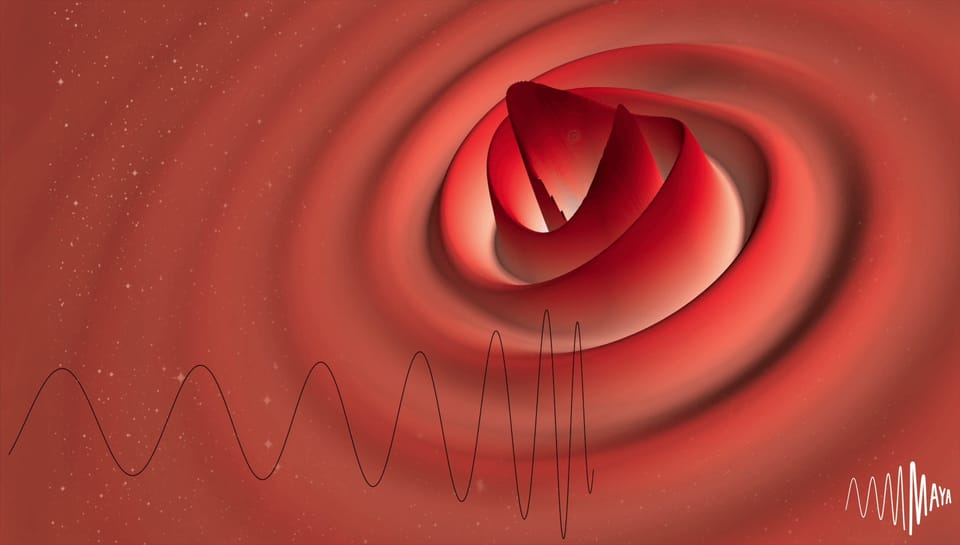
This frequency-dependent separation connects directly to the phenomenon of gravitational wave echoes. In earlier studies of compact binaries, researchers noted that when waves scatter off a wormhole, the initial signal matches the quasinormal ringdown of a black hole.1 Only after a time delay proportional to the throat length, during which trapped radiation traverses the throat and bounces off the opposing barrier, does a train of secondary pulses leak back into the original universe.1 The findings of Solodukhin and Tagiev establish that dynamic tidal Love numbers follow a similar principle: over observation windows shorter than the throat transit time, a wormhole responds to high-frequency tidal disturbances like a black hole.1 Paolo Pani explained that testing this transit delay requires an observation lasting longer than the round-trip echo time, approximately twice the effective throat length divided by the speed of light, though the exact duration grows without bound as an object nears the black hole limit.
What limits the current models of wormhole tidal deformation?
Current calculations of wormhole Love numbers remain restricted to idealized scalar field perturbations and rely on static geometric backgrounds whose physical formation mechanisms remain unknown.1 The analysis by Solodukhin and Tagiev modeled incoming tidal influences using a scalar field rather than solving the full set of coupled tensor gravitational perturbations required by general relativity.1 While scalar perturbations capture essential scattering dynamics across effective potential barriers, they omit the polarization states present in real gravitational radiation.1 Sergey acknowledged that moving beyond the scalar toy model remains an open challenge, telling Primary that “This is a difficult question to be analyzed in the future. At the moment we do not have a dynamic mechanism for formation of these wormhole so that the relevant version of gravity is not yet known. However the scalar case gives us a hint on what one could expect in the more realistic case of full tensor gravitational perturbations.”
Gravitational perturbations also introduce additional physical complexities at the throat boundary. Paolo Pani pointed out that while the throat length provides the same characteristic dividing scale for gravitational perturbations, those fields directly couple to the matter supporting the throat, making the detailed tidal response dependent on the physical properties and dynamics of that material. Furthermore, within four-dimensional classical general relativity, maintaining a traversable wormhole throat requires exotic stress-energy that violates standard null energy conditions, leaving the physical origin of such geometries unverified.1
The calculations also depend on a frequency-domain framework that assumes monochromatic waves rather than the changing waveforms produced during a binary merger.1 In an astronomical inspiral, orbital frequency accelerates continuously across multiple octaves, sweeping an inspiraling companion through different wavelength regimes as it approaches coalescence.1 Sergey noted that “The transition should happen at very low frequencies so that the respective wave length would be of order of logarithm of the deformation parameter.” Paolo Pani cautioned that a sweeping chirp complicates the separation between modes, telling Primary that returning radiation emitted at an earlier frequency could interfere with the current signal unless the frequency changes slowly compared with the transit time through the throat, necessitating time-dependent waveform models.
Finally, the results remain posted as a preprint that may not have been peer reviewed on the arXiv server, awaiting independent verification and formal peer review.1 Understanding how the tidal response of horizonless objects converges to the black hole limit carries consequences for gravitational wave observatories like the Laser Interferometer Gravitational-Wave Observatory and future space missions like the Laser Interferometer Space Antenna.12 If an astrophysical compact object is a wormhole with an extraordinarily deep throat, detectors observing binary inspirals over finite durations might detect tidal phase shifts indistinguishable from zero, masking the exotic nature of the body during early merger stages.
Distinguishing such mimickers from true black holes will require either detecting delayed post-merger gravitational echoes or measuring the low-frequency regime where super-throat modes register. Paolo Pani noted that the initial hurdle is detecting any non-zero static Love number at all, which would indicate physics beyond isolated vacuum black holes in general relativity, while isolating super-throat behavior would require exceptional low-frequency sensitivity. Sergey suggested how future detectors might isolate that signal, telling Primary that “Answering this question would require possibly writing a new paper. At this point we could speculate that, provided the Love numbers could be measured experimentally the decisive feature of super-throat modes is that the imaginary part of the respective Love numbers becomes growing as a a higher power of frequency while for the sub-throat modes the imaginary part of the Love numbers grows only linear with frequency.”
The record
83 sentences trace to 2 sources and 2 contributors.
-
1
SN
 Sergey N. Solodukhin, Vagif Tagiev
Paper
· arxiv.org · 14 Sep 2026
Tidal Love numbers of wormholes as black-hole mimickers
Preprint · may not have been peer reviewed
See the source
-
2
A
arxiv.org
Paper
· arxiv.org
Testing strong-field gravity with tidal Love numbers
Preprint · may not have been peer reviewed
See the source
- 3 Contribution — Sergey N. Solodukhin 12 statements added to this article
- 4 Contribution — Paolo Pani 10 statements added to this article
Other consulted pages2 pages
ar5iv.labs.arxiv.org1 page
Article history
-
Published 27 Nov 2026, 16:31Assembled by the Primary desk from 2 sources · 2 contributors · 83 cited sentences
-
Paolo Pani, theoretical physicist
- Go to the sentence: Paolo Pani highlighted how observation times govern this apparent horizon mimicry, stating in response to questions from Primary that “The key is the timescale involved. The sub-throat modes have wavelengths shorter than the throat length, while remaining in the low-frequency regime relative to the object's size. They scatter off the same exterior potential barrier as in Schwarzschild, but the transmitted part travels down the throat and does not return within the relevant observation time. From that observer's perspective, this effectively reproduces black-hole absorption. As the throat becomes longer, this resemblance persists for increasingly long times.”
- Go to the sentence: Pani noted that while this fits the broader behavior of horizonless objects before internal reflections return, the convergence of tidal dissipation is not universal across all mimickers, since wormholes provide a specific geometric mechanism of energy loss through transmission down the throat.
- Go to the sentence: Other theorists interpret that static behavior differently.
- Go to the sentence: Paolo Pani urged caution regarding whether static results represent an artifact, telling Primary that “In many models of horizonless compact objects, static Love numbers are nonzero but approach zero continuously in the black-hole limit. The wormholes studied here show that same behavior, so there is no inherent inconsistency to resolve, and the static response should not be dismissed as a mathematical artifact.”
- Go to the sentence: Pani argued that the paper clarifies which dynamical response becomes black-hole-like rather than removing an inconsistency in static Love numbers, because the distinction lies between measuring the entire spacetime globally and observing it over windows shorter than the round-trip echo time through the throat.
- Go to the sentence: Paolo Pani explained that testing this transit delay requires an observation lasting longer than the round-trip echo time, approximately twice the effective throat length divided by the speed of light, though the exact duration grows without bound as an object nears the black hole limit.
- Go to the sentence: Gravitational perturbations also introduce additional physical complexities at the throat boundary.
- Go to the sentence: Paolo Pani pointed out that while the throat length provides the same characteristic dividing scale for gravitational perturbations, those fields directly couple to the matter supporting the throat, making the detailed tidal response dependent on the physical properties and dynamics of that material.
- Go to the sentence: Paolo Pani cautioned that a sweeping chirp complicates the separation between modes, telling Primary that returning radiation emitted at an earlier frequency could interfere with the current signal unless the frequency changes slowly compared with the transit time through the throat, necessitating time-dependent waveform models.
- Go to the sentence: Paolo Pani noted that the initial hurdle is detecting any non-zero static Love number at all, which would indicate physics beyond isolated vacuum black holes in general relativity, while isolating super-throat behavior would require exceptional low-frequency sensitivity.
-
Sergey N. Solodukhin
- Go to the sentence: In both geometries, the distance between the two peaks defines the throat length, which scales logarithmically with the parameter measuring deviation from a black hole.
- Go to the sentence: Sergey, a co-author of the study, told Primary that “The two regimes are separated by a scale that logarithmicaly depends on the deformation parameter that differs the wormhole from a black hole.”
- Go to the sentence: Solodukhin and Tagiev showed that the dynamical Love numbers calculated for sub-throat perturbations reproduce the frequency-dependent response of a Schwarzschild black hole without mathematical discontinuity.
- Go to the sentence: Sergey told Primary that “The smooth transition for the sub-throat modes was anticipated. The absence of such transition for the super-throat modes, which were the first to be calculated, was quite puzzling that ultimately led us to uncovering the importance of the sub-throat modes.”
- Go to the sentence: The authors concluded that the apparent mismatch between static wormhole Love numbers and vanishing black hole Love numbers arises because static calculations set perturbation frequency to zero, artificially treating all perturbations as super-throat modes regardless of throat length.
- Go to the sentence: Sergey explained how the sub-throat calculation resolves this divergence, stating that “Static calculations do not miss the black hole limit provided one uses the Love numbers computed for the sub-throat modes. Static Love numbers due to the sub-throat modes have a smooth black hole limit. This is not the case for the super-throat modes. However, the role of the super-throat modes becomes gradually irrelevant when the black hole limit is taken.”
- Go to the sentence: While scalar perturbations capture essential scattering dynamics across effective potential barriers, they omit the polarization states present in real gravitational radiation.
- Go to the sentence: Sergey acknowledged that moving beyond the scalar toy model remains an open challenge, telling Primary that “This is a difficult question to be analyzed in the future. At the moment we do not have a dynamic mechanism for formation of these wormhole so that the relevant version of gravity is not yet known. However the scalar case gives us a hint on what one could expect in the more realistic case of full tensor gravitational perturbations.”
- Go to the sentence: In an astronomical inspiral, orbital frequency accelerates continuously across multiple octaves, sweeping an inspiraling companion through different wavelength regimes as it approaches coalescence.
- Go to the sentence: Sergey noted that “The transition should happen at very low frequencies so that the respective wave length would be of order of logarithm of the deformation parameter.”
- Go to the sentence: Distinguishing such mimickers from true black holes will require either detecting delayed post-merger gravitational echoes or measuring the low-frequency regime where super-throat modes register.
- Go to the sentence: Sergey suggested how future detectors might isolate that signal, telling Primary that “Answering this question would require possibly writing a new paper. At this point we could speculate that, provided the Love numbers could be measured experimentally the decisive feature of super-throat modes is that the imaginary part of the respective Love numbers becomes growing as a a higher power of frequency while for the sub-throat modes the imaginary part of the Love numbers grows only linear with frequency.”