Topological qubits could rewrite quantum hardware limits if federal evaluations succeed
Microsoft has delivered its Majorana 2 system to federal researchers in Maryland, opening its contested topological hardware to outside testing while aiming to build a fault-tolerant machine by 2029.
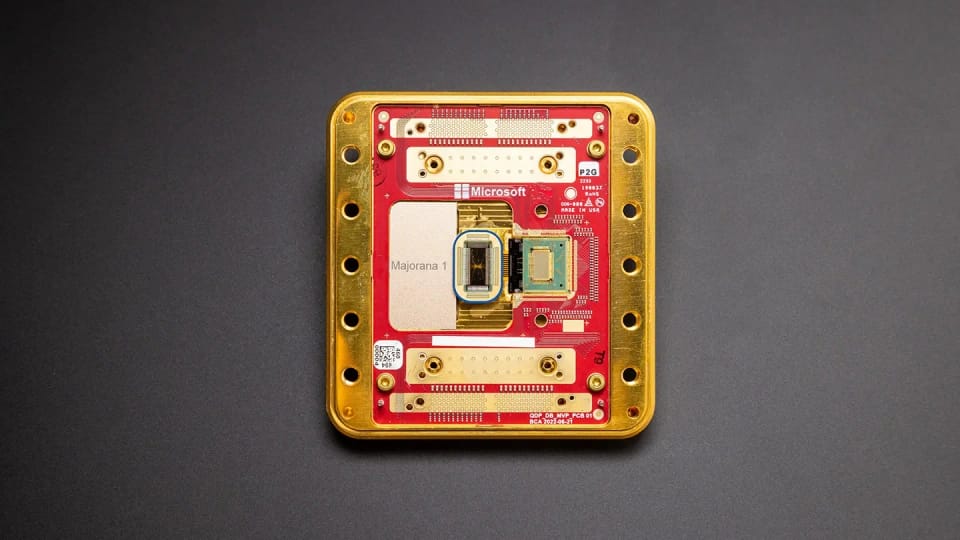
Quantum information is notoriously fragile because the slightest warmth or stray electromagnetic radiation in the environment can scramble a delicate calculation before it finishes. In conventional quantum systems, engineers attempt to shield individual subatomic particles or artificial circuits, yet environmental disturbances routinely destroy those quantum states within fractions of a millisecond. If quantum hardware is ever to tackle chemistry calculations or factor large numbers, it must preserve information long enough to perform millions of coordinated operations without collapsing into random noise.
A long-theorized alternative seeks to protect information by encoding it not in a single vulnerable point, but across the broader geometric arrangement of a physical system. In this approach, known as topological quantum computing, quantum bits or qubits store data in collective states that remain unaffected by local bumps and microscopic defects, much as a knot tied into a piece of string retains its structure when the string is jostled. For two decades, hardware developers have pursued this concept because it promises physical qubits that are inherently shielded against stray electrical disturbances, potentially bypassing the thousands of extra error-correcting qubits required by traditional machines.
That theoretical promise faces a concrete test at a newly opened facility in College Park, Maryland. In late September 2026, Microsoft announced that it delivered a quantum system built on its experimental Majorana 2 hardware to a dedicated testing space for the Defense Advanced Research Projects Agency, known as DARPA.12 The agency is conducting independent evaluations under its Quantum Benchmarking Initiative to verify whether Microsoft's topological architecture functions as claimed, as the company moved its projected target date for fielding an industrially useful quantum computer forward to 2029.21
How can topology protect a fragile quantum state?
Topological hardware preserves quantum calculations by distributing a single unit of information across multiple separated points rather than trapping it in one spot. In theoretical physics, certain composite excitations called quasiparticles can emerge inside tailored semiconductor-superconductor junctions, behaving mathematically like Majorana fermions, which are hypothetical particles that act as their own antiparticles. When two of these excitations are isolated at opposite ends of an engineered microscopic wire, an electron state can be split between them, making the stored information immune to local noise that touches only one end.
To create these conditions, researchers place a semiconductor nanowire in direct contact with a superconducting material under extreme cold and an applied magnetic field. The interaction between the materials induces a specialized superconducting state where zero-energy excitations appear at the wire boundaries. Because local electromagnetic noise typically perturbs only one microscopic point at a time, it cannot easily flip the global topological arrangement of the split state. In principle, this design allows a quantum computer to maintain coherent calculations without needing hundreds of physical control cables for every single qubit.
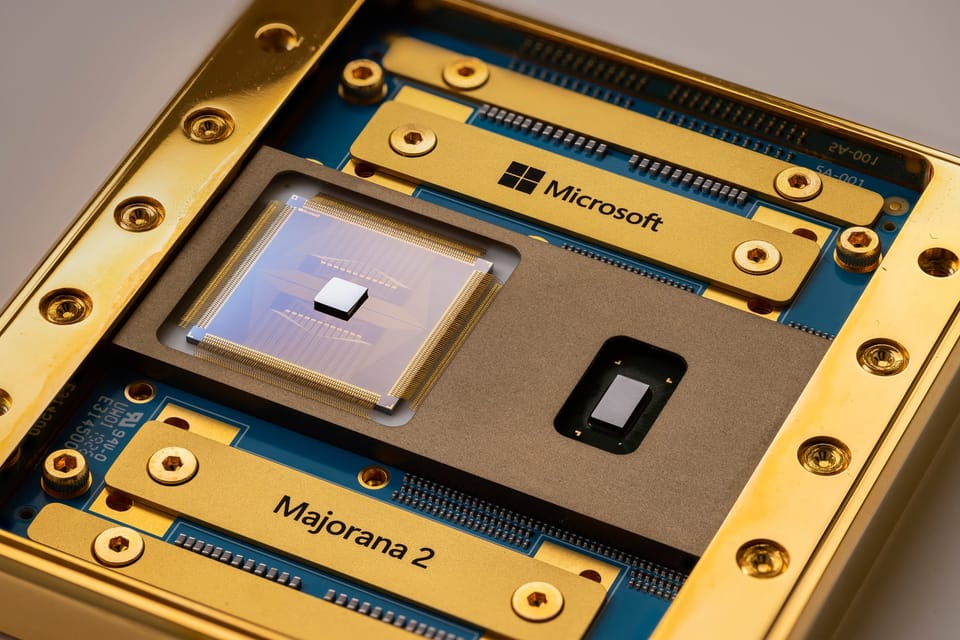
In February 2025, Microsoft researchers published a paper in Nature describing the Majorana 1 platform, an eight-qubit processor built from indium arsenide nanowires coated with superconducting aluminum.32 The company followed that work in June 2026 by posting a preprint that may not have been peer reviewed describing Majorana 2, a revised architecture that replaces the aluminum layer with lead and pairs indium arsenide with indium arsenide antimonide.12 In that preprint, the authors reported parity lifetimes, which measure how long a device retains its quantum charge state before noise flips it, exceeding 20 seconds and occasionally surpassing 60 seconds, compared with typical coherence times of microseconds in conventional superconducting circuits.12
Why do independent physicists question the hardware claims?
Independent researchers remain cautious because measuring an electron charge configuration in a laboratory wire does not prove that a device functions as a true quantum computer. A complete qubit requires verifiable measurements across two complementary quantum properties, usually designated by physicists as the Z basis and the X basis. The June 2026 preprint documented measurements in only the Z-parity basis on a single nanowire device, leaving unmeasured the complementary X-parity state that confirms topological protection.1
That technical gap matters because non-topological phenomena can produce experimental signals that closely mimic the behavior of Majorana excitations. Impurities in a semiconductor junction can create conventional trapped electron states known as Andreev bound states, which generate similar electrical conduction signatures at zero voltage without offering any geometric protection against errors. Without an X-parity measurement on the exact same device, outside specialists argue it is impossible to distinguish an authentic topological zero mode from trivial background noise.1
The scrutiny is further amplified by past disputes in the field. In 2018, a research group that included Microsoft research scientist Roman M. Lutchyn published a study in Nature Reviews Materials reviewing signatures of Majorana zero modes in hybrid structures, and an earlier research effort had to retract an experimental paper in 2021 after outside physicists identified flaws in data handling and methodology.241 In the peer-review record for Microsoft's February 2025 Nature paper, reviewers similarly noted that the presented data demonstrated interferometric parity readout rather than conclusive proof of isolated Majorana zero modes.1
What can the current experimental results tell us?
The reported data represent laboratory characterizations of isolated prototype hardware, not evidence of a functioning general-purpose quantum computer. Microsoft has not published a peer-reviewed experimental confirmation of its Majorana 2 measurements, and the agency-run evaluation in Maryland has not released an agreed-upon testing protocol or performance figures.1 Furthermore, the demonstrated devices examine charge parity on individual nanowires rather than demonstrating two-qubit logic gates or sustained topological braiding operations.

Even if the reported parity lifetimes of 20 to 60 seconds are verified by government testers, those numbers measure passive stability rather than computational gate fidelity. An undisturbed electron state sitting quietly in a dilution refrigerator shows that the material stack resists spontaneous charge jumping, but it does not demonstrate that the system can process complex quantum algorithms while preserving coherence. DARPA's Quantum Benchmarking Initiative is designed to test these hardware boundaries directly by operating the system independently at the Maryland center.
The evaluation operates under DARPA's Underexplored Systems for Utility-Scale Quantum Computing program, where Microsoft is working alongside agency evaluators and specialists drawn from national laboratories.1 Zulfi Alam, corporate vice president of Azure Quantum at Microsoft, described the arrangement as an opportunity for agency experts to run their own boot sequences on the hardware.1 Outside observers note that having independent operators control the equipment provides the structural capacity to run the specific two-basis parity measurements that critics have requested.
How could topological chips alter commercial computing?
If independent validation demonstrates genuine topological protection, the hardware requirements for building commercial quantum computers would decrease substantially. Traditional superconducting machines developed by industry competitors require individual analog microwave cables running to every physical qubit, creating severe physical bottlenecks inside cryogenic refrigerators as systems attempt to scale toward thousands of qubits. In contrast, Microsoft's topological design relies on an integrated digital control scheme where a compact core manipulates qubits using voltage pulses rather than dedicated external microwave lines.32
A drastic improvement in physical qubit reliability would also reshape the mathematical requirements for running quantum algorithms. To run Shor's algorithm for factoring numbers or to simulate complex molecular catalysts for industrial chemistry, current architectures require millions of physical qubits to create a small core of error-corrected logical qubits. Alam stated that internal Microsoft teams previously estimated needing 16 million physical qubits to execute Shor's algorithm, but revised those projections down to between 400,000 and 600,000 qubits if topological error suppression performs as designed.2
For now, the quantum physics community awaits verifiable results from the Maryland laboratories before declaring the topological approach vindicated. DARPA is benchmarking multiple competing hardware technologies under its utility-scale initiative to determine whether any platform can reach practical computational advantage by 2033.21 Whether Microsoft's 2029 timeline proves achievable will depend on whether its atom-by-atom material stacks produce authentic Majorana modes or merely fascinating semiconductor physics under extreme laboratory conditions.
The record
15 sentences trace to 4 sources.
- 1 Microsoft Hands DARPA a Majorana 2 System for On-Site Tests See the source
-
2
TG
 Tristan Greene
Document
· livescience.com · 27 Nov 2026
DARPA is assessing Microsoft's controversial quantum computing technology. What will happen if the Majorana 2 platform is vindicated?
See the source
- 3 Microsoft’s Majorana 1 chip carves new path for quantum computing - Source See the source
-
4
N
 nature.com
Paper
· nature.com
Majorana zero modes in superconductor–semiconductor heterostructures - Nature Reviews Materials
Journal article
See the source