A single photon changes shape depending on its surroundings
Quantum calculations show individual light particles lack a fixed form, taking on asymmetrical contours shaped directly by nearby nanomaterials.
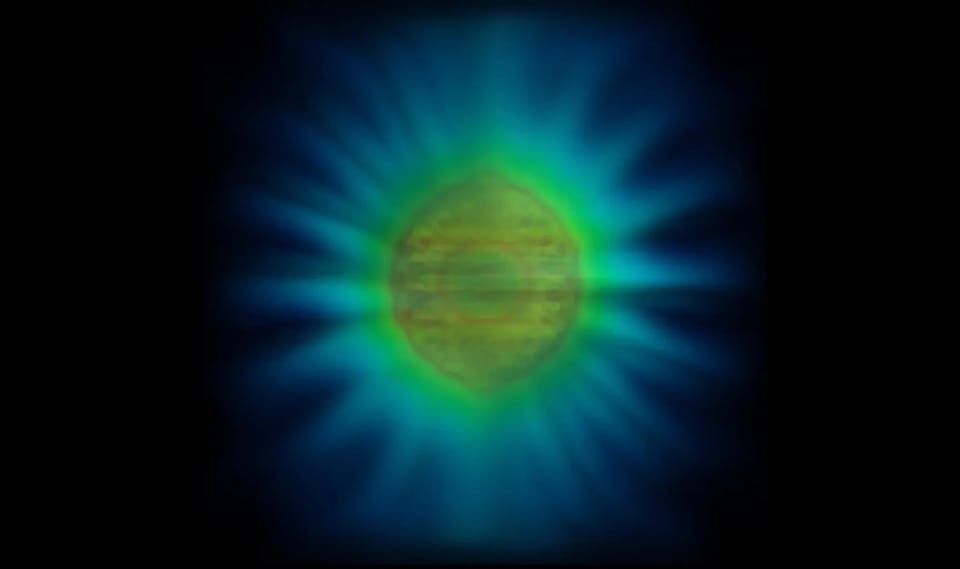
When light bounces off a mirror, scatters through the morning sky, or strikes the retina, human vision perceives an orderly world of definite shapes and solid surfaces. The light itself is treated as a uniform messenger, an immaterial stream whose indivisible constituent particles are assumed to possess an unchanging, fundamental simplicity. Standard depictions in textbooks frequently illustrate a single photon as an elementary point particle or a neat, isolated ripple gliding through the vacuum. Yet light at the quantum scale does not hold a universal, rigid silhouette, possessing instead an adaptable physical profile that bends and shifts according to the specific matter it encounters.
Understanding this fluid nature matters because modern technological devices increasingly rely on manipulating light at microscopic scales. In solar cells, quantum computing processors, and optical sensors, engineers attempt to direct energy exchange between single units of light and individual atoms. If a photon behaved like a rigid billiard ball, researchers could assume a fixed interaction profile regardless of the setting. When the particle instead reshapes itself around microscopic structures, designing optical circuits requires knowing precisely how those surroundings alter the quantum profile of the light being produced.
The physical chain of events that dictates this behaviour begins inside an excited atom. To release light, an atom must first undergo an electronic transition, shedding excess energy into the surrounding electromagnetic vacuum. As that disturbance radiates outwards, it encounters whatever structures lie in its immediate neighbourhood. If a microscopic particle sits beside the atom, the emitted electromagnetic waves bounce, refract, and interfere with the particle's physical boundaries. The wave disturbance folds back upon itself, altering how energy couples between the atom and the open radiation field, before ultimately travelling into distant space. Every boundary, curve, and material property in that immediate vicinity leaves an indelible imprint on the emerging wavepacket.
Why does a single photon lack a fixed shape?
A single photon does not possess a permanent physical boundary because it is fundamentally an excitation of an electromagnetic field rather than a solid particle with a hard exterior. Ben Yuen, a research fellow in theoretical quantum nanophotonics at the University of Birmingham, and Angela Demetriadou, a professor of theoretical nanophotonics at the same institution, reported that a photon's spatial profile represents an expected electromagnetic intensity distribution.12 In practical terms, this distribution maps the spatial probability of where a detector would register the quantum of light.2 Because a single quantum measurement destroys the particle upon detection, the full physical contour represents the statistical pattern that emerges if the identical emission process were repeated many times under suitable experimental conditions.2
Unlike an isolated wave travelling uninterrupted through empty space, a photon generated in the presence of nanoscale matter interacts continuously with its immediate environment. Demetriadou stated that the geometry and optical properties of the surroundings exert profound consequences on how photons emerge, defining their expected shape, their colour, and the basic probability that emission occurs at all.32 When an atom sits on a microscopic object, the classical electromagnetic modes of that object combine with the quantum state of the atom. The spatial distribution of the resulting light packet mirrors those hybrid boundaries rather than an idealized, symmetrical wave.
In a study published on November 14, 2024, in the journal Physical Review Letters, the two researchers examined an atom coupled directly to a tiny silicon sphere.412 The simulated photon that emerged took on an asymmetrical, lemon-shaped profile.25 The blunt curvature and tapered tip of this lemon-like intensity distribution directly recorded the presence of the nanosphere, demonstrating that the particle's geometry deformed the quantum field at the very moment of emission.2
How did physicists visualize the photon without measuring it?
Physicists visualized the photon by developing an exact theoretical framework that converted an infinite mathematical continuum into a discrete set of solvable equations, avoiding the standard approximations that previously blurred such models. In typical open optical systems, light radiates away to the far field, meaning energy is continually lost from the local interaction zone.1 Describing this open quantum dynamics normally requires solving energy exchanges across a continuous spectrum of light frequencies, a task that quickly overwhelms finite computational resources.13 Earlier efforts to model light-matter interactions frequently relied on phenomenological simplifications or assumed closed boundaries, such as two mirrored walls in an optical cavity.12
To overcome this computational barrier, Yuen and Demetriadou treated the entire universe as a single, infinitely large closed system, thereby retaining energy conservation while accounting for radiative loss.1 They then applied complex analysis, a branch of mathematics dealing with functions of complex numbers, to transform the continuous spectrum of real-valued optical frequencies into a discrete collection of complex-valued modes, termed pseudomodes.14 This transformation reduced an intractable infinite problem to a system that could be represented precisely using a few hundred discrete complex light modes.1 By integrating complete solutions of classical Maxwell equations into their quantum model, the researchers generated an exact description of the atom's emission dynamics.1
The spatial intensity distribution emerged directly from these quantum calculations without the authors having to specify the photon's appearance in advance. The simulation revealed that the silicon nanoparticle dramatically altered the interaction dynamics, allowing the atom to enter a cycle where the photon was repeatedly emitted and reabsorbed before escaping into free space.2 Yuen reported that the silicon sphere made the photon thousands of times more likely to be emitted compared to an atom radiating into empty vacuum.2 As the wavepacket travelled away from the nanosphere toward the distant far field, the intensity distribution evolved continuously, confirming that the lemon shape reflects the local environment rather than an unchangeable travelling form.2
What can the model explain, and where are its limits?
The resulting visualization provides a theoretical simulation of spatial intensity rather than an optical photograph captured by an experimental camera. The calculations describe the quantum dynamics of a single idealized emitter resting on an individual silicon nanoparticle under perfectly specified geometric conditions. In physical laboratory experiments, thermal fluctuations, material impurities, and stray electromagnetic noise would introduce environmental decoherence that is not included in this pristine mathematical model. Furthermore, because detecting an individual quantum of light absorbs and destroys it, no physical instrument can view this lemon-shaped contour in a single snapshot. The model represents the statistical distribution of many identical runs rather than a tangible, freestanding object frozen in time.
The study also rests on an exact treatment of radiative nanophotonic environments that assumes specific linear optical responses. While the pseudomode formalism captures non-Markovian dynamics, meaning memory effects where previously emitted energy feeds back into the atom, it was tested on a symmetric, spherical dielectric structure.4 Extending these exact quantum electrodynamic calculations to irregular surfaces, large ensembles of fluctuating molecules, or absorbing metallic structures will require further adaptations of the computational tools.
How will shaping single photons affect future technologies?
Controlling the spatial profile of single photons provides physicists with a practical foundation to engineer light-matter energy exchange for advanced optical devices. In quantum communication networks and optical quantum processors, the physical shape and wavefront of a single photon determine how efficiently it couples into optical fibres, cavities, and semiconductor quantum dots.21 If engineers can tailor the surrounding nanostructure to emit photons with specific shapes, they can significantly reduce transmission losses and improve the fidelity of quantum data transfer.
Beyond quantum computing, understanding these environmental modifications could inform solar energy harvesting and photocatalytic chemical manufacturing. Biological systems rely on delicate light-matter coupling during natural photosynthesis, where molecular complexes funnel photon energy through tightly packed pigments. Demetriadou noted that the Birmingham framework could help researchers analyze how complex nanophotonic environments govern photochemical reactions at the single-molecule level.12 By showing that an environment can actively sculpt the fundamental particles of light, the research turns what was once treated as uncontrolled environmental noise into an intentional design tool for future technologies.
The record
20 sentences trace to 5 sources.
- 1 Quantum electrodynamics theory unveils precise ‘shape’ of a single photon See the source
-
2
TP
 Tibi Puiu
Document
· zmescience.com · 27 Nov 2026
What Does a Single Photon Actually Look Like? Physicists Have a Stunning Answer
See the source
-
3
S
 sciencedaily.com
Third-party reporting
· sciencedaily.com
New theory reveals the shape of a single photon
See the source
- 4 Exact Quantum Electrodynamics of Radiative Photonic Environments | Phys. Rev. Lett. See the source
- 5 Mirror, mirror on the wall, who is the fairest photon of them all? See the source